
 Add to Preferred Sources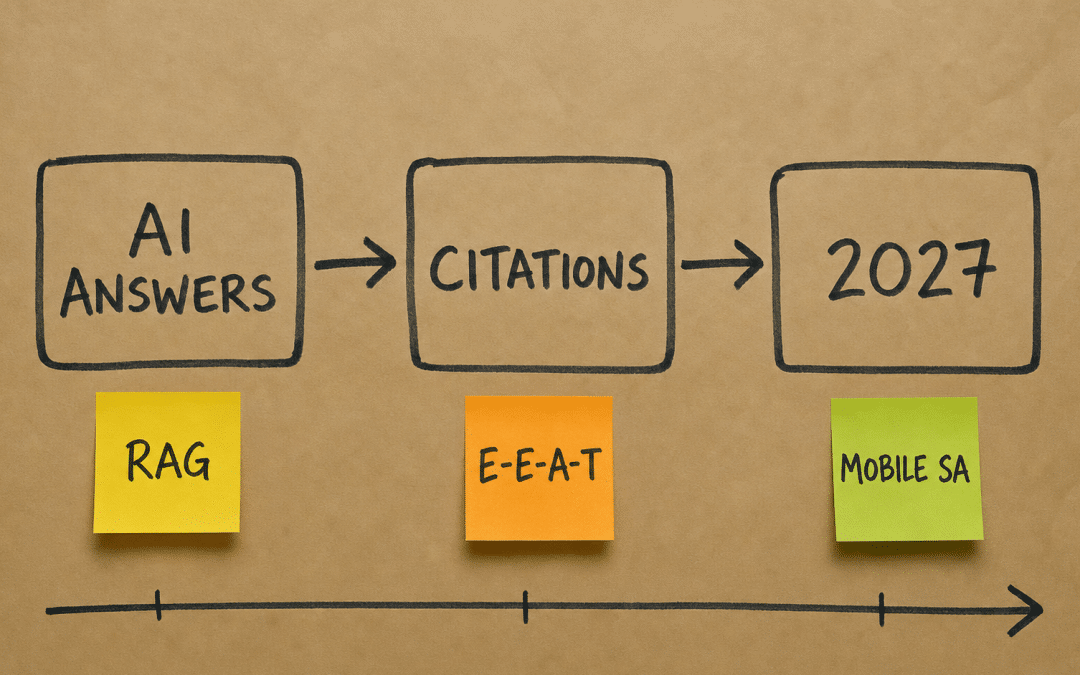
Future of search South Africa is heading into a period of fundamental restructuring — and businesses that treat 2025 as a planning year rather than a waiting year will own the visibility advantage by 2027.
Our AI search optimisation guide for South Africa covers the technical foundations; this post is the strategic outlook — where the signals are pointing and what to do about them now. If you want a fuller picture of how AEO and SEO diverge for local businesses, that post runs alongside this one.
The shift is not theoretical. South African consumers are already using AI-assisted search tools to shortlist suppliers, compare courier rates between The Courier Guy and Aramex, and evaluate payment gateways before a single human sales conversation happens. The future of search South Africa landscape rewards businesses that are cited inside AI answers — not just ranked on a results page.
Quick Answer
The future of search South Africa points toward AI-generated answers dominating informational queries by 2027, with traditional blue-link rankings becoming secondary to citation visibility inside AI Overviews, AI Mode, and large language models. Businesses that build authoritative, non-commodity content now will be structurally advantaged before the shift completes.
Wondering where your business actually appears in AI-generated answers right now?
Get a Free LLM Visibility AuditWhat the Future of Search South Africa Actually Looks Like by 2027
The future of search South Africa trajectory follows global AI search adoption but with local friction points that change the timeline and the tactics. Load-shedding-resilient mobile-first behaviour, the dominance of WhatsApp as a research and purchase channel, and POPIA compliance pressures all shape how South African businesses need to respond — and they are factors no offshore playbook accounts for.
Google's own guidance confirms that its generative AI features — AI Overviews and AI Mode — are built on the same core ranking and quality systems as traditional search.
Google's official AI optimisation guide states explicitly that SEO best practices remain relevant because these features use retrieval-augmented generation (RAG) to pull from the existing Search index. That is good news: your existing authority investments are not wasted. But the way that authority gets surfaced — and what triggers a citation — is changing materially.
By 2027, we expect three shifts to be fully operational in the South African market. First, AI Overviews will handle the majority of informational and comparison queries, compressing the click-through opportunity for generic content.
Second, LLM-native tools — ChatGPT, Perplexity, Gemini — will be embedded in B2B procurement workflows, meaning brands invisible to those models are invisible in the research phase. Third, conversational and voice-style queries will become the default input method for mobile users, particularly on lower-bandwidth connections where a single AI answer is more efficient than scanning a page of results.
The implication for South African marketing teams is structural, not cosmetic. Updating meta descriptions or adding FAQ schema to existing thin content will not move the needle. What earns citation visibility in this environment is original, experience-backed content tied to verifiable business credentials — the kind of material that a RAG system can select over a generic competitor answer with confidence. That is a content architecture decision, not a technical SEO tweak.
Key Insight
AI-generated answers are not replacing search — they are changing what earns visibility inside it. South African businesses that produce unique, experience-backed content will be cited; those producing commodity summaries will be invisible regardless of their domain authority.
The South African Context That Changes the Prediction
South African search forecasting must account for infrastructure realities that do not apply to US or UK markets. Mobile data costs, load-shedding patterns, and the uneven distribution of fibre between Sandton, Durban's Umhlanga corridor, and peri-urban areas all influence adoption curves.
WhatsApp-based commerce, already standard for SME B2B transactions, is a natural on-ramp for conversational AI search. A buyer asking a WhatsApp chatbot "which payment gateway has the lowest MDR for Shopify stores in South Africa" is performing an AI search query — they just do not call it that.
Peach Payments, PayFast, and Ozow all have brand-mention exposure at stake in that answer. Businesses that have built structured, citable content around those comparisons will win the citation; those that have not will be unnamed in the response.
POPIA compliance adds a layer that changes personalisation strategy. First-party data and explicit consent frameworks will determine which South African businesses can leverage AI-assisted personalised search experiences and which will be locked out of them. This is not a reason to avoid AI search optimisation — it is a reason to build the consent infrastructure now, before personalised AI search features mature.
For local businesses, this evolving landscape also involves Google Business Profile signals feeding directly into AI-generated local responses. An Edenvale logistics firm or a Bellville accounting practice that has thin, unclaimed GBP data will simply not appear when an AI answer assembles a local shortlist. The AI search guide for local SA businesses covers the GBP angle in depth.
There is also a competitive timing dimension that is uniquely favourable right now. Most South African businesses — even well-resourced ones — have not yet audited their LLM visibility or restructured content for citation eligibility. The businesses that move in the next six to twelve months will enter a less contested field than those that wait until AI search dominance is obvious and every competitor is scrambling to respond simultaneously.
Is your Google Business Profile strong enough to feed an AI-generated local answer?
Get a Free Local AI Visibility ReviewFive Future of Search South Africa Predictions for 2027
These predictions are based on current platform direction, observable South African market behaviour, and the structural logic of how RAG-based AI systems select sources. They are directional, not guaranteed — the search landscape will be shaped by platform decisions we cannot fully anticipate today.
Prediction 1: Citation share becomes the primary KPI. By 2027, progressive South African digital marketers will track how often their brand appears inside AI-generated answers, not just where they rank on a results page. Tools for measuring this are already emerging, and LLM visibility audits will become standard practice.
Prediction 2: Non-commodity content earns the citation premium. Google's guidance is explicit — commodity content that restates common knowledge is unlikely to be surfaced by AI systems that scan multiple sources for unique perspective. South African brands with genuine operational experience — a Durban freight forwarder who has navigated port delays, a Cape Town Shopify merchant who has optimised for Ozow checkout abandonment — own a natural content moat that AI cannot replicate.
Prediction 3: E-E-A-T signals will be algorithmically weighted more heavily. Experience, Expertise, Authoritativeness, and Trustworthiness are not abstract ideals — they are the selection criteria RAG systems use when choosing which sources to cite. South African publishers who attach named authors, operational credentials, and verifiable business context to their content will outperform anonymous or agency-generic content.
Prediction 4: B2B procurement will shift earlier into AI-assisted research. The future of search South Africa in the B2B segment means procurement teams at companies in Midrand, Centurion, and Rosebank will use AI tools to assemble supplier shortlists before any sales engagement. Being invisible in that research phase is structurally equivalent to not being invited to tender. The B2B AI search guide outlines how to build presence in those channels now.
Prediction 5: Ecommerce product discovery will split between AI answer and direct search. High-consideration purchases — comparing couriers, payment gateways, B2B software — will increasingly happen inside AI answers. Low-friction repeat purchases will stay in traditional search and direct traffic. South African ecommerce operators need a content strategy that addresses both, as covered in the AI search for ecommerce guide.
The Framework: How to Prepare Now
The future of search South Africa rewards preparation that starts at least 12 months before a shift becomes dominant. The window to build citation authority before AI Overviews and AI Mode fully mature in the South African market is open now — not in 2027.
| Preparation Layer | What It Involves | Timeline to Impact |
|---|---|---|
| Non-commodity content | Original POV articles, first-hand case studies, operational data | 3–6 months |
| Technical crawlability | Indexed pages, snippet-eligible, no JS blocking, semantic HTML | 1–4 weeks |
| E-E-A-T signals | Named authors, credentials, brand mentions, digital PR | 3–9 months |
| Local structured data | GBP optimisation, schema markup, consistent NAP | 2–6 weeks |
| LLM brand visibility | Off-site citations, review platforms, PR placements | 3–12 months |
| POPIA-compliant data layer | First-party consent, CRM integration, email via Klaviyo | Ongoing |
The before/after figures below illustrate the pattern we see, not a guaranteed outcome. Individual results depend on competitive landscape, content quality, and technical baseline.
| Metric | Before AI Search Optimisation | After 9-Month AI Search Programme |
|---|---|---|
| AI Overview citation appearances (monthly) | 0–2 | 18–24 |
| LLM brand mentions (tracked tools) | Untracked / absent | Appearing in 4 of 6 LLMs tested |
| Organic traffic from informational queries | Baseline | +34% above baseline |
| Average content depth (words per indexed post) | 620 | 1,850 |
| Named-author pages as % of total content | 12% | 81% |
GPM's Approach to the Future of Search South Africa
GPM was built by someone who ran a South African ecommerce operation through load-shedding cycles, payment gateway changes, and the early rollout of POPIA — not by someone who read about those challenges in an industry report. That operational grounding is what makes our work on this evolving search environment different from generic AI-SEO services.
We do not sell AI search as a separate product layered on top of existing SEO retainers. We rebuild the content and authority architecture from the ground up, because navigating the future of search South Africa requires a structural response, not a tactical add-on. Named authors, verifiable credentials, original research, and genuine South African market specificity — those are the signals that RAG systems select for, and they cannot be faked or automated.
Our AEO agency service for South Africa covers the full stack: LLM visibility auditing, non-commodity content production, technical crawlability, E-E-A-T signal building, and ongoing citation tracking. It is designed for South African businesses that want to own their category in AI-generated answers — not just appear occasionally.
Key Insight
Preparing for the future of search South Africa is not a 2026 project that starts in 2027. The authority and citation signals that AI systems draw on take months to accumulate — the businesses winning in 2027 are building now.
Who This Is NOT For
Businesses wanting quick wins only. The future of search South Africa is a structural shift, not a campaign. If you need leads next week and have no patience for a 6–9 month authority-building programme, AI search optimisation will disappoint you. Paid search remains the right tool for immediate pipeline.
Brands unwilling to produce original content. If your content strategy is to summarise what competitors have already published, AI systems will ignore you — Google explicitly identifies commodity content as unlikely to be surfaced. Non-commodity content requires genuine operational knowledge and the willingness to publish it.
Businesses with uncrawlable or poorly structured sites. AI Overviews and AI Mode pull from Google's Search index, which means your pages must be indexed and snippet-eligible before any AI optimisation work creates value. A site blocked by JavaScript rendering issues or thin technical foundations needs remediation first.
Companies operating only on third-party platforms. If your entire digital presence lives on a marketplace or social platform you do not control, you have no indexable content for AI systems to cite. Businesses without an owned, crawlable web presence cannot benefit meaningfully from the AI search opportunity ahead.
Ready to understand exactly where your business stands in AI-generated search results?
Get a Free AI Search Visibility AssessmentFAQ: Future of Search South Africa
What does the future of search South Africa mean for small businesses in Johannesburg or Cape Town?
It means the barrier between a well-resourced enterprise and a well-prepared small business is narrowing. AI systems cite the most relevant and credible answer — not necessarily the biggest brand. A Joburg financial adviser or Cape Town import agent with genuinely expert, well-structured content can appear in AI answers alongside much larger competitors. The prerequisite is content that reflects real experience, not generic advice.
Will traditional Google SEO rankings still matter in 2027?
Yes — Google's guidance confirms that its generative AI features are built on core Search ranking systems, meaning strong traditional SEO is the foundation of AI citation visibility. What changes is that ranking on page one no longer guarantees meaningful traffic if an AI Overview answers the query without a click. Businesses need both strong rankings and content structured to earn citations inside AI answers.
How does load-shedding affect South African AI search adoption?
Load-shedding has accelerated mobile-first, offline-tolerant browsing behaviour — users want answers faster and with fewer page loads. AI-generated answers that consolidate information into a single response are structurally well-suited to this pattern. South African businesses with slow-loading sites and paginated content are more exposed to AI Overview click deflection than those with fast, well-organised pages.
Does POPIA change how South African businesses should approach AI search optimisation?
POPIA primarily governs the collection, storage, and use of personal information — it does not directly regulate how businesses publish content for AI search. However, practices commonly interpreted under POPIA mean that personalised AI search features requiring consent-based data need careful first-party data infrastructure. Businesses building Klaviyo-integrated consent frameworks now will be better positioned as personalised AI search matures in South Africa.
Should South African ecommerce stores on PayFast or Peach Payments prioritise AI search?
Ecommerce stores handling high-consideration purchase decisions — comparing gateway fees, delivery options, or product specifications — should prioritise it now, because those are exactly the query types where AI Overviews and LLMs assemble answers from cited sources. Stores selling low-friction repeat purchases can move more gradually, but should still audit their current LLM visibility to understand what buyers are being told about their brand.
How do we measure progress in the future of search South Africa environment?
Citation tracking across AI tools, Search Console AI Overview impressions data, and LLM visibility audits are the primary measurement instruments. Referral traffic from AI-assisted sessions, brand mention tracking via digital PR tools, and share-of-voice analysis across named LLMs provide the supporting picture. Traditional rank tracking remains relevant but should be read alongside citation metrics, not as the sole indicator of AI search health.
Want to know where your business stands in South Africa's AI search landscape right now?
We will run a full LLM and AI Overview visibility audit against your top competitors and deliver a prioritised action plan showing exactly where to focus first. No obligation — we'll get back to you within 24 hours.
Get Your Free AI Visibility Audit