
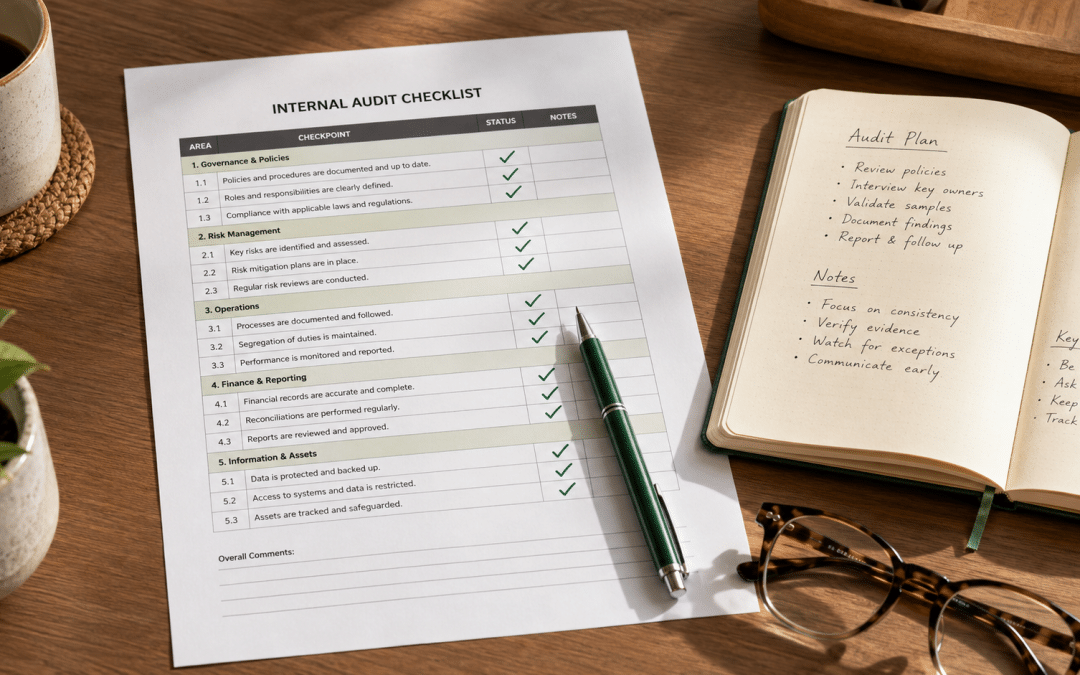
An LLM visibility audit answers one commercially urgent question: when South African buyers ask ChatGPT, Gemini, Perplexity or Google’s AI Overviews for help in your category, does your company get named, described accurately — or skipped? It’s the diagnostic layer of our AI search strategy for South Africa, and the natural first step before the fixes in our guide to earning AI referrals.
The question has a habit of arriving late — usually after a lost deal where the buyer mentions, in passing, that “the AI suggested” someone else. By then the shortlist has been forming for months.
Most SA companies have never checked. Their AI standing was assigned by default — by whatever the models retrieved and believed — and defaults in a shortlist economy are usually someone else’s name.
Quick Answer
An LLM visibility audit systematically tests what AI assistants say about your company across five layers: whether you’re mentioned for buyer-style questions, whether descriptions of you are accurate, whether your site is fetchable by AI crawlers, whether your content is extractable enough to cite, and whether independent sources corroborate your claims. A basic version takes one afternoon with a prompt list and a spreadsheet; a professional version adds console detection, technical checks and a prioritised fix plan.
Want the answer without the afternoon? We’ll run the first-pass check for you — free — and tell you exactly where you stand.
Get My Free Visibility CheckLLM Visibility Audit: What Does It Actually Check?
The exercise works through five layers, ordered from what buyers see down to why they see it. Skipping layers is how businesses fix symptoms while the cause keeps regenerating.
| Layer | Question It Answers | How It’s Tested |
|---|---|---|
| Mention standing | Are we named for buyer-style prompts? | Fixed prompt set run across the major assistants, logged monthly |
| Description accuracy | When we are described, is it correct? | Direct company prompts; answers scored against reality |
| Fetchability | Can AI crawlers actually read us? | robots.txt review, rendering check, crawler log inspection |
| Extractability | Is our content quotable? | Page-structure review against citation patterns |
| Corroboration | Do independent sources confirm our claims? | Reviews, directories, entity signals, consistency scan |
The order matters diagnostically. A company absent from mentions (layer one) might be blocked at fetchability (layer three) or contradicted at corroboration (layer five) — the audit’s job is to find which gate is failing, because each has a completely different fix and price tag.
Why Do SA Businesses Suddenly Need One?
Because the shortlist has replaced the results page for a growing share of buying decisions. AI replies name two or three providers where classic results listed ten; 70% of SA adults have used an AI chatbot; and cited brands measurably out-earn uncited ones — the full evidence sits in our AI search statistics roundup.
The audit exists because this channel fails silently. Nothing in your analytics tells you an assistant recommended a competitor at lunchtime today. Traffic reports show the aftermath; only direct testing shows the event. That’s the same blind spot we documented in our own console in our AI traffic analysis — machines reading at scale while dashboards stayed quiet.
There’s an internal reason too: budget defence. When leadership asks why content or entity work deserves funding, a logged baseline with dates and screenshots answers in evidence rather than opinion. The teams that struggle to fund this channel are almost always the ones arguing from anecdotes.
Key Takeaway
AI recommendation failures are silent: no analytics event fires when an assistant names your competitor instead of you. An LLM visibility audit converts that invisible standing into a logged, scored baseline — which is the difference between managing the channel and hoping about it.
How Do You Run a DIY Version This Afternoon?
The honest news first: a genuinely useful first-pass audit needs no tools beyond a spreadsheet and ninety minutes. Build a prompt list of fifteen to twenty questions phrased the way your buyers actually speak — service plus city, “who should I use for”, “best X for Y business” — plus three direct prompts about your company by name.
Run every prompt in a private session on each major assistant — logged-out or incognito, because assistants personalise, and a session that knows you will flatter you with mentions real buyers never see. OpenAI’s own ChatGPT Search documentation explains the retrieval behaviour you’re testing: the assistant rewrites your prompt into web queries and composes from what it fetches.
Sample prompt set (adapt the pattern): “best accounting firm for ecommerce sellers Johannesburg” · “who should I use for Shopify bookkeeping in Gauteng” · “is [your company] legit” · “what does [your company] charge” · “[your service] recommendations South Africa”. Log: named yes/no, position in the reply, description accuracy, who was named instead.
Design the list to cover four prompt families. Buyer prompts — service plus city, phrased casually, misspellings included, because that’s how people actually type. Comparison prompts — “X or Y for [need]” — since shortlists often form there.
Then reputation prompts — “is [company] legit”, “complaints about [company]” — because assistants answer those whether you like it or not. Round it out with two or three long-tail problem prompts unique to your niche, where thin SA coverage makes early wins likeliest.
Keep the logging honest in two small ways. Date every entry, because “the assistants said” without a date is unusable in three months. And record the full reply, not just your line in it — who else got named, and in what order, is competitive intelligence you’ll want when the benchmarking conversation starts.
Score each reply on three columns — mentioned, accurate, cited source — and screenshot everything. The first run is your baseline; the same run repeated monthly is your trend line, and the trend is what turns anecdotes into decisions.
Rather have the full five-layer version — with the technical checks the DIY pass can’t reach? The scoping call costs nothing.
Book a Free Audit Scoping CallWhat Does a Professional Audit Add?
The professional layer covers what a spreadsheet afternoon can’t: the technical and competitive depth. That means Search Console machine-query detection to quantify how much AI systems already read you, robots.txt and rendering checks against the full roster of AI crawlers, a structure review of your key pages against citation patterns, and the entity and structured data layer underneath it all.
The crawler review alone justifies the technical pass for most sites. Beyond the OpenAI pair, there’s Google’s extended crawler, Perplexity’s bot, Anthropic’s, and half a dozen others — each individually allowable or blockable, each silently absent if a blanket rule caught it. We routinely find sites that blocked everything in a panic and forgot.
It also means competitor benchmarking — running the same prompt set against the two rivals who keep getting named, then reverse-engineering why: their corroboration footprint, their page structure, their pricing transparency. The gap analysis is usually where the fix plan writes itself.
The deliverable that matters isn’t the findings document; it’s the prioritised fix sequence. A good LLM visibility audit ends with this-before-that ordering — fetchability before content, content before corroboration — so the budget lands where the failing gate actually is.
Key Takeaway
DIY testing establishes your mention baseline; professional depth adds what the spreadsheet can’t reach — console-level machine-read quantification, crawler and rendering checks, competitor reverse-engineering, and a prioritised fix sequence. The value is in knowing which of the five gates is failing, not in a longer findings document.
What Do the Results Look Like?
Audit value shows up as fixes that move the logged numbers. The composite below reflects the typical shape for an SA services firm three months after acting on a five-layer audit. Figures illustrate the pattern, not a single client’s audited results.
| Metric | Before (audit baseline) | After 3 Months | Change |
|---|---|---|---|
| Accurate descriptions on direct prompts | 8 of 20 | 18 of 20 | +125% |
| Mentions on buyer-style prompts | 1 of 20 | 6 of 20 | New channel |
| Monthly enquiries mentioning an AI tool | 0 | 2 | New source |
| Estimated monthly pipeline value | R150,000 | R225,000 | +50% |
Read the table with the funnel in mind. Accuracy protects deals you were already winning — a buyer who checks you out and gets told wrong facts quietly disappears, and fixing that leak pays before any new demand arrives. Mentions then open doors that didn’t exist, and the enquiry column confirms the doors lead somewhere.
Note which row moves first: accuracy. Entity and corroboration fixes land within weeks, mentions follow over months, enquiries last. Setting those timing expectations upfront protects the programme from being judged on the slowest metric at the earliest checkpoint.
How Often Should You Re-Audit?
Quarterly for the full five layers, monthly for the mention log. AI replies are rebuilt from live retrieval, so standings genuinely move month to month — a competitor’s new content or a directory update can reshuffle a shortlist without anyone announcing it.
The monthly log is deliberately lightweight — the same half-hour ritual we recommend across this cluster, one spreadsheet serving the mention tracking, accuracy scoring and citation counts together. The quarterly re-audit is where you re-test fetchability after site changes and re-benchmark the competitors, because their standing moved too.
Three events warrant an off-cycle re-run regardless of the calendar: a site migration or theme change (rendering and crawler access can break silently), a competitor’s visible content push, and any month where the mention log moves sharply in either direction — sharp moves have causes worth finding while the trail is fresh.
Key Takeaway
Cadence beats intensity: a monthly half-hour mention log plus a quarterly five-layer re-audit outperforms a single deep audit left to age. AI standings rebuild from live retrieval continuously — your measurement rhythm has to match the medium’s refresh rate.
The GPM Differentiator: Audited on Ourselves First
Growth Pulse Media built this audit by running it on our own brand — the machine-query detection, the prompt logs, the citation tracking all operate monthly on our own 382-post site, and the first-party numbers we publish come out of that exact discipline. Our AEO services for South African businesses deliver the same five-layer audit, with the same honesty about which gate is failing and what it’ll take to fix.
Running it on ourselves first also shaped what we dropped. Early versions tracked a dozen vanity measures that never changed a decision; the five-layer format survived because every layer maps to a specific fix with a specific owner. If a check can’t change what you do next, it doesn’t belong in the scoring sheet — that’s an operator’s rule, learned the slow way.
We also run the first pass free. Partly because it’s the right entry point, and partly because showing an owner what the assistants currently say about their business is the most persuasive document we could ever write.
Who This Is NOT For
Businesses that won’t act on findings. An audit that ends in a drawer is an expensive way to feel informed. If there’s no appetite to fix what it finds, save the effort.
Brand-new sites with no content or reviews. There’s nothing to audit yet — the five layers all return “absent”. Build the foundation first; audit once there’s a standing to measure.
Anyone shopping for a guaranteed-mentions package. An audit diagnoses; it cannot promise what generative models will say. Vendors bundling “guaranteed AI placement” with their audits are selling the diagnosis and the miracle cure in one invoice.
Teams that will run it once and frame the certificate. Standings rebuild continuously from live retrieval. A twelve-month-old audit describes a market that no longer exists.
Ready to see the five-layer version applied to your actual market — with the two competitors who keep getting named benchmarked alongside you?
Request My Free First-Pass AuditQuestions SA Businesses Ask About Auditing AI Visibility
What does an LLM visibility audit cost in South Africa?
The first-pass version costs nothing but an afternoon — a prompt list, private sessions and a spreadsheet. Professional versions vary with scope, mainly driven by competitor benchmarking depth and technical checks. We run the first pass free for SA businesses, which settles whether the deeper work is worth commissioning.
Which AI platforms should the audit cover?
Google’s AI Overviews first, because they sit inside the search results SA buyers already use, then ChatGPT, Gemini and Perplexity. Perplexity deserves inclusion despite its smaller share because it cites sources most transparently — it’s the clearest window into which pages are actually being read.
How is this different from an SEO audit?
An SEO audit measures rankings and crawl health for classic results; this measures mentions, accuracy and citability in generated replies. They overlap at the technical layer — crawlability serves both — but the buyer-visible outputs, the testing methods and most of the fixes are different exercises.
Can I trust what the assistants tell me about my own business?
Test in logged-out or private sessions only. Assistants personalise heavily, and a session with your history will surface your brand in ways a real buyer’s session never would. The audit’s value depends on seeing what strangers see, which is why session hygiene is a scoring rule, not a suggestion.
How long before audit fixes show up in AI answers?
Fetchability and accuracy fixes can influence replies within weeks, because answers rebuild from live retrieval. Mention gains typically build over one to three months as content and corroboration signals land. The audit’s baseline log is what makes that progress visible instead of anecdotal.
What’s the single most common failure an audit finds?
Description inaccuracy — assistants describing a company’s services, locations or pricing wrongly because the entity signals contradict each other across the web. It’s also the cheapest failure to fix, which is why accuracy is usually the first metric to move after an audit.
Still assuming no news is good news? The assistants answered questions about your category today — the only open question is whose name was in the reply.
Get Your Free LLM Visibility First-Pass
We’ll run 15 buyer-style prompts for your service across ChatGPT, Gemini, Perplexity and AI Overviews and send a 2-page report: your mention standing, your description accuracy, and which of the five layers is holding you back — from the SA team that runs this audit on its own brand every month. No obligation — we’ll get back to you within 24 hours.
Claim My Free First-Pass