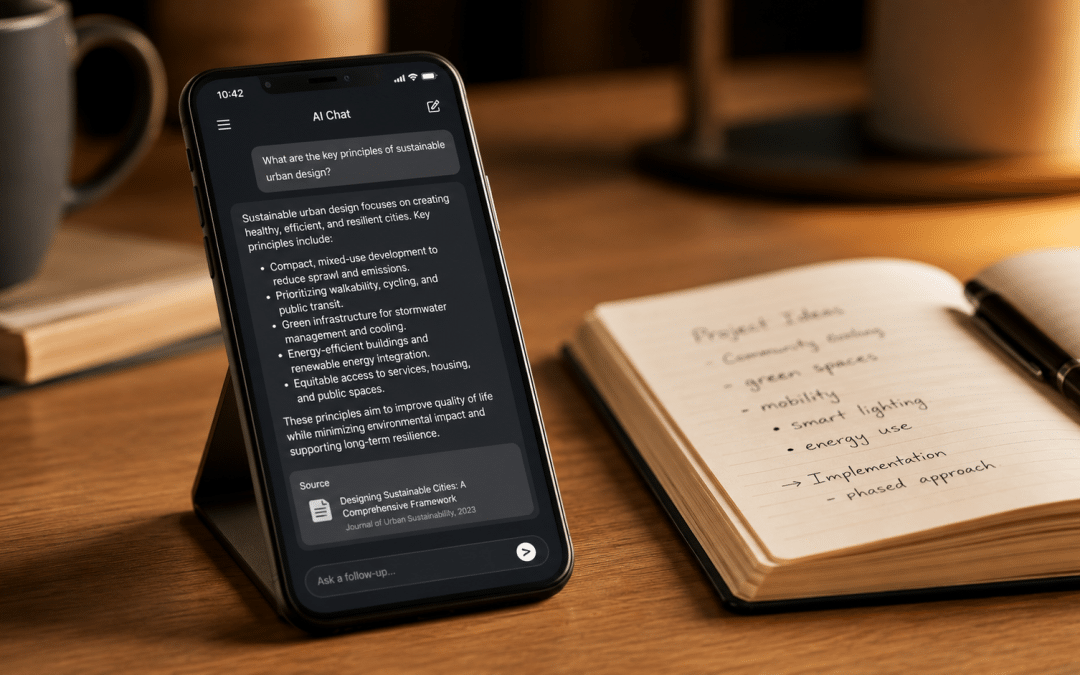
What is answer engine optimisation? In one sentence: it is the practice of structuring your content so AI platforms — ChatGPT, Gemini, Perplexity and Google's AI Overviews — select it, quote it and cite it when someone asks a question in your market. It builds directly on the strategy in our AI search guide for South Africa and reshapes how SEO in South Africa pays off.
The shift matters because a growing share of South African buyers now ask an AI assistant before they ever open a list of blue links. If the AI's response quotes your competitor, the buyer may never see you at all. AEO is how you become the source that gets quoted.
Quick Answer
What is answer engine optimisation in plain terms? It's the work of making your content the source AI tools quote: direct opening definitions, question-based headings, self-contained facts, citable statistics and clean structured data. Traditional SEO earns you a ranking; AEO earns you a citation — and in South Africa, citations increasingly happen before the click.
Curious whether AI tools are already quoting your site — or quietly quoting your competitors instead?
Get a Free AI Visibility CheckWhat Is Answer Engine Optimisation?
Answer engine optimisation is best understood as content strategy for machines that read on behalf of humans — you write so an AI system can lift a complete, accurate, attributable response from your page in a single pass. Where traditional search rewards relevance across a whole page, AI platforms reward extractability at the paragraph level.
The name comes from what these systems do. A classic search result hands the user ten options and lets them choose. ChatGPT, Gemini, Perplexity and Google's AI Overviews respond directly, then attach a small set of cited sources. AEO is the discipline of earning a place in that small set.
Three things make a page quotable. First, the response to the question must appear immediately — not after four paragraphs of build-up. Second, every key claim must stand alone, making sense when lifted out of context. Third, the page must carry verifiable specifics: numbers, Rand figures, named platforms, dates. Vague content gives an AI nothing worth citing.
When SA marketers ask "what is answer engine optimisation" in a strategy session, the honest reply is short: it's the discipline of writing for the machine that reads before the buyer does. Everything else — schema, headings, stat blocks — serves that one shift in audience.
None of this replaces the fundamentals. Google's own AI features documentation states there are no special requirements to appear in AI Overviews beyond normal indexability and quality. AEO is not a trick layered on top of search — it's a sharper version of the same craft.
How Do AI Platforms Decide Which Content to Quote?
AI platforms choose sources through retrieval: when a user asks something, the system searches an index, pulls a shortlist of relevant pages, and generates its response from the passages it can parse most cleanly. Pages that resolve the question in a self-contained block get pulled; pages that ramble get skipped.
This is why structure beats volume. A 4,000-word essay that buries its key fact in paragraph nineteen loses to an 800-word page that states the fact in sentence one. The machine isn't rewarding effort — it's rewarding retrievability.
Authority signals still matter, just as they do in classic search. Consistent topical coverage, real expertise markers, schema markup, and specific first-hand data all raise the odds that a retrieval system trusts your page enough to quote it. Thin, generic content fails on both fronts at once.
Key Takeaway
AI platforms select sources at the paragraph level, not the page level. A page earns citations when its key facts are stated immediately, stand alone without surrounding context, and carry verifiable specifics — numbers, names, dates and Rand figures a machine can safely repeat.
AEO vs SEO: What Actually Changes?
AEO and SEO share the same foundation — crawlable pages, genuine expertise, useful content — but they reward different behaviours at the content layer. Understanding how SEO works is still step one; AEO changes what "winning" looks like once you're indexed.
| Dimension | Traditional SEO | AEO |
|---|---|---|
| Goal | Rank in the top 10 links | Be the cited source in the AI's reply |
| Unit of competition | The whole page | The individual passage |
| Success metric | Clicks and positions | Citations, brand mentions, high-intent enquiries |
| Content style | Comprehensive coverage | Direct, self-contained, liftable statements |
| Winner-takes | Top 3 share most clicks | 2–4 cited sources take nearly everything |
The practical consequence for SA businesses: informational visibility and click traffic are decoupling. A page can be the source of truth for an AI-generated summary and receive very few clicks — while quietly building the brand recognition that drives the eventual agency search or direct enquiry.
Why Does AEO Matter for South African Businesses Right Now?
AEO matters now because AI-mediated search has already reached measurable scale in South African results — this is no longer a forecast. AI Overviews rolled out at scale locally in 2026, and AI assistants are steadily becoming the first stop for research-stage questions.
GPM first-party data — our own Search Console, one 28-day window: across Growth Pulse Media's own 382-post site, 11,388 of 146,251 impressions (roughly 7.8%) came from machine-style queries — long, hyper-specific prompts sitting at high positions with zero clicks. One page held position 1.9 on a single query with 9,279 impressions and not one click.
That is AI systems grounding their replies on our content. Treat this as a single-site case study, not a national benchmark — but it shows the behaviour is live in SA search today, at meaningful volume, on an ordinary business site.
The commercial logic follows from who stops clicking. Casual researchers get satisfied by the AI summary and disappear — they were never going to buy. Serious buyers read the summary, register which brand it cites, then click or search for that brand directly. The traffic that remains converts harder, and the citation itself does silent brand-building at scale.
Key Takeaway
Across Growth Pulse Media's own site, roughly 7.8% of Search impressions in a recent 28-day window came from machine-style AI grounding queries — pages being read by AI systems, not people. For SA businesses, being the quoted source is becoming a distinct visibility channel with its own rules.
Want to know which of your pages AI systems are already reading — and which are invisible to them?
Request a Free AEO Readiness ReviewHow Do You Structure Content So AI Tools Can Use It?
Content becomes AI-usable when every section resolves its own question in the first sentence, headings are phrased the way people actually ask, and key facts are packaged as standalone, citable statements. This page practises the pattern it describes — that's deliberate.
The working checklist looks like this. Open every page with a bolded direct definition or figure. Use question-based H2s that mirror real queries. Add a self-contained summary block near the top. Keep paragraphs short enough to lift whole. Include at least one specific, sourced statistic per major section. Mark the page up with FAQ and Article schema so machines can parse intent.
Quotable: "WhatsApp cart recovery flows for SA stores typically recover 18–28% of abandoned carts, versus 3–8% on email — the first message should fire within 60 minutes."
Unquotable: "In today's fast-paced digital landscape, recovering abandoned carts is more important than ever, and there are many factors to consider when choosing the right approach for your business."
Notice what separates them: the first is specific, self-contained and safe for a machine to repeat with attribution. The second says nothing an AI could cite. Most SA websites are built almost entirely from the second kind of sentence — which is exactly the opportunity.
Keyword thinking shifts too. Classic keyword research still identifies the questions worth owning, but the target stops being a two-word phrase and becomes the full conversational question a buyer would type into a chat box.
How Do You Measure AEO When Clicks Don't Tell the Story?
AEO is measured through citations, grounding signals and branded demand — not through click-through rate. Judging an AEO page on clicks alone will tell you it's failing precisely when it's working.
Four signals matter most. First, direct citations: run your priority questions through AI Overviews, ChatGPT, Gemini and Perplexity monthly and record where your brand appears. Second, machine-query impressions in Search Console — long, specific queries at high positions with zero clicks, like the pattern in our own data above. Third, branded search growth, the lagging footprint of repeated citations. Fourth, enquiries that mention finding you "through AI" — the signal that actually pays.
Build a simple monthly scorecard around those four signals. A shared sheet with your 20–25 priority questions down one column and the major AI platforms across the top takes an hour to set up and turns an invisible channel into something the whole team can track. Screenshots of each citation double as sales collateral.
Framed that way, "what is answer engine optimisation" stops being a definitional curiosity and becomes a reporting line: which questions do we own, on which platforms, and what did that visibility feed into the pipeline this month?
For context on how the underlying numbers are moving locally, our SA search statistics roundup tracks the wider data this discipline sits inside.
What Does AEO Look Like in Practice for an SA Business?
In practice, AEO turns existing pages into citable assets rather than requiring a new site. The composite below reflects the pattern we see when a Johannesburg B2B services firm restructures its top informational pages — direct openings, question headings, citable stats, schema — over roughly four months. Figures are illustrative of the typical shape, not a single client's audited results.
| Metric | Before | After 4 Months | Improvement |
|---|---|---|---|
| Tracked questions where the brand is cited by AI tools | 0 of 25 | 9 of 25 | New channel |
| Branded searches per month | 110 | 210 | +91% |
| Qualified enquiries per month | 6 | 11 | +83% |
| Estimated monthly pipeline value | R160,000 | R290,000 | +81% |
The revealing detail: organic clicks on the restructured informational pages barely moved. The growth arrived through the side doors — brand recognition, direct visits and AI-referred enquiries. That's the AEO economics working as designed.
Key Takeaway
AEO results show up in citations, branded demand and enquiry quality before they ever show up in click reports. An SA business that measures only clicks will abandon the strategy at exactly the moment it starts compounding.
The GPM Differentiator: AEO Built by People Who Practise It
Most agencies selling AEO in South Africa have read about it. Growth Pulse Media runs it on our own 382-post site — the machine-query data quoted above is our own Search Console, our own AI Overview citations, our own tested structure. Every recommendation in our AEO services for South African businesses comes from something we've already measured on ourselves.
That operator base changes the advice. We know which structural changes moved grounding signals and which were wasted effort, because we ran both. We build AEO on top of proper local foundations — SA-specific data, Rand-denominated proof, PayFast-and-Peach-Payments-level market specificity — because generic global content is precisely what AI systems skip.
Who AEO Is NOT For
Businesses that want guaranteed #1 chatbot placement. Nobody can guarantee what a generative system will cite. Anyone promising it is selling you the 2026 version of "guaranteed first page on Google."
Sites with no content foundation. AEO restructures and sharpens what exists. If your site has five thin pages, you need a content programme first — there's nothing yet for an AI to quote.
Businesses that need leads in the next 30 days. Citation-building compounds over months. If the pipeline is empty right now, paid channels solve this quarter; AEO solves next year.
Teams unwilling to publish specifics. AI systems cite numbers, prices and verifiable claims. If your business insists on vague, committee-approved copy with no data in it, machines will keep quoting competitors who publish real figures.
Not sure whether your site has the foundation AEO needs? A ten-minute look at your existing pages usually settles it.
Book a Free Content Foundation AssessmentAEO Questions SA Businesses Actually Ask
What is answer engine optimisation in simple terms?
It's structuring your content so AI tools like ChatGPT, Gemini, Perplexity and Google's AI Overviews quote and cite it when users ask questions in your market. Direct openings, question-based headings, standalone facts and citable statistics are the core techniques.
Is AEO replacing SEO?
No — AEO extends SEO rather than replacing it. AI platforms select sources from the same indexed, authoritative content that classic search rewards. You still need crawlable pages and genuine expertise; AEO adds the structural layer that makes that content quotable.
Which AI platforms matter most for South African businesses?
Google's AI Overviews matter most because they sit inside the search results SA buyers already use. ChatGPT and Gemini matter for research-stage questions, and Perplexity matters because it cites sources most transparently. One well-structured page can earn citations across all of them.
How long does AEO take to show results?
Early grounding signals — machine-style queries appearing in Search Console — often show within 6 to 10 weeks of restructuring key pages. Citations, branded search growth and AI-referred enquiries typically build over 3 to 6 months and compound from there.
Do AI citations actually generate leads?
Yes, indirectly but measurably. Citations build repeated brand exposure with research-stage buyers, which surfaces later as branded searches, direct visits and enquiries that mention finding you through an AI tool. The click volume is lower than classic search; the intent per visitor is higher.
How much does AEO cost in South Africa?
Restructuring existing content for AI visibility typically costs less than producing new content from scratch, because the assets already exist. Most SA businesses start with an audit of their top pages, then a phased restructure — a fraction of a full content programme's budget.
Still thinking "we'll wait and see how this AI thing plays out"? That's exactly what most of your competitors are thinking — which is why the citation space in your market is still winnable right now.
Get Your Free AEO Readiness Snapshot
We'll review your site and send you a 2-page snapshot showing which pages AI systems can already use, which are invisible to them, and the three highest-impact fixes — built by the team running AEO on its own 382-post South African site, with PayFast-to-Perplexity-level local specificity. No obligation — we'll get back to you within 24 hours.
Claim My Free Snapshot