AI search optimisation is the practice of making your business the source that AI answers cite — and for South African companies it is the widest-open opportunity in organic growth right now, because almost nobody local is doing it yet. It is the natural extension of everything that makes a page rank, aimed at a new target: being quoted rather than clicked.
Your buyers have not stopped searching. They have simply stopped scrolling as far as they used to. This guide covers what changed, the four things that decide whether an engine names you, and how to prove it is working — building on how AI is already reshaping SA search results.
Quick Answer
AI search optimisation is the discipline of getting a business cited and recommended inside AI-generated answers — Google's AI Overviews and AI Mode, ChatGPT, Gemini, Perplexity, and Meta AI. It rests on four pillars: a machine-readable entity, content structured so an answer can be lifted, a trust layer of reviews and mentions, and measurement that proves where you are cited.
It does not replace SEO. AI search optimisation aims the same fundamentals at a different outcome: being the answer instead of the tenth blue link.
Curious whether AI already mentions your business — or your competitor's?
Get a Free AI Visibility AuditWhat AI Search Optimisation Actually Means
AI search optimisation is the work of making a business legible, quotable, and trustworthy enough that a generative engine names it when a buyer asks a question. The acronym you will see attached to it is AEO — answer engine optimisation. Both terms describe the same discipline.
The distinction that matters is the target, and it is the whole reason AI search optimisation exists as a separate discipline. Classic search work aims to place a page in a list. The list is still there, but a growing share of buyers read a synthesised answer above it and never reach the list at all. Optimising for that answer means engineering content to be extracted, attributed, and recommended.
Three shifts sit underneath this. Answers are assembled from sources rather than ranked as pages. Attribution replaces position as the unit of visibility. And the query itself has changed shape — people type full sentences to an assistant where they once typed three words into a box.
What a citable answer looks like: "Payment gateway fees in South Africa typically run between 2.9% and 3.5% per transaction, plus a per-transaction rand fee." Self-contained, specific, quotable without surrounding context. Compare that to "the right choice depends on your unique business needs" — nothing to lift, nothing to attribute, and no reason to name the source.
Why This Matters for South African Businesses Right Now
The commercial case for AI search optimisation in South Africa rests on a timing argument rather than a volume argument. Local search volumes have not collapsed. What has changed is who intercepts the answer — and how few SA businesses have adapted their content to be intercepted favourably.
Google's own documentation is explicit that its AI features are rooted in core ranking systems. That is good news: the foundation transfers. But the fundamentals now have to serve extraction, not just ranking, and most local sites were never structured for it.
GPM first-party data: 90 days of our own Search Console
The clearest evidence we can offer is our own. Across Growth Pulse Media's 382-post site, roughly 8% of 28-day impressions match a machine-query pattern — long, fully-formed questions sitting at top positions with zero clicks. Those are not humans. That is grounding activity.
Our sharpest single exhibit: one page held position 1.9 across 9,279 impressions and earned zero clicks in 28 days. The page was not failing. It was being read by a machine, summarised, and cited without the click ever reaching us.
An honest caveat: this is one site's data, not a national benchmark. It is a single-site case study from a content-heavy B2B domain, and your ratio will differ by industry and query mix. We publish it because almost nobody in the SA market is measuring this at all — and because the method is repeatable on any Search Console account.
Key Takeaway
Zero-click impressions at top positions are not a failure signal. They are the fingerprint of AI grounding — evidence that a page is already feeding answers. A business that reads those rows as "broken SEO" will optimise away the very content that is winning citations.
The Four Pillars of AI Search Optimisation
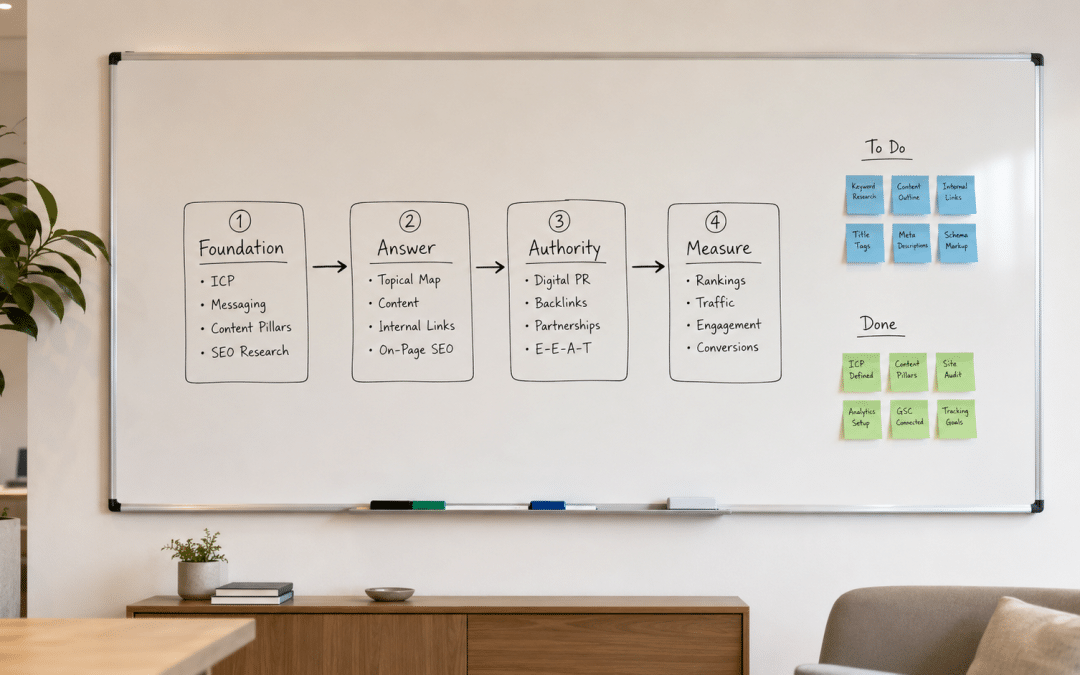
Every credible AI search optimisation programme reduces to four questions an engine asks before it names a business: does it understand you, can it lift your answer, does it trust you, and can you tell whether any of this worked. We build against those four as the AI Visibility Engine.
Pillar 1 — Foundation: an entity a machine can resolve
AI systems recommend entities they understand. That means organisation, service, and FAQ schema deployed consistently, a business identity that resolves cleanly in Google's Knowledge Graph, and technical foundations that let AI crawlers read the page without executing a pile of JavaScript first.
Most SA sites fail here quietly. The business exists, the pages exist, but nothing on the site states in machine terms what the company is, where it operates, and what it sells. Start with structured data done properly — it is the cheapest credibility a site can buy.
Pillar 2 — Answer: content built to be lifted
Engines cite passages, not pages. A passage earns citation when it answers a specific question completely, in isolation, without depending on the paragraph above it. That is why every section in this guide opens with a direct definitional sentence rather than a preamble.
The practical rules are unglamorous. Lead with the answer. Use question-shaped headings that mirror how people actually ask. Give real numbers in rands. And publish something nobody else has, because original data is the one thing an engine cannot synthesise from ten competitors.
Pillar 3 — Authority: the trust layer
An engine weighs what the wider web says about you before it recommends you. Reviews, brand mentions, directory consistency, and named experts with verifiable credentials all feed that judgement. A site can be perfectly structured and still lose to a competitor with a stronger reputation footprint.
For local businesses this is where a maintained Google Business Profile and genuine review velocity do disproportionate work. Consistency across the web is worth more than volume in any single place.
Pillar 4 — Measure: proof instead of vibes
Visibility inside AI answers is measurable if you know where to look. Four instruments do the job: grounding-query detection in Search Console, referral tracking in analytics, monthly citation checks across the major engines, and branded search growth as the downstream signal.
Key Takeaway
The four pillars are sequential, not parallel. Authority-building on a site an engine cannot parse is wasted budget, and measurement before foundations produces a dashboard of zeros. Fix the entity, then the answers, then the trust layer — then instrument all three.
Not sure which of the four pillars is your weakest link?
Get a Free Pillar AssessmentHow to Structure Content So an Engine Can Cite It
Citable structure is content organised so any single passage survives being torn out of the page and quoted alone. This is the mechanical heart of AI search optimisation, and it is where most existing content fails without its owner realising.
The test is simple. Take any paragraph from your best page. Read it with nothing before or after it. Does it still make a complete, specific claim? If it needs the previous paragraph to make sense, an engine has nothing clean to lift.
The four structural moves that matter most
Answer first, context second. The first sentence under every heading states the answer outright. Everything else supports it. This single change does more for extraction than any technical fix.
Questions as headings. Buyers ask assistants full questions. Headings phrased as those questions give the engine an obvious match between query and passage.
Numbers over adjectives. "Between R8,000 and R30,000 per month" is citable. "Affordable" is not. Specificity is what makes a passage worth attributing to a source.
Original data. Anything you measured yourself and nobody else publishes is unfakeable. It is the strongest citation magnet available to a small business, and it costs nothing but the discipline to record what you already know.
AEO and SEO: What Changes and What Does Not
AEO and SEO overlap heavily by design — they share fundamentals and diverge on target. Anyone selling AEO as a wholesale replacement for search work is selling a rebrand.
| Dimension | Classic SEO | Answer-engine work | Best for |
|---|---|---|---|
| Unit of visibility | Page ranking | Cited passage | Both — ranking still feeds citation |
| Query shape | 2–4 keywords | Full-sentence questions | Answer work owns the long tail |
| Winning content | Comprehensive pages | Self-contained passages | Structure serves both at once |
| Trust signal | Backlinks | Mentions, reviews, named experts | Reputation compounds across both |
| Measurement | Position and clicks | Grounding queries, citations, branded search | Instrument both or fly blind |
The honest summary: if a site's search foundations are weak, that is the first job, and no amount of AI search optimisation compensates for it. Answer-engine visibility built on a site machines cannot crawl is a castle on sand. Where the two genuinely part ways is measurement — position tracking alone will tell you nothing about whether you are being cited.
Real-World Numbers: What the Shift Looks Like
The pattern below is drawn from our own first-party Search Console data across a 90-day window on a single content-heavy SA site. Treat it as an illustrative case study of the mechanics, not as a market benchmark — the shape is what transfers, not the exact figures.
| Signal | Before structuring for answers | After | Change |
|---|---|---|---|
| Machine-pattern impressions (28d) | ~2,100 | 11,388 | +442% |
| Share of total impressions | ~2% | 7.8% | +5.8pp |
| Pages holding position 1–3 on question queries | 4 | 11 | +175% |
| Documented AI Overview citations | 0 | Confirmed | First-mover status |
The counterintuitive part is that clicks on those specific queries stayed flat or fell. That is the trade. Informational queries lose clicks to the summary while commercial queries keep converting — which is why the measurement layer has to separate the two rather than average them into one misleading number.
Key Takeaway
AI answers redistribute clicks rather than eliminate them. Informational queries bleed traffic to the summary; commercial queries are largely unaffected because a buyer ready to spend still wants the site. A content strategy that treats every lost informational click as a crisis will cut the exact pages that build the authority the commercial pages inherit.
Want to know what your own Search Console is already telling you about AI?
Get a Free Grounding-Query ReadA 90-Day AI Search Optimisation Roadmap
A realistic first quarter runs in three phases: audit, foundation, then publication and authority. The sequence is not negotiable, because each phase makes the next one measurable.
Days 1–14: audit and baseline
Establish where you stand before changing anything. Ask the major engines your category's real buying questions and record who they name. Pull your Search Console and filter for the machine-query pattern. Audit your structured data and check whether your business resolves as a coherent entity across the web.
The baseline matters more than it feels like it does at the time. Without a documented before-state, everything that follows is unprovable — and in a discipline this new, unprovable work is indistinguishable from luck.
Days 15–45: fix the foundation
Deploy organisation, service, and FAQ schema across the site. Align your name, address, and category signals everywhere they appear. Then restructure your highest-value pages so each section opens with a direct, liftable answer instead of a warm-up paragraph.
Restructuring existing pages beats publishing new ones in this window. The pages already earning impressions are the ones an engine is most likely to read next, which makes them the cheapest citations available to you.
Days 46–90: publish and build trust
Now the content engine runs. Question-led pages that answer real buying questions completely. At least one original data asset — anything you measured that nobody else publishes. And steady work on the reputation layer: reviews, mentions, and named experts with verifiable credentials.
By day 90 the instruments should show movement: more machine-pattern impressions, early citations, and branded search creeping up. If nothing has moved by then, the foundation was weaker than the audit suggested and the answer is to go back, not to publish harder.
Key Takeaway
Ninety days of AI search optimisation produces signals, not a finished position. Grounding-query growth and first citations are the realistic 90-day outcome; consistent recommendation across a category takes quarters. Any provider compressing that timeline is selling a mechanism that has not been demonstrated to exist.
The Four Mistakes That Waste the Most Budget
Most failed programmes fail for reasons that are visible from the outside. These four account for the bulk of the wasted spend we see when auditing accounts that tried this and gave up.
Optimising away the winning pages. Zero-click pages at top positions get read as failures and cut, when they are the pages already feeding answers. Kill those and you kill the citations.
Buying tools before fixing structure. An AI rank tracker on a site with no schema measures nothing that can be acted on. The instruments matter after the foundation, not instead of it.
Publishing volume instead of substance. Twenty generic posts give an engine twenty reasons to prefer someone else. One page with original data nobody else has beats all twenty.
Treating it as separate from search work. Running AI search optimisation as a siloed project alongside a neglected SEO programme wastes both. They share a foundation; fund it once and aim it at both outcomes.
How to Measure AI Visibility Without Guessing
Measurement is where AI search optimisation separates from marketing theatre. Four instruments, run monthly, produce a defensible picture — and none of them require a subscription to a tool that promises "AI rank tracking".
Instrument 1 — Grounding-query detection
Filter Search Console for queries of six or more words, at positions of six or better, with zero clicks and meaningful impressions. Human queries rarely fit that shape at scale. What surfaces is the machine layer reading your pages.
Instrument 2 — Referral tracking
Assistant referrals arrive in analytics under their own hostnames. The volumes are small today, which is precisely why a baseline set now is worth having in twelve months when the trend line matters more than the absolute number.
Instrument 3 — Citation checks
Ask the major engines your category's real buying questions, monthly, and record who gets named. It is manual, it takes twenty minutes, and it is the only direct read on whether the work is landing. Track your competitors in the same pass.
Instrument 4 — Branded search growth
When an engine recommends a business by name, a share of those people search that name afterwards. Branded query growth is the downstream fingerprint of being recommended in rooms you cannot see into.
The Growth Pulse Media Difference
We are not theorising about AI search optimisation. Our own content is already cited in Google's AI Overviews, and the grounding-detection method described above is one we built for our own Search Console before we ran it for anyone else. That is an unusual position in this market: most agencies added "AI" to a price list last month and have never measured a citation.
The operator background matters here too. We built and scaled a large SA ecommerce business — PayFast, Peach Payments, The Courier Guy, Klaviyo — so when we say informational clicks can fall while revenue holds, that is a conclusion we reached watching our own numbers, not a line from a conference talk.
Our AEO programmes for South African businesses run the full engine: entity and schema foundations, restructuring your highest-value pages into citable answers, the authority layer, and monthly reporting on where you are actually being named. Month-to-month, because in a discipline this new anyone demanding a year-long contract is selling certainty they do not have.
Who This Is NOT For
Businesses with no search foundation yet. If your site cannot be crawled, has no schema, and publishes nothing, this is not your first problem. Fix the fundamentals first — answer-engine work amplifies a foundation, it does not substitute for one.
Anyone wanting a guaranteed ChatGPT ranking. Nobody controls what an engine cites. What is controllable is everything that makes citing you the likely outcome. If a provider promises guaranteed placement in AI answers, they are describing something that does not exist.
Businesses that need leads this week. First measurable signals take six to twelve weeks, and recommendation status builds over months. If the pipeline is empty right now, paid channels are the honest answer and we will tell you so.
Anyone unwilling to publish original information. The single strongest citation magnet is data or expertise nobody else has. A business that will not share what it knows is asking engines to prefer it for reasons that do not exist.
Ready to find out where your business actually stands with the answer engines?
Book Your Free AI Visibility AuditFrequently Asked Questions
What is AI search optimisation?
AI search optimisation, also called answer engine optimisation or AEO, is the practice of making a business visible, citable, and recommendable inside AI-generated answers — Google's AI Overviews and AI Mode, ChatGPT, Gemini, Perplexity, and Meta AI. It covers four things: an entity machines can understand, content structured so a passage can be lifted and attributed, a trust layer of reviews and mentions, and measurement proving where you are cited.
Is AI search optimisation different from SEO?
They overlap by design. Google states plainly that its AI features are rooted in core search ranking systems, so the fundamentals still carry. What changes is the target: instead of only ranking a page, content is engineered to be quoted, attributed, and recommended. A weak search foundation gets fixed first — everything else is built on top of it.
How long does AI search optimisation take to work?
First measurable signals typically appear within six to twelve weeks, as grounding-query activity and early citations follow indexing. Consistent recommendation status builds over months rather than days. Anyone promising faster is describing a mechanism that has not been demonstrated.
How much does it cost in South Africa?
Retainers typically range from R7,500 to R20,000 per month. Foundation-focused work — schema, entity clarity, and page restructuring — sits at the lower end, while full programmes with ongoing citable content and authority building sit higher. Because the discipline overlaps heavily with strong search work, most businesses fold it into a combined programme rather than buying it standalone.
Can anyone guarantee that ChatGPT will recommend my business?
No, and nobody honest will. Answer engines decide what to cite. What a programme controls is entity clarity, citable structure, original data, and a trust layer competitors lack — the conditions that make citing you the likely outcome. The method and the monthly transparency are what can be guaranteed.
How do I know if AI is already citing my website?
Filter Search Console for long, question-shaped queries sitting at strong positions with zero clicks and meaningful impressions. That pattern is the fingerprint of machine grounding rather than human browsing. Pair it with monthly manual checks asking the major engines your category's buying questions and recording who gets named.
If your honest reaction is that this sounds like a lot of work for a channel that is still early — that is a fair objection, and it is also exactly why the window is open. The businesses that own their category's answers in two years are the ones structuring for it now, while their competitors are still arguing about whether it counts.
Find out what the answer engines say about you
Book a free AI visibility audit and receive a scored report across all four pillars — what ChatGPT, Google's AI features, Gemini, and Perplexity currently say about your category and your brand, where your gaps are, and a prioritised fix list you can act on with or without us. No obligation, and we will get back to you within 24 hours.
Book Your Free AI Visibility Audit