
 Add to Preferred Sources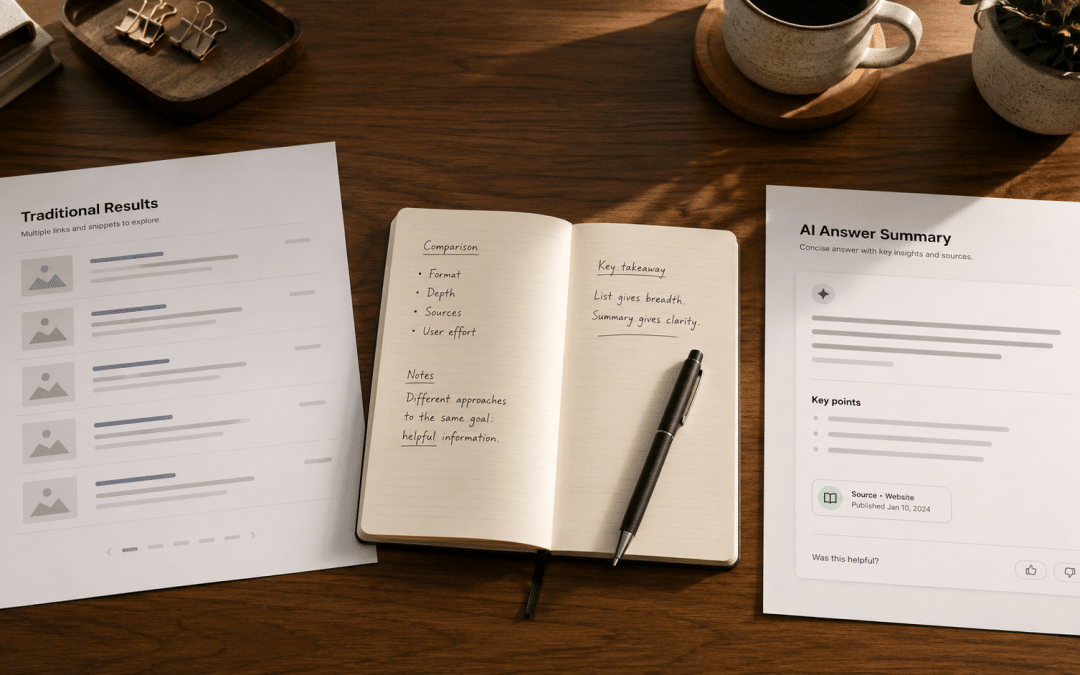
The AEO vs SEO South Africa debate comes down to one distinction: SEO earns you a ranking in a list, AEO earns you a citation inside an AI-written reply — and SA businesses now need both from the same content. This comparison sits inside our AI search guide for South Africa and builds on the fundamentals in our AEO explainer.
The stakes are concrete. AI answers now sit on roughly half of Google results pages, redistributing clicks away from classic listings — while buying-intent queries still behave the old way. Getting the split right is a budget decision, not a philosophical one.
Quick Answer
SEO optimises pages to rank in a list of results; AEO structures the same content so AI systems quote and cite it in generated replies. They share foundations — crawlability, expertise, authority — but reward different things: SEO rewards page-level relevance and links, AEO rewards passage-level clarity, citable specifics and independent corroboration. In the AEO vs SEO South Africa decision, the answer isn't either-or: layer AEO onto working SEO.
Quick Verdict
Keep SEO as the foundation — it still drives the clicks that convert today, especially on commercial queries. Add the AEO layer to your highest-value informational and comparison pages, where AI replies are absorbing the clicks. For most SA businesses the working split is roughly 70/30 effort toward SEO fundamentals versus AEO restructuring in year one, shifting as citations start landing.
AEO vs SEO: Quick Comparison
Best for leads this quarter: SEO — commercial-intent queries still deliver clicks
Best for research-stage visibility: AEO — citations reach buyers inside AI replies
Best for small budgets: SEO first — foundations feed both channels
Best conversion quality per visitor: AEO — AI-referred visitors convert at roughly 4.4× organic (Semrush)
Best measurement maturity: SEO — decades of tooling vs manual citation tracking
Best defensibility in thin SA niches: AEO — early citations compound before competitors adapt
Best overall for SA businesses: Both, layered — SEO foundation with AEO structure on priority pages
Classic SEO Pros and Cons
Pros: Proven, measurable and mature. Commercial queries still send clicks the old way, tooling is excellent, and every rand spent on foundations — crawlability, authority, content depth — also feeds AI visibility. For lead generation this quarter, it remains the workhorse.
Cons: Informational rankings earn fewer clicks every quarter as AI replies absorb them. Position-one on a research query can now mean single-digit CTR. Teams that only measure rankings and sessions are watching a scoreboard that undercounts what's happening.
AEO Pros and Cons
Pros: Citations reach buyers where clicks no longer happen, concentrate attention on a two-to-three-name shortlist, and convert exceptionally well downstream. SA fields are thin, so early structural movers capture outsized share. Cited brands even earn more classic clicks — visibility compounds across both channels.
Cons: No guarantees — nobody controls what a model says. Measurement is manual, results lag by weeks to months, and clicks on restructured informational pages may still fall. It extends SEO rather than replacing it, so it can't rescue a site with broken foundations.
Not sure which side of this comparison your site needs first? Your Search Console already knows — we can read it with you.
Get a Free Channel Priority CheckAEO vs SEO South Africa: What's Actually Different?
The two disciplines differ in what they optimise, where they compete and what winning pays. SEO competes at the page level for a ranked position; AEO competes at the passage level for a place in the AI's short list of cited sources.
| Dimension | Classic SEO | AEO | Best For |
|---|---|---|---|
| Unit of competition | The whole page | The individual passage | AEO for extractability |
| Visible outcome | Position in a list | Citation in a generated reply | Depends on query intent |
| Click behaviour | Top 3 share most clicks | 2–4 cited sources take nearly all attention | AEO for concentration |
| Content style rewarded | Comprehensive coverage | Direct, self-contained, citable statements | Both — one page can do both |
| Key off-page signal | Links | Independent corroboration and mentions | Overlapping — invest once |
| Measurement | Rankings, clicks, GSC | Citation logs, machine queries, branded demand | SEO for maturity |
The practical consequence: you don't build two content programmes. You build one programme whose pages rank and quote well — direct openings, question-shaped headings, specific claims — which is why the disciplines belong in the same budget line, not competing ones.
Where Do the Two Overlap?
They overlap almost completely at the foundation layer: crawlable pages, genuine expertise, real authority signals and useful content feed both channels. Google's own AI features documentation is explicit that its AI surfaces have no special requirements beyond normal indexability and quality.
That overlap is why the "SEO is dead" framing gets the comparison wrong. A site that can't get crawled, indexed and trusted can't get cited either. Everything covered in how SEO works remains the entry ticket; the AI layer changes what happens after admission.
The overlap extends to skills. The person who writes a strong featured-snippet paragraph already writes a citable one; the analyst who reads Search Console can log machine queries in the same session. For SA teams this means no new hires — it's a structured extension of work the team already does, which is exactly why treating the channels as rivals wastes money.
Key Takeaway
AEO and SEO share the same foundation — crawlability, expertise, authority — and diverge only at the content-structure and measurement layers. Budget-wise that means one programme with two scoreboards, not two competing programmes: every foundational rand pays into both channels simultaneously.
What Does Each Discipline Reward at the Content Level?
SEO rewards covering a topic more completely and authoritatively than competing pages; AEO rewards stating extractable facts a machine can safely repeat with attribution. The same article can do both, but most SA content currently does neither.
The rewrite pattern looks like this: keep the comprehensive depth that ranks, then sharpen every section to open with its answer, package key claims as standalone statements with Rand figures and named platforms, and mirror real question phrasing in headings. Our guide to getting named by AI assistants covers the corroboration side — reviews, directories, independent mentions.
Notice the asymmetry in effort. Going from nothing to ranking takes months of content and authority building. Going from ranking to citable is usually a restructure of what already exists — which is why AEO is cheap for sites with an SEO history and impossible for sites without one.
Curious how much of your existing content could be made citation-ready without writing a single new post?
Request a Free Restructure EstimateWhich Delivers Results Faster for SA Businesses?
For a site starting cold, SEO delivers first — commercial rankings can produce enquiries within months while citation authority is still building. For an established site, the order flips: AEO restructuring of existing pages can influence AI replies within weeks, because those replies are rebuilt from current sources every time someone asks.
The numbers behind that: AI answers appear on roughly 48% of tracked queries and cut top-position clicks by up to 58% on affected informational searches, yet transactional queries remain around 31% zero-click — the full dataset behind the AEO vs SEO South Africa picture is in our AI search statistics roundup. Speed depends on which of those query types your revenue lives on.
How Should SA Businesses Split Budget Between Them?
Most SA businesses should hold roughly 70% of search budget on SEO fundamentals and commercial visibility, directing about 30% into AEO restructuring of priority pages — then let citation results argue for more. The split shifts by model: heavy informational traffic means more AEO sooner; a transactional site can defer longer.
Two signals justify accelerating the AEO share. First, machine-style queries appearing in your Search Console — evidence AI systems already read you. Second, competitors' names appearing in AI replies for your money questions — evidence the shortlist formed without you. Either signal turns the 30% into a floor, not a ceiling.
Key Takeaway
The working budget split for most SA businesses is roughly 70% SEO fundamentals and commercial visibility, 30% AEO restructuring of priority informational pages — shifting toward AEO when machine queries appear in Search Console or competitors start being named in AI replies for money questions.
What Does the Transition Look Like in Practice?
In practice, adding the AEO layer to a working SEO base changes the revenue mix before it changes the traffic graph. The composite below shows the typical shape for an SA B2B services firm over four months. Figures illustrate the pattern, not a single client's audited results.
| Metric | Before (SEO only) | After 4 Months (SEO + AEO) | Change |
|---|---|---|---|
| Monthly organic clicks | 2,800 | 2,950 | +5% |
| AI citations on tracked questions | 0 of 20 | 6 of 20 | New channel |
| Qualified enquiries per month | 11 | 17 | +55% |
| Estimated monthly pipeline value | R230,000 | R360,000 | +57% |
Read the first row against the third. Clicks barely moved; enquiries jumped. The citations and the cited-brand click premium — Seer Interactive measured cited brands earning 35% more organic clicks — quietly upgraded the quality of everything arriving, which is the entire point of layering rather than switching.
Key Takeaway
Layering AEO onto working SEO typically changes enquiry quality before it changes traffic volume: flat clicks, rising citations, and a pipeline lift driven by better-qualified visitors and shortlist presence. Teams reporting only sessions will miss the improvement entirely.
Final Verdict: AEO or SEO for Your SA Business?
Both — sequenced, not chosen. If your foundations are weak, spend the next two quarters on SEO: crawlability, commercial pages, authority. If you already rank for meaningful queries, start the AEO layer this month on your ten highest-value informational and comparison pages, and log citations from day one.
Sequence matters more than allocation precision — and more than most agencies admit when pitching either channel. Two quarters of foundations before layering beats a perfectly calculated split applied to a site that can't yet be crawled cleanly. And once both are running, review against your own logs quarterly rather than against anyone's benchmark — including ours.
The only genuinely wrong answer in the AEO vs SEO South Africa decision is treating it as either-or. The channels share one foundation, one content library and increasingly one buyer — who reads an AI summary at lunch and clicks a commercial result that evening.
The GPM Differentiator: Bilingual in Both Disciplines
Growth Pulse Media runs both channels on its own 382-post site — classic rankings alongside earned AI citations, with our own Search Console as the scoreboard. Our AEO services for South African businesses are delivered by the same team doing the SEO, so the 70/30 split gets managed inside one strategy instead of two competing agencies fighting for budget.
That matters practically: the restructure that earns citations is done directly to the pages that rank, by the people who know why those pages rank in the first place — with PayFast-level SA specificity included throughout, because generic imported content wins neither channel.
Who This Comparison Is NOT For
Sites with no rankings and no content. There's nothing to layer AEO onto. Build the SEO foundation first — this comparison becomes relevant in six months.
Teams looking for a reason to stop doing SEO. The data doesn't support it: commercial queries still click, and citations favour sites with authority. Reallocating everything to the new thing is how agencies sell panic.
Businesses that won't track citations manually. AEO's scoreboard is monthly prompt logs, not a dashboard. If nobody will own that half-hour ritual, the AEO share of budget will be judged blind and cut unfairly.
Anyone expecting a permanent answer. The right split moves as AI surfaces expand. Treat the 70/30 as this year's starting point, reviewed quarterly against your own data — not a setting to lock and forget.
Want the split calculated for your actual site instead of the average one? That's a twenty-minute exercise with your data.
Book a Free Budget Split SessionQuestions SA Businesses Ask About the Two Channels
Is AEO vs SEO South Africa an either-or choice?
No. They share the same foundations — crawlable pages, expertise, authority — and the same content library. SEO remains the base that earns rankings and commercial clicks; AEO is a structural layer on top that earns citations in AI replies. Businesses that switch entirely to either one underperform businesses that layer them.
Will AEO replace SEO in South Africa?
The evidence points to coexistence, not replacement. Transactional queries still deliver clicks through classic results while informational queries migrate into AI replies. Since AI systems cite the same authoritative, crawlable sites that rank well, SEO strength remains the entry requirement for AEO success.
Do I need a separate agency for AEO?
No — and splitting the work usually hurts, because AEO restructuring is performed on the exact pages your SEO programme built. One team managing both channels can move budget between them as your data dictates, instead of two suppliers each arguing for their own line item.
Which is cheaper for an SA small business?
SEO costs more upfront because foundations take months to build; AEO is comparatively cheap once those foundations exist, since it's mostly restructuring existing pages. For a site starting from zero, SEO carries the cost either way — AEO alone has nothing to work with.
How do I measure AEO if it doesn't show in rankings?
Track four signals monthly: citations on a fixed set of buyer-style prompts across the major AI platforms, machine-style zero-click queries in Search Console, branded search growth, and enquiries that mention finding you through an AI tool. Together they describe citation progress that rankings reports can't see.
Does adding AEO structure hurt existing rankings?
Done properly, no — answer-first openings, question-shaped headings and citable statements align with what classic search already rewards for featured snippets. The risk comes from careless rewrites that thin out depth; keep the comprehensive coverage and sharpen its structure rather than replacing it.
Still planning to revisit this "once the dust settles"? The dust is the new surface — and the shortlists forming in your market this quarter won't wait for the settling.
Get Your Free AEO vs SEO Split Report
We'll analyse your Search Console and your market's AI replies, then send a 2-page report: your click-risk by query intent, your current citation standing, and the budget split your data actually supports — from the SA team running both channels on its own 382-post site. No obligation — we'll get back to you within 24 hours.
Claim My Free Split Report