
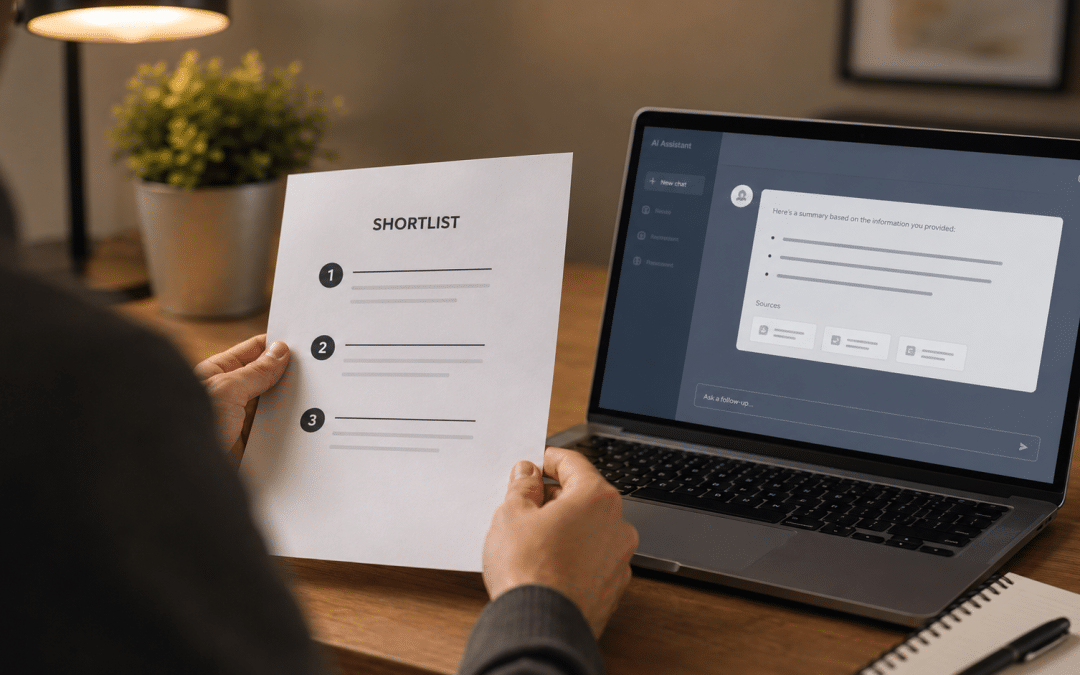
AI search for B2B matters more than for any other sector, for one structural reason: B2B buyers do their research privately, and an assistant that names three vendors during that private research has effectively built the shortlist before anyone fills in a contact form. This bridges our AI search strategy for South Africa into the pipeline mechanics of our B2B lead generation guide.
The asymmetry is what makes it urgent. A single citation influencing one enterprise shortlist can be worth more than a year of consumer-scale traffic, because the deal sizes are larger, the cycles are longer, and the shortlist is short.
Quick Answer
AI search for B2B is won by being the vendor an assistant can describe precisely: published pricing logic, specific capability statements, named integrations and compliance positions, evidence-backed case results, and comparison content that admits trade-offs honestly. Because buyers research privately and assistants compress vendor discovery into two or three names, being uncitable in your category means being absent from shortlists you never see forming.
Want to know which vendors the assistants name in your category right now — and whether you're one of them?
Get a Free Vendor Shortlist CheckHow Do B2B Buyers Actually Use AI in Research?
They use it for the private, exploratory half of the buying process — defining the problem, learning the category vocabulary, drawing up an initial vendor list — long before any vendor knows the evaluation started. B2B buyers have always done most of this research without contacting suppliers; what's changed is that a meaningful share of it now happens inside a conversation with an assistant rather than across ten browser tabs.
That conversation looks different from a search. A buyer asks "what should we look for in a lead generation partner for a Gauteng manufacturer", follows up with "what does that usually cost", then asks "who does this in South Africa" — three questions in one thread, with the vendor list arriving at the end already filtered by the criteria the assistant just helped define.
The committee dynamic multiplies it. In a typical B2B evaluation several people research independently, and each brings names to the table. A vendor cited consistently across those separate private conversations arrives at the shortlist meeting with three people already nodding.
There's a second-order effect worth naming. Assistants don't only produce vendor lists — they produce evaluation criteria, and a buyer who defined those criteria in conversation arrives with a fixed frame for judging everyone. Vendors whose published content shaped that frame get evaluated on their own terms; everyone else answers someone else's questionnaire.
Key Takeaway
B2B evaluations now begin in private AI conversations that define the criteria and produce the initial vendor list before any supplier is contacted. Multiple committee members research independently, so a consistently cited vendor enters the shortlist meeting with several people already familiar with the name — and an uncited vendor never enters at all.
AI Search for B2B: What Gets a Vendor Cited?
Assistants cite vendors whose capabilities, terms and evidence are stated precisely enough to repeat without risk. In B2B that means five things: what exactly you do, who you do it for, what it costs or how pricing works, what you integrate with or comply with, and what results you can evidence.
| Signal | What It Answers for the Buyer | Typical SA B2B Failure |
|---|---|---|
| Precise capability statements | Are they a fit for our specific problem? | "End-to-end solutions" for everyone |
| Pricing logic or ranges | Are they in our budget band? | "Contact us for a quote" only |
| Named integrations and compliance | Will this work in our stack and our law? | No mention of POPIA or local systems |
| Evidenced results | Has this worked for someone like us? | Testimonials with no numbers |
| Honest comparison content | How do they differ from the alternatives? | Competitor pages that only flatter the author |
Pricing transparency deserves singling out, because it's where SA B2B firms most often disqualify themselves. An assistant asked "what does this cost in South Africa" will quote whoever published a number. A firm whose entire pricing story is "it depends" contributes nothing to that answer and gets omitted from the reply that shapes the budget conversation.
You don't have to publish a rate card to fix it. A pricing logic — what drives cost up or down, what a typical engagement band looks like, what's included at each level — is quotable, honest and protects your negotiating position while getting you into the answer.
Not sure how much of your capability and pricing story is actually readable to a machine? A quick review usually finds the gaps fast.
Request a Free Citability ReviewWhich Content Types Earn B2B Citations?
Five formats do most of the citation work in B2B: honest comparisons, pricing and cost explainers, implementation and process content, results evidence, and industry-specific depth. Each maps to a question a buying committee genuinely asks, which is why they get retrieved.
Industry-specific depth is the most under-exploited in South Africa. A general page about lead generation competes with the world; a page about lead generation for SA manufacturers, or for fintech dealing with local compliance, competes with almost nobody — and it's exactly the specificity an assistant needs to justify naming you for a narrow query.
Results evidence is the format most firms get wrong. Google's own helpful content guidance asks whether a page provides original information, reporting, research or analysis and demonstrates first-hand expertise — which is the same bar a machine applies before quoting your claims. A case study with real numbers, a named sector and a stated timeframe clears it; "we delivered great results for a leading client" does not.
Sequence them by deal proximity. Pricing and comparison content sits closest to a decision and pays first; implementation and process content nurtures the middle of the evaluation; industry depth builds the durable position. Working AI search for B2B in that order means the earliest wins land where the money already is.
Write all of them to the properties in our guide to content AI systems quote. The formats differ; the underlying discipline — answer first, stand alone, bring evidence — does not.
Why Does South African B2B Have an Unusual Opening?
Because the local evidence pool is thin, and thin pools reward whoever fills them first. Most SA B2B categories have a handful of pages worth citing, so a firm publishing genuinely specific local content — Rand benchmarks, POPIA-aware process detail, integrations with systems SA companies actually run — can become the default source for its category in months rather than years.
Local compliance detail is the most reliable form of that specificity. POPIA obligations, SARS-adjacent processes, B-BBEE considerations in procurement, integration with the accounting and ERP systems SA companies actually run — these are facts an international competitor cannot credibly publish, and precisely what a local buyer asks an assistant about before shortlisting anyone.
Compare that to the same effort in a saturated market, where the specific query you'd like to own already has forty credible pages competing for it. The arithmetic of scarcity is the single strongest argument for SA B2B firms moving on this now rather than after it's proven safe by everyone else.
Sector pages compound the advantage. Publishing distinct, genuinely different pages for the verticals you actually serve — manufacturing, logistics, fintech, professional services — creates several narrow answer spaces where you are the obvious citation, rather than one broad space where you're the fifteenth option.
Key Takeaway
SA B2B categories have thin local evidence pools, which inverts the usual competitive maths: a firm publishing genuinely specific local content — Rand benchmarks, POPIA-aware detail, named local integrations — can become its category's default citation in months. Vertical-specific pages multiply the effect by creating several narrow spaces instead of one crowded one.
How Do You Measure This When Sales Cycles Run Six Months?
Measure the leading indicators, because the lagging one arrives too late to steer by. Three signals move well before revenue does: citation share on your tracked buyer questions, description accuracy when assistants explain what you do, and the quality of inbound conversations — specifically whether prospects arrive already knowing your positioning.
That last one is the most underrated signal in B2B. When a discovery call opens with "we know you focus on X, we want to talk about Y", the shortlisting already happened somewhere you couldn't see. Log those moments; they are the closest thing to direct evidence this channel gives you.
Then add the sales-team question that costs nothing: ask every new enquiry how they came across you, and record the answer verbatim. "Someone mentioned you" and "the AI suggested you" are different data points, and the second is now appearing in SA intake conversations often enough to be worth counting.
The AI search for B2B measurement rhythm that works is monthly, not quarterly — replies rebuild from live retrieval, so a competitor's new content can reshuffle your standing between board meetings without any announcement.
Key Takeaway
With six-to-twelve-month B2B cycles, measure leading indicators monthly: citation share on tracked buyer questions, description accuracy, and whether prospects arrive already knowing your positioning. Ask every enquiry how they found you and record it verbatim — "the AI suggested you" is now a countable source in SA intake conversations.
What Does This Produce for an SA B2B Firm?
It produces better-informed prospects arriving earlier in your favour. The composite below reflects the typical shape for an SA B2B services firm building citation presence over five months. Figures illustrate the pattern, not a single client's audited results.
| Metric | Before | After 5 Months | Change |
|---|---|---|---|
| Citation share on 25 tracked buyer questions | 1 of 25 | 9 of 25 | New channel |
| Enquiries arriving with positioning already understood | 20% | 55% | +175% |
| Qualified opportunities per month | 7 | 11 | +57% |
| Estimated monthly pipeline value | R380,000 | R560,000 | +47% |
Be honest about what this table can and can't prove. In a six-month cycle, no attribution model cleanly separates an AI citation from the three other touches around it — which is exactly why the leading indicators above carry the weight, and why the pipeline column is presented as a directional shape rather than a measured causal claim.
The second row is the one B2B leaders should care about most. Prospects who arrive already understanding your positioning convert faster, negotiate less on price, and waste fewer hours of senior time on fit conversations that were never going anywhere.
The GPM Differentiator: Pipeline Value, Not Impressions
Growth Pulse Media's B2B work is measured in pipeline rather than sessions, which is exactly the discipline this channel demands — and our AEO services for South African businesses apply it by tying citation tracking to the enquiry log rather than to a traffic dashboard. We run the same monthly prompt logs on our own brand and publish the first-party console data behind them.
The operator's argument for B2B specifically: everything that earns citations here — published pricing logic, evidenced results, honest comparison — also shortens sales cycles with human buyers. You are not building a machine-visibility asset and a sales asset separately. You're building the one thing that serves both, which is why this work survives budget scrutiny that pure traffic plays don't.
Who This Is NOT For
Firms that won't publish any pricing signal. An assistant asked what something costs quotes whoever published a number. If "contact us" is the entire pricing story, you're structurally absent from budget-stage answers.
Businesses whose differentiation is genuinely vague. Machines quote specifics. If nobody internally can state precisely who you serve and what you do differently, the citation problem is a positioning problem wearing a marketing costume.
Teams needing pipeline inside 60 days. Citation presence builds over months and pays across long cycles. Outbound and paid carry the immediate quarter; this compounds underneath them.
Anyone unwilling to name trade-offs. Comparison content that only flatters the author reads as marketing to both buyers and machines. Honest limitations are what make the rest of the page quotable.
Prefer this run as a programme — buyer question mapping, citability fixes, and the monthly log tied to your pipeline reporting?
Book a Free B2B Visibility SessionQuestions SA B2B Leaders Ask About AI Citations
Is AI search for B2B really different from B2B SEO?
The foundations are shared, but the target changes. B2B SEO wins rankings for pages; this wins a place in the two-or-three-vendor shortlist an assistant produces during private buyer research. The extra work is publishing precise capability, pricing and evidence detail that a machine can repeat without risk.
Do we have to publish our prices?
You need a pricing signal, not a rate card. Publishing what drives cost up or down, typical engagement bands, and what's included at each level gives assistants something quotable while protecting your negotiating position. Firms with no pricing signal at all are omitted from budget-stage answers by default.
How do we know if AI research is influencing our deals?
Ask every enquiry how they found you and record the answer verbatim, then track two more signals monthly: citation share on your tracked buyer questions, and whether prospects arrive already understanding your positioning. Together these appear months before revenue attribution can confirm anything.
Which content should an SA B2B firm write first?
Start with vertical-specific depth for the sectors you actually serve, then pricing logic, then evidenced case studies. Local B2B evidence pools are thin, so a genuinely specific page about your sector in South Africa can become the default citation far faster than a general page ever will.
Does LinkedIn activity help with AI citations?
Indirectly. Much social content is weakly retrievable, but LinkedIn builds the relationships and profile consistency that produce the mentions, coverage and partner references that do corroborate you. Treat it as the amplifier feeding your mention footprint rather than the citation source itself.
Can a small SA firm out-cite a large competitor?
In narrow categories, routinely. Assistants reward specificity and evidence over size, and large firms often publish the vaguest content because more approval layers strip the specifics out. A focused firm publishing real numbers for one vertical frequently out-cites a national competitor covering everything generically.
Still assuming your buyers will find you when they're ready? They're defining their shortlist this quarter, in conversations you'll never see — and the names in it are being chosen from whoever published something worth quoting.
Get Your Free B2B Citation Report
We'll map the questions your buyers ask during private research, run them across the major AI assistants, and send a 2-page report: who gets named in your category, how accurately you're described, and the content and pricing-signal fixes that change the shortlist — from a Johannesburg team that reports on pipeline value rather than impressions. No obligation — we'll get back to you within 24 hours.
Claim My Free Citation Report