
 Add to Preferred Sources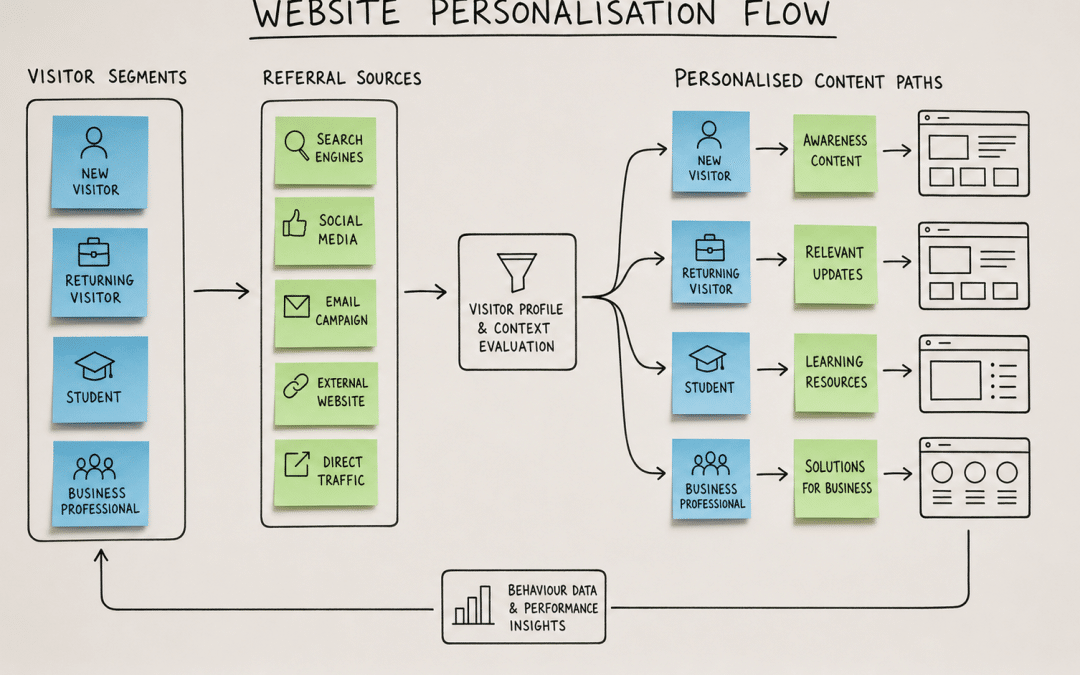
Website personalisation South Africa is the practice of dynamically adapting your website's content, offers, and layout to each visitor based on who they are, where they came from, and what they have done before — and it is one of the highest-leverage CRO moves available to SA businesses right now.
If you are running paid traffic to a generic homepage, or showing the same product sequence to a first-time visitor and a repeat buyer, you are leaving conversion gains on the table. Our South Africa CRO guide covers the full conversion optimisation landscape; this post goes deep on personalisation specifically.
South Africa's ecommerce market is already the largest on the continent, and it expanded 38% in a single year — with 71.4% of purchases made on mobile devices. In that environment, a one-size-fits-all website is not neutral — it actively disadvantages you against competitors who are already serving relevant experiences.
McKinsey research consistently shows that personalisation drives a 10–15% revenue lift on average, with strong executors reaching 25%. The commercial case is settled. The implementation questions — what types to prioritise, which tools work for SA merchants, and how to stay POPIA-compliant — are what this post answers.
Quick Answer
Website personalisation South Africa means dynamically changing what each visitor sees — product recommendations, banners, messaging, offers — based on their behaviour, location, referral source, or purchase history. McKinsey research shows it typically drives a 10–15% revenue lift. For South African businesses, the priority types are behavioural recommendations, geo-based content, and referral-source targeting, all implemented within POPIA's lawful-processing framework. Platforms like Shopify, Klaviyo, and Omnisend provide the infrastructure SA merchants need without enterprise-level budgets.
Jump to a section
Want a personalisation audit of your SA website? Talk to Growth Pulse Media — we'll identify your highest-value personalisation opportunities in one session.
What Is Website Personalisation?
Website personalisation is the process of using visitor data to display different content, offers, or experiences to different people on the same URL. Instead of every visitor seeing the same homepage hero, the same product grid, and the same checkout flow, a personalised site adapts in real time based on signals like geographic location, referral source, browsing history, past purchases, and device type.
Personalisation exists on a spectrum from simple to sophisticated:
| Complexity Level | Example | Tools Needed |
|---|---|---|
| Basic | Show a Cape Town-specific banner to visitors from the Western Cape | Shopify Geolocation app, or rule-based logic in most CMSs |
| Intermediate | Recommend products based on previous purchases or browsing categories | Klaviyo, Omnisend, Shopify's recommendation engine |
| Advanced | Dynamically change homepage hero, pricing display, and CTA based on acquisition source and lifecycle stage | Insider, Nosto, or custom data layer + A/B testing platform |
Rule-based personalisation applies human-defined logic — for example, automatically surfacing a free-delivery banner for visitors arriving from a specific Meta ad. AI-driven personalisation uses machine learning to predict which product or message a visitor is most likely to engage with, without you defining every rule. Most SA businesses start with rule-based and layer in AI tools as their data volume grows.
Key Takeaway
Personalisation is not a single feature — it is a layer that sits across your entire site. You can start with one rule-based use case (geo banner or referral-source landing page) and expand as your visitor data grows. The infrastructure you need is already built into platforms like Shopify and Klaviyo that SA merchants already use.
Why Website Personalisation Matters for South African Businesses
The case for website personalisation South Africa businesses can build on is grounded in both local research and global revenue benchmarks. SA consumers expect relevance — and punish irrelevance more than most markets expect.
A peer-reviewed 2025 study in the South African Journal of Information Management surveyed 204 SA ecommerce consumers and found that personalisation features offering distinct competitive advantages directly drove purchase decisions. Critically, the study found that customer control over their own data increased trust and purchase intent — meaning transparency is not just a POPIA requirement, it is a conversion driver.
The global figures align with the SA reality. According to aggregated consumer research compiled by Instapage, 90% of consumers find ecommerce personalisation appealing, 60% of shoppers become repeat buyers after a personalised experience, and 62% say they lose loyalty to brands that deliver generic experiences. In a market where SA consumers now spend an average of 9 hours 23 minutes online daily — and where 71.4% of ecommerce purchases happen on mobile — the session window for relevance is narrow and the competition for attention is fierce.
The Cart Abandonment Connection
The Baymard Institute's aggregation of 50 studies puts the average cart abandonment rate at 70.22%. Personalisation attacks abandonment directly: personalised cart recovery messaging and product substitute recommendations bring back shoppers that a generic "You left something behind" email cannot reach. For SA stores, this connects to the SA-specific cart abandonment patterns we cover separately.
The commercial outcome is consistent: 70% of retailers investing in personalisation report 400%+ ROI, according to the same aggregated research. For SA businesses competing in a market that grew 38% in a single year, personalisation is no longer an advanced tactic — it is table stakes.
The 5 Types of Website Personalisation South Africa Merchants Should Prioritise
Not every personalisation type delivers equal returns for SA merchants. Here are the five most impactful, ranked by implementation speed versus payoff:
1. Behavioural Product Recommendations
Show products based on what a visitor has browsed, added to cart, or bought before. This is the personalisation type with the highest direct revenue impact — Dermalogica achieved a 6.9% increase in average order value through personalised product bundling, while Industry West saw a 15% AOV increase and 25% increase in sales from their personalisation programme. Shopify's native recommendation engine, Klaviyo's product blocks in email flows, and Omnisend's smart segments all support this without custom development.
2. Referral-Source Personalisation
A visitor arriving from a Google Ads search for "office chairs Johannesburg" is not the same as one arriving from a branded Meta retargeting ad. Showing both the same landing page wastes the intent signal the first visitor already gave you. Match your hero headline, social proof, and CTA to the channel and campaign that sent each visitor. This is also where landing page optimisation and personalisation overlap most directly.
3. Geographic and Language Targeting
SA's geographic diversity creates real personalisation opportunities: Cape Town customers respond differently to delivery timelines than Johannesburg customers, and regional promotions (e.g., coastal summer campaigns) are worth tailoring to the visitor's location — specificity signals relevance, and the SAJIM research confirms that perceived relative advantage drives SA purchase decisions. If you serve multiple SA provinces or neighbouring markets like Namibia or Botswana, currency display and delivery messaging should adapt automatically to avoid friction at checkout.
4. Lifecycle-Stage Messaging
What you say to a first-time visitor is different from what you say to a customer who has bought three times. A new visitor needs trust signals and a clear value proposition; a repeat buyer needs loyalty acknowledgment and next-category discovery. Klaviyo and Omnisend handle lifecycle segmentation natively, and both integrate cleanly with Shopify and WooCommerce stores in South Africa.
5. Device-Aware Layout Adjustments
With 71.4% of SA ecommerce purchases happening on mobile, your personalisation stack needs to account for device context — not just screen size, but interaction behaviour. Mobile visitors scroll faster, tap rather than click, and abandon checkout more readily if payment steps are complex. Surfacing PayFast's instant EFT or Ozow as the primary payment option for mobile visitors (rather than burying it below credit card fields) is a form of device-aware personalisation that directly affects checkout completion rates.
Personalisation is most effective when it runs alongside A/B testing — so you know which variant is actually lifting conversions, not just which one you prefer. Growth Pulse Media runs both disciplines together.
How to Build a Personalisation Stack for Your SA Website
Building a personalisation capability does not require a custom development team. SA merchants can capture the majority of personalisation impact from platforms they already pay for.
| Personalisation Type | Recommended Tool (SA-Available) | Difficulty | Typical Timeline |
|---|---|---|---|
| Product recommendations | Shopify native / Klaviyo blocks | Low | 1–3 days |
| Email/SMS personalisation | Klaviyo, Omnisend | Low–Medium | 1 week (with flows) |
| Landing page variants by source | VWO, AB Tasty | Medium | 2–4 weeks |
| Geo-based content | Shopify Geolocation, Insider | Medium | 2–3 weeks |
| AI-driven dynamic content | Nosto, Insider, Dynamic Yield | High | 4–8 weeks setup |
The implementation sequence that works for most SA businesses:
- Audit your first-party data first. Personalisation quality is bounded by data quality. Before you add any tool, confirm that purchase history, browse data, and email capture are flowing cleanly into your CRM or ESP. A Klaviyo account with incomplete Shopify sync cannot segment effectively.
- Start with email and SMS flows. Personalised flows — welcome series, browse abandonment, post-purchase — deliver immediate, measurable lifts and require no on-site code changes. This is your fastest path to evidence that personalisation works in your specific SA store context.
- Layer on-site recommendations second. Once you have behavioural data from email engagement, use it to power on-site recommendations. Shopify's recommendation engine works out of the box; Klaviyo's product blocks extend this into email flows.
- Add referral-source landing page variants third. Use your paid traffic data to identify the top 3–5 acquisition sources, then build tailored landing pages for each. Test headline variants using controlled A/B testing before committing to permanent personalisation rules.
- Introduce geo and device personalisation last. These require the most configuration and the most data to validate. Do not start here — start with the layers that generate the data you will need to make geo and device personalisation worthwhile.
Good: A Johannesburg clothing retailer captures email at checkout, tags customers by category (men's / women's / kids'), and sends browse-abandon flows with personalised product blocks within a few hours of the browsing session — a working heuristic, not a fixed rule. Post-purchase flows surface complementary categories with explicit "Based on your recent purchase" framing. First-party data drives every personalisation decision — no third-party cookies required.
Bad: The same retailer installs an expensive AI personalisation platform before fixing broken Klaviyo sync, resulting in blank recommendation blocks and generic fallback content for a significant share of visitors. The tool is blamed; the data plumbing was the real problem.
POPIA and Website Personalisation: Getting the Lawful Basis Right
POPIA (the Protection of Personal Information Act) governs how SA businesses collect and process the personal data that powers personalisation. Getting this right matters both legally and commercially — the SAJIM research found that SA consumers who perceive control over their personal data show higher purchase intent, which means transparency is a conversion asset, not just a compliance checkbox.
Section 11 of POPIA lists multiple lawful bases for processing personal information. Consent is one basis, but not the only one. Legitimate interests, contractual necessity, and legal obligations are also recognised bases. For most standard ecommerce personalisation — product recommendations based on purchase history, lifecycle segmentation, and referral-source targeting — a business can rely on legitimate interests (with appropriate balancing of those interests against customer rights) or on the customer's contractual relationship.
Practical POPIA Checklist for SA Personalisation
- Cookie consent: Under POPIA's processing conditions, informed consent is the typically recommended basis for tracking and profiling cookies — the obligation is derived from POPIA's Section 11 processing requirements rather than an explicit cookie-consent statute comparable to GDPR's ePrivacy Directive. Use a compliant cookie banner; seek legal advice for your specific implementation.
- Opt-out right: SA consumers have the right to opt out of profiling for targeted advertising. Your privacy policy and preference centre must make this easy to exercise.
- Special personal information: If your personalisation uses health, biometric, religious, or racial data, explicit consent is always required — there is no legitimate-interests route for special categories.
- Data minimisation: Only collect and process the data you actually use for personalisation. A retailer personalising by purchase category does not need health or financial data.
- Transparency: Tell visitors what data you collect, how you use it for personalisation, and how they can update their preferences. Clear language builds the trust that legal-prose privacy notices rarely achieve.
The practical takeaway: POPIA does not prevent personalisation — it requires that personalisation is built on honest data practices. SA businesses that frame this correctly (transparent, preference-respecting, control-giving) will find that POPIA compliance and conversion performance pull in the same direction. For more on how to build opt-in-driven forms that support compliant data collection, see our form optimisation guide.
Key Takeaway
POPIA's Section 11 recognises consent as one of several lawful bases for processing — not the only one. Standard ecommerce personalisation (recommendations, segmentation, lifecycle messaging) can rely on legitimate interests or contractual necessity, with proper transparency. Only special personal information categories require explicit consent. Getting the legal basis right also means building the trust that drives SA consumers to buy more.
Why South African Businesses Choose Growth Pulse Media
Most digital agencies in South Africa treat personalisation as a technology implementation project — install the tool, configure the rules, move on. Growth Pulse Media starts from the revenue question: which visitor segments are abandoning at which touchpoints, and what does each segment need to see to convert? Every personalisation rule we build is matched to a hypothesis that can be tested in controlled A/B experiments.
Dirk built and scaled a South African ecommerce business before founding GPM. That background means we have already encountered the failure modes — the Klaviyo sync that breaks when Shopify variant structures get complex, the geo-targeting that misfires on VPN traffic and sends Cape Town visitors Johannesburg pricing, the AI recommendation engine that serves out-of-stock products because no one connected the inventory feed. We build personalisation stacks with those failure points pre-empted.
Our conversion rate optimisation service for South African businesses integrates personalisation with A/B testing, landing page optimisation, and checkout friction removal — because personalisation in isolation rarely achieves its full lift. The full CRO programme is how we drive results that compound.
We work with a deliberately limited client load, which means senior-level attention on every account. We do not delegate SA ecommerce strategy to junior staff. Named SA platforms — Shopify, Klaviyo, Omnisend, PayFast, Peach Payments, Yoco — are not theoretical tools for us; they are the infrastructure our clients run on every day.
Who Website Personalisation Is NOT For
Not for: Businesses with low session volumes. Personalisation requires data to perform. As a working heuristic, if your website receives fewer than a few hundred visits per month, segmentation produces buckets too small to be statistically meaningful, and AI recommendation engines have nothing to train on. Fix your traffic acquisition first — see what CRO actually involves at your stage.
Not for: Businesses without first-party data infrastructure. If your email list is uncleaned, your CRM is unsynchronised with your store, and you have no behavioural tracking in place, personalisation tools will surface the wrong products to the wrong people. The data foundation must come before the personalisation layer — otherwise you are personalising noise.
Not for: Single-product businesses with no meaningful segmentation. If every visitor needs the same product and your catalogue has three SKUs, personalisation does not unlock new revenue — it just adds complexity. Invest in checkout optimisation and trust signals instead; those move the needle at any traffic volume.
Not for: Businesses that cannot action test results. Personalisation must be validated through testing, and testing requires the organisational ability to act on findings quickly. If it takes three months to get a developer to change a product recommendation rule, your personalisation strategy will stagnate. Businesses without a clear testing cadence get better returns from simpler CRO improvements first.
Ready to connect personalisation to measurable conversion lifts? Our ecommerce CRO service covers the full stack — from data audit to personalisation rules to validated A/B test results.
Frequently Asked Questions
What does website personalisation cost for a South African business?
The cost depends on which layer of personalisation you are implementing. Email and SMS personalisation via Klaviyo or Omnisend is included in the platform subscription most SA stores already pay. On-site personalisation tools like Nosto or Insider start at a few thousand Rand per month for smaller stores. Enterprise AI personalisation platforms price on revenue percentage or session volume. Most SA SMEs get the highest return by maximising the personalisation capabilities of platforms they already pay for before adding new tools.
Do I need to get explicit consent for website personalisation under POPIA?
Not always — POPIA's Section 11 recognises multiple lawful bases for processing personal data. Explicit consent is one basis; legitimate interests and contractual necessity are others. For standard personalisation (product recommendations, lifecycle segmentation based on purchase history), a business can typically rely on legitimate interests with proper transparency and opt-out mechanisms. Explicit consent is required when processing special categories of personal information such as health or biometric data.
How long does it take to see results from website personalisation?
Email and SMS personalisation flows — browse abandonment, post-purchase recommendations, welcome sequences — typically show measurable results within two to four weeks of activation, as a practical working heuristic, because they run on existing traffic without requiring new visitor volume. On-site personalisation takes longer to validate because you need enough session data to run meaningful A/B tests; as a working rule, allow four to six weeks of clean data collection before drawing conclusions. Businesses with higher traffic volumes will reach statistical significance faster.
Which personalisation tools work best for Shopify stores in South Africa?
For Shopify stores, the most effective personalisation stack for SA merchants is Shopify's native product recommendation engine combined with Klaviyo or Omnisend for email and SMS flows. Klaviyo's predictive analytics and segmentation tools handle lifecycle-stage and behavioural targeting natively, and both platforms integrate with PayFast, Peach Payments, and other SA payment gateways without custom development. Stores with higher SKU counts or international ambitions can add Nosto or Insider for more advanced on-site recommendations.
How does website personalisation interact with CRO?
Effective website personalisation South Africa operators deploy works as a CRO tactic, not a separate discipline. The conversion rate optimisation process identifies where visitors drop off; personalisation addresses drop-offs by making the experience more relevant for specific visitor segments. The most effective approach pairs personalisation changes with A/B testing — so you are measuring the lift from relevance rather than assuming it. Businesses that implement personalisation without a testing framework often cannot distinguish personalisation gains from seasonal or traffic-mix changes.
Get a Website Personalisation Assessment
Growth Pulse Media assesses your current personalisation baseline, identifies the highest-return opportunities in your specific SA business context, and builds the implementation roadmap — using Shopify, Klaviyo, Omnisend, and SA-native payment integrations your team already knows. No obligation — we'll get back to you within 24 hours.
Talk to Growth Pulse Media