
 Add to Preferred Sources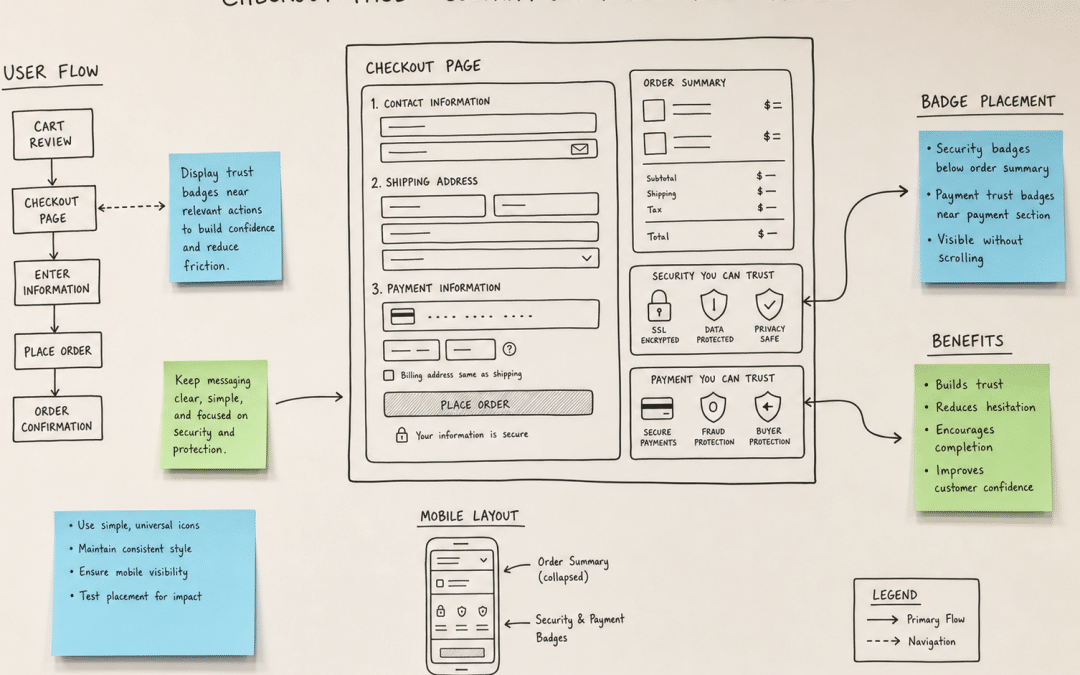
Website trust signals are the visible, verifiable cues — secure checkout, local contact details, real reviews, accessible support and clear policies — that let a South African buyer confirm your business is legitimate before they hand over money or personal data. They are not badges you write yourself; they are things a cautious visitor can check, and they sit alongside page speed and honest pricing inside a broader CRO Guide South Africa approach to turning visitors into paying customers.
The reason they matter more here than in many markets is straightforward. South African shoppers are cautious about fraud, delivery delays and unclear refund terms, so trust has to be demonstrated through concrete website features rather than asserted in marketing copy. A banner reading “trusted by thousands” convinces nobody. A local phone number that a visitor can dial does.
Quick Answer
Website trust signals are the visible cues — secure checkout, local contact details, reviews, accessible support and clear policies — that reassure South African buyers a business is legitimate before they pay or share data. SA shoppers are notably cautious about fraud, delivery delays and refunds, and POPIA compliance adds direct legal weight on top of the marketing benefit.
Not sure which trust signals your site is missing?
Ask us for a straightforward look at what is reassuring visitors and what is quietly costing you sales.
What exactly counts as a trust signal?
A trust signal is any visible, verifiable cue — from a security padlock to a named customer review — that lets a visitor confirm a business is legitimate without taking the business’s word for it.
The working definition is visual and textual cues that build confidence and reassure visitors a business is credible and reliable. That range is wide: a padlock in the browser bar, a support portal, a refund policy written in plain language, a review with a real name attached.
The distinction that separates a signal from a slogan is verifiability. Payfast makes the point that trust is demonstrated through concrete website signals like checkout experience, refund policies and payment security rather than stated outright.
A claim: “South Africa’s most trusted online store.” Nothing here can be checked, so a cautious buyer discounts it entirely — and may read it as overcompensation.
A signal: a Cape Town landline, a support portal with published response times, twelve reviews with first names and dates, and a refund policy that states how many days a return takes. Every element can be independently verified in under a minute.
Key Insight
A trust claim you write yourself carries little weight; a trust signal a visitor can verify themselves does the real work.
Why are South African shoppers especially cautious online?
Caution here concentrates on three specific risks — fraud, delivery delays and unclear refunds — which means a site has to answer all three before checkout, not just prove it is secure.
Payfast’s assessment of the local market is that South African shoppers weigh fraud risk, delivery reliability and refund clarity, which makes trust building essential for conversion rather than a nice-to-have. That caution surfaces at exactly the wrong moment: the point of payment.
Checkout friction compounds it. Baymard Institute reports that nearly 1 in 5 shoppers have abandoned a cart due to a checkout process that was too long or complicated, and its latest quantitative study found 42% of US online shoppers abandoned a cart because they were simply browsing rather than ready to buy. Those are global figures rather than South African ones, but they establish something useful: a meaningful share of abandonment has nothing to do with trust at all, and the rest is worth attacking properly.
The practical consequence is that a slow, confusing checkout reads as untrustworthy even when the business is entirely legitimate. A visitor cannot distinguish between “this company is disorganised” and “this company is a risk” — the felt experience is the same. Our breakdown of Cart Abandonment South Africa: Why SA Shoppers Leave covers where local checkouts typically lose buyers.
Key Insight
Checkout friction and trust deficits overlap — a slow, unclear checkout reads as untrustworthy even when the business is not.
Which website trust signals should every South African business show?
Five signals carry the load: local contact details, visible HTTPS, real reviews, accessible self-service support, and a POPIA-compliant privacy policy.
Local contact details and business information are the baseline. A local phone number, a support email and a physical or registered address all answer the same underlying question a hesitant buyer is asking: is anyone actually there? Payfast identifies this as the signal that reassures South African shoppers a real business sits behind the website.
Visible self-service support does similar work. A help centre, FAQ or support portal signals accountability and reliability — and it does so even when the shopper never clicks through. Its presence answers “what happens if this goes wrong?” before the question is consciously asked.
Reviews, testimonials and ratings build credibility because they show other people have already taken the risk. The detail that matters is specificity: dated reviews with names and product references are verifiable in a way that an anonymous five-star average is not.
Underneath all of it sits basic security. A secure site displays HTTPS in the URL, verified by an SSL certificate that authenticates the site and encrypts user data. This is now a baseline that many visitors check before typing anything personal, and its absence is disqualifying rather than merely unhelpful.
| Signal | What it proves to a buyer | Effort to fix | Source |
|---|---|---|---|
| Local contact details & business info | A real, contactable business exists | Low — a footer and a contact page | Payfast |
| Visible HTTPS / SSL | Data is encrypted and the site authenticated | Low — certificate installation | Certifying |
| Reviews & testimonials | Real customers bought and were satisfied | Medium — requires collection over time | Payfast |
| Help centre / FAQ / support portal | Someone is accountable after the sale | Medium — content plus maintenance | Payfast |
| POPIA-compliant privacy policy | Personal data is handled lawfully | Low to medium — needs to be accurate, not generic | Scytale |
Signals should be verifiable by the visitor, not merely claimed in copy.
The sequencing matters as much as the list. Security and contact details come first because their absence actively disqualifies a site. Policy pages follow, because they are quick and carry legal weight. Reviews come last in build order — not because they matter least, but because collecting genuine ones takes time you cannot compress.
Key Insight
None of these signals requires a redesign — most are additions to pages you already have: a footer, a policy page, a reviews widget.
Weighing up which signals to prioritise first?
Talk to us about sequencing contact details, security, reviews and policy pages so the highest-friction gaps close first.
How does POPIA compliance work as a trust signal and a legal safeguard?
A clear, accurate POPIA privacy policy does two jobs at once: it explains to a buyer how their data is handled, and it reduces a real financial exposure.
A well-drafted POPIA privacy policy builds trust by clarifying how personal information is used and protected. For any site collecting names, numbers or payment details, that clarity is itself a signal — a visitor who reads a specific, plainly written policy learns something reassuring about how the business operates.
The incentive is not only reputational. POPIA penalties include fines ranging from 1 to 10 million ZAR, which makes an accurate privacy policy a business protection measure as much as a marketing one. Given the range, this is not a document to generate from a template written for another jurisdiction — and a visitor who spots GDPR language or a foreign regulator’s name on a South African site has been given a reason to doubt rather than trust.
Every form that collects customer data is also a trust touchpoint: quote requests, newsletter sign-ups, checkout fields. Each one asks the visitor to extend a little more confidence, which is why Form Optimisation: Get More SA Leads from the Same Traffic and trust-building work should be reviewed together rather than as separate projects.
Key Insight
A privacy policy that is vague or copy-pasted from another country’s template does the opposite of building trust the moment a visitor actually reads it.
What does South African research say about trust and repeat purchases?
A Gauteng study of online shoppers found that website informativeness, retailer and customer interaction, and website security all influence trust — and that trust in turn influences whether a shopper buys again.
A peer-reviewed study surveyed 201 online shoppers in Gauteng to test what actually drives trust in online stores rather than relying on assumption. That local sample is worth more here than a larger international one, because the specific anxieties differ by market.
The finding was that website informativeness, retailer- and customer-related interaction, and website security influence customer trust, which then influences repurchase intention. In practice these work together: thorough product detail, responsive interaction and visible security reinforce one another rather than substituting for each other.
The more useful finding for anyone allocating budget is the second one. Informativeness and security were found to directly influence repurchase intention, an effect only partially mediated by trust. Both factors matter even beyond their contribution to trust itself — which makes thin product pages a repeat-purchase problem, not only a first-purchase one.
Key Insight
Informativeness and security are not only trust boosters in this research — they independently predict whether a South African shopper comes back.
Do case studies and testimonials work the same way for B2B buyers?
International B2B research suggests most of the buying decision happens before any contact with sales, which puts the burden of proof on the website — though the figures are not South Africa-specific.
Forrester Research (2025), as cited in B2B marketing coverage, puts 67% of B2B purchasing decisions as made before first contact with sales. DemandGen research cited in the same context found 78% of B2B buyers were more likely to consider a vendor providing case studies. Neither figure is South African, and neither should be quoted locally as though it were.
What does transfer is the underlying logic: buyers want proof before a conversation, and in the absence of a salesperson the website is the only thing supplying it. For a South African B2B service page, that makes the case study section and the client-logo strip active conversion elements rather than decoration — worth reviewing alongside broader Landing Page Optimisation South Africa: Convert More Clicks work.
The B2B equivalents of the ecommerce signals are direct: named client references instead of anonymous reviews, a physical office address instead of a returns policy, and named team members instead of a support portal. The question a buyer is answering is identical — is this a real operation that will still exist in eighteen months?
Key Insight
Treat international B2B statistics as directional evidence for South African sites, not as a guaranteed local outcome.
The Bottom Line
Website trust signals work because they let a South African buyer verify — rather than take your word for — whether a business is real, secure and worth paying. That is the entire mechanism, and it explains why self-authored claims underperform so consistently.
The signals with evidence behind them are specific and unglamorous: local contact details, visible payment security, an accessible support page, genuine reviews, and refund and privacy policies that read as written for this business rather than pasted from elsewhere.
None of it replaces a fast, clear checkout. Trust signals sit alongside checkout design, not instead of it — a trusted site with a painful checkout still loses the sale.
The GPM Difference
Trust signals sit at the exact point where a South African visitor decides to buy or bounce, so we treat them as testable conversion elements inside a site’s CRO plan rather than badges bolted onto a footer.
Growth Pulse Media is run by an operator, not an account manager. Dirk van Greuning built and scaled South African ecommerce businesses before founding GPM, which is why the advice here is costed in Rands, tested against the South African market, and measured in pipeline rather than impressions.
If you want Conversion Rate Optimisation South Africa handled by someone who has carried the same numbers you are carrying, that is the work we do.
Who This Is NOT For
Your site gets fewer than 500 sessions a month. Below that level there is not enough traffic to tell a real improvement from normal variation, so any change we made would be guesswork dressed up as optimisation. Put the budget into traffic first.
You are not willing to collect and publish real customer reviews. We will not fabricate social proof to fill the gap, and a review section built from invented testimonials is a liability rather than a trust signal.
You want a badge, not a review. If the budget stretches to adding two trust seals rather than examining contact details, security, policies and checkout, this is not the right engagement yet.
Your checkout or contact page does not work properly. Fix the basics first — optimising the trust signals around a broken checkout improves nothing.
Losing sales at checkout despite decent traffic?
Tell us where buyers drop off and we will help pinpoint whether it is a trust gap, a checkout issue, or both.
Frequently Asked Questions
What is the single most important website trust signal for a South African ecommerce site?
There is no single signal that outweighs all others in the evidence. Payfast identifies local contact details, reviews and testimonials, and self-service support access as a connected set, alongside a secure HTTPS connection verified by an SSL certificate. Missing any one of them raises doubt for a cautious buyer.
Does having HTTPS alone make a website trustworthy?
No. HTTPS and an SSL certificate authenticate the site and encrypt data, which matters, but South African research found website informativeness and interaction also directly affect trust and repurchase intention. Security is necessary rather than sufficient.
What happens if my business is not POPIA compliant?
POPIA penalties include fines ranging from 1 to 10 million ZAR. A clear, accurate privacy policy is both a trust signal and a way to reduce that exposure, which is why a generic template borrowed from another jurisdiction is a poor economy.
Do trust signals matter for B2B websites, not just online stores?
Yes. International research cited by B2B marketing sources found most purchase decisions form before a sales call, and that most buyers favour vendors who publish case studies. Those figures are global rather than South African, but the logic — buyers want proof first — holds locally.
Is checkout abandonment mostly about trust, or something else?
Both. Baymard’s global data shows checkout complexity and browsing without intent to buy are each major abandonment reasons, while South African shoppers add fraud, delivery and refund caution on top. Trust signals address the caution; checkout design addresses the complexity.
How many reviews do I need before they count as a trust signal?
Fewer than you would expect, provided they are verifiable. A small number of dated reviews with real names and specific product references does more than a large anonymous star average, because the buyer can assess them rather than simply being told a number.
Most South African businesses we speak to have been burned by an agency that reported on impressions while the pipeline stayed flat. That is the conversation we would rather start with.
Ready to see where your website loses buyer confidence?
Book a no-obligation consultation and we will walk through your site’s trust signals page by page. We reply within 24 hours.
