
 Add to Preferred Sources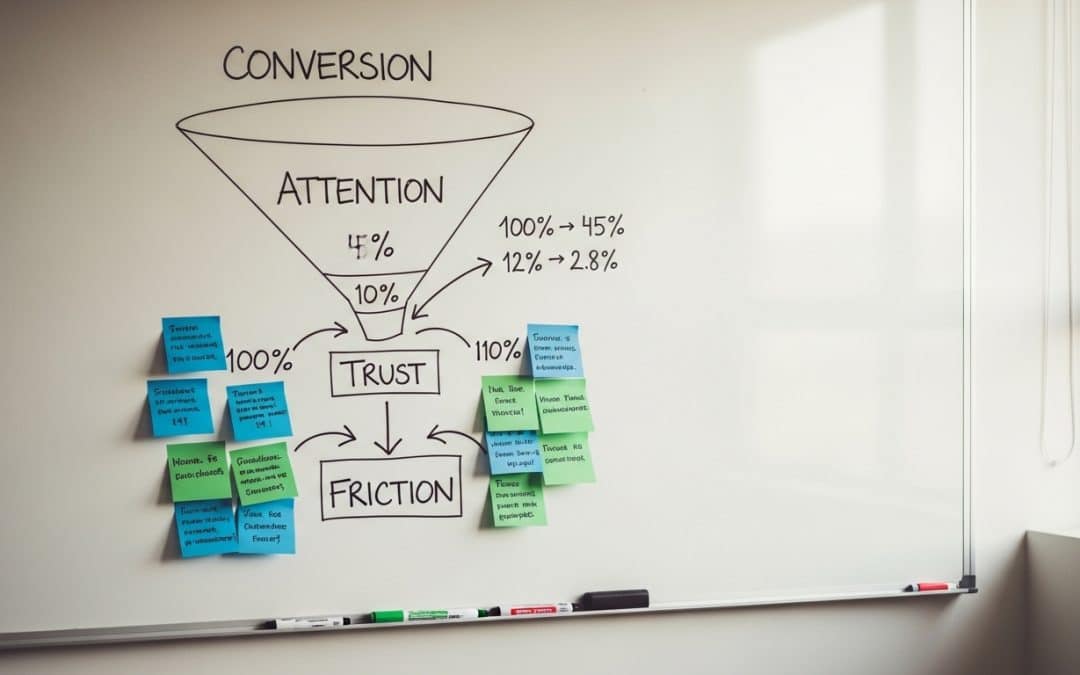
Conversion rate optimisation South Africa is the systematic process of increasing the percentage of website visitors who take the action you want them to take — purchase, enquire, book, or subscribe — without having to pay for more traffic. Most South African websites spend heavily on driving visitors and almost nothing on improving what happens once visitors arrive, which is why conversion rates in SA typically sit well below global benchmarks.
This guide explains the framework we use at Growth Pulse Media — The Conversion Multiplier™ — and shows exactly how to apply it to SA websites across ecommerce, B2B services, and lead generation. For ecommerce-specific benchmarks, see our ecommerce conversion rate South Africa breakdown. If you want this built for you, see our conversion rate optimisation service.
Quick Answer
Conversion rate optimisation South Africa works when you fix three compounding stages — Attention (getting visitors to notice the right offer above the fold), Trust (giving them reasons to believe the site), and Friction (removing obstacles between intent and action). Most SA websites have major gaps at all three. Baymard Institute data shows structured CRO lifts conversion rates by 35% on average — typically meaning 35–60% more revenue from the same traffic.
Want to see which stage of the conversion funnel is costing your SA business the most revenue?
Get a Free Conversion AuditConversion Rate Optimisation South Africa: What It Actually Means
Conversion rate optimisation South Africa is the discipline of improving how well a website turns visitors into outcomes — purchases, leads, bookings, signups. It is not about making pages prettier. It is about systematically identifying where visitors drop off, understanding why, and fixing the causes one by one so more of every 100 visitors convert into paying customers.
The reason most South African businesses under-invest in CRO is that conversion feels abstract compared to traffic. A 50% increase in Google Ads traffic is easy to visualise. A 50% increase in conversion rate sounds technical. But the outcomes are identical — double the revenue from the same starting point. And conversion improvements compound because they apply to every visitor from every channel, forever.
According to Baymard Institute research across 50 studies, the average ecommerce checkout abandons 70.19% of carts, and structured checkout optimisation can lift conversion rates by 35.26% on average. Those numbers apply equally to SA businesses. The ones that treat CRO as a priority unlock revenue that is already sitting inside their existing traffic.
The Conversion Multiplier™ — Framework Overview
The Conversion Multiplier is the framework Growth Pulse Media uses to systematically lift conversion rates across South African websites. Each stage addresses a specific class of conversion problem. Together they multiply — fixing all three produces far more revenue than fixing any one in isolation.
| Stage | Purpose | Primary Tactics | Key Metric |
|---|---|---|---|
| 1. Attention | Make the right offer impossible to miss in the first 5 seconds | Above-the-fold clarity, hero messaging, visual hierarchy, CTA prominence | Bounce rate and scroll depth |
| 2. Trust | Give SA visitors reasons to believe the business and the offer | Reviews, SA payment badges, security signals, real photos, social proof | Add-to-cart rate and form-start rate |
| 3. Friction | Remove every unnecessary obstacle between intent and completed action | Checkout fields, form length, page speed, mobile UX, required account creation | Checkout completion rate and form completion rate |
Why Three Stages
Most SA conversion optimisation work fixes one stage and expects the whole conversion rate to transform. It does not. A beautifully clear hero section (Attention) fails if the checkout has 18 form fields (Friction). A frictionless checkout fails if the page has no trust signals (Trust). The Conversion Multiplier works because each stage feeds the next — fixing all three stages compounds, while fixing one in isolation produces marginal gains.
Stage 1: Attention — Getting Visitors to Notice the Right Thing
The Attention stage is about the first five seconds a visitor spends on the page. If the offer is unclear, the value is not obvious, or the primary action is not visible, the visitor bounces before any other optimisation matters. Attention problems are the cheapest to fix and produce the fastest results.
The biggest attention failure on SA websites is the hero section. Too many SA sites open with a generic tagline, a stock-style image, and no clear primary action. Visitors arrive expecting to understand within seconds what the business offers and what the next step is. When that is not obvious, they leave regardless of how strong the rest of the site might be.
What Good Attention Looks Like
Hero section: Clear statement of what the business does and who it serves, one visible primary CTA, and a supporting image or visual that reinforces the offer rather than decorating the page. The rule is simple — a first-time visitor should understand what you do and what to do next within five seconds.
Visual hierarchy: The most important element on the page should be visually dominant. If three things compete for attention, none of them win. Reduce the competing elements, make the primary CTA the obvious next action, and use contrast and spacing to guide the eye.
Above-the-fold clarity: The most valuable pixels on any page sit above the fold on the first screen. Use them for the headline, the key value proposition, and the primary CTA — not for a hero carousel or a promotional banner that takes focus away from the main action.
✅ Works — clear offer, clear action
Hero section reads: "Accounting for SA Small Businesses — Fixed monthly fee, no surprises." Single CTA button: "Get a free quote in 60 seconds." Supporting image shows an accountant reviewing a real set of SA business documents.
❌ Does not work — vague, no clear action
Hero section reads: "Empowering Your Business for the Future." Three competing CTAs: "Learn More", "Our Services", "Contact Us". Generic stock image of people in suits shaking hands.
Stage 2: Trust — Giving SA Visitors Reasons to Believe
The Trust stage is where SA visitors decide whether your business is real, credible, and safe to transact with. South African consumers have been burned by scams, fake stores, and unreliable service providers — the default posture when landing on an unfamiliar site is scepticism. Trust signals either overcome that scepticism or they do not, and the conversion rate reflects the result.
Trust is especially important in South Africa because cross-border ecommerce fraud is a known concern, payment security is a buyer consideration, and courier reliability varies. SA visitors look for specific, local signals that an international template-based site will not provide by default.
Trust Signals That Actually Work for SA Visitors
SA payment gateway badges: PayFast, Peach Payments, Ozow, and SnapScan logos near the buy button or checkout. These are the payment methods SA buyers recognise and trust. A site that only shows "Visa/Mastercard" feels foreign; a site that shows PayFast feels local.
SA courier trust signals: Delivery estimates mentioning The Courier Guy, Aramex, or PostNet make delivery feel real. "Delivered by The Courier Guy in 2–3 working days" outperforms "Fast delivery" every time.
Real customer reviews: Verified reviews with SA names, photos where possible, and specific product or service detail. Star ratings alone are weak — the specific review text does the trust work. Visible Google Business or TrustPilot scores with a link to the source add credibility.
Founder or team photos: A real team page with real people builds more trust than any badge. SA buyers want to see who is behind the business. For our agency vs in-house comparison, this is one of the strongest differentiators.
Physical address and phone number: A Johannesburg or Cape Town street address and a local phone number signal legitimacy. A Gmail address and a form-only contact option signal the opposite.
Not sure which trust signals are missing from your SA website?
Get a Free Trust AuditStage 3: Friction — Removing Obstacles Between Intent and Action
The Friction stage is where Baymard's 35.26% conversion lift number comes from. Friction is every unnecessary obstacle between a visitor wanting to take action and successfully completing it — form fields that should not exist, required account creation, slow page speed, hidden shipping costs, mandatory information that could have been inferred. Each obstacle loses some percentage of visitors. The cumulative effect is the gap between a 1.2% conversion rate and a 3.5% conversion rate.
SA websites have an additional friction problem that global best-practice guides rarely cover — mobile network conditions. A significant proportion of SA traffic comes from mobile devices on variable data connections. A page that loads in 2.5 seconds on Cape Town fibre may load in 11 seconds on a Gauteng mobile connection. That difference alone collapses conversion rate before any other factor matters.
The Highest-Impact Friction Fixes for SA Websites
Checkout form field reduction: The average SA checkout has 23 form fields. Optimised checkouts have 12–14. Every unnecessary field costs a percentage of buyers. Audit every field and remove anything that is not strictly required for fulfilment. For ecommerce stores, see our cart abandonment reduction guide for the full checkout breakdown.
Guest checkout enabled: Requiring account creation is the second most common reason SA visitors abandon checkout (Baymard's data shows 25% of abandonments globally). Enable guest checkout and offer account creation after purchase.
Shipping cost transparency: Surprise shipping costs at the final checkout step kill 47% of SA checkout sessions. Show shipping cost as early as possible — on the product page if possible, or immediately in the cart.
Page speed optimisation: A 1-second delay in SA mobile page load typically costs 7–12% of conversions. Compress images, defer non-critical scripts, and test on throttled mobile connections — not just desktop fibre.
Form length reduction: B2B lead forms with 8+ fields convert at a fraction of forms with 3–4 fields. Ask for the minimum to qualify the lead, then capture the rest in conversation.
Real-World SA Conversion Optimisation Example
A Cape Town-based SA B2B services firm approached Growth Pulse Media with an 80,000 Rand monthly Google Ads spend producing only 12–15 leads per month. The traffic was qualified. The problem was conversion. We applied the Conversion Multiplier over 60 days and tracked the before/after across all three stages.
| Metric | Before Multiplier | After Multiplier | Improvement |
|---|---|---|---|
| Monthly sessions | 8,400 | 8,600 | +2% |
| Bounce rate | 67% | 41% | −39% |
| Form start rate | 3.8% | 11.2% | +195% |
| Form completion rate | 34% | 71% | +109% |
| Overall conversion rate | 1.3% | 4.2% | +223% |
| Qualified leads per month | 14 | 66 | +371% |
| Cost per qualified lead | R5,710 | R1,210 | −79% |
| Monthly pipeline value | R420,000 | R1,980,000 | +371% |
What Drove The Result
Traffic barely changed. Ad spend stayed the same. Every improvement came from the Conversion Multiplier — a rebuilt hero section for Attention, SA-specific trust signals added throughout the site for Trust, and a form field reduction from 11 to 4 for Friction. The compounded effect across all three stages turned the same traffic into nearly 5x the qualified pipeline value.
Why Growth Pulse Media Builds SA Conversion Optimisation Differently
Growth Pulse Media approaches conversion rate optimisation from the operator side. We have scaled a large South African ecommerce business ourselves — which means we have personally lived through the cost of bad checkout flows, missing trust signals, and slow mobile pages. Every Conversion Multiplier engagement reflects that operator perspective.
We know the specific SA friction points that international CRO playbooks miss — PayFast redirect flows, Peach Payments 3DS handling, The Courier Guy rate card surprises, and mobile data reality across Gauteng, Western Cape, and KZN. Generic global CRO advice does not account for these, which is why SA businesses that hire international consultants often see modest lifts despite significant investment.
Every CRO programme we deliver is executed in-house by senior practitioners with real operator experience. We do not outsource. We do not run template audits. We work with a limited client load — fewer clients, more senior attention, better outcomes. For SA businesses that want the Conversion Multiplier applied end-to-end, our CRO service covers all three stages from Attention through Friction.
Who This Is NOT For
The Conversion Multiplier is not the right fit for every SA business. Before engaging with Growth Pulse Media, it helps to know whether your business fits the profile this framework is designed for.
❌ Not For: Businesses looking for the cheapest agency option
CRO done properly requires senior execution across UX, copy, design, analytics, and development. If the evaluation criterion is the lowest monthly retainer, a junior-executed agency is a better fit. We are not the cheapest.
❌ Not For: Businesses with under 3,000 monthly sessions
CRO needs statistically meaningful traffic volume to test changes properly. Under 3,000 monthly sessions, test results are too slow and too noisy to act on with confidence. Focus on traffic acquisition first, then return to CRO when volume justifies it.
❌ Not For: Businesses expecting overnight conversion doubling
The Conversion Multiplier produces compounding results over 60–120 days. Attention fixes produce early lift, Trust signals compound over 30–60 days, and Friction reduction compounds over 60–90 days as the cumulative effect becomes clear. If the timeline is under 60 days, expectations will not match reality.
❌ Not For: Businesses that want tools installed without strategy
Heatmap software, session recording, and A/B testing tools are not CRO. They are instrumentation. Installing them without the Multiplier framework produces data without direction. If the brief is "just install Hotjar", the engagement will not produce the conversion lift CRO is capable of.
Ready to see what the Conversion Multiplier could unlock for your SA website?
Get a Free Conversion AuditFrequently Asked Questions
How much does conversion rate optimisation cost in South Africa?
Conversion rate optimisation South Africa typically costs R8,000 to R35,000 per month in agency retainer depending on site complexity, traffic volume, and scope. Once-off audits range from R5,000 to R15,000 for a structured report covering all three Multiplier stages with prioritised recommendations.
The economics are strong — a well-run CRO programme typically delivers 3–8x return in recovered revenue within the first 90 days. Unlike paid ads, those returns compound because every conversion improvement applies to every future visitor.
What conversion rate should an SA website aim for?
Benchmarks vary by industry. SA ecommerce stores should target 2–4% as the baseline, with high-performers reaching 4–6%. SA B2B lead forms typically convert at 3–8% for warm traffic and 1–3% for cold paid traffic. SA service businesses with quote forms typically run 4–10% on organic traffic.
Rates significantly below these benchmarks almost always indicate structural issues across Attention, Trust, or Friction — not a traffic quality problem. Fix the conversion rate before scaling spend.
How long does it take to see results from CRO?
Attention-stage fixes (hero rebuilds, CTA clarity, visual hierarchy) produce measurable lift within 14–30 days. Trust-stage additions (reviews, payment badges, team visibility) compound over 30–60 days as cumulative visitor perception shifts.
Friction-stage fixes (checkout rebuilds, form reduction, page speed) typically produce the largest single lift but need 60–90 days to fully validate across test cycles. A complete Conversion Multiplier engagement delivers meaningful revenue compounding over 90–120 days.
Do I need enough traffic to run CRO?
Yes — CRO requires statistical volume to produce reliable results. Most CRO programmes need at least 3,000 monthly sessions on the target page to produce confident test outcomes. Below that, tests take too long and results have too much noise to act on reliably.
For low-traffic sites, the right approach is heuristic CRO — applying proven best-practice changes based on established patterns rather than testing. This still produces meaningful lift and sets the site up for proper testing once traffic grows.
What is the difference between CRO and A/B testing?
A/B testing is one tool inside CRO. It is the method used to validate whether a specific change produces a measurable lift. CRO is the complete discipline — identifying where conversion breaks, hypothesising why, prioritising which fixes to make first, designing the fixes, and then testing them.
Many SA businesses run A/B tests without a CRO strategy behind them. The result is tests that technically succeed but do not compound into meaningful revenue gains because they are not connected to a bigger framework.
Does CRO work for B2B websites in South Africa?
Yes, sometimes with higher impact than ecommerce because B2B deal values are larger. A B2B site converting at 1.5% with 4,000 monthly sessions and a R25,000 average deal produces 60 leads a month. Lifting that to 4% produces 160 leads — effectively 100 extra leads per month at zero extra ad cost.
B2B CRO focuses more on Trust and Friction than ecommerce CRO. Form length, trust credentials, case studies, and clarity of the offer matter more than checkout design in B2B contexts. For the full framework for B2B, see our B2B lead generation guide.
Can CRO work alongside Google Ads and SEO?
CRO multiplies the ROI of every other channel. Every lift in conversion rate improves Google Ads ROAS, makes SEO traffic more valuable, and reduces the payback period on email and social campaigns. It is the single highest-leverage investment a business can make because it applies to every channel simultaneously.
Most SA businesses should treat CRO as a permanent discipline rather than a one-off project. The sites that dominate their category are the ones continuously improving conversion rate alongside their acquisition work.
The Conversion Multiplier is not theory — it is the same framework we apply internally and deliver to SA clients. Each stage fixes a specific class of conversion problem. When all three stages run together, conversion rate compounds rather than plateauing.
Unlock Hidden Revenue With the Conversion Multiplier
Growth Pulse Media builds complete conversion rate optimisation programmes for South African businesses — Attention, Trust, Friction — all three stages executed in-house by senior practitioners with real SA operator experience. Limited client load, no outsourcing, revenue reporting over vanity metrics.
Request a free Conversion Audit and receive a prioritised 3-page report covering your current performance at each of the three stages and the highest-leverage fixes for your site. No obligation — we will get back to you within 24 hours.
Get Your Free Conversion Audit