
 Add to Preferred Sources
Reducing cart abandonment in South Africa is the fastest way to grow ecommerce revenue without spending more on traffic — because every rand invested in reducing abandonment works on demand that already exists.
South Africa's cart abandonment rate sits at 83–83.5%, meaning for every 100 shoppers who add a product to a cart, 83 leave without buying. Understanding how to reduce cart abandonment for SA stores comes down to identifying which of the five abandonment drivers your store is most affected by and applying the right fix in the right order.
This is the tactical companion to our cart abandonment explainer — if you understand what abandonment is and want the specific step-by-step fixes, you are in the right place. Every fix below has been applied to Shopify and WooCommerce stores with measurable revenue results.
Quick Answer
To reduce cart abandonment in South Africa, apply fixes in this priority order: (1) enable guest checkout — removes the highest-friction abandonment cause in under 60 seconds on Shopify,
(2) add multiple payment methods — PayFast, Ozow, and at least one BNPL option to eliminate payment failure abandonment, (3) show delivery costs on product pages not only at checkout — removes the surprise fee that drives 67.3% of checkout exits, (4) reduce checkout to 3 steps maximum, (5) launch a 3-email Klaviyo abandoned cart sequence to recover 10–15% of abandoners who still leave despite the structural fixes.
Want to know which of the five abandonment drivers is costing your store the most — before you spend time fixing the wrong thing first?
Get a Free Cart Abandonment DiagnosisHow to Reduce Cart Abandonment South Africa: Fix 1 — Enable Guest Checkout
Enabling guest checkout is the single highest-impact cart abandonment fix available — and the fastest to implement. Forcing shoppers to create an account before completing a purchase adds friction at the most sensitive conversion moment: the point where the shopper has selected a product, confirmed the price, and is ready to pay.
On Shopify stores, guest checkout is enabled in Settings → Checkout → Customer accounts → select "Accounts are optional." This takes under 60 seconds and is reversible. Stores that switch from mandatory account creation to guest checkout consistently see immediate improvement in checkout completion rates — and the shopper's email address is still collected during the guest checkout flow, so email marketing capability is not lost. If your store runs on Shopify, our guide to Shopify in South Africa explains how the platform works for local sellers, from setup to the checkout your shoppers see.
Correct checkout account setting: "Accounts are optional" — shoppers can check out as a guest or create an account. Email is collected at checkout regardless of which option the shopper chooses. Post-purchase account creation prompt appears on the order confirmation page for shoppers who checked out as guests.
High-abandonment checkout setting: "Accounts are required" — every shopper must create and verify an account before accessing the checkout. This is the single most common high-abandonment setting found in ecommerce stores. Shoppers who abandon at this point rarely return — they go to a competitor with frictionless checkout instead.
How to Reduce Cart Abandonment South Africa: Fix 2 — Payment Method Diversity
Payment failure is the primary driver of above-average cart abandonment. Approximately 71% of shoppers abandon a purchase entirely when their payment fails — and 62% never return to the merchant after a failed payment.
Stores that offer only one payment method are fully exposed to this abandonment driver every time a card is declined, a bank's fraud prevention blocks a transaction, or a shopper simply does not trust the payment provider they are presented with.
The Minimum Viable Payment Stack
Every ecommerce store should offer at minimum three payment options: a card gateway (PayFast or Peach Payments for debit and credit card acceptance), instant EFT (Ozow for direct bank transfer without card), and at least one BNPL option (PayJustNow, Payflex, or Float for shoppers who want to split the purchase across instalments).
Each additional payment method added to the checkout eliminates a specific abandonment cause that no amount of remarketing can recover.
The Payment Trust Gap
Over 45% of online shoppers will not complete a payment if they do not recognise the payment provider on the checkout page.
This is why PayFast and Peach Payments — which consumers encounter repeatedly across ecommerce stores — convert at higher rates than lesser-known payment processors, even when the underlying bank processing is identical. Brand recognition on the checkout page is a measurable conversion factor, not just a preference.
How to Reduce Cart Abandonment South Africa: Fix 3 — Transparent Delivery Pricing
Unexpected delivery fees revealed at checkout are the second most common cart abandonment driver. 67.3% of online shoppers cite free delivery as the primary reason for completing a purchase — meaning delivery cost is not a secondary consideration for buyers, it is a primary purchase decision factor.
Delivery Cost Display Options
Stores have three approaches to delivery cost transparency. The first and most effective is free delivery funded by building courier costs into product pricing — shoppers see "Free Delivery" throughout the shopping journey and encounter no surprise fees at checkout.
The second is a free delivery threshold ("Free delivery on orders over R500") displayed on product pages and in the cart — shoppers know the delivery rule before reaching checkout. The third — displaying delivery costs only at checkout for the first time — is the approach that drives the highest abandonment and should be avoided entirely.
Is your store losing revenue to delivery cost surprises at checkout — or to payment failures you cannot see in your analytics? We find the specific abandonment cause for your store.
Get Your Free Checkout AuditHow to Reduce Cart Abandonment South Africa: Fix 4 — Checkout Speed and Mobile Optimisation
Over 77% of online shopping sessions occur on mobile devices — making mobile checkout performance the most critical technical abandonment driver. According to Google's Core Web Vitals documentation, a good Largest Contentful Paint (LCP) requires content to load within 2.5 seconds. Mobile checkout pages that exceed this threshold face measurable conversion rate drops at every additional second of load time.
Checkout Page Speed Fixes
Shopify stores hosted on Shopify's CDN typically meet Core Web Vitals thresholds without additional optimisation — checkout pages load from Shopify's globally distributed infrastructure.
WooCommerce stores on shared hosting are the most common checkout speed failure point. Moving a WooCommerce store from shared hosting to a managed WordPress host (Kinsta, WP Engine, or Cloudways) typically reduces checkout page load time by 40–60% — directly improving mobile checkout completion rates.
Checkout Step Reduction
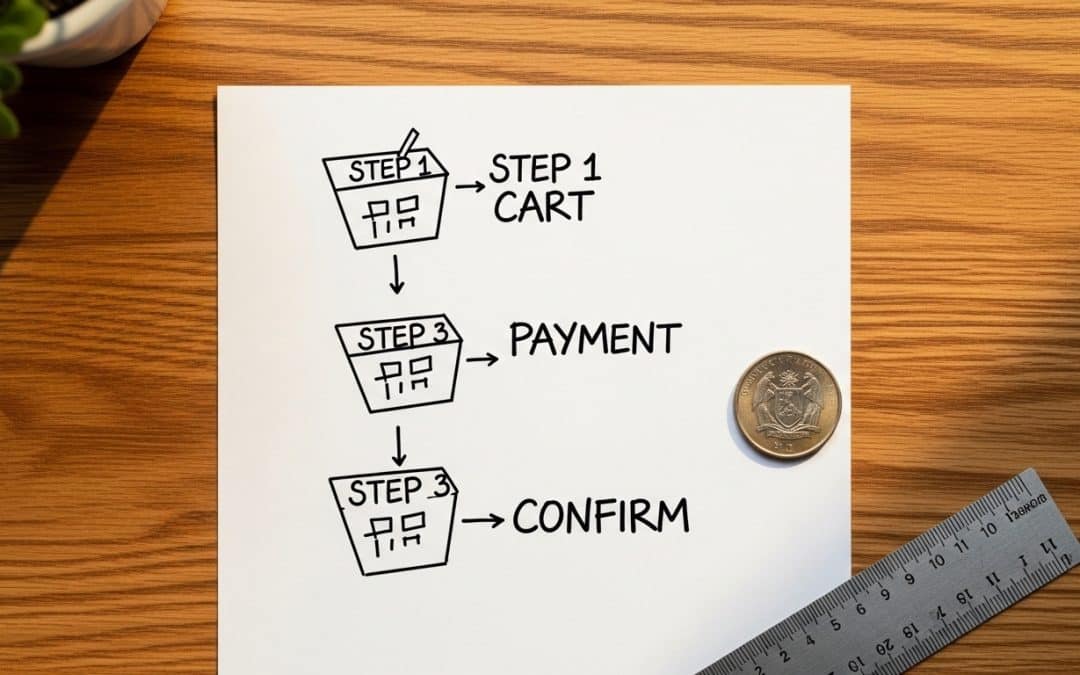
Every additional checkout step reduces completion probability. The optimal checkout flow has three steps maximum: cart review, payment and delivery details, and order confirmation. Stores that combine delivery address and payment on a single checkout page — rather than separating them across multiple steps — consistently see higher checkout completion rates than stores with 4–5 step checkout flows.
| Checkout Element | Abandonment Impact | Fix | Implementation Time |
|---|---|---|---|
| Mandatory account creation | High — primary friction point | Enable guest checkout | Under 60 seconds (Shopify) |
| Single payment method | High — 71% abandon on payment failure | Add PayFast + Ozow + BNPL | 1–3 days |
| Delivery cost surprise at checkout | High — 67.3% cite free delivery as #1 driver | Show cost on product pages | Same day |
| Slow mobile checkout (LCP >2.5s) | Medium — mobile majority affected | Hosting upgrade or CDN | 1–2 weeks |
| 4+ checkout steps | Medium — each step reduces completion | Consolidate to 3 steps | 1 week |
| No exit-intent popup | Low-medium — last retention opportunity | Add Klaviyo exit popup | 2–3 days |
How to Reduce Cart Abandonment South Africa: Fix 5 — Abandoned Cart Email Recovery
The four structural checkout fixes above reduce abandonment at source. Abandoned cart email sequences recover the revenue lost from abandonment that structural fixes cannot prevent — the 43% of shoppers who abandon because they were "just browsing" or not yet ready to buy, regardless of how frictionless the checkout is.
The 3-Email Abandoned Cart Sequence
The most effective abandoned cart sequence has three emails sent over seven days. Email 1 sends 1 hour after abandonment — a simple product reminder showing the exact abandoned items with a direct checkout link, no discount offered.
Email 2 sends 24 hours after abandonment — social proof added (customer reviews, trust signals, return policy reminder). Email 3 sends 7 days after abandonment — a time-limited incentive (free delivery, or 10% discount expiring in 48 hours) to convert price-sensitive abandoners who did not respond to the first two emails.
The Email Recovery Rate Benchmark
A correctly configured 3-email abandoned cart sequence recovers 10–15% of cart abandoners — meaning for every 100 shoppers who abandon, 10–15 return and complete their purchase after receiving the sequence.
At an 83% abandonment rate and R650 average order value, a store with 1,000 monthly cart additions abandons R538,850 in monthly revenue. Recovering 12% of that through email generates R64,662/month in additional store revenue from a single automation that runs without manual intervention.
Abandoned Cart Email Setup on Klaviyo
Klaviyo's Shopify integration pulls product images, product names, prices, and checkout links directly from the store — meaning the abandoned cart email shows the exact product the shopper left behind without any manual content creation per email.
Setup time for the full 3-email sequence is approximately 3 days including copywriting, design, and testing. The sequence then runs automatically for every cart abandoner who has provided their email address.
How to Reduce Cart Abandonment South Africa: Before and After Results
A Cape Town homeware ecommerce store on Shopify had an 86% cart abandonment rate — above the average. The store had: mandatory account creation, PayFast only (no instant EFT or BNPL), delivery costs shown only at checkout, and no abandoned cart email sequence. Four fixes were applied over 3 weeks.
| Fix Applied | Week Implemented | Revenue Impact (Month 1) |
|---|---|---|
| Guest checkout enabled | Week 1 | +R28,400 incremental revenue |
| Ozow instant EFT + PayJustNow BNPL added | Week 1 | +R19,200 incremental revenue |
| Free delivery threshold shown on product pages | Week 2 | +R14,600 incremental revenue |
| Klaviyo 3-email abandoned cart flow launched | Week 3 | +R87,300 recovered revenue |
| Total revenue increase (month 1) | +R149,500/month |
Cart abandonment rate dropped from 86% to 71% through structural checkout fixes alone. The Klaviyo email sequence then recovered 13% of the remaining abandoners. Combined, the four fixes generated R149,500 in additional monthly revenue from a store that was already live and generating traffic — without increasing ad spend by a single rand.
How Growth Pulse Media Reduces Cart Abandonment for SA Stores
Growth Pulse Media configures cart abandonment recovery for South African Shopify ecommerce businesses — covering guest checkout activation, PayFast and Ozow payment gateway integration, Klaviyo 3-email abandoned cart flow setup, and checkout page speed audit. Every cart abandonment engagement starts with a checkout audit that identifies which specific abandonment driver is costing the most revenue before any configuration work begins.
We have direct operator experience with PayFast, Peach Payments, Ozow, The Courier Guy, and Aramex integrations on Shopify — and with Klaviyo abandoned cart flow configuration for ecommerce stores across fashion, homeware, health, and electronics categories. We know which checkout fixes generate the fastest revenue return for each store type.
All ecommerce work is executed in-house. We do not outsource Shopify configuration or Klaviyo setup offshore. We work with a limited number of ecommerce clients to maintain senior-level execution quality on every account.
Who This Is NOT For
Cart abandonment optimisation is not the right priority for every ecommerce store right now.
Your store generates fewer than 50 cart additions per month. At under 50 monthly cart additions, the absolute revenue recoverable from abandonment optimisation is too small to justify the time investment in email sequence configuration and checkout restructuring. The higher priority is growing traffic volume — more cart additions mean more abandonment to recover. Return to cart abandonment optimisation when cart additions exceed 100/month.
You want to launch retargeting ads before fixing checkout structure. Retargeting ads re-serve abandoners the products they viewed — but if the checkout that caused the original abandonment has not been fixed, retargeting sends shoppers back to the same friction points that drove them away.
Fix checkout structure first, then launch retargeting. Retargeting on a broken checkout generates clicks and ad spend with minimal conversion improvement.
Your product pricing does not support free delivery or BNPL. Stores with very low average order values (under R150) or very thin margins may not be able to absorb delivery costs into product pricing or offer BNPL without commercially viable margins.
For these stores, focus on checkout step reduction and guest checkout first — the zero-cost structural fixes — before addressing delivery cost strategy.
You have not yet set up conversion tracking in Google Analytics. Without conversion tracking, you cannot measure whether cart abandonment fixes are working — you are optimising blind. Set up Google Analytics 4 with ecommerce tracking (cart additions, checkout initiations, purchases) before implementing any abandonment fixes. Data visibility is the prerequisite for abandonment optimisation, not an optional extra.
Cart abandonment optimisation delivers some of the fastest revenue returns available in ecommerce — because it converts demand that already exists, rather than creating new demand from scratch.
Ready to implement the cart abandonment fixes that will generate the fastest revenue return for your specific store — in the right order?
Get Your Free Cart Abandonment Recovery PlanHow to Reduce Cart Abandonment South Africa: Frequently Asked Questions
What is the fastest way to reduce cart abandonment for ecommerce stores?
The fastest cart abandonment fix is enabling guest checkout — it takes under 60 seconds on Shopify and removes the highest-friction abandonment cause immediately.
The second fastest fix is adding Ozow instant EFT alongside PayFast — eliminating payment failure abandonment for shoppers whose debit cards are declined. Both fixes are live within hours and generate measurable checkout completion improvement from the first day. These two structural fixes consistently deliver faster revenue impact than any email marketing or retargeting campaign.
How much does cart abandonment recovery cost for SA stores?
Cart abandonment recovery costs vary by fix type. Guest checkout activation costs nothing — it is a Shopify settings change. Adding Ozow or PayJustNow to a Shopify store costs R0–R500 in integration setup plus transaction fees (typically 2–3.5% per transaction).
Klaviyo abandoned cart email configuration costs R3,000–R8,000 in setup time or agency fees, plus Klaviyo's monthly subscription (from $20/month). Retargeting ads cost from R1,500/month in ad spend. The highest-ROI cart abandonment investment is always the structural checkout fixes first — they are either free or very low cost and generate immediate revenue improvement.
Does guest checkout reduce conversion rates long-term?
No — enabling guest checkout increases conversion rates, not reduces them. Stores that switch from mandatory account creation to guest checkout see immediate checkout completion improvement.
Post-purchase account creation prompts on the order confirmation page convert a meaningful percentage of guest checkout buyers into registered accounts — so customer account data is not lost by enabling guest checkout. Registered account rates from guest checkout stores are typically 30–40% of guest buyers, which is a better account creation rate than forcing account creation before purchase.
Which payment methods reduce cart abandonment most effectively?
Adding Ozow instant EFT to a store that previously offered only card payment has the highest measurable impact on payment-failure abandonment — because it provides an alternative payment path for shoppers whose debit cards are declined by bank fraud prevention systems.
PayJustNow or Payflex BNPL addition reduces abandonment from shoppers who want to spread purchase cost across instalments. Together, offering PayFast + Ozow + one BNPL option covers the three primary payment method preferences and eliminates payment-failure abandonment for the majority of checkout sessions.
How do I set up abandoned cart emails for my Shopify store?
To set up abandoned cart emails on Shopify, install Klaviyo from the Shopify App Store, connect Klaviyo to your Shopify store (this syncs customer data, product catalogue, and cart events automatically), and activate the pre-built Klaviyo abandoned cart flow.
Customise the three email templates with South African copy, your brand colours, and a SA-relevant incentive on the third email. Set send timing to: 1 hour after abandonment (Email 1), 24 hours (Email 2), and 7 days (Email 3). Testing the flow with a test order before going live confirms product images and checkout links are pulling correctly from the Shopify integration.
What analytics do I need to track cart abandonment improvement?
To measure cart abandonment improvement, you need Google Analytics 4 with ecommerce events configured: add-to-cart event, begin-checkout event, purchase event.
The cart abandonment rate is calculated as (add-to-cart events minus purchase events) divided by add-to-cart events.
Shopify also provides a native checkout funnel report under Analytics → Reports → Checkout behaviour — showing drop-off at each checkout step. Klaviyo's abandoned cart flow analytics show emails sent, open rate, click rate, and revenue attributed to the flow. Monitor all three data sources weekly during the first month after implementing abandonment fixes.
Ready to Reduce Cart Abandonment and Recover the Revenue Your Store Is Already Generating?
Growth Pulse Media implements cart abandonment fixes for South African Shopify stores — guest checkout activation, PayFast and Ozow payment setup, Klaviyo 3-email abandoned cart flow, and checkout speed audit all in-house. We start with a checkout audit to identify your highest-impact fix first. No obligation — we will get back to you within 24 hours.
Get Your Free Cart Abandonment Audit