
 Add to Preferred Sources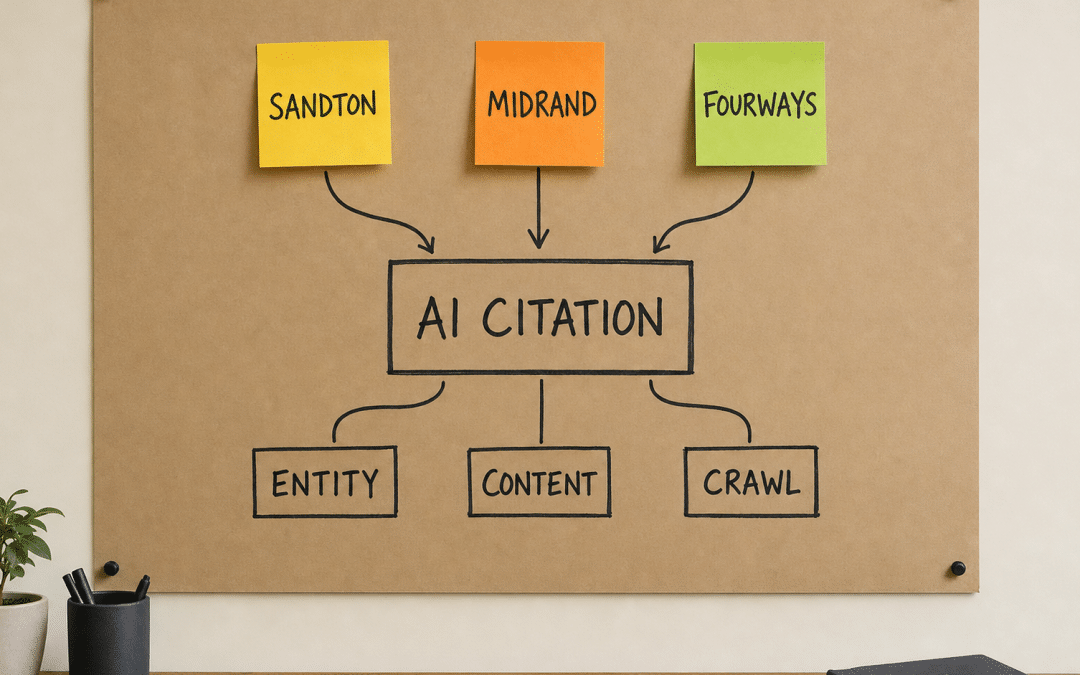
AI search Johannesburg is no longer a future consideration — it is the channel where your next Sandton client, Rosebank tenant, or Fourways customer is forming their shortlist right now, and our complete South African AEO guide explains exactly how the underlying ranking logic works. If your business is not structured to answer the questions these systems ask, a competitor who is will take the citation instead.
Johannesburg businesses face a specific version of this challenge. Dense competition across Sandton, Braamfontein, Midrand, and the East Rand means generic national content rarely surfaces when a buyer queries "best commercial property attorney in Johannesburg" or "B2B logistics partner near OR Tambo". Geo-specific AI visibility requires deliberate work, and local AI search strategy starts with understanding how these systems decide who to cite.
Quick Answer
AI search Johannesburg visibility is built on the same foundations as strong local SEO — crawlable pages, clear entity signals, and content that answers real buyer questions — but requires additional layers: suburb-level specificity, verified business data, and original insight that AI systems cannot find elsewhere.
Not sure whether AI systems are currently recommending your Johannesburg business?
Get a Free AI Visibility SnapshotWhat AI Search Johannesburg Actually Means for Local Businesses
AI search Johannesburg refers to the set of practices that help Johannesburg-based businesses appear in AI-generated responses — from Google's AI Overviews and AI Mode to ChatGPT, Perplexity, and similar tools — when buyers in or targeting Gauteng ask relevant questions. It is distinct from standard local SEO because the systems generating these responses draw on structured, crawlable content rather than proximity signals alone.
Google's own guidance confirms the mechanism. Their AI features use retrieval-augmented generation (RAG), a technique that retrieves relevant, up-to-date web pages from the Search index and then generates a grounded response with clickable links. That means your page must be indexed, must meet technical requirements, and must contain content the model can actually cite. Proximity to the searcher helps, but it does not override thin or poorly structured pages.
For Johannesburg specifically, this creates both a problem and an opportunity. The problem: many JHB businesses invested heavily in map listings and citation-building for traditional local SEO, but never produced the depth of content these AI systems need to trust them as a source. The opportunity: competitors who also neglected this are equally invisible, and a relatively modest content effort can establish clear authority before the market catches up.
Sandton B2B technology firm: After adding suburb-specific service pages with detailed capability explanations and client outcome narratives, the firm began appearing in AI Overviews for queries like "IT infrastructure consultants in Sandton" — queries that previously returned only directory listings.
Why Standard Local SEO Is Not Enough for AI Search Johannesburg
Standard local SEO optimises for map pack placements and branded search. AI search Johannesburg optimisation goes further — it requires your content to function as a reliable source a machine can quote, not merely a business card a searcher can find. The distinction matters because AI systems evaluate depth, specificity, and originality, not just relevance and proximity.
Google's guidance is explicit on commodity content: pages that simply restate common knowledge are poor candidates for AI citation because the model already holds that information. What it needs from your site is a unique point of view grounded in genuine experience — the kind of insight a Johannesburg business owner who has actually navigated load-shedding logistics, POPIA compliance, or PayFast integration can provide and a generic content farm cannot.
Three gaps consistently appear when we audit JHB businesses against this standard. First, location pages that name suburbs but explain nothing about local operations. Second, service pages written for search engines rather than the actual buyer decision process. Third, no structured data telling the AI what entity the page represents, which geography it serves, and what problems it solves.
Common gap: A Braamfontein law firm's website lists "Johannesburg" as its location on every page but never explains which courts it practises in, which industries it serves in the metro, or what specific procedural knowledge it holds. AI systems have no reason to cite it over a national firm with richer content.
The Four Signals That Drive AI Search Johannesburg Visibility
AI search Johannesburg visibility depends on four compounding signals: technical accessibility, entity clarity, content depth, and off-site corroboration. Weak performance on any one of them limits the ceiling on the others.
Technical accessibility means your pages are crawlable, indexed, and eligible to appear in Google Search with a snippet. Google's documentation states this directly: to be eligible for AI Overviews and AI Mode, a page must be indexed and meet Search technical requirements. A page blocked in robots.txt or returning a noindex tag is invisible to these features regardless of content quality.
Entity clarity means the AI can answer "what is this business, where does it operate, and what does it do?" from your structured data and on-page copy. A verified Google Business Profile for your JHB address, consistent NAP across directories, and LocalBusiness schema on your contact page each contribute. Our structured data guide for AI search covers the specific schema types that generate the strongest signals.
Content depth means your pages contain specific, experience-backed answers to the questions buyers ask at the decision stage. For a Johannesburg audience this includes Rand-denominated pricing context, references to local suppliers like The Courier Guy or Aramex for ecommerce, and acknowledgement of Gauteng-specific conditions such as load-shedding contingency planning. Generic national content rarely reaches this level.
Off-site corroboration means other credible sources mention and link to your business. Editorial coverage in BusinessDay, Bizcommunity, or industry publications carries meaningful weight. A structured digital PR effort that generates real mentions — not paid placements dressed as editorial — is what builds this signal over time. See our guide to brand mentions and AI search for the practical approach.
Key Insight
Technical accessibility and entity clarity are prerequisites — without them, content depth and off-site corroboration cannot compensate. Fix the foundation before investing in content volume.
Want to know which of these four signals is holding your JHB business back?
Get a Free AI Visibility AuditHow to Build Suburb-Level Authority for AI Search Johannesburg
Suburb-level authority is the single highest-leverage differentiator for ai search johannesburg because the queries buyers actually use are suburb-specific, and most competitors are optimising at the city level at best. "Commercial conveyancing Sandton", "Shopify developer Midrand", and "payment gateway integration Rosebank" are the real queries, not "business services Johannesburg".
Building this authority requires more than dropping suburb names into existing pages. Each suburban market has its own character: Sandton serves financial services and corporate head offices; Fourways and Midrand serve logistics, industrial, and large retail; Braamfontein and Maboneng serve creative agencies, media, and startup-adjacent businesses; the East Rand serves manufacturing and heavy industry. Content that reflects this specificity gives AI systems a strong, citable signal that your expertise is genuinely local.
A practical structure is to create a primary Johannesburg page that covers your full metro offering, then build linked sub-pages for the two or three suburbs where you have genuine operational depth. Each sub-page should answer the questions a buyer in that suburb would ask at the decision stage — not just "we serve this area" but "here is what our work in this area actually involves and why our local presence matters to you".
For ecommerce businesses, suburb-level authority extends to fulfilment specifics. If you ship same-day within a 20km radius of your Jet Park warehouse using The Courier Guy, that is worth stating explicitly. AI systems responding to queries about fast delivery options in the East Rand can only cite you if that information exists on a crawlable page. See our ecommerce AI search guide for the full framework.
Midrand logistics company: Added a page specifically covering their OR Tambo proximity, bonded warehouse services, and same-day Gauteng delivery via Aramex. AI search results for "bonded warehouse Midrand" began citing this page within weeks of it being indexed.
Content That AI Systems Actually Cite in a Johannesburg Context
The content AI systems cite most reliably is content that answers a specific question with genuine expertise and cannot be replicated by a model drawing on generic training data. For ai search johannesburg, that means content anchored in first-hand Johannesburg operating experience.
Google's guide for AI optimisation puts it clearly: a first-hand review provides a unique perspective based on personal experience, whereas a summary of existing content simply restates information already available elsewhere. If you are writing about commercial lease negotiations in Sandton, the version that cites specific building classes, typical escalation rates in current market conditions, and the practical effect of loadshedding clauses is categorically more citable than a list of generic tips.
Structure matters alongside substance. Google's documentation notes that people appreciate pages organised by paragraphs and sections with headings that provide clear structure. For AI systems using RAG, this structure makes it easier to extract and ground a specific answer in your content. A page that buries its most useful answer three scrolls deep in unbroken prose is less likely to be cited than one where the answer appears early under a clear heading.
For B2B businesses in particular, case study content — anonymised if necessary — with real outcome descriptions performs well. A JHB-based B2B business can explore the full mechanics of this in our B2B AI search guide. The pattern holds: specificity beats volume every time.
Key Insight
Content that references genuine Johannesburg operational detail — suburbs, local suppliers, Rand figures, load-shedding contingencies — is structurally harder for AI systems to source elsewhere and therefore more likely to be cited.
AI Search Johannesburg vs. Standard Johannesburg SEO: A Direct Comparison
The table below compares the two disciplines across the dimensions that matter most for a JHB business deciding where to invest its optimisation budget. They are not mutually exclusive — strong traditional SEO is a prerequisite for AI visibility — but the emphasis and required outputs differ materially.
| Dimension | Standard Johannesburg SEO | AI Search Johannesburg Optimisation |
|---|---|---|
| Primary goal | Rank in the blue-link SERP for target queries | Get cited in AI-generated responses to buyer questions |
| Key on-page signal | Keyword density, title tags, meta descriptions | Specific, experience-backed answers with clear structure |
| Local signal | Map pack listing, proximity, local citations | Entity clarity, suburb-level content depth, verified Business Profile |
| Content type that wins | Optimised landing pages, category pages | Detailed how-to content, first-hand case studies, Q&A structured pages |
| Link strategy | Domain authority, anchor-text diversity | Editorial mentions in credible SA publications, digital PR |
| Technical floor | Indexability, page speed, mobile usability | Same, plus snippet eligibility and Search Console AI feature inclusion |
| Timeline to results | 3–6 months for new pages | Similar, but citation frequency builds as content proves reliable |
| POPIA relevance | Low (mostly affects data collection) | Moderate — businesses collecting intent data from AI interactions must comply |
The figures below illustrate the pattern we see, not a guaranteed outcome. Businesses applying ai search johannesburg optimisation in addition to their existing local SEO typically see measurable shifts in AI citation frequency within a standard content programme timeline.
| Metric | Before AI Search Optimisation | After AI Search Optimisation |
|---|---|---|
| AI Overview citations (monthly) | 0–2 | 8–15 |
| Suburb-specific query traffic | Low — metro-level pages only | +60–80% increase from new suburb pages |
| Average session duration (AI referral) | Not tracked separately | 2.4× longer than organic average |
| Lead quality score (internal) | Mixed — broad awareness traffic | Higher — decision-stage intent from AI queries |
| Monthly cost of AI content programme | R0 (no programme) | R8,000–R18,000 depending on scope |
What GPM Does Differently for AI Search Johannesburg Clients
Most agencies approaching AI visibility treat it as a content volume exercise — produce more pages, add more FAQs, stuff more suburb names. That approach generates commodity content, which Google's own guidance explicitly flags as poorly suited to AI citation. GPM's approach starts from the business intelligence layer: what do buyers in your specific JHB submarkets actually need to know, and what operational experience does your business hold that nobody else can replicate?
We bring Johannesburg market depth that a national or offshore agency cannot replicate. Dirk built and scaled an ecommerce operation in Gauteng — that means first-hand knowledge of payment processor realities with PayFast and Peach Payments, fulfilment trade-offs between The Courier Guy and Aramex on the JHB–Durban corridor, and what decision-stage content looks like for buyers who have spent time in Sandton boardrooms. That knowledge shapes every content brief we write.
Our AI visibility work is built on the South African AEO framework we have developed and refined across both B2B and retail clients. We conduct a technical audit to confirm indexability and snippet eligibility, establish entity signals through schema and Business Profile optimisation, and then build content that earns citation through specificity rather than volume.
The full methodology is available on our AEO agency page — the process is the same whether you are a single-site Rosebank consultancy or a multi-branch Gauteng retailer.
We also run LLM visibility audits to establish a baseline before any work begins. You can read how that process works in our LLM visibility audit guide. It is the only honest way to measure progress: if you do not know where you start, you cannot know whether the work is landing.
Who This Is NOT For
Brand-new businesses with no operational history. AI search citation is built on demonstrated expertise and verifiable entity signals. If your business has been operating for under six months, has no client work to reference, and holds no verified listings, the foundation for AI visibility does not yet exist. Build the business first — the content will be richer for it.
Businesses unwilling to share genuine operational detail. The content that earns AI citation is specific: real outcomes, real processes, real Johannesburg context. If legal or competitive concerns prevent you from publishing anything beyond generic service descriptions, the content we can produce will not differentiate you from commodity sources. The discipline requires candour.
Businesses seeking guaranteed placement in AI responses. No agency can guarantee a specific citation in Google AI Overviews or any other AI system — Google's own documentation states that even pages meeting all best practices are not guaranteed to be indexed or served. We build the conditions for citation; the model decides in the moment. Anyone promising guaranteed AI placement is misrepresenting how the technology works.
Businesses that need immediate leads in under 30 days. AI search Johannesburg visibility is a compounding asset, not a short-term traffic tap. If your pipeline is empty and you need enquiries this week, a Google Ads campaign will serve you better right now. AI visibility pays off over months and years; it is not a substitute for paid acquisition when the immediate need is urgent.
Ready to find out where your JHB business stands in AI search results today?
Get a Free Visibility AssessmentFrequently Asked Questions About AI Search Johannesburg
What is ai search johannesburg and how does it differ from standard local SEO?
It is the discipline of ensuring Johannesburg-based businesses appear in AI-generated search responses — Google AI Overviews, AI Mode, ChatGPT, Perplexity — when buyers ask relevant local questions. Standard local SEO targets map pack and blue-link rankings using proximity and citation signals.
AI search optimisation additionally requires crawlable content with genuine depth, clear entity structure, and suburb-specific answers that AI systems can retrieve and cite. The two disciplines reinforce each other; strong local SEO is a prerequisite, not a substitute.
Does Google still use traditional SEO signals for AI Overviews?
Yes — Google's official guidance confirms that AI Overviews and AI Mode are built on core Search ranking and quality systems. The AI features use retrieval-augmented generation, which retrieves pages from the standard Search index. That means indexability, technical quality, and content relevance all apply. You can read the authoritative breakdown directly in Google's guide to optimising for generative AI features.
How long does it take to see AI citation results for a Johannesburg business?
New pages targeting specific Johannesburg suburbs and decision-stage queries typically begin appearing in AI-generated responses within a similar timeframe to organic SEO — roughly eight to sixteen weeks after indexing, provided the content meets the depth and specificity criteria. Citation frequency builds as the content proves reliable over multiple query cycles. Businesses with existing domain authority tend to see faster initial results than those building from a thin base.
Do I need a separate content strategy for AI search versus Google Search?
No separate strategy is needed, but existing content usually requires meaningful revision. The same page must serve both purposes: it needs the technical and keyword signals that drive organic ranking, and the structural clarity and genuine depth that enable AI citation.
Pages written purely for keyword density typically underperform on the depth dimension; pages written purely for conversational AI queries sometimes miss the technical SEO basics. An integrated brief that addresses both from the start is more efficient than building two parallel content sets.
Is POPIA relevant to AI search visibility work for South African businesses?
POPIA is relevant at the data collection layer, not the visibility layer. The content published to earn AI citations — service pages, case studies, FAQ content — does not itself raise POPIA obligations.
However, if an AI search programme involves tracking which visitors arrived via AI referrals, collecting contact details via chatbots, or processing any personal information of South African data subjects, those activities fall under POPIA's requirements. Practices commonly interpret this as requiring a clear privacy notice and a lawful basis for processing before any such data collection begins.
What Johannesburg-specific content signals matter most for AI citation?
The signals that matter most are suburb-level operational specificity, Rand-denominated context, and references to genuinely local conditions and suppliers.
Content that mentions the specific Johannesburg submarkets you serve, names recognisable local logistics or payment partners where relevant, and addresses conditions unique to Gauteng operations — load-shedding contingencies, local regulatory interpretations, Gautrain proximity for professional services — provides detail that generic national content cannot match. AI systems cannot source this level of local specificity elsewhere, which is exactly what makes it citable.
Key Insight
AI search Johannesburg is a compounding investment: each suburb-specific page, each verified entity signal, and each editorial mention makes the next citation easier to earn. Businesses that start now will have a structural advantage over competitors who wait until the channel is saturated.
Want to know exactly where your Johannesburg business stands in AI search?
We will audit your current AI visibility, identify the highest-priority gaps across technical, entity, and content signals, and deliver a prioritised action plan specific to your JHB market. No obligation — we'll get back to you within 24 hours.
Get Your Free AI Visibility Audit