
 Add to Preferred Sources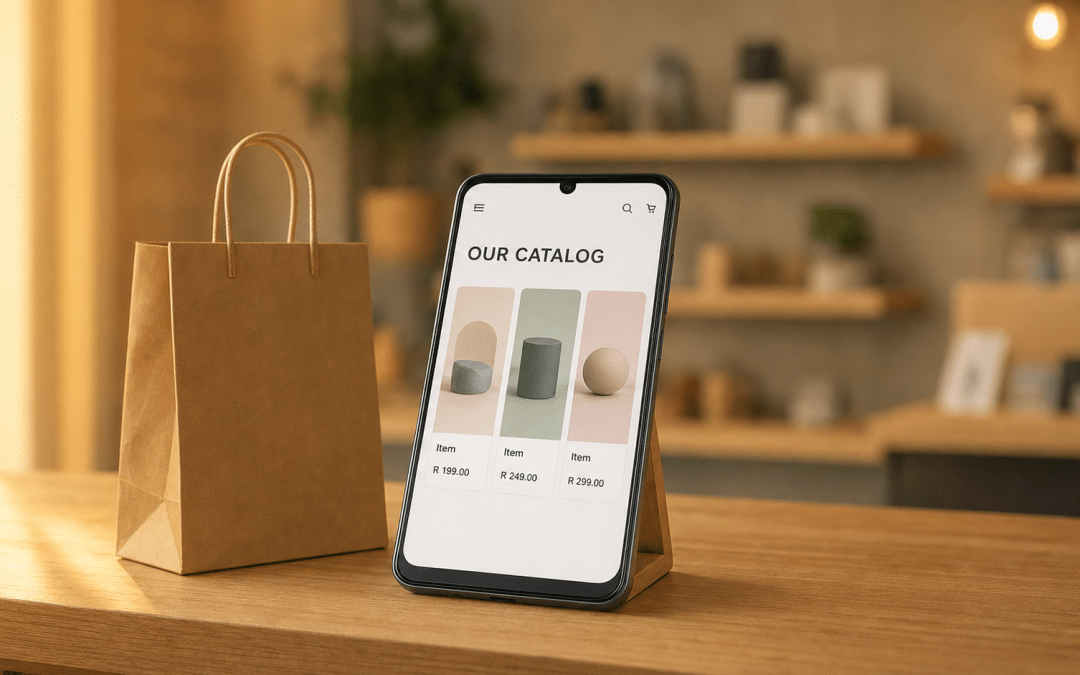
WhatsApp catalogs South Africa give businesses a native product showcase inside the chat window — customers browse, tap, and enquire without leaving the app, which matters enormously when your audience is shopping on a R3 000 data-light handset in Mitchells Plain or Soweto. If you want the full strategic framework for conversational commerce, start with our WhatsApp Marketing Guide for South African businesses and then come back here for the catalog mechanics.
The honest limitation: the native catalog is a browsing layer, not a checkout. It routes enquiries into chat but does not process payment. For retailers already on Shopify with PayFast or Peach Payments configured, that gap matters — and the fix is a deliberate bridge strategy, not a workaround.
Quick Answer
WhatsApp catalogs South Africa lets businesses list products inside WhatsApp Business, free to set up. Customers browse and message — but payment happens off-app. The priority is connecting your catalog to an existing checkout (Shopify, WooCommerce) so the conversation converts, not stalls.
Not sure whether your current product setup is costing you sales in chat?
Get a Free WhatsApp Commerce AuditWhat WhatsApp Catalogs South Africa Actually Does
A WhatsApp catalog is a structured product library — images, names, prices, descriptions, and links — hosted inside your WhatsApp Business profile and visible to anyone who opens your chat. According to Meta's developer documentation, catalogs allow businesses to showcase products and services directly within WhatsApp, enabling customers to browse without switching apps.
Each product item in the whatsapp catalogs south africa ecosystem supports a name, price, description, product code, and a link — typically to your product page. A customer can tap "Send message" on any item, which opens a pre-filled chat with the product name. Your team or a chatbot then handles the actual sale.
This is fundamentally different from a Takealot listing or a Facebook Shop. There is no cart, no native payment rail, and no order management inside WhatsApp itself. The catalog is a conversation-starter, not a transaction engine.
Key Insight
WhatsApp catalogs surface your products in chat — but payment, fulfilment, and order tracking must happen on a connected external system. Treat the catalog as the top of a funnel, not the funnel itself.
Setting Up WhatsApp Catalogs South Africa: The Practical Steps
Setting up whatsapp catalogs south africa requires a verified WhatsApp Business App or API account, a Facebook Business Manager, and a product data source — either manual entry or a connected Commerce Manager feed.
For businesses with fewer than 50 SKUs, manual entry in the WhatsApp Business App is realistic. For retailers with hundreds of lines, you need Commerce Manager and a product feed — the same feed that powers your Facebook and Instagram shops. If your Shopify store is already connected to Meta Commerce Manager, the catalog can populate automatically via the Shopify Meta channel app.
Key steps for the App-based setup:
- Open WhatsApp Business → Business Tools → Catalog
- Add items with image, name, price in Rands, description, and product link
- Publish — the catalog appears on your profile immediately
- Enable "Cart" if you want customers to bundle items before messaging
For API-connected businesses using the WhatsApp Business API, catalog management runs through Meta's Graph API or through your business solution provider's dashboard. Platforms like WhatsApp chatbot tools can trigger catalog item cards automatically inside conversations based on what a customer asks.
One practical South African note: your product images need to load quickly on mobile data. Use compressed JPEGs under 500 KB per image. A product photo that takes eight seconds to load on a standard mobile connection in Polokwane will be scrolled past before it renders.
Operator Note
The setup itself is the easy part. A catalog populated in a morning will stall at volume unless Commerce Manager, your live product feed, and your checkout are connected before you start driving traffic into WhatsApp conversations.
The Commerce Gap and the Shopify Bridge
The central challenge with whatsapp catalogs south africa is the payment gap. A customer taps "Add to cart" inside WhatsApp, sends the cart as a message, and then what? Someone has to respond, confirm stock, send a payment link, and follow up. That is a human-intensive process that breaks at volume.
The Shopify bridge solves this cleanly. When your Shopify store is linked through Meta Commerce Manager, your WhatsApp catalog items carry product page URLs. A tap on any item sends the customer directly to your Shopify checkout — where PayFast, Ozow, or Peach Payments handle the transaction. The conversation drove the discovery; the website closes the sale.
Furniture retailer, Johannesburg North: Connected WhatsApp catalog to Shopify product pages. Customer messages asking about a dining set, agent shares the catalog link in chat, customer taps through to a mobile-optimised Shopify PDP and checks out with Ozow instant EFT. Fulfilment triggers automatically via The Courier Guy. No manual invoice, no EFT proof chasing.
Fashion boutique, Durban CBD: Uses the WhatsApp Business App catalog for 30 seasonal items. No Shopify integration — agents send PayFast payment links manually. Works at low volume, but order confirmations are inconsistent and abandoned carts are invisible.
The gap between those two scenarios is integration. Without a connected checkout, you cannot see abandoned carts, you cannot trigger CRM-based follow-up sequences, and your team spends time on admin instead of selling.
Running a Shopify store but still sending manual payment links over WhatsApp?
Get a Free Catalog Integration ReviewWhatsApp Catalogs South Africa: Compliance Under POPIA
POPIA compliance for whatsapp catalogs south africa centres on how you initiate catalog-driven conversations, not on the catalog itself. The catalog sitting on your profile is passive — customers opt in to engagement by messaging you first. That is a clean interaction.
The risk arises when you proactively send catalog links to contacts who have not opted in. Under POPIA's section 69 regime for electronic communications, sending unsolicited marketing messages — including WhatsApp messages with product links — requires prior consent or an existing-customer relationship. Practices commonly interpret this as: if someone bought from you before, you may message them about similar products, provided you offered an opt-out at collection and include one in every message.
For new contacts via click-to-WhatsApp ads, the ad click itself signals intent, but you should still confirm opt-in before adding them to any broadcast list. The Information Regulator has moved from guidance to enforcement — its first direct-marketing enforcement notice was issued in February 2024, and fines for ignoring opt-out requests have followed.
Practically: build a simple opt-in keyword ("Reply YES to receive our product updates") into your first automated message, log the responses in your CRM, and honour opt-outs immediately. That discipline protects you regardless of how your catalog strategy evolves.
Compliance Shortcut
Your WhatsApp catalog sitting on your profile is passive and POPIA-clean. The compliance burden starts the moment you proactively push catalog links outbound. Build opt-in logging into your first automated message before you build your broadcast list — retrofitting consent records after the fact is far harder than capturing them from day one.
Catalog Features Worth Using and Features Worth Ignoring
Not every feature in the whatsapp catalogs south africa toolset earns its complexity. Here is a direct assessment:
Use the Cart feature. When enabled, customers can add multiple catalog items to a cart and send the whole order as one message. For retailers with complementary products — a hardware store selling paint, rollers, and tape — this reduces back-and-forth materially.
Use catalog sharing in chat. Agents can share individual catalog items or the full catalog during a conversation. Combined with a WhatsApp Flow for qualification, this creates a guided shopping experience inside the thread.
Skip the catalog as a stock management tool. WhatsApp does not sync stock levels. If a product sells out on Shopify and you do not manually update or remove it from the catalog, customers will enquire about unavailable items. Your product feed must pull from your live inventory system, not be managed separately.
Consider channels for discovery, not catalogs. If your goal is broadcasting new arrivals to a large subscriber base, WhatsApp Channels versus Broadcast Lists is the right decision framework — catalogs are for transactional conversations, not top-of-funnel announcements.
| Feature | Best For | Limitation in SA Context |
|---|---|---|
| Native catalog (App) | Businesses under 50 SKUs, service-based menus | Manual updates, no stock sync |
| Commerce Manager feed | Shopify/WooCommerce retailers, 50+ SKUs | Requires Meta pixel and Commerce Manager setup |
| Cart + catalog | Multi-item retail, food ordering | No payment inside WhatsApp — still needs checkout link |
| Agent-shared catalog items | High-consideration purchases, real estate, vehicles | Depends on agent discipline and CRM logging |
| API-triggered catalog cards | Chatbot-driven product recommendations | Needs API access and developer resource |
| Scenario | Before Catalog Integration | After Catalog + Shopify Bridge |
|---|---|---|
| Time to send product info | Agent types manually, 3-5 min per enquiry | Under 30 seconds — catalog item shared instantly |
| Payment process | Manual PayFast link, proof of EFT chased via chat | Automated Shopify checkout — Ozow or card, confirmed instantly |
| Abandoned enquiry recovery | Not tracked — invisible to the business | CRM-triggered follow-up sequence within 2 hours |
| Monthly catalogue revenue | R18 000 (manual, 2 agents) | R41 000 (same agents, automation handling qualification) |
| Stock errors | Frequent — catalog updated weekly at best | Zero — live feed from Shopify inventory |
These figures illustrate the pattern we see, not a guaranteed outcome. Results depend on your product category, price point, existing traffic, and how thoroughly the integration is configured.
GPM's Approach to WhatsApp Catalog Commerce
We approach whatsapp catalogs south africa as a commerce infrastructure problem, not a content problem. The catalog itself takes a morning to populate. What takes real work is the architecture behind it: Commerce Manager connected to Shopify, a chatbot qualification flow that surfaces the right catalog items based on what a customer asks, CRM logging so no enquiry disappears, and a follow-up sequence for carts that were built but never checked out.
Our WhatsApp marketing service covers the full stack — from API access and catalog setup through to Klaviyo-connected abandon sequences and POPIA-compliant opt-in flows. We have built this for retailers in Sandton and Durban North, and the operational difference between a catalog that generates enquiries and one that generates revenue is always in the integration layer, not the product photography.
We do not charge for the audit. We look at your current setup, identify where enquiries are leaking, and give you a prioritised action plan before any engagement begins.
Who This Is NOT For
Businesses without a real product list. WhatsApp catalogs are built around discrete, priceable items. If your offering is a bespoke service quoted per project — architecture, legal work, complex B2B consulting — a catalog will create confusion rather than clarity. A conversation-first approach with a qualification chatbot serves you better.
Retailers unwilling to connect a checkout. If your plan is to populate the catalog but continue processing sales manually via EFT, you will create more admin than you solve. The catalog generates enquiry volume; without a connected checkout, that volume overwhelms a small team fast. Either integrate or keep your current process.
Businesses with no WhatsApp Business API access. The App-based catalog works for low volume, but if you are handling more than 30 product enquiries a day, the App's limitations — single device, no CRM sync, no automation — will cap your results. Upgrading to the API is a prerequisite for serious catalog commerce. See our WhatsApp Business API pricing guide for what that costs in South Africa.
Businesses outside metro courier coverage relying on next-day delivery promises. If your catalog items imply fast delivery but your courier network does not serve the customer's area reliably — common in smaller towns beyond Gauteng, the Western Cape, and KZN metros — you will generate enquiries that produce complaints, not repeat buyers. Sort your fulfilment coverage before scaling catalog traffic.
Ready to turn WhatsApp enquiries into tracked, automated revenue?
Book a Free Strategy SessionFrequently Asked Questions About WhatsApp Catalogs South Africa
How does whatsapp catalogs south africa handle payment if there's no native checkout?
It does not — payment is always handled externally. The standard approach is to link each catalog item to a Shopify, WooCommerce, or standalone product page where PayFast, Peach Payments, or Ozow processes the transaction. Alternatively, agents send a payment link inside the chat after a customer selects items from their cart. The catalog drives discovery and intent; the payment platform closes the sale.
Is there a cost to set up a WhatsApp catalog for my South African business?
The catalog feature itself is free inside WhatsApp Business App and WhatsApp Business API. You pay nothing to Meta to list products. Costs arise from the API access subscription (charged by your business solution provider), any developer time for Commerce Manager integration, and the ongoing management of your product feed. Our API pricing breakdown covers what South African businesses actually pay end-to-end.
How many products can I list in a WhatsApp catalog?
Meta's catalog supports a substantial product range — large enough that most South African retailers will not hit the ceiling with a single range. Businesses with extensive lines typically segment by category, running a separate catalog for each product line or seasonal collection, which also makes agent sharing more targeted during conversations.
Can I run whatsapp catalogs south africa through the standard WhatsApp Business App without the API?
Yes, for low-volume operations. The App supports catalog creation, cart sharing, and manual agent responses on a single device. The constraint is scale: no multi-agent access, no CRM sync, no automation. If you are processing more than 20-30 product enquiries daily, the App will create a bottleneck. The API removes those constraints but adds a monthly cost.
How does POPIA affect sending catalog links to customers on WhatsApp?
If a customer messages you first — via your profile, a click-to-WhatsApp ad, or a QR code scan — and you respond with a catalog link, that is a solicited interaction and POPIA compliance is straightforward. Proactively broadcasting catalog links to contacts without prior consent or an existing-customer relationship falls under section 69's opt-in requirement for electronic communications. Build your opt-in logging before you build your broadcast list.
What is the difference between a WhatsApp catalog and a WhatsApp Channel for promoting products?
A WhatsApp catalog is a structured, searchable product library attached to your business profile — customers browse it during a conversation and can send items directly to chat. A WhatsApp Channel is a one-to-many broadcast tool for pushing content to subscribers. Channels suit new-arrival announcements and promotional campaigns; catalogs suit the moment a customer is ready to enquire and buy. For the strategic comparison, see our guide on WhatsApp Channels vs Broadcast Lists.
Want a catalog that generates revenue, not just enquiries?
We will audit your current WhatsApp setup, map the gap between your catalog and your checkout, and hand you a prioritised action plan for connecting them. No obligation — we'll get back to you within 24 hours.
Get Your Free WhatsApp Catalog Audit