
 Add to Preferred Sources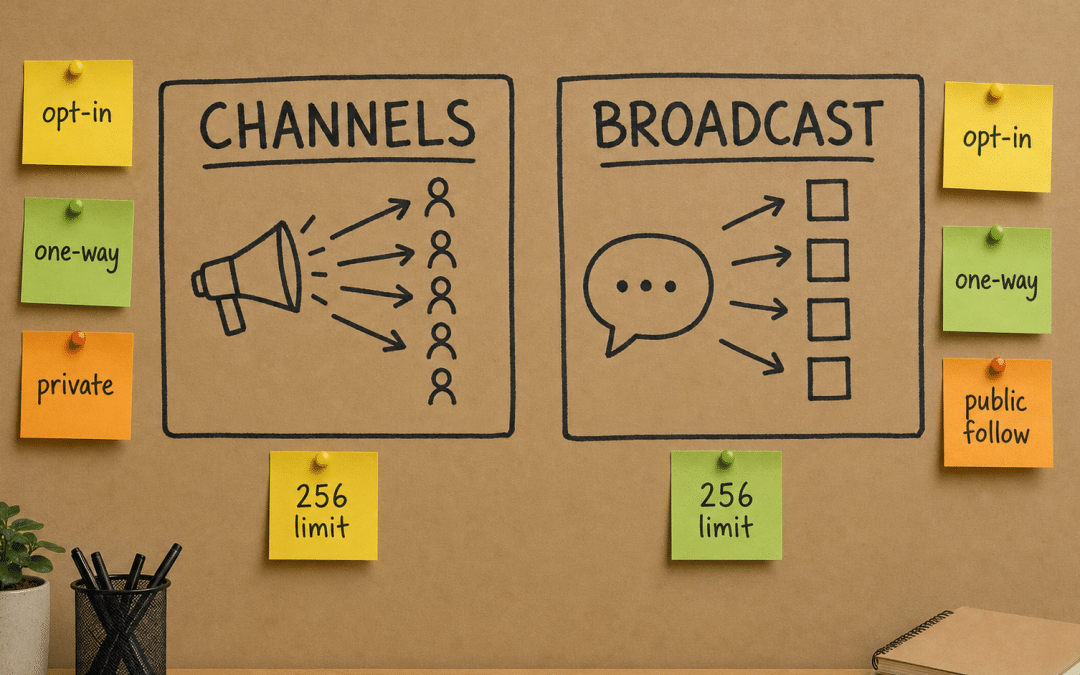
WhatsApp Channels vs Broadcast Lists are two completely different tools, and choosing the wrong one will either kill your open rates or land you in POPIA trouble — our WhatsApp marketing guide for South Africa covers the full picture, but this post settles the comparison head-on.
Channels are one-to-many public announcements; Broadcast Lists are one-to-one private messages sent in bulk. The distinction matters enormously for compliance, deliverability, and what your Sandton or Durban customer actually experiences on their phone.
Most SA businesses pick whichever tool they stumbled across first, then wonder why engagement drops or why contacts start blocking them. Getting this decision right early — before you've burned a warm list — is worth the ten minutes it takes to read this. We also cover WhatsApp Business API pricing in South Africa if you're considering the next tier up.
Quick Answer
WhatsApp Channels suit public, one-way content broadcasting to followers who opt in by searching or subscribing. Broadcast Lists suit private, personalised messages to existing contacts who have saved your number. For most SA retail and B2B use cases, Broadcast Lists drive conversions while Channels build brand awareness. Many businesses need both.
Not sure which tool matches your current customer list and compliance obligations?
Get a Free WhatsApp Channel AuditWhat WhatsApp Channels vs Broadcast Lists Actually Are
The whatsapp channels vs broadcast lists distinction comes down to audience relationship and message privacy. Channels are a public follow model — like a social feed inside WhatsApp. Broadcast Lists are a private messaging model — your message lands in each recipient's individual chat.
WhatsApp Channels were introduced as a one-way content distribution tool. Anyone with the app can follow a channel without sharing their phone number with the business. Followers receive content in a dedicated section of the app, separate from their private conversations. Engagement options are limited by design; the tool is built for broadcasting, not conversation.
Broadcast Lists, by contrast, are a bulk private messaging feature within WhatsApp Business. You build a list from contacts already saved in your phone book. When you send, each person receives a message that looks like a private conversation with your business — they can reply, and replies land back in your individual chat with them. Delivery depends on the relationship between sender and recipient, which is why list hygiene matters so much in practice.
Understanding this structural difference is the prerequisite for every decision that follows. Businesses that treat the two tools as interchangeable end up with a compliance gap on one side and a missed conversion opportunity on the other. The architecture of each tool determines what you can legitimately ask it to do.
Key Insight
With Broadcast Lists, delivery depends on the quality of your contact relationship. A well-maintained, opted-in list of 400 people will consistently outperform a poorly curated list of 4,000 — because genuine consent and a saved number work together to get your message read.
Key Feature Differences That Affect SA Businesses
The practical whatsapp channels vs broadcast lists gap shows up in four areas that matter most to South African operators: reach mechanics, compliance posture, two-way engagement, and tooling requirements.
Reach mechanics. Channels can theoretically reach an unlimited public audience. Broadcast Lists on the free WhatsApp Business app have practical scaling constraints, and once your list strategy grows beyond what manual management allows, most mid-size SA retailers move to the WhatsApp Business API via a provider like Clickatell or Cell C Business.
POPIA compliance posture. Channels require a follower to actively choose to follow you, which gives you a clean opt-in paper trail. Broadcast Lists depend on your contacts having saved your number, but that doesn't automatically mean they've consented to marketing messages under POPIA's requirements. Practices commonly interpret this as: you still need documented consent before sending promotional content via Broadcast Lists, even if the technical delivery works without it.
Two-way engagement. Broadcast Lists enable real conversation. A Claremont boutique can send a flash sale message and have ten customers reply to reserve stock — all in separate private threads. Channels don't support this natively. If conversation is your goal, Channels are the wrong tool.
Tooling requirements. Channels are built into the standard WhatsApp Business app at no cost. Running high-volume Broadcast Lists properly — with segmentation, scheduling, and analytics — typically means stepping up to the API. See our breakdown of WhatsApp Flows for South African businesses for what the API tier unlocks.
Key Insight
The free WhatsApp Business app is a starting point, not a scaling tool. Once your Broadcast List strategy requires scheduling, segmentation, or meaningful analytics, you are already at the point where the API pays for itself.
Running Broadcast Lists manually and losing track of who replied to what?
Get a Free Messaging Workflow ReviewWhatsApp Channels vs Broadcast Lists: Feature Comparison
The table below maps the two tools across the criteria SA business owners ask about most. Use it as a reference before committing to either approach.
| Feature | WhatsApp Channels | Broadcast Lists |
|---|---|---|
| Audience relationship | Public followers (no contact exchange) | Saved contacts only |
| Message privacy | Separate section, not private chat | Private individual chat |
| Two-way replies | No (broadcast only) | Yes, full conversation |
| Scaling | Unlimited followers | Free app has practical limits; API removes these |
| POPIA opt-in clarity | Strong (follow action = explicit opt-in) | Requires separate consent process |
| Personalisation | None — identical broadcast | Can personalise name, offer, segment |
| Cost | Free on WhatsApp Business app | Free app; API incurs per-message fees |
| Analytics | View count, reaction count | Limited in app; full via API |
| Best use case | Brand updates, content, announcements | Promotions, follow-ups, service alerts |
Real-World Before/After: Switching from Ad Hoc Broadcasts to a Structured Approach
The figures below illustrate the pattern we see, not a guaranteed outcome. They reflect a composite of SA retail clients who restructured their whatsapp channels vs broadcast lists strategy after previously using a single, unmanaged Broadcast List for all contacts.
| Metric | Before | After |
|---|---|---|
| Active list size (opted-in) | 1,800 contacts (mixed consent) | 640 contacts (fully POPIA-documented) |
| Message open rate | 34% | 71% |
| Block/unsubscribe rate per send | 4.2% | 0.6% |
| Revenue attributed per campaign | R4,200 average | R11,800 average |
| Monthly time spent managing lists | 9 hours | 2.5 hours |
| Channel follower count (new) | Not in use | 1,100 followers for awareness content |
The key shift: the business stopped treating every number it had ever collected as a Broadcast List candidate and started running Channels for cold/warm audience nurturing in parallel. Quality of consent drove every improvement.
WhatsApp Channels vs Broadcast Lists for Specific SA Business Types
The right whatsapp channels vs broadcast lists split depends on your business model, not just your preference. Here's how different SA contexts map to each tool.
Retail (Johannesburg, Cape Town, Durban): Use Broadcast Lists for promotional messages to existing buyers — they already have a relationship with you and are likely to have saved your number. Use Channels to attract new followers from your broader community before they've bought.
B2B Services (Pretoria, Sandton): Broadcast Lists work well for proposal follow-ups and event reminders to a curated contact list. Channels are less useful here — B2B buyers rarely follow brand channels for purchasing decisions. See our WhatsApp vs email marketing comparison if you're weighing alternatives.
Hospitality and Events: Channels suit venues promoting upcoming events to a broad local following. Broadcast Lists handle booking confirmations, load-shedding schedule alerts, and upsell messages to confirmed guests where two-way confirmation is needed.
Community and NGO Organisations: Channels shine here — transparent, opt-in, no phone number exchange required. Broadcast Lists can supplement for urgent one-to-one communications with members who have opted in explicitly.
POPIA, Consent, and What SA Businesses Get Wrong
The biggest whatsapp channels vs broadcast lists compliance mistake in South Africa is assuming that having a phone number equals having permission to market to it. POPIA's requirements around processing personal information for direct marketing mean this assumption is a liability.
Channels carry the cleanest consent posture: the follow action is a deliberate opt-in by the user. There is no ambiguity about whether they wanted to hear from you.
Broadcast Lists require you to have obtained consent separately — at point of sale, via a sign-up form, or through a documented opt-in process. Many SA businesses collect WhatsApp numbers on paper forms or at checkout and assume this constitutes consent. Practices commonly interpret POPIA's direct marketing provisions as requiring explicit consent that names the channel (i.e., WhatsApp messages specifically), not just a general "contact me" tick-box.
The practical fix: add a clear WhatsApp opt-in field to your checkout flow (PayFast and Peach Payments both support post-payment confirmation pages where this can sit), keep a consent log, and honour opt-outs immediately. If you're using Ozow for instant EFT, the same logic applies to your post-payment redirect page.
A consent audit is not a one-time exercise. As your contact database grows through new campaigns and in-store sign-ups, the quality of your consent documentation needs to keep pace. Businesses that let this slip — even with good intentions — create a backlog that becomes increasingly expensive to clean up the longer it's left unaddressed.
Key Insight
POPIA compliance for WhatsApp marketing is not a once-off checkbox. It requires an ongoing consent log, a clear opt-out mechanism, and channel-specific consent language at every point where you collect a phone number — whether that is PayFast checkout, a paper form at a Joburg trade show, or an Ozow post-payment redirect.
How GPM Structures WhatsApp Strategy for SA Clients
At GPM, we approach the whatsapp channels vs broadcast lists decision as a sequencing problem, not a binary choice. Most businesses need both tools running in a deliberate order — Channels first to build a warm, opted-in audience; Broadcast Lists to convert that audience once trust is established.
We've run this for retailers across Johannesburg, Pretoria, and KZN. The pattern that consistently works: Channel content drives follower growth and educates the audience; a structured invitation within that Channel content moves ready-to-buy followers onto a Broadcast List with explicit documented consent. From there, localised WhatsApp campaigns for KZN businesses show how regional personalisation amplifies conversion further.
What we don't do is bolt one tool onto an existing mess of unconsented numbers and call it a strategy. The audit process — mapping your current contact database against consent documentation — is where the real work starts. Our full whatsapp channels vs broadcast lists service page at WhatsApp Marketing South Africa outlines how we scope that engagement.
The Meta Business Messaging platform, as described in Meta's official WhatsApp Business documentation, underpins both tools — understanding the platform architecture helps us make the right implementation recommendation for each client.
Who This Is NOT For
Businesses with no opt-in process. If you've never asked customers for explicit permission to send WhatsApp messages, neither Channels nor Broadcast Lists will save you. Broadcasting to unconsented numbers is a POPIA exposure, and you'll burn your reputation with every send before fixing the foundation.
Teams expecting full automation from the free app. WhatsApp Business's free tier handles small Broadcast Lists manually — there is no scheduling, segmentation, or analytics built in. If you need that capability, you need the API, and the API has costs. Expecting enterprise results from a free tool without upgrading will lead to frustration and wasted effort.
Businesses wanting two-way Channel conversations. If your goal is customer service dialogue — questions about stock, delivery queries via The Courier Guy or Aramex, returns — Channels are the wrong tool. They are broadcast-only. Routing customers to a Channel when they expect a reply is one of the fastest ways to generate negative reviews.
Marketers who want a set-and-forget solution. The whatsapp channels vs broadcast lists framework requires ongoing list hygiene, consent audits, and content calendars. Businesses that set up a Broadcast List once and blast the same offer every week will see block rates climb and deliverability degrade. This is active channel management, not passive automation.
Ready to build a WhatsApp strategy that passes a POPIA audit and actually converts?
Get a Free WhatsApp Strategy SessionFrequently Asked Questions: WhatsApp Channels vs Broadcast Lists
What is the main difference between whatsapp channels vs broadcast lists?
It is the relationship model. Channels are public, one-way feeds that anyone can follow without sharing their phone number with you. Broadcast Lists are private bulk messages sent only to contacts who have saved your number. The delivery experience, consent requirements, and conversation capability are fundamentally different between the two.
Can a South African business use both tools at the same time?
Yes, and many should. A common effective structure is using a Channel to attract and warm a broader audience with content, then inviting engaged followers to join a consented Broadcast List for promotional messaging. Running them in parallel lets you serve different stages of the customer relationship without conflating them.
Do WhatsApp Channels help with POPIA compliance?
They simplify the opt-in question because the follow action constitutes a deliberate choice by the user. However, POPIA compliance still requires that your channel content itself doesn't misuse personal information or breach other provisions of the Act. Practices commonly interpret the follow action as sufficient consent for the content you publish within the channel you were followed for.
What happens if a contact hasn't saved my number on a Broadcast List?
Delivery to that contact is unreliable — this is a widely reported source of unexplained low delivery rates for SA businesses using Broadcast Lists. Addressing it requires an explicit number-saving prompt during onboarding: many businesses send a first message asking the recipient to save the number and reply with a keyword to confirm receipt.
Is the WhatsApp Business API necessary for Broadcast Lists to work at scale?
The free app has practical scaling constraints, requires fully manual sending, and offers limited analytics beyond what you can see in individual chats. For anything beyond a small, highly curated list, the API — available through providers such as Clickatell — is the practical requirement. Our guide to WhatsApp Business API pricing in South Africa breaks down what that costs in 2026.
How does load-shedding affect WhatsApp Broadcast List delivery in South Africa?
Timing your sends during or immediately after a Stage 4 outage in areas like Soweto or Mitchell's Plain will tank your open rates — recipients are offline or managing data usage on limited mobile data. Schedule Broadcast List sends for windows when your target area is likely to have power, and avoid the hour immediately following loadshedding restoration when inboxes flood. Your open-rate data will show the pattern within two or three sends.
Want a clear recommendation on which tool fits your business right now?
We'll audit your current contact list, consent documentation, and messaging goals — then deliver a prioritised action plan that tells you exactly which WhatsApp tools to run and in what order. No obligation — we'll get back to you within 24 hours.
Get Your Free WhatsApp Messaging Audit