
 Add to Preferred Sources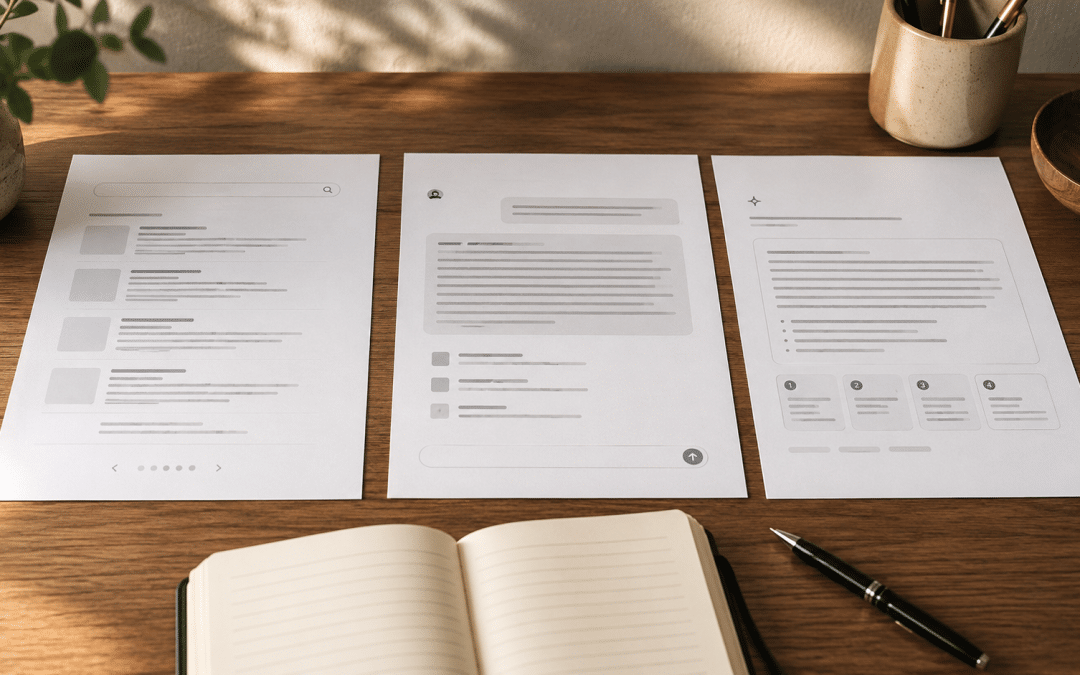
The ChatGPT vs Google vs Perplexity South Africa question has one answer that surprises people: Google still wins on volume by a wide margin, but it no longer wins the whole buying journey. This landscape overview anchors our AI search strategy for South Africa and complements the market data in our AI search statistics roundup.
Most SA marketing conversations treat this as a horse race with one winner. It isn't. The three platforms occupy different moments in the same buyer's week — and the practical question is not which to back, but what a single well-built site needs to do to be present on all three.
Quick Answer
Where the ChatGPT vs Google vs Perplexity South Africa comparison lands: Google dominates SA search volume — Africa is the most Google-concentrated region on earth at 95.74% share (StatCounter, 2026) — so its AI Overviews reach the most local buyers. ChatGPT carries the largest standalone assistant audience globally and owns research-stage questions. Perplexity is far smaller but cites sources most transparently, making it the best diagnostic tool. One well-structured, well-corroborated site competes on all three.
Quick Verdict
Prioritise Google's AI surfaces first — that's where SA buyer volume actually is, and the work overlaps entirely with existing search foundations. Treat ChatGPT as the second priority for research-stage visibility, and use Perplexity as a measurement instrument rather than an audience. For most SA businesses the effort split is roughly 60% Google surfaces, 30% general assistant visibility, 10% measurement discipline.
ChatGPT, Google and Perplexity: Quick Comparison
Best for reaching SA buyer volume: Google — Africa sits at 95.74% Google search share
Best for research-stage conversations: ChatGPT — the largest standalone assistant audience
Best for checking who cites you: Perplexity — the most transparent source attribution
Best for local and "near me" questions: Google — map and profile data feeds its replies directly
Best for long, multi-part buying questions: ChatGPT — sustained conversational context
Best for verifying a claim's origin: Perplexity — visible citation chain per answer
Best overall for SA businesses: All three, from one site — the underlying signals are shared
Google AI Surfaces: Pros and Cons
Pros: Unmatched local reach, since Google is effectively the default gateway for SA internet users. Its AI Overviews sit inside results buyers already use, and they draw on the same crawlable, authoritative content classic SEO builds — plus your Business Profile for local questions. Every rand spent here pays into both the AI surface and the traditional listing.
Cons: The heaviest click compression of the three. Pew Research measured traditional-result clicks nearly halving when a summary appears, and links inside summaries get clicked around 1% of the time. High reach, low click yield — you win brand presence more than sessions.
ChatGPT: Pros and Cons
Pros: The largest standalone assistant audience, and the platform most used for extended research conversations where buyers weigh options before shortlisting. Search-mode replies retrieve live web sources, so a fetchable, specific site can enter answers quickly — no ranking history required.
Cons: Opaque about why sources were chosen, and personalisation makes self-testing unreliable unless you work in private sessions. Blocking its search crawler by accident — a common robots.txt mistake — removes you entirely with no warning or diagnostic.
Perplexity: Pros and Cons
Pros: The clearest window into machine reading. Every answer shows its sources, which makes it the fastest way to learn which pages in your category actually get retrieved — intelligence you can act on across all three platforms.
Cons: The smallest audience of the three by a wide margin in SA, so optimising specifically for it is poor value. Treat the traffic as a bonus and the transparency as the real product.
Curious which of the three currently names your business — and which one your competitors own? We'll run all three and send you the transcripts.
Get a Free Three-Platform CheckChatGPT vs Google vs Perplexity South Africa: Where Do Buyers Search?
SA buyers still start on Google for the overwhelming majority of searches, then increasingly move to an assistant for the thinking-out-loud part of the decision. The volume case is not close: StatCounter's data puts Africa at 95.74% Google search share, the most concentrated region globally, driven by low-cost Android defaults across the continent.
But volume and influence have separated. Roughly 70% of South African adults have used an AI chatbot according to Google and Ipsos research, and SA leads Africa in generative AI usage at 23.1% of working-age people per Microsoft's Q1 2026 diffusion report. That's a large, engaged second audience sitting alongside the search default rather than replacing it.
Device habits sharpen the picture locally. Mobile is where most South Africans search, and mobile Google share runs even higher than desktop across the continent — so a business invisible on a phone-sized result is invisible to the majority of its market, regardless of which assistant it optimised for.
The realistic buyer pattern in 2026 looks like this: a research-stage conversation with an assistant, a verification search on Google, then a branded search or direct visit to whoever survived both. Being absent from any stage costs you the stages after it.
Key Takeaway
Volume and influence have separated in SA. Google holds near-monopoly search share — 95.74% across Africa per StatCounter — while roughly 70% of SA adults now also use AI chatbots, most often for research-stage thinking. The winning position is presence across the whole sequence, not a bet on one platform.
How Differently Do the Three Choose Sources?
All three retrieve from the open web and reward the same underlying qualities — crawlability, clarity, corroboration — but they differ in transparency and in how much of the search index they lean on. Those differences matter more for how you measure than for how you build.
| Dimension | Google AI Surfaces | ChatGPT | Perplexity |
|---|---|---|---|
| SA audience size | Largest by far | Large and growing | Smallest — Google wins reach |
| Source transparency | Partial citation links | Cited in search mode | Full visible chain — best for auditing |
| Local question handling | Profile and map data | General web retrieval | Google wins local decisively |
| Crawler you must allow | Standard Googlebot | OAI-SearchBot | Each is separately blockable — check all |
| Best strategic use | Reach and local | Research-stage presence | Diagnostics and source intelligence |
The row worth acting on today is the crawler row. These are separately controlled, and a single over-broad robots.txt rule can remove you from one platform while leaving the others intact — a silent, self-inflicted absence we still find on SA sites monthly. The fix is a two-line edit; the diagnosis is covered in our five-layer visibility audit.
Should SA Businesses Optimise Differently for Each?
No — build once, measure three ways. The content properties that earn citations are effectively identical across the platforms: answer-first openings, self-contained passages, dated specifics and clean structure, exactly as set out in our guide to writing content AI systems quote.
What legitimately differs is emphasis. Local firms should weight Google's profile and review signals hardest, since that data feeds its local answers directly. National B2B firms get more from research-stage depth and corroboration, which is what assistants lean on when nobody's asking about a suburb. Neither is a separate programme — they're different first pages of the same plan.
The one genuinely platform-specific task is technical: confirm each crawler can reach you, and confirm your key pages render their content in HTML rather than only after heavy scripts. Everything else is content and corroboration work that pays across all three surfaces simultaneously.
Key Takeaway
Build once, measure three ways. The ChatGPT vs Google vs Perplexity South Africa decision is a measurement question, not a content-strategy one — the three reward near-identical properties, so the only genuinely platform-specific work is confirming each crawler can fetch and render your pages.
Want your robots.txt and rendering checked against every major AI crawler before you spend a cent on content?
Request a Free Crawler Access CheckWhat Does Presence on All Three Produce?
It produces shortlist presence at every stage of a decision that now spans several platforms. The composite below reflects the typical shape for an SA B2B firm building cross-platform visibility over four months. Figures illustrate the pattern, not a single client's audited results.
| Metric | Before | After 4 Months | Change |
|---|---|---|---|
| Platforms naming the brand on tracked prompts | 0 of 3 | 3 of 3 | Full coverage |
| Tracked prompts producing a mention | 2 of 25 | 11 of 25 | +450% |
| Branded searches per month | 200 | 340 | +70% |
| Estimated monthly pipeline value | R220,000 | R330,000 | +50% |
The first row usually completes before the second climbs. Coverage arrives quickly once the technical gates open, while mention frequency builds as content and corroboration accumulate — which is why the early weeks look flat to anyone counting mentions instead of platforms.
Key Takeaway
Cross-platform coverage arrives before cross-platform frequency: fixing crawler access and structure typically gets a business named somewhere on all three within weeks, while the share of prompts producing a mention builds over months. Track both numbers — coverage first, frequency second — or the early progress looks like nothing.
Final Verdict: Which Platform Should SA Businesses Prioritise?
Google first, ChatGPT second, Perplexity as your instrument — and none of them exclusively. Google earns priority on volume alone in a market where it holds near-monopoly share, and its surfaces reward the SEO foundations most SA firms already part-own. ChatGPT earns second place on audience size and research-stage influence.
Hold those weights loosely. Adoption in SA is climbing fast enough that a split fixed in January will read as conservative by December, and the only reliable correction is your own monthly log rather than anyone's published share estimate — including the ones in this post.
Perplexity earns its place for a different reason: it tells you the truth about what machines read. Half an hour a month there will teach you more about your retrieval standing than any dashboard, and everything you learn applies to the two bigger platforms.
The wrong reading of the ChatGPT vs Google vs Perplexity South Africa landscape is to pick one and build for it. The platforms share a substrate — the open web, read by retrieval systems that reward the same clarity — so the only defensible strategy is one site built well enough to be quoted anywhere.
The GPM Differentiator: We Log All Three Monthly
Growth Pulse Media runs the same prompt set across all three platforms every month on our own brand, logs who gets named and why, and publishes what our own Search Console shows about machine reading — including the 7.8% of impressions arriving as zero-click grounding queries documented in our first-party traffic analysis. Our AEO services for South African businesses apply that same three-platform discipline to client brands.
The operator's read after doing this monthly: the platform rankings will shuffle, and any agency whose strategy depends on today's shares is selling a snapshot. What survives every reshuffle is a fetchable, specific, well-corroborated site — which is why that's what we build first, every time.
Who This Comparison Is NOT For
Anyone hoping to pick one platform and ignore the rest. The buyer uses several in one decision. Optimising for a single assistant means being absent from the stages around it.
Businesses chasing platform-specific hacks. The three reward near-identical content properties. Vendors selling a separate "ChatGPT strategy" and a separate "Perplexity strategy" are selling the same work twice.
Teams that will treat these shares as permanent. Audience numbers move quarterly and local adoption is climbing fast. Use the split as this year's starting weight, reviewed against your own logs.
Sites that can't be crawled. None of this applies until the machines can fetch and render your pages. Fix access first; the platform question is academic while the door is shut.
Rather have the whole cross-platform programme run for you — access checks, content structure and the monthly transcript log as proof?
Book a Free Platform Strategy SessionQuestions SA Businesses Ask About the Three Platforms
In the ChatGPT vs Google vs Perplexity South Africa comparison, which has the most users?
Google, decisively, for search volume — StatCounter puts Africa at 95.74% Google share, the most concentrated region globally. ChatGPT has the largest standalone assistant audience worldwide, and Perplexity is much smaller than both. Reach follows that order; influence over research-stage decisions is more evenly spread.
Do I need a different strategy for each platform?
No. All three retrieve from the open web and reward the same properties: crawlable pages, answer-first structure, specific verifiable claims and independent corroboration. The only platform-specific work is technical — confirming each crawler can reach and render your site, since they're separately blockable.
Why does Perplexity matter if its audience is small?
Because it shows its sources. Perplexity's visible citation chain is the fastest way to learn which pages in your category machines actually retrieve, and that intelligence applies directly to the larger platforms. Treat it as a diagnostic instrument rather than a traffic channel.
Is Google losing search share to AI assistants in South Africa?
Not meaningfully in raw search volume — Google's African share remains near-monopoly per StatCounter. What's changing is behaviour inside and around that search: informational clicks are being absorbed by AI summaries while assistants take a growing share of the research conversation that precedes a search.
Which platform sends the most valuable traffic?
AI-referred visitors convert at roughly 4.4 times organic rates according to Semrush data, but volumes are far lower than classic search. In practice Google still sends the most revenue overall through sheer scale, while assistant referrals punch above their weight per visitor because the shortlisting already happened.
How do I test my visibility across all three?
Run the same 15 to 20 buyer-style prompts on each platform monthly, always in private or logged-out sessions to avoid personalisation flattering your results. Log which brands get named, in what order, and with what reasoning. One spreadsheet covers all three and takes about half an hour.
Still waiting for a winner to emerge before you act? The buyers deciding in your category this month are already using all three — and the shortlists are being written now, not when the market settles.
Get Your Free Cross-Platform Visibility Report
We'll run your buyer-style prompts across all three platforms, check every AI crawler's access to your site, and send a 2-page report: where you're named, where you're absent, and the fixes that change the answer on all three at once — from the Johannesburg team that logs these platforms monthly on its own brand. No obligation — we'll get back to you within 24 hours.
Claim My Free Visibility Report