
 Add to Preferred Sources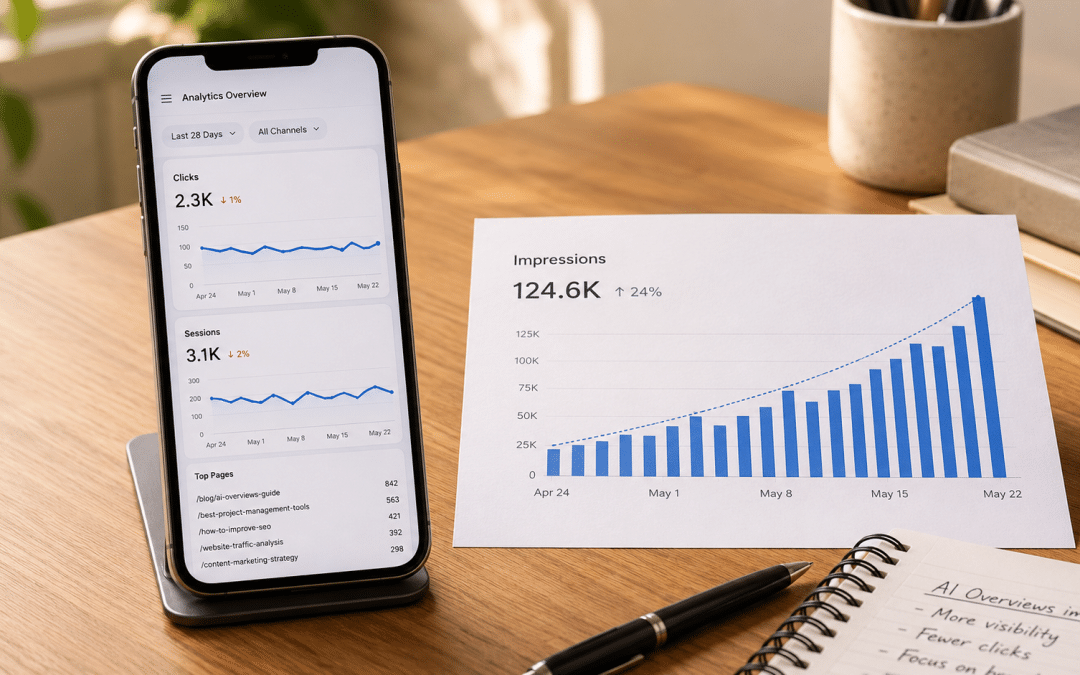
AI Overviews affect website traffic in one dominant pattern: they redistribute clicks away from informational listings while leaving commercial ones largely intact — and we can show you that pattern in our own Search Console, not just in overseas studies. This analysis anchors our AI search strategy for South Africa and pairs with the full AI search statistics roundup.
What follows is deliberately split in two: what the large independent studies measure globally, and what one heavily-published SA site — ours — actually sees. The two tell the same story, which is exactly why it's worth acting on.
Quick Answer
How AI Overviews affect website traffic: clicks on traditional results nearly halve when a summary appears — 8% versus 15% of visits in Pew Research's tracking of 68,879 real searches — with losses concentrated on informational queries while transactional queries stay largely clicked. On our own SA site, impressions tripled-to-quadrupled between April and July while clicks stayed near-flat, with about 7.8% of impressions coming from zero-click machine-style queries.
Wondering what this pattern looks like in your own Search Console? We'll walk you through it on your screen, on us.
Get a Free Traffic Pattern ReviewHow Do AI Overviews Affect Website Traffic in Practice?
The mechanism is simple: when a results page carries an AI summary, a large share of visits end inside the summary instead of proceeding to a website. The Pew Research Center's browsing study measured it directly: 8% of visits with a summary produced a traditional-result click versus 15% without one, and links inside summaries themselves were clicked just 1% of the time.
The other large studies agree on direction and add detail. Ahrefs measured top-position CTR on affected informational queries collapsing from 7.6% to 1.6% across two Decembers — a drop of roughly 58%. BrightEdge tracked summaries appearing on about 48% of queries. Seer Interactive added the counterweight: brands cited inside those summaries earn 35% more organic clicks than uncited brands.
Intent splits the damage. Semrush's intent research puts informational queries at roughly 74% zero-click against about 31% for transactional queries. The clicks disappearing are overwhelmingly research-stage; the clicks that buy are mostly still arriving.
What Does Our Own Search Console Show?
Everything in this section is Growth Pulse Media first-party data — our own Search Console, our 382-post site, a recent 28-day window. It's a single-site case study, not a market benchmark, published because our own console is the one dataset nobody can accuse us of cherry-picking from a blog post.
The headline shape: 848 clicks from 146,251 impressions — a 0.58% CTR, down from 0.63% across the trailing three months. Behind that mild-looking compression sits the real story: daily impressions roughly tripled to quadrupled between April and July while clicks stayed near-flat. Exposure exploded; the click-through didn't follow. That's the decoupling the global studies describe, running live on an SA site.
Then there's the machine layer. Eleven queries in the window match our detection pattern for AI grounding — six-plus words, position six or better, fifty-plus impressions, zero clicks — totalling 11,388 impressions, about 7.8% of everything the site was shown for.
The cleanest exhibit: the query "website security & updates south africa" gave our page 9,279 impressions at position 1.9 with zero clicks — the single largest query on the entire site, and not one human visit from it. Two more of the eleven: a hyper-specific Meta CPM pricing prompt (1,037 impressions, position 4.1) and "do i need seo or google ads south africa" (position 2.1, no clicks). Machines reading, humans not clicking.
The device split corroborates the machine layer. Mobile delivered 45% of our clicks from just 25% of impressions — a mobile CTR of 1.04% against 0.42% on desktop. Humans browse from phones; automated retrieval registers overwhelmingly as desktop, so the widening desktop gap is the same story told through a different report.
Watching AI Overviews affect website traffic inside our own console, in other words, looks nothing like the apocalypse framing and everything like a sorting: machine reads up, human clicks steady, exposure repriced.
One more first-party angle: our content has been cited inside a Google AI answer box, and the cited page's CTR ran near 10% at a position where 25–30% was the historical expectation. The citation didn't erase the audience — it moved the reading upstream and sent fewer, warmer visitors through.
Key Takeaway
GPM first-party data, one 28-day window: impressions up three-to-four-fold since April with clicks near-flat, CTR compressed from 0.63% to 0.58%, and 7.8% of all impressions coming from machine-style zero-click queries — including a position-1.9 query with 9,279 impressions and not a single visit. The global decoupling studies describe is measurably present on an ordinary SA site.
Which Pages Lose Clicks — and Which Don't?
Informational explainers lose first and hardest; commercial and pricing pages hold. In our console, the machine-query cluster sits entirely on research-stage questions — security explainers, cost benchmarks, "do I need X" comparisons — while the pages that answer buying questions kept earning human clicks through the same window.
Our cluster-level numbers rhyme with this, with an honest caveat. Explainer-heavy clusters on our site carry enormous impression mass against thin clicks, while transactional and pricing content earns clicks at a fraction of the exposure. Position differences explain part of that gap — some of those pages simply rank lower — but the intent pattern underneath is unmistakable once you've seen the query-level exhibits.
That maps exactly onto the intent numbers above, and it gives SA businesses a practical sorting rule: list your pages by the question they answer, not the traffic they get. "What is / how does / how much roughly" pages are exposure assets now — read by machines, cited to humans. "Buy / hire / price for my case" pages remain click assets, and deserve protection accordingly.
Want your own pages sorted into exposure assets and click assets — with the machine queries highlighted? That's one working session with your console.
Book a Free Page Sorting SessionIs Losing These Clicks Actually Losing Business?
Mostly, no — and this is the point where panic produces bad strategy. The visits disappearing into AI summaries are dominated by researchers a summary fully satisfies; they were the audience least likely to enquire. The buyers still click, still convert, and increasingly arrive pre-shortlisted by a summary that named you.
The evidence for the compensating channel is specific: cited brands earn 35% more organic clicks (Seer Interactive), AI-referred visitors convert at roughly 4.4× organic rates (Semrush), and our own cited page kept a meaningful CTR while doing silent brand work at position volume. The strategic reading matches our AEO vs SEO analysis: this is a redistribution to manage, not a collapse to mourn.
The honest caveat: redistribution only compensates businesses that compete for the citations. A site that loses the informational clicks and stays uncited gets the downside with none of the offset — which is the actual risk worth losing sleep over.
Key Takeaway
The clicks AI summaries absorb are overwhelmingly research-stage visits that rarely enquired; the compensating value — citations, brand shortlisting, higher-converting AI-referred visitors — flows only to businesses competing for cited positions. The danger isn't losing informational clicks; it's losing them while staying invisible in the summaries that replaced them.
What Should SA Businesses Do About It?
Four moves, in order. First, measure your exposure: run the machine-query detection pattern on your own console and split your CTR by device and intent — the how-to lives in our AEO guide. Second, restructure your top informational pages for citation: answer-first openings, question-shaped headings, citable Rand-specific facts.
Third, build the corroboration that gets you named — reviews, consistent entity signals and independent SA mentions, per our guide to earning AI referrals, with the structured data layer underneath. Fourth, protect and sharpen your commercial pages, because that's where the surviving clicks concentrate and compound.
Run the cycle monthly and keep it boring: same prompt list, same console filters, same four numbers on one page. Consistency is what turns how AI Overviews affect website traffic from an anxiety into a managed input — the trend line will tell you when to shift budget long before any headline does.
Key Takeaway
The four-move response: detect your machine-query exposure in Search Console, restructure top informational pages for citation, build the reviews and entity corroboration that get you named, and protect commercial pages where surviving clicks concentrate. Measured monthly, the same content investment keeps paying through a different door.
What not to do: cut content investment because "clicks are dying". The pages machines read are the pages machines cite — deleting your exposure assets is how you exit the shortlist right as it forms.
What Does Adaptation Look Like in Numbers?
Adaptation shows up as a small informational-click decline you stop fighting, alongside commercial and citation growth you start compounding. The composite below reflects the typical shape for an SA firm applying the four moves over five months. Figures illustrate the pattern, not a single client's audited results.
| Metric | Before | After 5 Months | Change |
|---|---|---|---|
| Informational page clicks per month | 1,900 | 1,650 | -13% |
| Commercial page clicks per month | 620 | 700 | +13% |
| AI citations on tracked questions | 0 of 20 | 7 of 20 | New channel |
| Monthly revenue from organic-assisted channels | R270,000 | R340,000 | +26% |
Set expectations on timing before anyone judges the table. The informational decline shows up immediately because it was already underway; the citation and commercial gains build over the middle months. A quarterly review rhythm keeps the early red row from triggering a premature retreat.
The first row going red while the last row goes green is the whole lesson. Teams that treat the informational decline as the headline will fight the wrong battle; teams that read all four rows together will fund the right one.
The GPM Differentiator: We Published Our Console, Not a Hot Take
Every SA agency has an opinion about AI summaries; very few will show you their own numbers. The figures in this post — the CTR compression, the 7.8% machine share, the position-1.9 zero-click exhibit — come from Growth Pulse Media's live Search Console, and our AEO services for South African businesses apply the same detection and response playbook we run on ourselves.
The reason we keep publishing these numbers quarterly is the same reason a builder shows you houses they've finished: claims about a shifting market are cheap, and receipts are not. If our next pull shows the pattern accelerating or reversing, that update will appear here too.
Hold your next agency conversation to that standard: ask to see their data before they interpret yours. An operator who can't show you the pattern in their own console is reading you someone else's weather report.
Who This Analysis Is NOT For
Sites whose revenue is pageview advertising. For ad-funded publishers, informational clicks are the business, and redistribution genuinely hurts. That's a different strategic problem than the lead-generation case this analysis covers.
Teams that will extrapolate our numbers to their site. Our 7.8% machine share and CTR curve are one site's fingerprint. Run the detection on your own console; borrowing ours as a benchmark defeats the entire point of first-party evidence.
Anyone waiting for the trend to reverse. Every tracked quarter shows summary coverage expanding. A strategy premised on rollback is a delay with compounding cost.
Businesses unwilling to change what they measure. If the monthly report stays clicks-only, adaptation will read as failure and get defunded at exactly the wrong moment. The measurement change precedes the strategy change.
Prefer to skip straight to the response plan? We'll run the detection pattern on your console and hand you the four moves, prioritised for your site.
Request a Free Response PlanQuestions SA Businesses Ask About AI Summaries and Traffic
How much do AI Overviews affect website traffic in South Africa?
The same mechanics measured globally are visible locally. Pew's tracking found clicks nearly halving when a summary appears (8% vs 15% of visits); on our own SA site, impressions grew three-to-four-fold between April and July while clicks stayed near-flat, with 7.8% of impressions coming from zero-click machine-style queries.
Which types of pages lose the most clicks?
Informational pages — explainers, definitions, cost benchmarks and "do I need X" questions — lose first and hardest, with informational queries running around 74% zero-click versus roughly 31% for transactional ones. Commercial and pricing pages largely keep their clicks, which is why they deserve protection and sharpening.
Can I see this happening in my own Search Console?
Yes, with a simple detection pattern: filter recent queries for long, specific phrasings holding strong positions with zero clicks and meaningful impressions. Also compare desktop and mobile CTR — machine reading registers mostly as desktop, so a wide gap is a supporting signal. Log both monthly.
Should I block Google's AI from using my content?
For lead-generation businesses, blocking usually costs more than it protects — you exit the summaries where buyers now shortlist providers while competitors stay in them. The calculation differs for ad-funded publishers, whose revenue depends directly on the visits summaries absorb.
Do AI Overview citations send any traffic at all?
Some, and it's disproportionately valuable. Links inside summaries are clicked rarely — about 1% of visits in Pew's data — but cited brands earn 35% more organic clicks overall, and AI-referred visitors convert at roughly 4.4 times organic rates. The citation works mostly through shortlisting, not the click itself.
Is this the end of investing in blog content?
No — it's a change in what that investment buys. Informational pages are becoming exposure assets that machines read and cite rather than click magnets. Cutting them removes you from the summaries buyers actually see; restructuring them for citation is how the same investment keeps paying.
Still hoping this settles down before you have to respond? Our console says it's been "settling" upward for months — and the shortlists in your market are forming from whoever adapted first.
Get Your Free AI Traffic Impact Report
We'll run the machine-query detection pattern on your Search Console and send a 2-page report: your zero-click exposure, your intent-split click risk, and the four-move response plan prioritised for your site — from the SA team that published its own console instead of a hot take. No obligation — we'll get back to you within 24 hours.
Claim My Free Impact Report