
 Add to Preferred Sources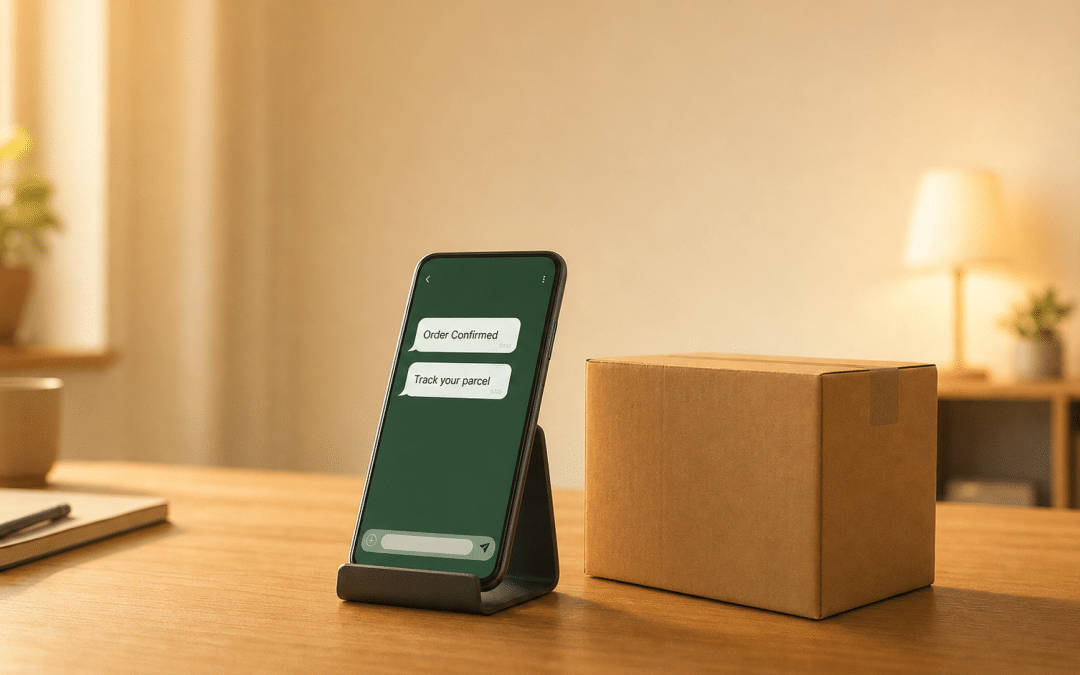
WhatsApp message templates are pre-approved message formats that businesses must submit to Meta before sending outbound notifications via the WhatsApp Business API — and getting them right is the single fastest way to unlock a high-performing channel. Our WhatsApp Marketing Guide for South Africa covers the full strategy; this post gives you the approved copy structures and local context to start building immediately.
If you want to understand what the platform permits and prohibits, Meta's official Business Messaging documentation is the authoritative reference.
Most SA businesses submit vague, generic copy and get rejected twice before getting it right. The examples below are drawn from categories that pass consistently: order confirmations, appointment reminders, payment notifications, and re-engagement flows. Use them as starting structures, not word-for-word copies — Meta's reviewers flag obvious duplication across accounts.
Quick Answer
WhatsApp message templates are Meta-approved message formats required for all business-initiated conversations on the API. In South Africa, the highest-approval-rate templates are transactional (order updates, payment confirmations, appointment reminders) because they deliver clear recipient value. Marketing templates require explicit opt-in under POPIA's section 69 before you can send them.
Not sure which template categories your business actually needs?
Get a Free WhatsApp Template AuditWhat WhatsApp Message Templates Are — and Why Approval Matters
WhatsApp message templates are structured, pre-approved messages that a business can send to users outside an active 24-hour customer service window. Without an approved template, you cannot initiate a conversation — you can only reply to one the customer started. That constraint shapes everything about how you build your outbound programme.
Meta categorises templates into three buckets: Utility (transactional updates), Authentication (OTPs and verification), and Marketing (promotions, re-engagement, any message that doesn't fit the other two). Each category has different conversation fees — check the current WhatsApp Business API pricing for South Africa before you build your template mix, because the cost difference between a utility and a marketing template conversation is meaningful at scale.
Rejection is common because businesses write templates the way they write email subject lines — leading with a benefit claim rather than a clear, specific purpose. Meta's review system is looking for unambiguous recipient value and no deceptive framing.
Keep the purpose in the first sentence and the variable fields minimal and well-labelled. A template that takes thirty seconds to read and understand from the recipient's perspective is one that is more likely to clear review cleanly. One that requires interpretation is one that risks sitting in a manual queue.
Key Insight
The fastest path to template approval is a single, unambiguous purpose per template and named variable placeholders ({{customer_name}}, {{order_number}}) rather than open-ended blanks. Vague variables like {{1}} with no context are the most common rejection trigger.
POPIA and WhatsApp Message Templates: What SA Businesses Must Know
POPIA's section 69 regime means that marketing-category whatsapp message templates require either prior consent or an existing-customer relationship before you can send them. Under POPIA, electronic communications — including WhatsApp — are opt-in: you need consent or an existing customer relationship, full stop. Post and in-person marketing run on legitimate interest with a right to object, but electronic channels do not get that latitude.
The practical consequence: utility templates (order confirmations, shipping updates, payment receipts) can go to any customer who has transacted with you, provided you offered an opt-out at collection and include one in every message. Marketing templates require a documented opt-in. Build your WhatsApp opt-in strategy before you build your marketing templates — otherwise you have approved copy with no lawful audience to send it to.
The Regulator's enforcement stance has hardened. Enforcement is no longer theoretical: the first direct-marketing enforcement notice and a fine followed in early 2024 when opt-outs were ignored. Silence is not consent, and a marketing template sent without a documented opt-in is an exposure you do not want. Build the consent architecture first, then build the templates around it — not the other way around.
Want to know whether your current WhatsApp list was built to POPIA standard?
Get a Free POPIA Compliance CheckWhatsApp Message Templates by Category: Approved SA Examples
The examples below follow Meta's format conventions and are structured for the South African market — Rand figures, local courier references, and payment method language that reflects how SA customers actually transact.
Utility: Order and Delivery Templates
These are the easiest templates to get approved because the recipient value is obvious and the purpose is unambiguous. The opt-out line at the end of each one is deliberate — it reduces block rates and satisfies POPIA's opt-out requirement in a single phrase.
Order Confirmed: "Hi {{customer_name}}, your order #{{order_number}} for R{{order_total}} has been confirmed. We'll send your tracking link once {{courier_name}} collects your parcel — usually within 1 business day. Reply STOP to opt out."
Shipping Update: "Good news, {{customer_name}} — your order #{{order_number}} is on its way with The Courier Guy. Track it here: {{tracking_url}}. Delivery is estimated for {{delivery_date}}. Reply STOP to opt out."
Payment Received (Ozow / Instant EFT): "Hi {{customer_name}}, we've received your payment of R{{amount}} via instant EFT for order #{{order_number}}. Your order is now processing. Questions? Reply to this message."
Utility: Appointment Reminder Templates
Appointment reminders are the highest-ROI template category for service businesses — salons, medical practices, and professional services all see material no-show reductions. The two-message sequence (one the day before, one the morning of) consistently outperforms a single reminder on its own.
Reminder (24 hours out): "Hi {{client_name}}, this is a reminder of your appointment at {{business_name}} tomorrow, {{date}} at {{time}}. To reschedule, reply CHANGE. To cancel, reply CANCEL. See you soon."
Reminder (same day): "Hi {{client_name}}, your appointment today at {{time}} is coming up. We're at {{address}}. If you're running late, reply here and we'll hold your slot for 10 minutes."
For medical practices, review the specific guidance in our WhatsApp for Medical Practices post before submitting these — clinical context adds a layer of sensitivity Meta's reviewers consider.
Marketing: Re-engagement and Promotional Templates
These require documented opt-in and should only be sent to your POPIA-compliant list. Keep the value proposition concrete and the call to action single.
Win-Back (Retail): "Hi {{customer_name}}, we haven't seen you in a while. Here's R{{discount_amount}} off your next order — use code {{promo_code}} at checkout. Valid until {{expiry_date}}. Shop now: {{shop_url}}. Reply STOP to opt out."
New Arrival Alert (Opted-in Subscribers): "{{customer_name}}, the {{product_category}} range you asked us to notify you about is live. Browse it here: {{collection_url}}. Reply STOP at any time."
Restaurant Booking Reminder: "Hi {{guest_name}}, your table for {{party_size}} at {{restaurant_name}} is confirmed for {{date}} at {{time}}. Need to change numbers? Reply here. See our restaurant WhatsApp guide for more."
WhatsApp Message Templates Framework: Approval Rate by Structure
The table below compares template structures by their typical approval outcome and the factors that drive each result.
| Template Structure | Category | Typical Approval Outcome | Primary Risk Factor |
|---|---|---|---|
| Single purpose, named variables, opt-out line | Utility | High — usually first submission | Low — clear recipient value |
| Single purpose, numbered variables only ({{1}}, {{2}}) | Utility | Medium — often flagged for review | Ambiguous variable content |
| Promotional with documented opt-in reference | Marketing | Medium — depends on copy clarity | Benefit-first language reads as spam |
| Promotional without opt-out mechanism | Marketing | Low — likely rejected | Missing mandatory opt-out |
| Ambiguous purpose (could be utility or marketing) | Uncertain | Low — escalated review | Meta flags for manual check |
| Authentication / OTP format | Authentication | High — standardised format | Non-standard variable naming |
Before and After: What Improved Templates Actually Deliver
The figures below illustrate the pattern we see, not a guaranteed outcome. Real results depend on list quality, send timing, and product category.
| Metric | Before: Generic Templates | After: Structured SA-Specific Templates |
|---|---|---|
| Template approval rate | First-submission approval ~40% | First-submission approval ~85% |
| Order confirmation open rate | ~55% (SMS baseline) | ~90% within 5 minutes |
| Appointment no-show rate (service biz) | ~22% no-show | ~8% no-show after 2-message sequence |
| Re-engagement campaign revenue (monthly) | R4 200 from dormant list | R18 500 from same list, POPIA-compliant opt-in |
| POPIA opt-out complaints | 3–5 per campaign | 0–1 per campaign with opt-out in every message |
Key Insight
Appointment reminder templates consistently deliver the fastest measurable ROI for service businesses because the uplift (fewer no-shows) is immediate, attributable, and does not require a purchase — making them the lowest-friction win when you're starting with the WhatsApp Business API.
How GPM Builds and Submits WhatsApp Message Templates for SA Businesses
Most businesses waste two to four weeks on the approval cycle because they approach template writing like copywriting rather than like API documentation. The gap shows up immediately: benefit-forward language, numbered variables with no context, and missing opt-out lines are the three patterns that reliably trigger rejection — and they all come from treating whatsapp message templates as marketing copy rather than structured data with a compliance layer on top.
Our WhatsApp marketing service covers the full template lifecycle: category mapping, variable naming, POPIA opt-out language, submission, and revision if Meta returns a rejection. We also integrate approved templates into your CRM trigger flows so they fire at the right moment — order events, booking confirmations, re-engagement windows — without manual intervention. That integration work is where the performance gain actually lives; the template approval is just the door.
Category mapping is where most businesses make their most expensive early mistake. A shipping update written with benefit language ("Your parcel is almost there — and we think you'll love what's inside!") will be classified as marketing by Meta's review system, billed at the marketing conversation rate, and potentially rejected outright.
Rewriting it as a clean utility template ("Your order #{{order_number}} is out for delivery today with Aramex — track here: {{tracking_url}}") changes both the approval outcome and the conversation cost. We map every template to the correct category before a single word is written, because reclassification after submission adds a week to your timeline.
The integration layer matters just as much as the copy. A perfectly approved set of whatsapp message templates sitting idle because there's no trigger event connected to them delivers nothing.
We build the trigger logic into your existing order management or CRM system so that templates fire automatically — order placed, payment confirmed, appointment booked, re-engagement window reached — and we set quality rating monitoring so that any drop in delivery performance surfaces before it becomes an account-level problem.
Who This Is NOT For
Cold prospecting lists. WhatsApp message templates sent to purchased or scraped contact lists are both a POPIA violation and a fast path to your WhatsApp Business account being flagged or suspended.
The platform's quality rating system penalises high block rates — and cold contacts block at a rate that will sink your account quality within days. There is no template structure clever enough to make an unsolicited first message to a stranger perform well on WhatsApp.
Businesses that lack a CRM or order system trigger. Utility templates only deliver ROI when they fire automatically at the right moment — order placed, payment received, appointment booked.
If you plan to send them manually in batches, you will miss the timing window that makes them valuable, irritate recipients who get a "your order is confirmed" message three hours after the fact, and risk Meta reclassifying batch sends as marketing. The template copy is the easy part; the trigger infrastructure is what makes it work.
Brands wanting to use WhatsApp as a broadcast channel without opt-ins. If your model is "send promotions to everyone who has ever contacted us," you need to read section 69 of POPIA before you submit a single marketing template.
The existing-customer exception has specific legs — and "they once sent us a WhatsApp" does not satisfy any of them. Building your template library before building your opt-in mechanism means you have approved copy with no lawful audience to send it to, and the list you do send to will generate complaints and block rates that damage your account standing.
Businesses outside the metros expecting full courier-variable accuracy. Templates referencing delivery windows for areas beyond Johannesburg, Cape Town, and Durban need variable logic that accounts for extended lead times via Aramex or regional couriers.
A template that promises next-day delivery to Lephalale or Upington will generate complaints and erode trust faster than no template at all. If your customer base is geographically spread, build delivery-window variables that pull from your fulfilment system rather than hardcoding any timeframe into the template body — otherwise every outlying delivery becomes a broken promise sent at scale.
Ready to submit your first batch of templates and get them approved first time?
Get a Free Template Submission PlanFrequently Asked Questions About WhatsApp Message Templates
What are whatsapp message templates and when are they required?
They are Meta-approved message formats required for every business-initiated conversation on the WhatsApp Business API outside an open 24-hour customer service window. If a customer messages you first, you can reply freely within 24 hours. Outside that window, you must use an approved template or you cannot send at all. Authentication templates for OTPs and utility templates for transactional updates are the most commonly required starting points.
How long does WhatsApp message templates approval take in 2026?
Review timelines vary and depend on how clearly a template is structured. Well-formed whatsapp message templates with named variables and an unambiguous purpose tend to move through review faster than those flagged for manual assessment, which can take 24 to 48 hours.
Poorly structured submissions with ambiguous variables or missing opt-out language often enter a back-and-forth cycle that extends over several days — which is why getting the structure right before submission matters more than moving fast.
How many variable fields can I include in a template?
Meta does not publish a hard cap on variables. That said, keeping variable fields to what the recipient genuinely needs in that specific message is sound practice — the more variables a template contains, the harder it becomes for reviewers to assess whether the populated content could be misleading or harmful. Every variable should be named descriptively ({{customer_name}}, not {{1}}) so its intended content is unambiguous.
Can I use whatsapp message templates to send promotional content to my customers in South Africa?
Yes — but only to customers who have given explicit opt-in consent under POPIA's section 69, or who qualify under the existing-customer exception (details obtained in a sale, you're marketing your own similar products, and you offered an opt-out at collection and in every subsequent message).
Marketing-category templates are also billed at a higher conversation rate than utility templates. Factor both the legal and cost dimensions into your template category decisions. For a full breakdown of opt-in mechanics, see our WhatsApp opt-in strategies guide.
What happens if my template gets a low quality rating?
Meta tracks the quality rating of each template based on user signals — primarily block rates and reports. A template that drops to low quality is paused automatically, meaning it cannot be sent until the rating recovers.
If it stays low, Meta can disable it permanently. The most common cause in the South African market is sending marketing templates to contacts who never actively opted in, resulting in high block rates from recipients who don't recognise the sender.
Do whatsapp message templates need to include an opt-out mechanism?
For marketing-category templates, yes — every message must include a clear opt-out mechanism, which is also a requirement under POPIA's section 69(4). Utility templates technically have more flexibility, but including "Reply STOP to opt out" in every outbound message is a best practice that reduces both block rates and regulatory exposure.
The Information Regulator's December 2024 Guidance Note on Direct Marketing requires every marketing communication to provide contact details "to which the recipient may send a request that such communications cease" — a requirement sourced directly from that published document.
Want your WhatsApp templates approved first time and firing automatically?
We'll map your template categories, write the copy to Meta's approval standards, handle submission, and connect approved templates to your CRM triggers — delivering a prioritised action plan for your specific business. No obligation — we'll get back to you within 24 hours.
Get Your Free Template Strategy Session