
 Add to Preferred Sources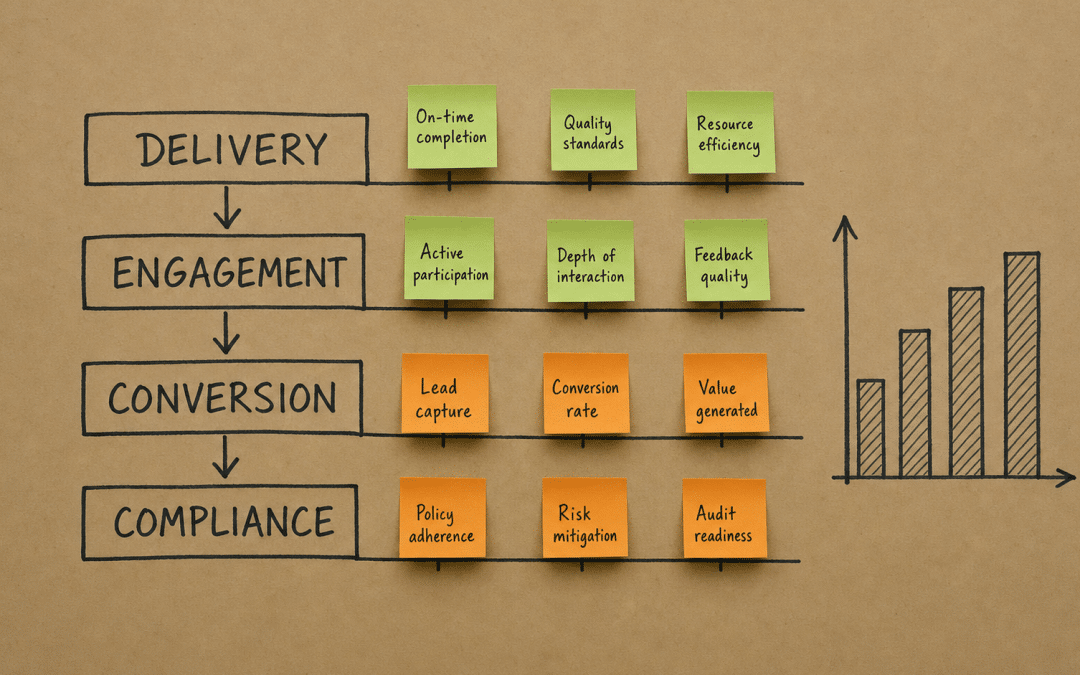
WhatsApp marketing metrics are the measurement layer most South African businesses skip entirely — and that gap is costing them money they cannot see. If you are running campaigns through the WhatsApp Business API and relying on message-sent counts as your primary success signal, read our WhatsApp marketing guide for South Africa first, then come back here for the measurement framework that turns activity into accountability.
The measurement gap is real and predictable. Businesses invest in API infrastructure and conversation credits, build broadcast lists, and send campaigns — then declare success because open rates look good. Without tracking the full funnel from delivery through to revenue, you are optimising a number that does not pay salaries.
Quick Answer
WhatsApp marketing metrics worth tracking fall into four tiers: delivery health (sent, delivered, read), engagement quality (reply rate, CTA click rate), funnel conversion (leads created, orders placed, revenue attributed), and compliance (opt-out rate, POPIA consent records). Most businesses only track tier one. That is the measurement gap.
Not sure which WhatsApp metrics your business is actually missing?
Get a Free Metrics AuditWhy WhatsApp Marketing Metrics Are Different From Email
WhatsApp marketing metrics operate inside a closed platform ecosystem, which changes both what you can measure and what those numbers actually mean. Meta's Business Messaging platform provides read receipt visibility via the API — a capability email has never reliably delivered at scale without pixel tricks that mobile clients routinely block.
That sounds like an advantage, and for delivery visibility it is. The catch is attribution. When a customer reads your message, clicks a PayFast checkout link, and completes a purchase, connecting that revenue back to the specific campaign requires deliberate UTM tagging and a CRM that logs the WhatsApp thread. Most setups do neither.
Email platforms like Klaviyo handle attribution automatically because they own the sending infrastructure end to end. WhatsApp sits across Meta's API, your BSP (business solution provider), and your own CRM or e-commerce stack. Every handoff is a potential data gap — and those gaps do not fix themselves without a deliberate measurement framework in place.
The Four-Tier WhatsApp Marketing Metrics Framework
A complete whatsapp marketing metrics framework organises every trackable signal into four tiers, from the cheapest data to collect (platform-native delivery stats) through to the hardest (attributed revenue). Most businesses live permanently in tier one.
Tier 1: Delivery Health
Delivery health metrics confirm that your messages are reaching real handsets. The three signals are: sent count (messages handed to Meta's infrastructure), delivered count (messages confirmed received by the device), and read count (blue ticks confirmed by the recipient's app).
A delivered-to-sent ratio materially below 95% usually signals list hygiene problems — numbers that have been deactivated, changed hands, or never verified at opt-in. A read-to-delivered ratio below 60% for a warm list suggests your template copy is not earning attention in the notification preview. Both are fixable, but only if you are watching them.
Tier 2: Engagement Quality
Engagement quality metrics tell you whether recipients are responding, not just reading. The two primary signals are reply rate (any inbound message from the recipient within 24 hours of your broadcast) and CTA click rate (taps on a button or link inside the message).
Reply rate is a uniquely powerful whatsapp marketing metrics signal. A recipient who replies opens a free-form conversation without requiring an additional template message — which means a business that converts reads into replies carries materially lower per-lead costs than one that does not. If you are using WhatsApp Flows for interactive in-chat forms, flow completion rate becomes a third tier-two signal.
Tier 3: Funnel Conversion
Funnel conversion metrics connect channel activity to commercial outcomes. For retail the key signals are: add-to-cart events, checkout initiations, and completed orders attributed to a WhatsApp touchpoint. For B2B or service businesses, the equivalent is leads created, appointments booked, and proposals sent.
Attribution here depends on your setup. The cleanest approach is a UTM parameter on every link in every template, with the campaign source set to "whatsapp" and the campaign name matching your broadcast label. If you are running WhatsApp CRM integration, your CRM should log the originating thread ID against each contact record, giving you a direct path from message to revenue without relying purely on last-click.
Tier 4: Compliance and List Health
Compliance metrics are the tier most businesses ignore until they receive an enforcement notice. Under POPIA's electronic marketing regime (section 69 of the Act), WhatsApp broadcasts to contacts who have not provided opt-in consent or who do not meet the existing-customer exception are prohibited. Practices commonly interpret this as requiring a documented opt-in record per contact before any marketing message is sent.
The metrics that protect you here are opt-out rate per campaign (track it to identify content that erodes consent), total opted-out contacts removed from active lists within the session, and a consent-timestamp record per contact in your CRM. The POPIA-compliant list building guide covers the opt-in side; the metrics side is the ongoing audit that proves compliance holds over time.
Key Insight
Reply rate is the single most underleveraged whatsapp marketing metrics signal in South African campaigns. Every reply opens a free-form conversation and costs nothing extra — but only if someone is staffed to respond. Measuring it without acting on it is as useless as not measuring it at all.
Running WhatsApp broadcasts but unsure whether your attribution is actually working?
Get a Free Attribution ReviewWhatsApp Marketing Metrics vs Other Channels: A Comparison
Understanding where the channel outperforms and where it falls short helps you allocate measurement effort. The table below compares WhatsApp to email and SMS across the signals that matter most to South African ecommerce and B2B operators.
| Metric Signal | Email (Klaviyo) | SMS | |
|---|---|---|---|
| Delivery confirmation | Per-message, platform-native | Inferred from bounce absence | Carrier-level, variable |
| Read receipts | Per-message (blue ticks via API) | Pixel-dependent, often blocked | Not available |
| Reply tracking | Native, opens free-form conversation | Requires dedicated reply address | Long code only, complex |
| CTA click attribution | UTM tags required, not automatic | Automatic in Klaviyo flows | UTM tags required |
| Revenue attribution | Manual setup required | Automatic in e-commerce integrations | Manual setup required |
| Opt-out compliance log | Manual or BSP-assisted | Automatic suppression list | Automatic (STOP command) |
| Conversation cost visibility | Per-conversation pricing model | Per-send pricing, predictable | Per-message, simple |
Real-World Before and After: Closing the Measurement Gap
The numbers in this table illustrate the pattern we see, not a guaranteed outcome. They reflect a composite of retail and service businesses in Gauteng and KZN that moved from delivery-only tracking to the full four-tier framework.
| Signal | Before (Delivery Tracking Only) | After (Four-Tier Framework) |
|---|---|---|
| Metrics tracked per campaign | 2 (sent, delivered) | 9 (all four tiers) |
| Revenue attributed to WhatsApp | R0 (not tracked) | R38,000 per month visible |
| Opt-out rate visibility | None — contacts silently ignored future messages | Tracked per broadcast; down 40% after list hygiene |
| Reply rate (warm list) | Unmeasured | 14% average — conversations opened at zero extra cost |
| Campaign iteration speed | Monthly (gut feel) | Weekly (data-driven template testing) |
| POPIA consent records | No documented audit trail | Full timestamp log per contact in CRM |
Setting Up Tracking That Actually Works in South Africa
Practical whatsapp marketing metrics setup in South Africa requires solving three infrastructure problems: UTM consistency, CRM logging, and opt-out automation. None of them is technically complex. All of them are routinely skipped.
UTM consistency means every link in every template carries a campaign source, medium, and name parameter — and those parameters follow a naming convention your analytics platform can filter on. "whatsapp" in lowercase as the source, "broadcast" or "api" as the medium, and a date-stamped campaign name.
If you use WhatsApp Catalogs for product browsing, the catalog click itself does not carry UTM data — you need to drive catalog browsers to a tagged landing page for attribution to hold.
CRM logging means your BSP (Gupshup, 360dialog, Wati, or whichever tool you use) writes inbound and outbound message events to contact records with timestamps. Without this, you cannot calculate reply latency, conversation-to-conversion time, or the contact-level opt-out history that POPIA compliance requires.
Opt-out automation means a keyword response ("STOP", "Unsubscribe", or an Afrikaans equivalent) instantly suppresses the contact from all future broadcast lists and writes a timestamped record. Handling this manually at scale is not compliant — it is too slow, and the enforcement guidance from the Information Regulator is clear that opt-outs must be acted on promptly.
Key Insight
UTM tagging on WhatsApp links is not optional if you want revenue attribution. It is one line of setup per template. The cost of skipping it is permanent blindness to your channel's commercial contribution.
Benchmarks South African Operators Can Use
Directional benchmarks help you calibrate your own results against what healthy programmes look like. These are directional ranges based on patterns across local ecommerce, retail, and service businesses — not published research figures, which vary too widely to be useful at a programme level.
A well-maintained list with opted-in contacts typically sees delivered-to-sent ratios above 95%, read-to-delivered ratios above 65% for transactional messages, and reply rates between 8% and 20% depending on the call to action. For Click-to-WhatsApp ad campaigns, the first-response conversion to a qualified conversation tends to run materially higher than equivalent email click-to-form campaigns, partly because the channel feels personal and partly because mobile-first South African traffic is already in a chat-native environment.
If your numbers are materially below these directional ranges, the most common causes are list age (contacts who opted in more than 12 months ago and have not re-engaged), template fatigue (the same message structure repeated too often), and send timing (mid-morning weekday sends outperform late-evening sends on most South African lists — data costs and commute patterns both play a role).
GPM's Approach to WhatsApp Marketing Metrics
At Growth Pulse Media, we build measurement frameworks before we build campaigns. Our WhatsApp marketing service includes a metrics layer as standard — not as an add-on. That means a UTM taxonomy agreed before the first template goes live, CRM event logging configured during onboarding, and a campaign dashboard that shows all four tiers in one view.
Dirk built and scaled an ecommerce business where every channel had to justify its spend with attributed revenue. That discipline is baked into how GPM runs WhatsApp programmes. We do not treat read rate as a success metric. We track the path from message delivered to rand deposited — and we build the infrastructure that makes that path visible from day one.
Who This Is NOT For
Businesses with no CRM. A four-tier whatsapp marketing metrics framework requires a system of record that logs contact-level events. If your customer data lives in a spreadsheet, the measurement gap cannot be closed without first solving the data infrastructure problem.
Teams expecting dashboards to run themselves. WhatsApp does not have a native analytics dashboard equivalent to Klaviyo or Google Analytics. Someone needs to own the data pull, the UTM audit, and the weekly review. If no one has that responsibility, the metrics will drift and stop reflecting reality within weeks.
Operators sending to unverified or purchased lists. Tracking metrics on a list built without proper POPIA opt-in consent does not make the programme compliant — it just makes non-compliance more visible. The measurement framework assumes a clean, consented list as its foundation.
Businesses that measure WhatsApp in isolation. Channel metrics only tell part of the story if you do not connect them to the broader funnel — your website analytics, your checkout platform, and your CRM pipeline. If there is no integration between these systems, attribution will remain incomplete regardless of how carefully you tag your templates.
Want to know exactly which metrics your WhatsApp programme is missing and how to fix that?
Get Your Free WhatsApp Metrics ChecklistFrequently Asked Questions About WhatsApp Marketing Metrics
What are the most important whatsapp marketing metrics for a South African retailer?
They are delivered rate, read rate, reply rate, CTA click rate, and revenue attributed per campaign. For retail specifically, add-to-cart and checkout completion rates tied to WhatsApp touchpoints round out the picture. Start with these six before adding complexity.
Can I track WhatsApp message opens the same way I track email opens?
The mechanism is different but the outcome is similar. WhatsApp delivers read receipt visibility via the API — no tracking pixel required. The data is generally more reliable than email open tracking, which depends on pixels that are frequently blocked by mobile email clients. The limitation is that read receipt data is at the message level, not tied to downstream behaviour automatically.
How do I attribute revenue to a WhatsApp campaign without a dedicated analytics platform?
UTM parameters on every link in your templates, consistent campaign naming, and a filter in Google Analytics 4 set to source "whatsapp" will give you basic attribution without specialist software. It is not as clean as an end-to-end CRM integration, but it is meaningfully better than no attribution at all. For anything at scale, a WhatsApp CRM integration is the proper solution.
What opt-out rate should trigger a list review?
Any campaign generating an opt-out rate above 2% of the delivered audience warrants immediate review of the message content, the send frequency, and whether the segment was appropriately targeted. A pattern of high opt-outs across multiple campaigns suggests list fatigue or a mismatch between what contacts expected when they opted in and what they are actually receiving.
Does POPIA require me to keep records of WhatsApp marketing consent?
Practices commonly interpret POPIA's section 69 and the Information Regulator's December 2024 Guidance Note as requiring documented consent records for electronic marketing — including the timestamp, the mechanism of consent, and a log of opt-outs acted on. Keeping these records in your CRM is the practical implementation. For more on building a compliant list, see the POPIA-compliant opt-in strategies guide.
How often should I review my whatsapp marketing metrics?
Delivery and engagement metrics should be reviewed within 48 hours of each broadcast to catch list hygiene issues and template performance problems before they compound. Funnel conversion and revenue attribution metrics warrant a weekly review tied to campaign planning. Compliance metrics — opt-out logs and consent records — should be audited monthly and before any significant list expansion.
Key Insight
The whatsapp marketing metrics measurement gap is not a technical problem — it is a prioritisation problem. The data is available. The tools exist. The businesses closing the gap are the ones that decided attributed revenue matters more than impressive-looking read rates.
Ready to see what your WhatsApp channel is actually generating?
We will audit your current WhatsApp measurement setup and deliver a prioritised action plan showing which metrics are missing, how to close the gaps, and what attributed revenue looks like once the tracking is in place. No obligation — we'll get back to you within 24 hours.
Get Your Free Measurement Audit