
 Add to Preferred Sources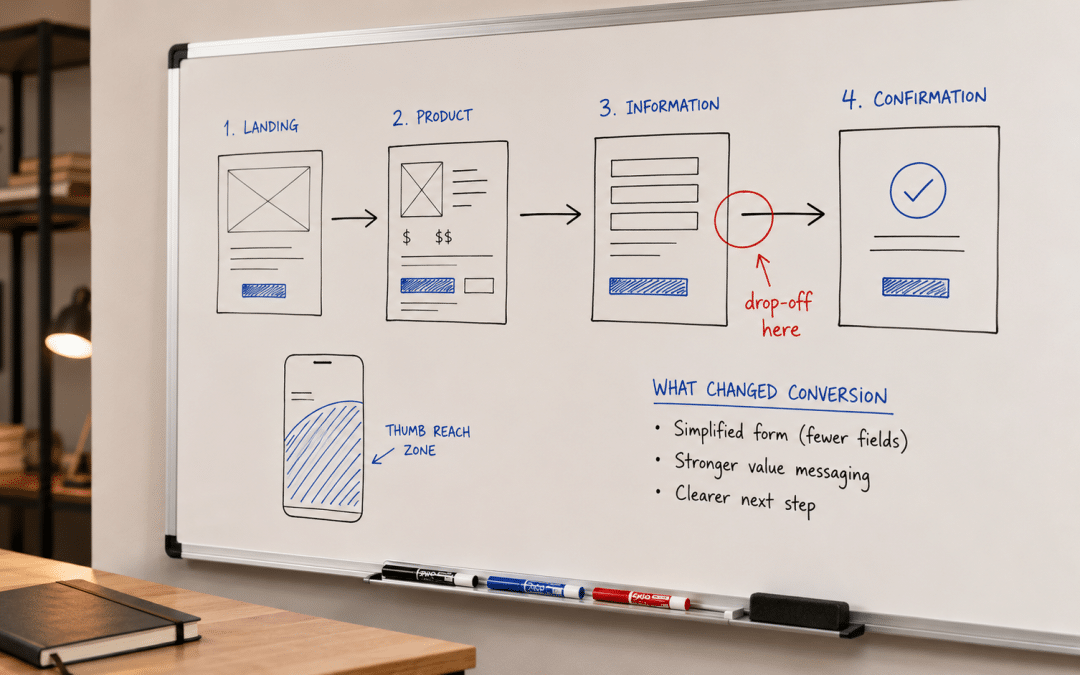
UX design South Africa businesses get value from is not visual styling — it is the work of removing every reason a ready buyer has to leave your website, and on South African sites that mostly means fixing mobile usability, making the next step obvious and showing local trust signals. A focused UX audit typically costs R5,000–R20,000 and often lifts conversions more than doubling your ad budget would. This guide explains the five design levers that move conversions, what UX work costs in Rand, how it relates to conversion rate optimisation, and when design is not your real problem. For the wider design picture, see our web design guide for Johannesburg businesses.
Quick Answer
UX (user experience) design decides whether visitors can understand, use and trust your site. The five levers that move conversions most, in order: one clear primary action per screen, mobile-first interaction, local trust signals, short forms with few decisions, and a visual hierarchy that points at the action. A beautiful site that hides its main button or breaks on a mid-range Android phone converts worse than a plain site that does neither.
Not sure whether your design is quietly costing you enquiries? We will show you where visitors drop off — free.
Get a Free UX Conversion ReviewWhy Design Decides Conversion
In UX design South Africa projects, design decides conversion because every sale or enquiry is the end of a path through your interface, and UX design is what makes that path obvious or obstructed — which is why a site with good traffic and a sound offer can still underperform.
When such a site underperforms, the cause is rarely the offer or the ad. It is usually a design decision somewhere on the path — a buried call to action, a form that is painful on a phone, a checkout that looks foreign — that quietly loses people. Visually impressive is not the same as usable: a site can win a design award and still hide its main button below a large animated banner. The visitor who cannot find it simply leaves.
The South African Constraints Generic Advice Ignores
Good UX design South Africa visitors respond to starts from the real visitor — usually on a mid-range Android phone, on mobile data, and wary of sites that do not look local — rather than from a designer's large desktop screen.
Mobile-first is not optional
Most South African web traffic is mobile, and a large share arrives on mid-range devices over mobile data. Designs that assume a big screen and fast connection fail silently: buttons out of thumb reach, text too small to read without zooming, and forms that need precise tapping all lose conversions without anyone complaining. Our guide to mobile website design covers the build side in detail.
Trust signals are local
South African buyers read trust cues differently. A checkout that shows only foreign payment options, a contact page with no local address or number, or elements that visibly break all say "this is not really for you". Local payment logos such as PayFast, Ozow or SnapScan, a real local contact route and a site that works end to end are design decisions, not afterthoughts.
Design problems are silent
A buyer who cannot find the button or does not trust the checkout does not email you to explain — they leave, and your analytics show only a slightly lower conversion rate. That is why design problems survive for months. The only reliable way to find them is to watch real users on real phones try to complete the main action, or to test changes against a measured baseline.
Want to see your site the way a South African mobile visitor sees it — before it costs you another month of enquiries?
Get a Free Mobile UX WalkthroughThe Five Highest-Impact UX Levers
The UX design South Africa levers that move conversions most are the ones that decide whether a visitor can act at all — clarity of the main action and mobile usability — and they should be fixed before anything that simply makes the site look better.
| UX lever | What it controls | Conversion impact | Best for |
|---|---|---|---|
| Primary action clarity | Whether visitors know the next step | Highest | Every site — one obvious action per screen |
| Mobile interaction | Whether mobile users can act at all | Very high | Sites with 60%+ mobile traffic |
| Trust signals | Whether visitors believe the site | High | Online stores and first-time buyers |
| Form and decision friction | How much effort each step takes | High | Lead-generation and quote forms |
| Visual hierarchy | Where the eye is guided | Moderate | Content-heavy and product pages |
According to Nielsen Norman Group's ecommerce UX research, most conversion-affecting design guidance concerns clarity, navigation and reducing friction rather than aesthetic polish — the same order South African sites should follow. Speed belongs on this list too: 53% of mobile visitors leave a page that takes longer than three seconds to load, and a visitor experiences a slow page and a confusing page as the same thing. Our Core Web Vitals guide explains the speed side.
Key Takeaway
Fix what stops people acting before you fix what makes the site prettier. A clear main action and a form that works one-handed on a phone will move conversions more than a new colour palette, new photography or a full visual redesign.
UX Design South Africa Costs: Audit, Fixes or Redesign
UX work in South Africa usually falls into three price bands — a UX audit, a targeted fix sprint, or a full redesign — and most businesses should start with the audit, because it tells you whether the smaller fix sprint is enough.
| Type of UX work | Typical cost (ZAR) | What you get | Best for |
|---|---|---|---|
| UX audit | R5,000 – R20,000 | Mobile walkthrough, analytics review, ranked list of friction points | Sites with traffic but weak conversion |
| Fix sprint | R10,000 – R40,000 | The top five to ten fixes designed, built and measured | Sites whose structure is basically sound |
| Conversion-led redesign | R40,000 – R150,000+ | New structure, templates and journey built around the main action | Sites where the core journey is broken |
Ranges vary with the number of templates, whether the site is an online store, and whether testing is included. If a full rebuild is on the table, our guide to when a website redesign makes sense will help you decide, and what a business website costs covers build pricing.
Sensible order: run the audit, fix the top five issues, measure for four to six weeks, and only then decide whether a redesign is needed. Many sites never need one.
Expensive order: commission a full redesign because the site "looks dated", with no baseline measurement. It can lower conversions while looking more modern — and nobody notices until revenue does.
How UX Design and CRO Work Together
UX design creates the conversion potential and conversion rate optimisation proves which design changes actually realised it — they are partners, not substitutes.
In practice, UX design makes a considered decision about how a path should work; CRO tests that decision against a measured baseline to confirm it moved the number. A site with strong design and no testing may convert well but cannot tell which choices mattered. A site running tests on a confusing design is simply rearranging obstacles. Our CRO guide for South Africa explains the testing side.
The Quiet Conversion Killers
Small UX mistakes drain conversions steadily rather than dramatically — each costs a few percent, and together they often explain why a site with decent traffic still underperforms.
The multi-action screen: three or four calls to action of equal weight raise the cost of deciding, and many visitors resolve that by doing nothing. One screen, one main action.
The over-long form: every extra field removes a share of the people who would have finished it. On a phone, one-handed and on data, long forms are abandoned even faster.
Slowness treated as "just technical": visitors do not separate a slow server from a confusing layout — both feel hard and both end the session.
Small Frictions Compound
No single friction is fatal: a slightly buried button, one extra form field and a moment of doubt at checkout each cost a few percent. Across the whole path they are often the difference between a site that converts and one that does not. Audit the path as a whole, not screen by screen.
How a UX Audit Is Done, Step by Step
A UX audit combines what the numbers show — where visitors drop out — with what people actually experience when they use the site, and ends with a short, prioritised list of fixes rather than a long report of opinions.
| Step | What happens | Tools | Output |
|---|---|---|---|
| 1. Funnel review | Map the path from landing page to enquiry or purchase and find the biggest drop | Google Analytics | The one or two pages losing the most people |
| 2. Behaviour review | Watch session recordings and heatmaps on those pages | Microsoft Clarity (free) or Hotjar | Where people hesitate, rage-click or give up |
| 3. Expert review | Check pages against established usability principles on mobile and desktop | Checklist, real devices | Specific issues with clear causes |
| 4. User testing | Five people try to complete key tasks while thinking aloud | Video call or in person | Problems the team could not see |
| 5. Prioritise | Score each issue by impact and effort | Spreadsheet | A ranked fix list for the next 30–60 days |
Microsoft Clarity is worth installing even if you never commission an audit. It is free, records anonymised sessions and shows heatmaps, and a single afternoon of watching real visitors struggle with a form or a menu is often more persuasive than any report. Add a short note to your privacy policy explaining that anonymised session data is collected, and exclude pages where visitors enter sensitive details.
Testing With Real Users on a Small Budget
Usability testing does not need a lab or a large budget — watching five people from your target audience try to complete a few key tasks on your site uncovers most of the serious problems, which is why small, frequent tests beat one large study.
Recruit people who match your customers, not colleagues or family who already know the business. Existing customers, people from a local community group or LinkedIn contacts in the right industry all work, and a modest thank-you such as a R200 voucher is usually enough.
Give each person three realistic tasks — "find out whether we deliver to your area and what it costs", "book a consultation for next Tuesday" — and ask them to think aloud while you watch without helping. Record the sessions with permission. After five sessions, the same two or three problems will almost always have come up repeatedly; those are the fixes to make first. Test again after the changes, because fixing one problem often reveals the next.
Illustrative example: a Johannesburg insurance broker tests its quote form with five small-business owners. Four of the five hesitate at a field asking for "SIC code", which nobody recognises. Replacing it with a simple "What does your business do?" drop-down lifts completed quote requests noticeably within a month.
Accessibility: Designing for Every Visitor
An accessible website is one that people with low vision, colour blindness, motor difficulties or older devices can still use easily, and designing for accessibility usually improves the experience — and conversion rates — for every visitor.
The internationally recognised standard is the Web Content Accessibility Guidelines (WCAG), and meeting its AA level is a sensible target. In practice, most of the gains come from a handful of basics: text with strong contrast against its background, body text at least 16 pixels on mobile, buttons large enough to tap easily, form fields with visible labels rather than placeholder text that disappears, descriptive alt text on images, and pages that can be used with a keyboard alone. These choices help older visitors, people reading on cracked or dim phone screens in bright sunlight, and anyone in a hurry.
Key takeaway: Accessibility is not a separate project for a minority of users. Clear contrast, readable text, large tap targets and labelled forms make a website easier for everyone to use, and they remove friction that quietly costs enquiries and sales.
How Growth Pulse Media Approaches UX and Conversion
Growth Pulse Media builds web design for South African businesses around the conversion path first and the look second, because a beautiful site that does not convert is a cost, not an asset.
We map the path a real South African visitor takes on a real phone, find the specific decisions that lose people, change them and measure the result — PayFast and Ozow checkouts, WhatsApp enquiry buttons and GA4 conversion events included. All work is done in-house from Johannesburg, so the person making the design call is the person who has to defend it against the numbers. Every UX design South Africa project we run starts with a measured baseline, so you see the before and after in your own analytics.
Who This Is NOT For
UX design South Africa projects are the right focus for many sites, but not in these four situations.
Sites with almost no traffic: UX improves the conversion of visitors you already have. With a handful of visitors a month, your problem is getting found first.
Owners who want a redesign for its own sake: changing a site because it "looks dated" rather than because of a measured problem often breaks things that were working.
Businesses unwilling to measure: design proposes and measurement decides. Without a feedback loop you are buying taste, not results.
Sites whose real blocker is price or offer: if qualified visitors reach a clear, usable page and still do not buy, the problem is upstream of design, and more UX work will not fix it.
Is your conversion problem design, traffic or offer? Find out before you spend on the wrong one.
Get Your Free Conversion DiagnosisFrequently Asked Questions
What is UX design and how does it affect conversions?
UX design is the practice of shaping how people move through a website — how clearly they understand it, how easily they use it and how much they trust it. It affects conversions because every sale or enquiry is the end of a path through the interface, and design decides whether that path is obvious or obstructed.
Why does UX design need to be different for South African websites?
Most South African visitors browse on mobile, often on mid-range phones over mobile data, and they look for local trust cues such as PayFast or Ozow payment options and a local contact route. Designs built for large screens and fast connections fail this audience silently.
How much does UX design cost in South Africa?
A UX audit usually costs R5,000–R20,000, a targeted fix sprint R10,000–R40,000, and a conversion-led redesign from about R40,000 upwards depending on size. Most businesses should start with the audit to see whether fixes alone are enough.
What is the difference between UX design and UI design?
UX design covers the whole experience — structure, flow, content order and how easy it is to complete a task. UI design covers the visual layer — colours, type, buttons and spacing. Good UI on poor UX still converts badly.
Is UX design the same as conversion rate optimisation?
No. UX design decides how a path should work; conversion rate optimisation tests those decisions against a baseline to prove which ones moved the numbers. They work best together, with testing applied on top of sound design.
How do I know if my website has a UX problem?
Watch for good traffic with weak enquiries, high mobile bounce rates, forms that are started but not finished, and checkout drop-off. The quickest confirmation is to watch three or four real people try to complete your main action on their own phones.
How many users do I need for usability testing?
Five users from your target audience is enough to reveal most of the serious problems on a website. Run small rounds of five, fix what you find, then test again rather than running one large study.
What tools can I use to see how visitors use my website?
Google Analytics shows where visitors drop out, and Microsoft Clarity, which is free, adds session recordings and heatmaps that show where they hesitate or get stuck. Together they point to the pages most worth fixing.
Turn More of Your Visitors Into Customers
Growth Pulse Media designs and fixes South African websites around the conversion path — mobile-first layouts, PayFast and Ozow checkouts, WhatsApp enquiry flows and GA4 tracking that proves what worked. We will show you where visitors drop off and what to fix first. No obligation — we will get back to you within 24 hours.
Get Your Free UX Consultation