
 Add to Preferred Sources
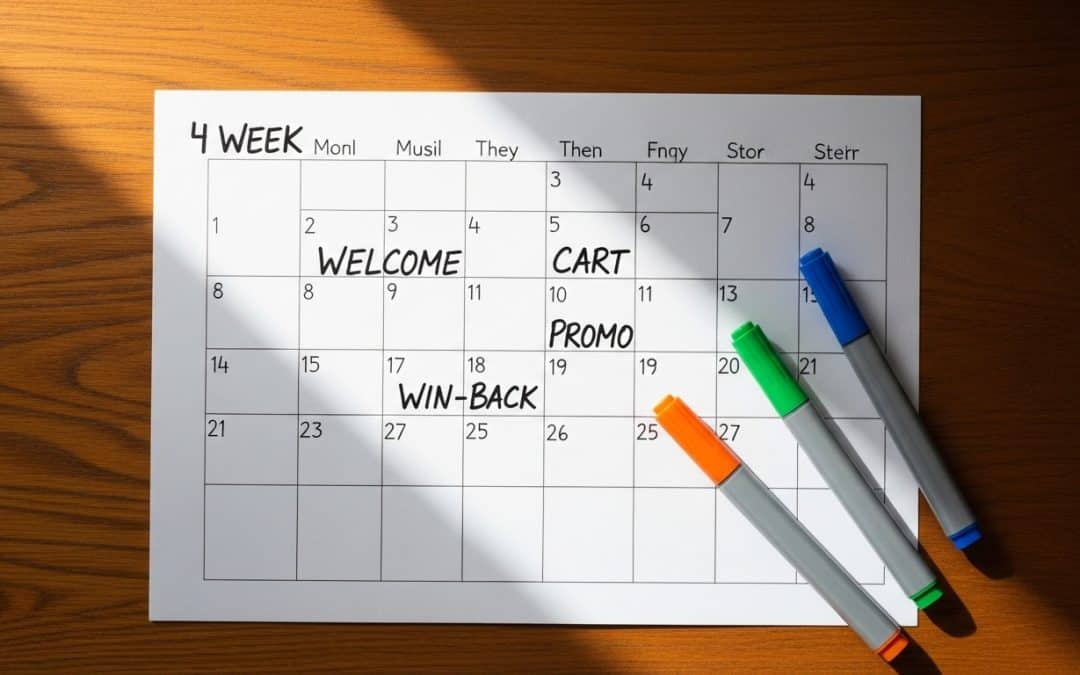
An ecommerce email marketing strategy for South Africa is the structured plan that determines which emails get sent, to which subscribers, at which point in the customer journey — and how automations and campaigns work together to generate consistent email revenue.
Most ecommerce stores have email marketing set up but no actual strategy behind it — they send a newsletter when they feel like it and wonder why email generates under 5% of total store revenue. The stores generating 25–40% of revenue from email have a deliberate email marketing strategy that combines automation flows with segmented campaigns in a structured revenue engine.
A complete ecommerce email strategy has three layers: automation flows that run always-on in the background, segmented campaigns sent to targeted subscriber groups, and email segmentation that ensures each message reaches only the subscribers for whom it is relevant.
Quick Answer
An ecommerce email marketing strategy for South Africa requires four components working together: automation flows covering the full customer lifecycle (welcome series, abandoned cart, post-purchase, win-back), segmented campaigns targeting specific subscriber groups with relevant promotional content, list growth systems generating new subscribers consistently, and performance measurement tracking revenue per email send rather than vanity metrics.
Ecommerce stores that execute all four components correctly generate 25–40% of total store revenue from email — the highest ROI of any digital marketing channel available to ecommerce businesses.
Running an ecommerce store without a structured email strategy — and watching email generate under 10% of your total revenue? We build complete Klaviyo email strategies for SA stores.
Get a Free Email Strategy AssessmentEcommerce Email Marketing Strategy South Africa: The Four-Layer Framework
An ecommerce email marketing strategy for South Africa is best understood as four layers that each serve a different revenue function — and all four must be operating simultaneously for email to reach its full revenue potential.
Layer 1: Automation Flows (Always-On Revenue)
Automation flows are the always-on layer of an ecommerce email strategy — emails that trigger automatically based on customer behaviour and run 24 hours a day without manual involvement.
According to Klaviyo's ecommerce email marketing strategy research, automation flows generate up to 30x more revenue per recipient than one-off campaigns because they are timed to customer behaviour rather than sent to a broad audience at an arbitrary time.
The five automation flows every ecommerce store needs are: welcome series (convert new subscribers to first buyers), abandoned cart flow (recover shoppers who left without purchasing), post-purchase sequence (review request and cross-sell), browse abandonment flow (re-engage product viewers who did not add to cart), and win-back flow (re-engage lapsed customers at 90+ days).
Flows should be built and optimised before campaigns are scaled. Automation is the revenue floor — revenue that comes in every month regardless of whether any campaign is sent that week.
Layer 2: Segmented Campaigns (Active Revenue)
Segmented campaigns are the active revenue layer — deliberately planned email sends to specific subscriber segments timed around promotional moments, new product launches, seasonal events, and content newsletters. Campaigns complement automation flows by generating revenue spikes around high-intent moments that automation alone cannot capture.
Campaign calendar planning should target 6–10 email sends per month across different subscriber segments. Brands on Klaviyo that send 8+ segmented campaigns per month consistently outperform brands sending 2–3 unsegmented broadcasts — because send frequency to engaged subscribers has no negative deliverability impact when segments are correctly maintained.
Layer 3: List Growth (Subscriber Acquisition)
List growth is the input layer — continuously adding new subscribers to the email list so that automation flows and campaigns have a growing audience to convert.
Ecommerce stores with static list sizes plateau in email revenue because automation flows convert a percentage of new subscribers, campaigns reach a fixed audience, and natural churn gradually reduces active subscriber count without new subscriber acquisition.
List growth systems include: website popup forms (targeting first-time visitors before exit intent), checkout email capture (capturing email from shoppers who do not complete purchase), social lead forms (Meta or LinkedIn lead gen forms connected to Klaviyo), and post-purchase referral incentives (encouraging existing customers to refer new subscribers).
Layer 4: Performance Measurement
Performance measurement is the optimisation layer — tracking revenue per recipient, open rates, click rates, unsubscribe rates, and flow conversion rates across all automation flows and campaigns.
Measurement enables strategy adjustments: which flows need copy improvements, which campaign segments generate highest RPR, which send times generate best open rates for subscribers in South Africa.
The Email Revenue Mix Target
A well-structured ecommerce email strategy should generate revenue in the following approximate split at maturity: automation flows 55–65% of total email revenue (always-on, no manual effort required), campaigns 35–45% of total email revenue (active promotional sends).
Stores where campaigns generate over 80% of email revenue have under-configured automation — flows are being substituted by manual campaign effort, which is unsustainable at scale. Automation should always be the larger revenue contributor.
Ecommerce Email Marketing Strategy South Africa: Campaign Calendar
An ecommerce email campaign calendar structures which campaigns are sent to which segments across each month — preventing ad hoc sending, list fatigue from over-sending, and missed revenue moments from under-sending. South African ecommerce stores have South African campaign calendar moments that global email templates do not account for.
High-Priority Campaign Moments
| Campaign Moment | Timing | Target Segment | Revenue Priority |
|---|---|---|---|
| Black Friday SA | Late November | All engaged subscribers | 🔴 Critical |
| Cyber Monday SA | Early December | Non-purchasers from Black Friday | 🔴 Critical |
| Festive season | December | VIP + active buyers | 🔴 Critical |
| January back-to-school | January | Relevant category buyers | 🟡 High |
| Valentine's Day SA | Early February | Gift category buyers | 🟡 High |
| Heritage Month | September | All engaged subscribers | 🟡 High |
| Women's Month | August | Female subscriber segment | 🟡 High |
| Monthly new arrivals | Monthly | Active buyers by category | 🟢 Standard |
| Win-back campaign | Quarterly | Lapsed 90–180 day segment | 🟢 Standard |
Want a complete ecommerce email campaign calendar built for your specific store — with flow configuration and segment strategy included?
Get Your Free Email Campaign Calendar ConsultationEcommerce Email Marketing Strategy South Africa: Illustrative Results
This example is illustrative: the figures are modelled to show how the approach works, not a client's measured results.
A Johannesburg homeware ecommerce store on Shopify had email set up but no strategy — one monthly newsletter to their entire 3,400-subscriber list, no automation flows, no segmentation. Email was generating R7,800/month — 4% of total store revenue. After implementing a complete four-layer email strategy over 10 weeks, email performance transformed across every metric.
| Email Layer | Before | After (Month 6) |
|---|---|---|
| Automation flow revenue | R0/month | R34,200/month |
| Campaign revenue (segmented) | R7,800/month (1 unsegmented send) | R22,400/month (8 segmented sends) |
| Total email revenue | R7,800/month | R56,600/month |
| Email as % of store revenue | 4% | 31% |
| Average open rate | 11.2% | 34.8% |
| Unsubscribe rate per send | 0.9% | 0.18% |
| Active list size | 3,400 (all) | 2,100 (engaged segment) |
| Klaviyo plan cost | $100/month | $60/month (after list hygiene) |
Email revenue grew from R7,800 to R56,600/month — a 7x increase from the same Klaviyo account and a smaller active list.
Automation flows contributed 60% of total email revenue (R34,200) despite requiring no ongoing manual effort after setup. Segmented campaigns contributed 40% (R22,400) from 8 targeted sends to specific subscriber groups instead of 1 unsegmented blast to the full list.
Why Strategy Beats Volume
The store in the example above sent fewer emails after implementing the strategy than before — 8 segmented sends versus 1 broadcast send to 3,400 subscribers.
Total email sends decreased.
Total email revenue increased by 7x. This is the core principle of an ecommerce email strategy: relevance and timing generate revenue, not raw send volume. Businesses that increase email sending frequency without strategy get unsubscribes and deliverability problems. Businesses that increase email relevance through segmentation and automation get revenue and subscriber retention.
How Growth Pulse Media Builds Ecommerce Email Strategies
Growth Pulse Media builds complete ecommerce email marketing strategies for South African ecommerce businesses on Shopify — covering all four strategy layers: automation flow configuration (all five core flows with South African copy and Shopify data integration),
Campaign calendar planning (monthly schedule with segment mapping for each send), list growth system setup (website popup, checkout capture, post-purchase referral), and monthly performance reporting (revenue per flow, revenue per campaign, blended email ROI).
Our ecommerce background means we understand the operator reality of email strategy — Black Friday email planning in South Africa is different from global playbooks, PayFast payment references in cart abandonment copy convert differently from generic checkout copy, and South African customers respond to local trust signals that international email templates omit.
All email strategy work is executed in-house using Klaviyo — the same platform we have used on our own ecommerce operations.
Who This Is NOT For
A full ecommerce email marketing strategy is not the right starting point for every store at every stage.
Your Shopify store has fewer than 200 monthly visitors. Email strategy generates revenue from existing traffic and subscribers — it does not generate traffic.
Stores with under 200 monthly sessions do not have sufficient traffic to build meaningful subscriber lists from website popups or checkout capture. Fix traffic first through Google Ads or SEO content, then implement email strategy once monthly sessions consistently exceed 500.
You want email strategy without automation flows. Email campaigns without automation flows generate sporadic revenue that requires constant manual effort to sustain. Automation is the foundation — campaigns are the enhancement. Businesses that want to run campaigns only are choosing the harder, more expensive path to email revenue. Automate first, campaign second.
You want to send daily emails to your entire list. High-frequency unsegmented sending is the fastest way to destroy email deliverability and subscriber trust.
Send frequency should increase only as list segmentation improves — daily sends are appropriate only for highly engaged segments during peak moments like Black Friday week. Outside peak moments, 2–3 weekly sends to engaged segments is the maximum frequency that preserves deliverability for most ecommerce stores.
You are looking for the cheapest email tool rather than the best email strategy. Email platform cost is the smallest variable in email marketing ROI.
Klaviyo at $150/month generating R80,000/month in email revenue has a 53x return on platform cost. Choosing a cheaper platform that generates R15,000/month in email revenue saves R1,500/month on platform cost while losing R65,000/month in revenue. Optimise for email revenue, not platform cost.
Ready to find out what a structured ecommerce email strategy would generate for your specific store — with projected Rand revenue per layer before you commit?
Get Your Free Email Strategy Revenue ProjectionEcommerce Email Marketing Strategy South Africa: Frequently Asked Questions
What is an ecommerce email marketing strategy for South Africa?
An ecommerce email marketing strategy for South Africa is the structured plan covering four layers: automation flows (always-on revenue from welcome series, abandoned cart, post-purchase, browse abandonment, and win-back), segmented campaigns (planned sends to specific subscriber groups), list growth systems (continuous new subscriber acquisition), and performance measurement (revenue tracking per flow and campaign).
Stores executing all four layers consistently generate 25–40% of total revenue from email.
How much of ecommerce revenue should come from email marketing?
A well-structured ecommerce email marketing strategy should generate 25–40% of total store revenue from email.
Stores generating under 10% of revenue from email are typically missing automation flows — running campaigns only without always-on automation. Stores generating over 40% of revenue from email are performing exceptionally well or are under-investing in paid acquisition channels. The 25–40% email revenue benchmark applies to Shopify stores with 500+ monthly visitors and active Klaviyo automation flows.
How many emails should an ecommerce store send per month?
Ecommerce stores should target 6–10 segmented campaign sends per month to their active engaged subscriber segment, in addition to automation flows that trigger continuously based on customer behaviour.
Sending fewer than 4 campaigns per month leaves promotional revenue on the table. Sending more than 12 campaigns per month without advanced segmentation risks list fatigue and deliverability damage. Send frequency should increase proportionally with list size and segmentation sophistication.
What is the difference between email flows and email campaigns?
Email flows are behaviour-triggered automated sequences — they send automatically when a customer takes a specific action (subscribing, abandoning a cart, purchasing).
Email campaigns are manually planned sends to subscriber segments at a chosen time — promotions, new product announcements, seasonal content.
Flows generate always-on revenue with no ongoing manual effort after setup. Campaigns generate revenue spikes around promotional moments but require ongoing planning and execution. Both are required for a complete ecommerce email strategy.
Which Klaviyo flows generate the most revenue for ecommerce stores?
For South African ecommerce stores, the highest-revenue Klaviyo flows are typically: abandoned cart flow (generates the highest revenue per recipient of any flow — Klaviyo benchmarks show $3.65 RPR versus $0.11 for standard campaigns),
Welcome series (converts new subscribers to first-time buyers at 1.97% average placed order rate), and post-purchase cross-sell sequence (59.77% average open rate — the highest of any flow type).
Win-back and browse abandonment flows add material incremental revenue once the three primary flows are live and optimised.
How long does it take to see email revenue from a strategy implementation?
Email automation flows generate revenue within days of going live — abandoned cart flows begin recovering cart abandoners from first trigger.
Segmented campaigns generate revenue from first send.
List growth systems take 4–6 weeks to produce meaningful new subscriber volume from website popups and checkout capture. The full four-layer email strategy — flows live, campaigns running, list growing, performance measured — typically reaches stable monthly email revenue between months 2–3 of consistent execution.
Ready to Build an Ecommerce Email Strategy That Generates 25–40% of Your Store Revenue — Automatically?
Growth Pulse Media builds complete ecommerce email marketing strategies for South African Shopify stores — all five automation flows, monthly campaign calendar, list growth setup, and monthly revenue reporting. All executed in-house using Klaviyo by operators who have run ecommerce at scale. No obligation — we will get back to you within 24 hours.
Get Your Free Email Strategy Consultation