
 Add to Preferred Sources
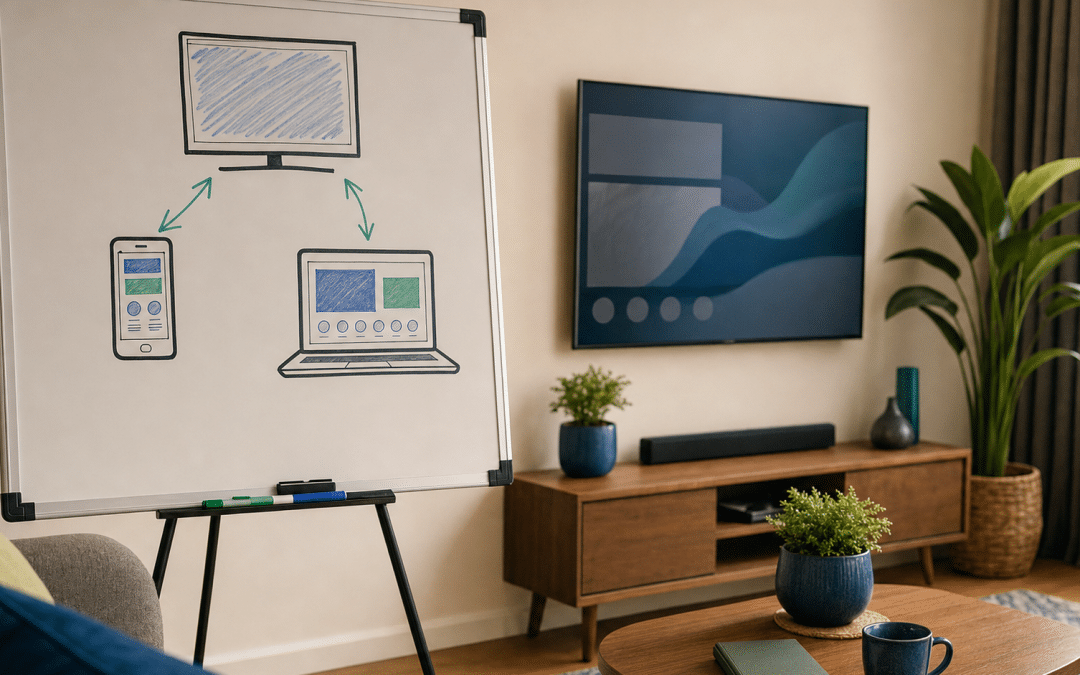
Connected TV is television delivered over the internet to a screen in the lounge, such as a smart TV, a Chromecast or a game console, and it lets advertisers place video ads there instead of buying a fixed slot on a broadcast channel. In South Africa the part of it you can buy yourself today is YouTube on the TV screen, which runs through Google Ads; we found no published self-serve route for the rest, which broadcasters and agencies handle.
The searcher's real question is usually "can my business use it, and what would it cost?" This post answers that with the South African numbers that are public, says plainly where public data runs out, and gives a decision table for whether to test it. For the nearest self-serve route, see our post on YouTube ads in South Africa.
Quick Answer
Connected TV advertising in South Africa means video ads on internet-connected television screens. A small advertiser can reach those screens through YouTube video campaigns in Google Ads, where TV screens appears as a device; confirm in your own account what you can adjust. We found no published self-serve route for other streaming inventory, so ask the broadcaster or an agency. The only published South African spend example is one agency's five clients at R1.2M to R10M a year. Measure it as awareness, not last-click sales.
Is YouTube already spending your budget on TV screens?
Send us your current Google Ads video campaign setup and we will show you how its device settings are configured and what to check.
What Is Connected TV Advertising in South Africa?
Connected TV advertising is the sale of video ad slots inside streaming content watched on an internet-connected television, as opposed to a scheduled slot on a broadcast channel. It is a delivery route, not a separate medium: the same video can run on a phone, a laptop or the TV in the lounge.
South Africa has the audience for it. In a June 2026 piece, TDMC says more than 8 million South African households have a smart TV. It also cites Google South Africa research putting connected TV at 32.6% of all YouTube watch time in the country, with connected TV watch time up 16% and views up 29%; the piece does not state the period for that growth. It adds that pay-TV fell 9.6% in a single year to 6.7 million subscribers (TDMC via Bizcommunity). These are TDMC's and Google's figures, not an independent audit.
Adoption is still early. Reach Africa's Leslie Adams wrote in August 2025 that South Africa is in an emerging phase and that adoption may lag global trends by two to three years (IT-Online).
What you can actually buy is narrower than the audience suggests:
| Where the ad runs | How it is bought | Status in South Africa | Best for |
|---|---|---|---|
| YouTube on a TV screen | Self-serve through Google Ads video campaigns | TV screens is a device in video campaign targeting; for scale, 3Vision forecasts $191M of total YouTube ad revenue in South Africa in 2026, all devices | Any advertiser who can supply a video and a test budget |
| DStv Stream | We found no published route; ask the broadcaster's sales team or a media agency | Ad-supported platform; Showmax was due to close on 30 April 2026 and its originals and select titles move to DStv Stream | Planned brand campaigns with agency support |
| Free ad-supported channels (FAST) | No published route found; ask the platform operators or an agency | Small: 3Vision forecasts $3.1M in 2026, rising to $10.7M by 2031 | Niche reach tests; not a starting point |
| Netflix | No route found | Stuff reported in May 2026 that South Africa was not among 15 countries newly given the ad tier | Nothing to plan around yet |
The DStv Stream row comes from TechCentral's March 2026 report that DStv Stream is an ad-supported platform; Marklives and 3Vision both later refer to the April 2026 Showmax closure. The YouTube and FAST forecasts are from 3Vision's July 2026 forecast; the FAST figure is for South Africa. The Netflix row comes from Stuff, whose list of 15 newly added countries did not include South Africa.
Quick Answer: What Can I Buy Today?
For most South African advertisers, the buyable connected TV inventory is YouTube viewed on a television screen, bought through Google Ads. DStv Stream carries ads, but we found no published self-serve route, so ask the broadcaster or an agency. FAST is small, and Netflix was not among the countries newly given an ad tier in May 2026.
How Do You Buy Ads on Television Screens Without a Broadcaster?
Small advertisers buy connected TV ads by running YouTube video campaigns in Google Ads and treating "TV screens" as a device in targeting and reporting. Google introduced the TV screens device type in October 2018, describing it as covering "set-top boxes, gaming consoles, streaming devices like Chromecasts and smart TVs of all stripes", and said advertisers could use a different creative or a specific device bid adjustment (Google, 2018).
Google Ads Help still lists TV screens among the devices a video campaign can reach: "Target users using computers, smart phones, mobile devices and TV screen devices like Chromecast" (Google Ads Help). That Help page does not say which campaign types allow device bid adjustments, and the 2018 announcement is old, so confirm in your own account which campaign types offer them.
Three practical steps follow from that:
- Segment the report by device. A device split tells you how much of your video spend landed on TV screens, so you stop guessing.
- Decide whether the TV screen deserves its own creative. A viewer on a sofa in front of a large screen is a different context from a commuter on a phone. Our post on how to write an advert that sells covers the message itself.
- Keep programmatic separate. Buying streaming inventory through a demand-side platform is a different route with different minimums; our programmatic advertising guide covers what that involves.
Not sure video belongs in your Google Ads mix?
Tell us your monthly budget and the one action you need, and we will give you an honest fit assessment before you spend anything.
How Much Does Streaming Advertising Cost in South Africa?
South Africa has no published rate card for streaming ad slots, and the people who buy it say so: René Fowler of Juno told Marklives in May 2026 that "there's still very limited publicly available South African data specifically isolating sponsored streaming or CTV investment". Any article that quotes you one tidy South African CTV CPM is repeating a vendor or a guess.
The one concrete data point is a range of spend. Alex Mac Neill of Connect told the same publication that five of Connect's clients invest in streaming consistently, at annual amounts from R1.2M to R10M over several years, across quick-service restaurants, retail, FMCG and telecoms (Marklives). It describes five clients of one agency: it is not a market average or a minimum.
One agency's range as a monthly budget
R1.2M a year divided by 12 months is R100,000 a month. R10M a year divided by 12 is about R833,000 a month. Those are the monthly equivalents for the five advertisers in that agency's example, so treat them as an illustration of what planned buys can look like, not as a price of entry.
For the self-serve route, costs follow YouTube pricing, not a separate CTV price list. Our YouTube advertising cost post covers per-view and per-thousand figures, and video production cost covers the other bill that arrives with the first campaign. Check the broader picture in digital advertising spend in South Africa.
Quick Answer: What Does It Cost?
There is no public South African rate card for streaming ads. The only published spend example is one agency's five clients investing R1.2M to R10M a year, about R100,000 to R833,000 a month; it is not a market average. Self-serve YouTube on TV screens is priced like other YouTube video and can start much smaller.
How Do You Measure Streaming Advertising When Last-Click Cannot See It?
Streaming ads are measured as an upper-funnel channel: by reach, completed views and shifts in demand you already capture, because a viewer watching on a sofa has no link to click. Neil Pursey of Measurebyte told Marklives that tying exposure of a streaming ad to the final purchase is close to impossible, and that most mid-market brands cannot access the data clean rooms that would help.
The industry is changing how television itself is counted. TDMC reports that GfK replaces Nielsen as South Africa's TV audience measurement provider, with a new daily TV currency launching on 1 January 2027 and broadcaster on-demand and streaming added by the end of 2027. Until then, expect different platforms to report different things.
| Signal | What it can tell you | What it cannot tell you | Best for |
|---|---|---|---|
| Completed views and reach in Google Ads | Whether people watched, split by device | Whether watching led to a purchase | Checking delivery and creative |
| Branded search volume in Search Console | A change in how often people look you up by name | Why it moved: seasonality, other campaigns and PR are rival explanations | Directional demand read |
| Direct and branded traffic in GA4 | Whether visits that arrive without a click are moving | Which ad caused them | Cross-checking the other signals |
| Holdout by region or period | A cleaner comparison of exposed and unexposed demand | Anything if the test is too small or too short to separate from noise | Larger budgets with patience |
As a working rule of thumb rather than a platform rule, decide in advance what movement in branded search or direct visits you would count as a signal, and compare it against a period without the campaign. For a wider method, see our marketing channel testing framework.
Should Your Business Test Streaming Advertising Right Now?
A business should test connected TV campaigns only if its search and social acquisition already work and it has a video worth showing on a large screen; otherwise that budget is better spent on search and social first. The table below sorts situations by constraint, as our own judgement rather than measured evidence.
| Your situation | Sensible route | Verdict |
|---|---|---|
| Local service business, small budget, needs enquiries this month | Fix search and the enquiry path first; see display ads or video later | Skip for now |
| Ecommerce brand with working search and social, wants more reach | YouTube video campaigns in Google Ads with a device split to see the TV screen share | Reasonable small test |
| National FMCG, retail or telecoms brand supplementing linear TV | Planned streaming buy through an agency or the broadcaster, including DStv Stream | Worth a plan, with budgets set by the agency or broadcaster rather than this post |
| You need proof of sales from every Rand | Search and shopping campaigns, where clicks are tracked | Poor fit |
The case for reach beyond linear is real. TDMC says just 21% of the population absorbs 61% of TV ad impressions and that linear TV caps at 60-63% reach, after which extra spend mostly adds frequency. That argument suits a national advertiser; it does not tell a local plumber to buy a streaming slot. For the trade-off against another traditional channel, see radio vs digital advertising costs.
What Makes an Advert Work on a Lounge Screen?
Connected TV ads work when the brand and the offer land in the first seconds and the video looks as though it was made for a large screen. A video made for a phone feed, cropped or low in resolution, shows its flaws on a big display.
Put the brand name and the single offer early, because skippable formats give you a short window. Use a clear call to action that works without a click: a memorable name to search for, or a short web address. Keep audio and on-screen text legible from a distance. If your only video is a vertical phone clip, ask whether you need a proper horizontal version first.
Built for the sofa. A horizontal video that names the brand in the first seconds, makes one offer and ends on a search-friendly name or short URL, so viewers can find you on their phone.
A phone clip on a big screen. A vertical video with small captions and the offer in the last seconds, which a skipping viewer never reaches.
Want a second opinion before you commission video?
Send us your channel mix and budget and we will audit where video fits and where it does not, with no obligation.
Why South African Businesses Choose Growth Pulse Media
Growth Pulse Media is a Johannesburg agency that runs Google Ads from the commercial question first: what the spend has to return. Our Google Ads management service starts from the account you have, not a pitch.
Founder Dirk van Greuning built and scaled a large South African ecommerce business before starting the agency, so the advice comes from the operator's side of the desk. All work is executed in-house and the client load is limited for senior attention. We do not buy broadcaster inventory such as DStv Stream; our scope here is Google Ads.
Who This Is NOT For
You need a broadcaster or agency media plan. If you are planning a national streaming buy at the scale of the Connect example, R1.2M to R10M a year, you need a media agency and the broadcaster's sales team. We cover the Google Ads route.
You need sales proof by next month. Streaming is an awareness route and its effect shows up indirectly. Start with search if you need trackable enquiries now.
You have no video and no plan to make one. Without a usable horizontal video there is nothing to run, and production is a cost you must plan for first.
Frequently Asked Questions
What is connected TV advertising?
Connected TV advertising is video advertising shown inside streaming content on an internet-connected television, such as a smart TV, Chromecast or game console. It replaces a scheduled broadcast slot with an ad delivered over the internet.
How do I advertise on connected TV in South Africa?
The self-serve route is YouTube video campaigns in Google Ads, where TV screens appears as a device in targeting and reporting. We found no published self-serve route for other platforms, including the ad-supported DStv Stream, so ask the broadcaster or a media agency.
How much does connected TV advertising cost in South Africa?
There is no public South African rate card. The one published example is one agency's five Connect clients investing between R1.2M and R10M a year in streaming, about R100,000 to R833,000 a month; it is not a market average. Self-serve YouTube is priced like other YouTube video campaigns.
Does Netflix show ads in South Africa?
Stuff reported in May 2026 that Netflix expanded its ad-supported tier to 15 more countries and that South Africa was not among them. We found no published way for South African advertisers to buy Netflix inventory, so check Netflix directly before planning around it.
How do you measure streaming ad results?
Measure it as awareness: completed views and reach in the ad platform, and changes in branded search and direct visits compared with a period without the campaign. A viewer on a sofa cannot click, so last-click reporting understates it and a measurement specialist told Marklives that linking exposure to purchase is close to impossible.
Put video on the screen that matters, with a plan behind it
Send us your Google Ads account, your goals and any video you already own, and we will tell you where it fits. Our work covers Google Ads, GA4 and Search Console. No obligation: we will get back to you within 24 hours.
