
 Add to Preferred Sources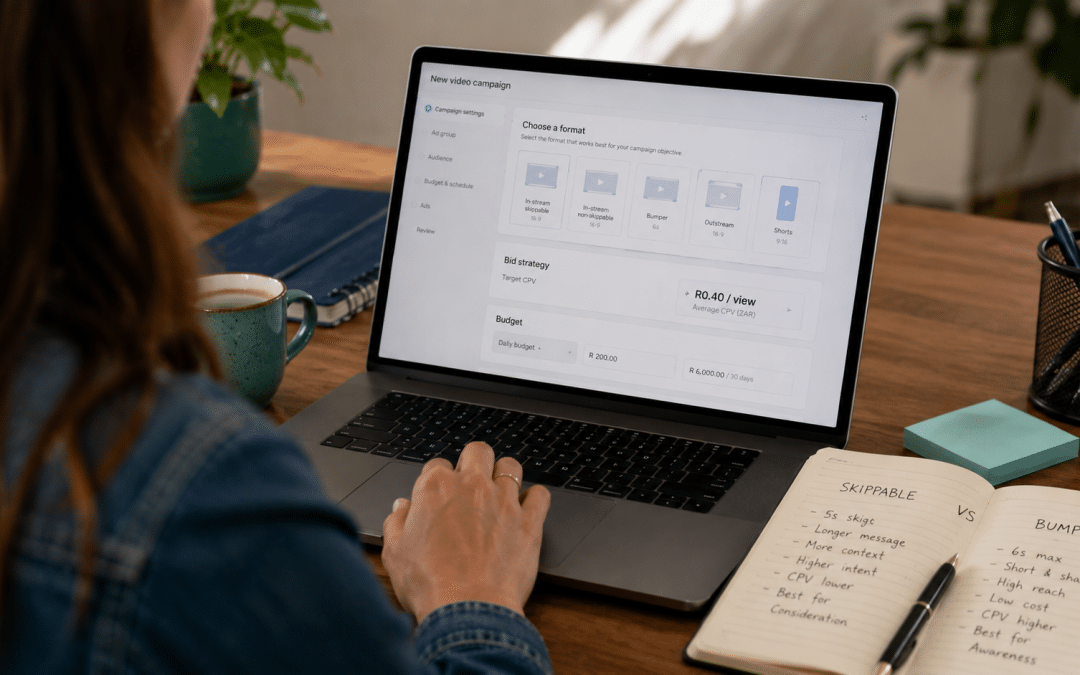
YouTube ads south africa campaigns are video adverts bought through Google Ads that run before, during, and around YouTube videos — and for most SA businesses they buy reach and brand attention far cheaper than search clicks, often at a cost per view of just R0.20 to R0.60.
They run on two pricing models: pay-per-view for skippable formats, and pay-per-thousand-impressions for short awareness spots. This guide covers the formats, what they cost in Rand, and when video is actually the right move for an SA business.
It sits within our Google Ads South Africa guide and covers the video channel specifically, which the rest of the cluster — built around search — does not. Where search captures people already looking, video works differently: it creates demand and builds awareness. Here the focus is using that channel without wasting budget.
Quick Answer
YouTube advertising runs through Google Ads as Video campaigns, using formats like skippable in-stream (you pay per view via CPV bidding, only when someone watches 30 seconds or interacts), 6-second non-skippable bumpers (sold on CPM), in-feed discovery spots, and Shorts placements. In South Africa, expect roughly R0.20–R0.60 per view and R40–R100 CPM for awareness formats — much cheaper reach than search.
The strategic catch is that video is mostly an awareness and consideration channel, not a capture-intent one like search. It is excellent at putting your brand in front of the right SA audience cheaply, but it rarely converts as directly as a search campaign catching someone mid-purchase. Used for the right goal — reach, recall, retargeting warm viewers — it is one of the best-value channels available locally.
Thinking about video but unsure it will pay back for your specific SA business and goal?
Get a Free Video Channel AssessmentHow YouTube Advertising Actually Works
The youtube ads south africa channel runs entirely through Google Ads as a Video campaign, so if you already run search, the account and billing are the same — you are simply choosing a video objective and format.
You upload a clip to your channel, pick who should see it by audience and interest, set a budget, and the platform serves your spot across YouTube and Google's partner sites. The mechanics mirror search; the creative and intent are what differ.
That shared plumbing is why video is an easy extension rather than a separate discipline for an SA business already advertising with Google. The targeting options — demographics, interests, topics, remarketing to past visitors — are familiar. What changes is that you are interrupting someone mid-content rather than answering a query they typed, which shapes both the creative it needs and the results you should expect.
Same Account, Different Intent
Because video runs inside the same Google Ads account as your search campaigns, the temptation is to expect the same behaviour from it — and that is the most common mistake an SA business makes here. Search catches demand that already exists; video interrupts people to create demand that does not yet exist. The plumbing is shared, but the job is not.
Judge the video channel on awareness, reach, view-through, and the warm audiences it builds — not purely on last-click sales, which will always flatter search. An SA business that measures video against search's conversion rate will wrongly conclude video does not work, when in reality it was being asked to do a job it was never built for.
The Ad Formats and How You Pay for Them
The youtube ads south africa toolkit offers a handful of formats, and the format you choose sets both how your message lands and how you pay for it.
Skippable in-stream spots play before or during videos and can be skipped after five seconds; with cost-per-view bidding you only pay when a viewer watches 30 seconds, the full spot if shorter, or interacts. The six-second bumper cannot be skipped and are sold per thousand impressions, ideal for cheap, repeated brand recall.
Beyond those, non-skippable in-stream spots of 15 seconds or less guarantee your full message on a CPM basis, in-feed placements appear where people browse and discover content, and Shorts reach the fast-scrolling mobile feed. Each suits a different goal, so picking the format is really picking what you want the campaign to achieve. The table below maps the main options for an SA business.
| Format | How You Pay & Best Use for an SA Business |
|---|---|
| Skippable in-stream | CPV — pay per 30s view or interaction; consideration, storytelling, retargeting |
| Bumper (6s) | CPM — cheap, repeated 6-second brand recall; awareness at scale |
| Non-skippable (15s) | CPM — full message guaranteed; launches, strong single offers |
| In-feed & Shorts | Discovery and mobile reach; lighter-touch awareness and engagement |
Not sure whether bumpers, skippable spots, or a mix fits your goal and budget?
Get a Free Format RecommendationChoosing the Format Is Choosing the Goal
The biggest format mistake an SA business makes is picking one spot type and forcing it at every objective. A 6-second bumper is built for cheap, repeated recall; a skippable in-stream spot is built for consideration and storytelling; an action format is built to drive conversions. Using a bumper to chase sales, or a long story spot to chase reach, fights the format's own design.
Decide the goal first — recall, consideration, or conversion — then let that choose the format, the bidding model, and how you judge success. An SA business that starts from the objective rather than the creative it happens to have will spend far more efficiently, because each Rand is pointed at a format actually built to deliver the outcome it wants.
What YouTube Ads Cost in South Africa
The cost of youtube ads south africa is best understood through the channel's two pricing models, not a single rate — and on both, it buys attention more cheaply than search buys clicks.
For skippable spots on cost-per-view bidding, an SA business typically pays in the region of R0.20 to R0.60 per qualified view, meaning you only spend when someone genuinely watches. For bumpers and other awareness formats sold on CPM, expect roughly R40 to R100 per thousand impressions.
Those figures move with your targeting, audience competition, and creative quality, but the headline holds: reach is cheap on video. A modest budget that would generate a handful of Google search clicks can deliver thousands of video views or tens of thousands of impressions. The trap is mistaking that cheap reach for cheap sales — low cost per view is only valuable if the views move people toward your business.
Cheap Views Are Not the Same as Cheap Customers
The headline metric on the video channel — a cost per view of a few cents in Rand — is genuinely impressive and genuinely misleading if read alone. An SA business can rack up enormous view counts at tiny cost and feel the campaign is winning, while almost none of those viewers ever become customers. Reach is the easy part; relevance is the hard part.
The number that matters is not cost per view but whether those views drive measurable lifts — branded search, site visits, warm audiences you can retarget, eventual conversions. Treat the low view cost as the price of attention, then judge the channel on what that attention does next. Cheap reach pointed at the wrong people is just cheap waste at scale.
When YouTube Ads Make Sense for an SA Business
Video earns its place when your goal is awareness, consideration, or building a warm audience — not when you need to capture someone at the moment of purchase.
The youtube ads south africa channel shines for an SA business launching a product, building brand recognition in a crowded market, telling a story that text and static images never could, or warming up audiences you will later convert through search and retargeting. It fills the top and middle of the funnel that search alone leaves empty.
It is weaker as a direct-response workhorse. If your entire goal is leads or sales this month and your budget is tight, search usually delivers more directly because it catches existing intent.
The smart SA play is rarely video instead of search — it is video alongside search, with the channel creating and warming demand that search and remarketing then capture. Many strong accounts pair it with social formats on the Meta ads channel for full coverage.
| Before (video judged like search) | After (video used for its real job) |
|---|---|
| Bumpers expected to drive direct sales | Bumpers run for recall — cheap repeated brand reach |
| Killed for low last-click conversions | Judged on view-through & warm audiences — kept and scaled |
| One long video for every goal | Format matched to objective — spend works harder |
| Run instead of search | Run alongside search — demand created then captured |
How Growth Pulse Media Approaches YouTube Ads
Most SA agencies either avoid the video channel entirely or run a single skippable spot at every goal, judge it on last-click sales, and quietly conclude it does not work. The honest approach starts with the goal: match the format to whether you want recall, consideration, or warm-audience building, measure the channel on the job it actually does, and pair it with search so the demand video creates is captured rather than lost.
Dirk built and scaled an SA business across Google's channels, where video was used deliberately to create demand that search then converted — and a campaign was judged on its real contribution to pipeline, not on a last-click number that was always going to favour search. That operator habit means video is treated as a funnel-building tool with clear measurement, not a vanity-view machine or a search substitute.
SA businesses wanting video campaigns built around the right goal and measured honestly can use our Google Ads management service, covering format selection, audience targeting, creative direction, and measurement that credits video for the demand it builds. We run it alongside your search and wider Google Ads strategy so the two channels reinforce rather than compete.
Who YouTube Ads Are NOT For
The video channel is not the right move for every SA business. Here is who should approach it with caution.
Tiny budgets needing sales this month: An SA business with a small budget and an urgent need for leads or sales should usually put that money into search, which catches existing demand directly. Video creates demand over time and rarely delivers immediate last-click sales. Spreading a tight budget into awareness video before capturing existing intent often leaves both channels underpowered and disappointing.
Businesses with no video creative: The channel lives or dies on the strength of the video itself, and an SA business with no footage and no budget to make any cannot run it well. A weak, hastily-made spot wastes even cheap views. If producing a competent video is genuinely off the table, that budget belongs in formats that do not depend on it.
Those who measure only last-click sales: If your reporting credits only the final click before a sale, video will always look like a failure because its contribution sits earlier in the journey. An SA business unwilling to measure view-through, branded search lift, or warm-audience value will keep killing video unfairly. Without the right measurement, the channel cannot show its real worth.
Niche B2B with a tiny target audience: Some SA businesses sell to such a small, specific group that broad video reach mostly hits irrelevant viewers. Where the addressable audience is tiny and highly specific, the cheap-reach advantage evaporates and tighter channels like search or targeted paid social usually serve better. Broad reach only helps when reach is what you actually need.
Want an honest read on whether video fits your goal, budget, and audience before you spend?
Get a Free Video Strategy SessionThe discipline that ties this together is matching the channel to the job and measuring it on that job, rather than expecting video to behave like search. Per Google's own documentation on Video campaigns, the formats are built for different objectives — bumpers for awareness, skippable spots for consideration, action formats for conversions — so choosing the format is really choosing the goal. Use the wrong format for your goal and even cheap reach disappoints.
For an SA business in 2026, the path is clear: use video to create and warm demand cheaply, match the format to the objective, pair it with search to capture the intent it generates, and measure it on view-through and warm-audience value rather than last-click sales.
Done that way, the video channel is one of the best-value tools in the local mix. Treated as a search substitute, it disappoints — not because it fails, but because it was asked to do the wrong job.
Frequently Asked Questions
How much do YouTube ads cost in South Africa?
On skippable formats with cost-per-view bidding, an SA business typically pays around R0.20–R0.60 per qualified view, spending only when someone watches 30 seconds or interacts. Awareness formats like 6-second bumpers are sold per thousand impressions, usually around R40–R100 CPM. These ranges shift with targeting, competition, and creative quality, but video consistently buys reach more cheaply than search buys clicks.
Are YouTube ads worth it for South African businesses?
They are excellent value for awareness, consideration, and building warm audiences, but weaker as a direct-response channel than search. A video campaign shines for launches, brand-building, and warming audiences you later convert. If your only goal is immediate sales on a tight budget, search usually delivers more directly. The strongest results come from running video alongside search, not instead of it.
How do YouTube ads actually run?
They run through Google Ads as Video campaigns, using the same account, billing, and targeting as search. You upload a clip to your channel, choose an objective and format, set targeting and budget, and the platform serves your spot across YouTube and Google partner sites. If you already run search, it is an extension of the same account rather than a separate system.
What YouTube ad formats are available?
The main formats are skippable in-stream (skip after 5 seconds, paid per view), 6-second non-skippable bumpers (paid on CPM), non-skippable 15-second in-stream spots, in-feed discovery, and Shorts. Each suits a different goal, so choosing a format is effectively choosing what you want the campaign to achieve — recall, consideration, a guaranteed full message, or mobile discovery.
Should I use YouTube ads or Google search ads?
They do different jobs, so the answer is usually both. Search catches people already looking and converts intent directly; video creates and warms demand earlier in the journey at much cheaper reach. An SA business with a tight, sales-focused budget should prioritise search, then add video to build the demand search captures. Run together, they reinforce each other rather than compete.
How do I measure if YouTube ads are working?
Judge them on the job they do, not on last-click sales alone, which will always favour search. Track view-through, branded search lift, site visits, the warm audiences built for retargeting, and assisted conversions. An SA business that measures video only on final-click sales will wrongly conclude it fails. Credit the channel for the demand it creates earlier in the journey.
Want a Video Channel That Builds Demand, Not Just Views?
Growth Pulse Media builds YouTube and Google video campaigns for SA businesses around the right goal — matching format to objective, targeting the local audience, and measuring the channel on demand created, not vanity metrics. Real operator experience using video to create demand that search then converts. No obligation — we will get back to you within 24 hours with an honest read on whether video fits your goal and budget.
Get Your Free YouTube Ads Strategy Call