
 Add to Preferred Sources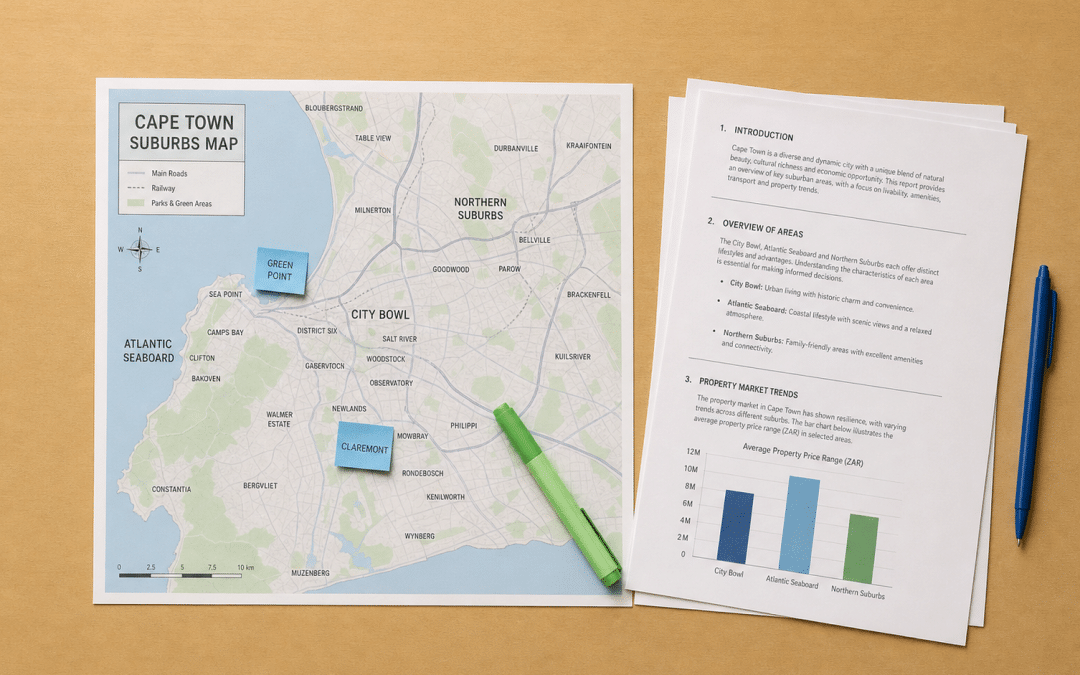
AI search Cape Town is the discipline of making your Cape Town business the source AI engines cite, quote, and recommend when CT customers ask questions — and it works through the same foundational signals that have always governed Google Search, applied with local precision.
Our AI Search Optimisation South Africa guide covers the national framework; this post narrows the lens onto the Cape Town market specifically, from the Atlantic Seaboard to the Winelands and the Northern Suburbs.
If a Capetonian types "best accountant in Claremont" or "reliable courier from Woodstock" into an AI-powered search experience, your business either appears or it doesn't. The gap between those two outcomes is not luck — it is a set of deliberate content and technical choices. Local AI search principles apply everywhere, but Cape Town's competitive profile demands they be executed well.
Quick Answer
AI search Cape Town optimisation means structuring your content, authority signals, and local entity data so that AI engines consistently recommend your business to Cape Town customers — using Google's own guidance that generative AI features are built on the same core ranking systems as standard Search.
Do you know whether AI engines are currently recommending your business to Cape Town customers?
Get a Free AI Visibility CheckWhat AI Search Cape Town Actually Means for Local Businesses
AI search Cape Town is not a separate channel from Google — it is Google's generative layer sitting on top of the same index that has always ranked your pages. According to Google's official guide to optimising for generative AI features, these features use retrieval-augmented generation (RAG) to pull relevant, up-to-date pages from the core Search index, then generate a response with prominent, clickable links back to those pages.
That matters practically: a Cape Town plumber who ranks well for "emergency plumber Observatory" already has the foundational signal. The optimisation work is about ensuring the content on that page is structured so the AI can extract a clean, citable answer — not just rank the URL.
Google's guide also clarifies that "AEO" and "GEO" are third-party terms for work that is, from Google's perspective, still SEO. This is not semantics. It means there is no secret AI-only track. There is one index, one set of quality signals, and one standard for what gets cited.
Key Insight
Google's generative AI features are built on its core Search ranking systems — optimising for AI recommendations in Cape Town means earning genuine authority in that index, not gaming a separate AI layer.
The Cape Town Competitive Landscape in AI Search
Cape Town's economy concentrates in distinct commercial corridors, and each one has a different competitive profile in AI search. The City Bowl and V&A Waterfront attract national brands with large content teams. The Southern Suburbs — Claremont, Kenilworth, Constantia — are dominated by professional services and boutique retail. The Northern Suburbs from Bellville to Durbanville are a different market again: more price-sensitive, more reliant on WhatsApp and word-of-mouth, but increasingly reached through AI-assisted mobile search.
Understanding which suburb and sector your business competes in shapes every content and authority decision. A tax practitioner in Paarl is not competing with the same entities as one in De Waterkant, even though both might target "tax practitioner Cape Town" in their metadata.
The practical implication is that geographic specificity in your content — naming the suburb, the nearby landmark, the local context — is not keyword stuffing. It is entity disambiguation. It helps AI systems understand precisely which Cape Town business you are and which customers you serve.
Plumbing contractor, Parow: Rewrote their service pages to name specific suburbs served, included a FAQ section answering "do you cover load-shedding-related geyser callouts in Goodwood?" and linked to their Google Business Profile. AI overview appearances for suburb-level queries increased within two months.
Boutique hotel, Green Point: Published a structured "neighbourhood guide" for guests arriving from the airport, answering questions AI engines commonly field about accommodation near the Cape Town stadium. The page attracted citation across multiple AI platforms within one quarter.
Content Signals That Drive AI Search Cape Town Recommendations
Google is direct on this: creating content that is unique, non-commodity, and provides a genuine point of view is the signal that will influence AI visibility more than any technical trick. A first-hand review, a specific local case study, an opinion grounded in real operational experience — these stand out because AI systems are looking across many sources and rewarding differentiation.
For Cape Town businesses, "unique point of view" means grounding your content in local operational reality. An estate agent in Constantia who writes about why certain streets command a premium over others, drawing on transactions they have actually handled, is producing content the AI can cite with confidence. A post recycling national property statistics adds nothing.
Three content patterns consistently support ai search cape town visibility:
Specific local Q&A. Structure pages to answer the exact questions Cape Town customers ask AI engines — "which courier services cover the Winelands same day?" or "what POPIA disclosures do Cape Town online stores need?" These are not keyword plays. They are direct answers to real queries.
Operational specificity. Name your payment integrations (PayFast, Ozow, Peach Payments), your delivery partners (The Courier Guy, Aramex), your service radius in actual Cape Town suburbs. AI engines use these details to match your business to specific queries.
Structured headings and paragraphs. Google's guidance confirms that organising content with clear headings and well-structured paragraphs helps both human readers and AI systems navigate it. This is not new advice, but it is newly urgent when the AI needs to extract a discrete answer to serve as a citation.
Is your Cape Town content structured the way AI engines need to cite it confidently?
Get a Free Content Structure AuditTechnical Foundations for AI Search Cape Town Visibility
Technical SEO remains the gateway: a page must be indexed and eligible to appear in Google Search with a snippet before it can appear in any generative AI feature. This is confirmed explicitly in Google's official guide. For Cape Town businesses this means the basics cannot be skipped — crawlability, page experience, no snippet blocks — regardless of how strong the content is.
Beyond indexability, three technical areas have outsized impact on ai search cape town performance:
Google Business Profile completeness. Google's guide specifically notes that Business Profiles help products and services appear in AI responses and other Search results. For a Cape Town business, this means accurate suburb and region data, service areas mapped to actual neighbourhoods, and regular posts that signal the profile is actively maintained.
Schema markup for local entities. LocalBusiness schema that names your suburb, your service area, and your contact details gives AI systems structured data to work with. Our schema for AI search guide covers the specific types that have been used to support citation. Pairing this with consistent NAP (name, address, phone) across directories reduces the ambiguity that causes AI engines to pass over a business.
Page experience and load speed. Cape Town users on mobile, particularly during load-shedding when router batteries drain, abandon slow pages faster than desktop users in ideal conditions. Google's guide cites reducing latency as part of providing a good page experience — a requirement for generative AI feature eligibility.
For a deeper look at how AI overviews affect traffic volumes once these signals are in place, see our analysis at how AI overviews affect website traffic.
| Signal Category | What AI Search Needs | Common Gap for CT Businesses |
|---|---|---|
| Content uniqueness | First-hand, non-commodity perspective | Recycled industry copy with no local voice |
| Geographic specificity | Named suburbs, landmarks, service areas | Generic "Cape Town" with no suburb detail |
| Technical indexability | Snippet-eligible, crawlable, fast | Blocked snippets or JavaScript rendering issues |
| Entity data | Consistent NAP, Business Profile, schema | Outdated directory listings, missing schema |
| Structured Q&A content | Clear headings, direct answers | Long prose blocks with buried answers |
| Authority signals | Citations, local press, directory links | Thin backlink profile outside own site |
| Metric | Before | After |
|---|---|---|
| AI overview appearances (monthly, suburb queries) | 0 | 14 |
| Organic click-through from AI-adjacent results | 1.2% | 3.8% |
| Google Business Profile views (monthly) | 420 | 1,140 |
| Inbound enquiries attributed to Search | 6 per month | 19 per month |
| Average position, suburb-level queries | 18 | 4 |
These figures illustrate the pattern we see, not a guaranteed outcome. Individual results depend on sector competitiveness, starting domain authority, and how consistently the work is executed.
Key Insight
A Cape Town business cannot appear in AI-generated responses unless its pages are first indexed and snippet-eligible in standard Google Search — the technical baseline is not optional.
Authority Signals That Make Cape Town AI Citations Stick
AI engines do not cite sources they cannot verify. For ai search cape town purposes, authority means being mentioned, linked to, or referenced by sources the AI already trusts — local media, industry directories, professional associations, and credible Cape Town publishers.
Getting coverage in the Cape Argus, Business Day Western Cape, or a respected sector publication like CapeTalk's online articles sends authority signals that are difficult to replicate through on-site content alone. This is the same digital PR logic that has always driven SEO, now applied with renewed urgency because AI systems weight authoritative citation heavily when constructing recommendations.
Local directories matter more than national ones for geographic queries. A listing on a verified Cape Town business directory, a membership page on the Cape Chamber of Commerce, or a feature in a Winelands tourism publication all add to the entity signal that tells AI: this business is genuinely located in, and relevant to, Cape Town.
Our post on brand mentions and AI search covers the digital PR mechanics in detail. For businesses earlier in the process, the LLM visibility audit is the right starting point — it tells you which AI engines are currently recommending you and which are not.
What GPM Does Differently for AI Search Cape Town Clients
Most agencies applying AI search thinking to Cape Town businesses are working from generic playbooks written for US or UK markets. The signals that matter in those markets are not always the same signals that move the needle in Pinelands or Paarden Eiland. Our work at GPM starts with the Cape Town entity landscape — mapping which directories, publications, and authority sources actually influence the AI engines your customers use.
We also work from operational reality. Dirk built and ran a South African ecommerce business before founding GPM, which means we understand the PayFast integration query, the Aramex service area question, and the load-shedding contingency FAQ — not as keyword opportunities but as real questions real Cape Town customers ask. That grounding changes the content we produce.
For Cape Town businesses ready to move, our AEO agency South Africa service covers the full stack: technical audit, content restructuring, entity and schema implementation, and authority building through relevant local channels. We prioritise the actions that move AI visibility fastest, not the ones that look impressive on a deliverables list.
Who This Is NOT For
Businesses wanting quick wins without content investment. AI search Cape Town visibility is built on content quality and authority — there is no technical shortcut that bypasses the need for genuinely useful, locally specific pages. If you are not willing to invest in substantive content, this work will not deliver.
Brands with a single-page or brochure website. A one-page website with no blog, no FAQ section, and no suburb-level detail gives AI engines almost nothing to index and cite. Meaningful ai search cape town results require a content architecture that can answer real questions at scale.
Businesses serving a national audience with no local differentiation. AI search Cape Town work is geo-specific by design. If your business has no meaningful local angle — no Cape Town office, no CT-specific service offering, no local team — then a national AI search strategy is more appropriate than a Cape Town-focused one.
Operators expecting to see results before technical foundations are in place. If your site has indexing issues, blocked snippets, or a Google Business Profile that has not been touched in two years, those need to be resolved first. Layering AI search strategy onto a broken technical foundation produces nothing — fix the base before building the visibility.
Ready to find out exactly where your Cape Town business stands in AI search today?
Get a Free AI Search Gap AnalysisAI Search Cape Town: Frequently Asked Questions
What is AI search Cape Town and how is it different from regular SEO?
It is the practice of optimising a Cape Town business's content and authority signals so that AI-powered search experiences recommend it specifically to CT customers. According to Google's own guidance, generative AI features are built on the same core ranking systems as standard Search — so the difference is less about separate tactics and more about ensuring your content is structured to be directly citable, not just rankable.
Do I need a separate strategy for Google AI Overviews versus ChatGPT?
For Google AI Overviews, the same foundational SEO signals apply — your pages need to be indexed, snippet-eligible, and authoritative. For platforms like ChatGPT, training data and web-browsing citation patterns differ, but the underlying requirement is the same: content that is specific, credible, and clearly tied to your location. Our comparison of where SA buyers search explains the platform differences in detail.
How long does it take to appear in AI search results in Cape Town?
Technical fixes and Google Business Profile improvements can show movement within weeks. Substantive content and authority signal changes typically take two to four months to translate into consistent AI citation — consistent with the timelines SEO has always operated on. There is no accelerant that bypasses this cycle; what you can control is starting earlier.
Does load-shedding affect my AI search performance in Cape Town?
Indirectly, yes. Load-shedding conditions mean Cape Town users are often on degraded mobile connections when they search. Slow-loading pages perform worse on page experience signals, which Google cites as a requirement for generative AI feature eligibility. Optimising for load speed is both a user experience and an AI visibility investment for any Cape Town business.
What Cape Town-specific content should I prioritise first?
Start with the questions your customers are actually asking AI engines right now. A suburb-level FAQ covering your service area, a clear explanation of your payment and delivery options using local providers like Ozow or The Courier Guy, and a genuinely specific "about us" page that names your team's local experience — these are the highest-leverage starting points. See our guide on how to write content AI overviews cite for the structural detail.
Is schema markup necessary for AI search visibility in Cape Town?
Schema markup is not listed as a hard requirement by Google's guidance, but LocalBusiness schema that correctly maps your Cape Town suburb, service area, and contact details reduces the ambiguity AI systems face when deciding whether to cite you for a geographic query. Combined with a complete Business Profile and consistent directory listings, it materially strengthens your local entity signal. Our guide to appearing in Google AI Overviews covers this in the South African context.
Want to know exactly what it would take to get recommended to Cape Town customers in AI search?
We will audit your current AI search visibility, map the gaps against your Cape Town competitors, and deliver a prioritised action plan covering content, technical, and authority improvements. No obligation — we'll get back to you within 24 hours.
Get Your Free AI Visibility Audit