
 Add to Preferred Sources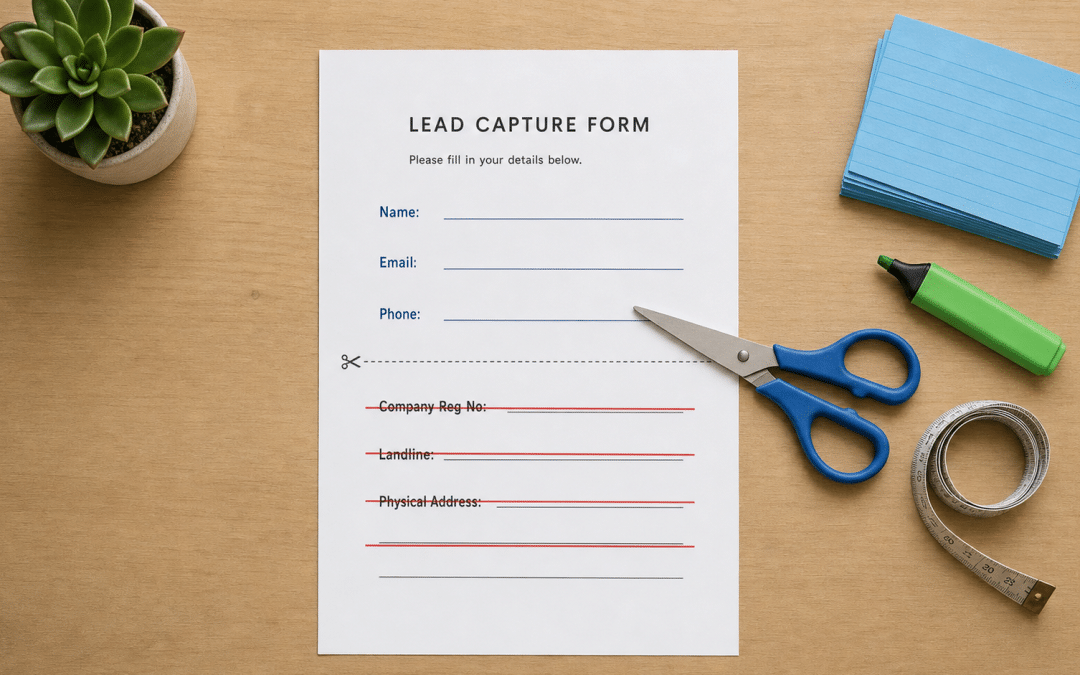
Form optimisation south africa is the practice of reworking the fields, layout and flow of your lead forms so more of the traffic you already pay for actually converts. It sits inside the broader conversion rate optimisation discipline, but forms are where most South African sites bleed leads fastest, long before checkout or landing page copy even come into play.
Most SA lead forms lose people to friction, not disinterest: a mobile visitor on limited data staring at nine required fields on a form built for desktop. Get the fundamentals right — see our guide to what conversion rate optimisation actually means for SA businesses — and the same ad spend starts producing measurably more enquiries.
Quick Answer
Form optimisation south africa works by removing unnecessary fields, clarifying labels, and shortening the path to submit — most SA businesses that do this properly see more completed leads from the same traffic within weeks, without paying for a single extra click.
Wondering how many leads your current form is quietly turning away?
Get a Free Form AuditWhat Is Form Optimisation South Africa?
It is the process of testing individual form elements — field count, labels, button copy, error handling — against real completion data, then keeping only what earns its place. Nothing here happens on assumption; every change ships as a test with a measurable before-and-after figure.
Where landing page optimisation gets someone to the page and checkout optimisation gets them to pay, form optimisation sits in between: the enquiry form, the quote request, the newsletter signup, the demo booking. Get this layer wrong and every rand spent upstream leaks out through a field nobody wanted to fill in.
For B2B operators, form optimisation south africa matters even more than it does for retail, because a single missed enquiry can be a lost contract worth tens of thousands of rand, not one abandoned cart worth a few hundred.
Most South African businesses run this alongside broader CRO work rather than as a standalone project, because the same testing infrastructure — traffic, tooling, a way to measure completions — serves both.
Key Insight
A form that asks for a company registration number before a first name is a form built for the business's convenience, not the buyer's — and it costs you enquiries every day it stays live.
Why South African Forms Leak Leads
South African forms leak leads because most were built once, on a desktop screen, and never adjusted for how local traffic actually arrives now. A form designed years ago for a keyboard and a wide monitor is a poor fit for a visitor scrolling on a phone with limited data.
Most SA web traffic today arrives on mobile, and every extra field on a bloated form template costs the visitor their own airtime, not just their patience. A ten-field enquiry form with an autoplaying background video is not a design choice — it is a tax on people trying to get a quote from their phone.
Payment behaviour tells the same story. Someone paying by instant EFT through Ozow or Peach Payments has already decided to move fast, and a form that demands a landline number or a full postal address before it will even validate an email address gives that decision time to cool off.
WhatsApp is increasingly the contact channel of choice for enquiries here, yet plenty of SA lead forms still only offer an email field and a landline-format phone field, missing the channel a large share of buyers would actually prefer to use.
This is precisely where form optimisation south africa earns its keep — not a full site redesign, but the removal of the specific friction points local buyers hit first, in the order they hit them.
The Fields That Kill Conversions On South African Forms
The fields that kill conversions on South African lead forms are the ones asking for information the business does not need at first contact — VAT numbers, landline numbers, full addresses, and province dropdowns that Gauteng visitors have to scroll past to find their own province.
Every additional required field is a decision point, and decision points are where a visitor on the Gautrain or standing in a queue closes the tab rather than finishes typing. Cut a form from nine fields to four and you have not simplified the design — you have removed four separate reasons to abandon.
The same pattern shows up in Baymard Institute's cart abandonment research: a checkout that feels too long or complicated is a leading reason shoppers abandon, and Baymard's own benchmark shows most sites can cut the form elements they display by 20 to 60% without losing information they actually use downstream. Lead forms carry the same risk, just earlier in the funnel.
The logic mirrors cart abandonment in ecommerce: extra friction at the point of commitment is consistently one of the biggest reasons people leave without completing. A form optimisation south africa audit typically starts here, because field-by-field friction is the fastest thing to fix and the easiest thing to measure.
A common SA pattern: a services business asks for annual turnover, industry sector and preferred contact time on a first-touch enquiry form — three questions that belong in a qualifying call once someone has raised their hand, not before.
There's also a compliance angle worth naming. POPIA's conditions for processing personal information are generally read to mean you should collect only what a defined purpose requires, so a lead form asking for an ID number "just in case" carries compliance exposure most businesses do not need to hold onto.
Key Insight
Every field you remove from a lead form is a decision you are making on the visitor's behalf — remove the ones that do not change how you follow up, and completion rates move immediately.
Not sure which fields on your form are actually necessary?
Get a Free Field-by-Field ReviewMobile-First Form Design For South African Traffic
Mobile-first form design for South African traffic means building the form for a small screen and a variable connection first, then scaling up for desktop — not the other way round. Most local visitors will never see the desktop version at all.
Practical fixes matter more than clever ones here: single-column layout so nothing sits side by side on a narrow screen, number-pad keyboards that trigger automatically on phone fields, and autofill that actually works instead of fighting the browser. None of this requires a redesign — most of it is a template setting.
Outside the metros, in towns across Limpopo, the Eastern Cape and rural KwaZulu-Natal, connectivity is patchier and data costs bite harder, so every unnecessary field has an outsized effect on completion compared with a visitor browsing on fibre in Sandton or the Cape Town CBD.
Confirming any of this works means testing it properly rather than trusting instinct — running a proper split test with enough traffic that the result reflects a real shift and not weekend noise from a handful of visits.
Mobile-first form design is one half of the equation; the other half is classic form optimisation south africa work — fewer fields, clearer error states, an obvious next step after submit.
B2B Lead Forms vs Retail Forms: What Changes
B2B lead forms and retail forms need different optimisation because a B2B enquiry is worth a personal follow-up while a retail signup needs to convert with zero friction and zero conversation. Treat them the same way and you will under-serve one of them.
A B2B quote request can usually afford five or six fields, including a short note on what the buyer needs, because a sales team is going to call and a little context speeds up that first conversation. A retail newsletter or promo signup should ask for almost nothing — an email address or a WhatsApp number is often enough.
This is the split most agencies miss when they treat form optimisation south africa as one exercise: what converts well on a Sandton IT services quote form will kill completion on a retail-style signup, and the reverse is just as true.
Progressive profiling splits the difference: capture the minimum on the first form, then ask for turnover, industry or budget range only once a lead has been qualified as worth the follow-up, rather than screening people out before they've even asked a question.
Key Insight
A quote request form and a newsletter signup are not the same product — treat them with the same field count and you will under-qualify the first and over-friction the second.
Framework: What To Fix First
The framework below shows how a form optimisation south africa project typically prioritises fixes, ranking each element by how much friction it removes against how much effort it takes to change.
| Form Element | Typical SA Default | Optimisation Move |
|---|---|---|
| Phone number field | Required, landline format assumed | Make optional or accept mobile-only format |
| Company / VAT number | Required upfront on B2B forms | Move to post-submission qualification step |
| Physical address | Full address required for a quote | Ask only for suburb or metro at first contact |
| Submit button copy | Generic "Submit" | Specific action, e.g. "Get My Quote" |
| Error messaging | Field turns red with no explanation | Inline message naming exactly what's wrong |
The figures below illustrate the pattern we see, not a guaranteed outcome, when a South African B2B services business cuts an enquiry form from nine fields to four and rewrites the button copy to name the specific action.
| Metric | Before | After |
|---|---|---|
| Form fields | 9 required fields | 4 required fields |
| Monthly form completions | 40 completions/month | 68 completions/month |
| Completion rate | 2.1% of form-page visitors | 3.6% of form-page visitors (+71%) |
| Cost per qualified lead | R850 per lead | R495 per lead |
How GPM Approaches Form Optimisation South Africa
GPM treats every lead form as a measurable asset sitting between your ad spend and your CRM, not a static page element nobody revisits after launch. Our conversion rate optimisation team starts with a full audit of your current form.
Our form optimisation south africa process narrows that audit to the two or three changes most likely to move completion, rather than redesigning everything at once and losing track of what actually worked. We report the shift in real numbers — completions, cost per lead, and where people are still dropping off.
Dirk van Greuning built and scaled a South African ecommerce operation before founding GPM, and the same instinct — cut what the buyer does not need to see — shapes how the team approaches every form it touches.
We also test copy and design changes in isolation, one at a time, so a completion lift can be traced to the specific fix that caused it rather than a bundle of simultaneous changes.
That process sits inside the same broader CRO programme as landing page and checkout work, tracked against one dashboard so a change on the form doesn't get credited — or blamed — for a shift that actually happened somewhere else in the funnel.
Who This Is NOT For
Form optimisation south africa is not a fit for every business at every stage, and saying so upfront saves everyone time. If any of the following sound like your business, fix the underlying issue first.
You get fewer than 50 form-page visitors a month. There isn't enough traffic to reach a reliable result from testing changes; fix your traffic volume first, then come back to the form once there's something meaningful to measure.
Your sales team can't follow up within a few days. A better-converting form just produces more leads that go cold in an inbox; the bottleneck is process, not the form, and fixing the form first only hides the real problem.
You want to test everything at once. Changing field count, layout, copy and design simultaneously makes it impossible to know what actually moved the number, which defeats the point of testing in the first place.
You're mid-rebuild on a new site or CRM. Optimise the form that's about to be replaced and the result won't transfer to the new build; wait until the new form is live before running any tests on it.
Still guessing why your enquiry form underperforms the rest of your site?
Get a Free Form DiagnosticFrequently Asked Questions
What Is Form Optimisation South Africa And Why Does It Matter?
It is the process of testing and refining the fields, layout and flow of a lead form so more visitors complete it, without changing anything upstream. It matters because most South African businesses spend heavily on traffic and comparatively little on what happens once someone lands on the form. A form that converts better turns existing spend into more enquiries without any extra budget.
How Many Fields Should A South African Lead Form Have?
Most B2B enquiry forms perform best with four to six fields — name, contact detail, company, and a brief note on what's needed. Retail newsletter or promo signups should aim for one or two fields, usually just an email address or a WhatsApp number. Add fields only when your sales or fulfilment team genuinely can't act without that specific piece of information.
How Long Does Form Optimisation South Africa Take To Show Results?
Most SA businesses see the first measurable shift within two to four weeks once a test is live, depending on how much traffic reaches the form page. Full-funnel movement — more qualified leads reaching your sales team — typically shows up over a full quarter. Low-traffic forms take longer simply because they need more visits to reach a reliable result.
Does Form Optimisation Work For B2B Quote Request Forms?
Yes, and the fixes usually pay off faster on B2B forms because a single extra completed enquiry can be worth far more than one retail sale.
The changes are similar — fewer required fields upfront, clearer next-step copy — but B2B forms can afford to ask a qualifying question or two that a retail signup should never include. The line is drawn by how long a buyer will tolerate being asked before deciding you're wasting their time.
What's The Difference Between Form Optimisation And Landing Page Optimisation?
Landing page optimisation covers everything above the form — headline, proof, layout, offer — while form optimisation covers the fields, labels and flow inside the form itself. They work together: a strong landing page that feeds a badly built form still loses the visitor at the last step. Most CRO programmes test both, just not at the same time.
What Does Form Optimisation South Africa Typically Cost?
Costs vary depending on how many forms are in play, how much testing traffic each one gets, and whether you need new design work alongside the testing itself. It's generally a smaller investment than a full site rebuild, because you're testing and refining what already exists rather than starting again. Ask any agency quoting you a fixed monthly figure to show exactly what they're testing for that price, not just what they're changing.
Ready to see what your lead form could be converting?
We'll run a focused form optimisation south africa audit on your current lead forms and hand you a prioritised action plan, ranked by expected impact and effort. No obligation — we'll get back to you within 24 hours.
Get Your Free Form Audit