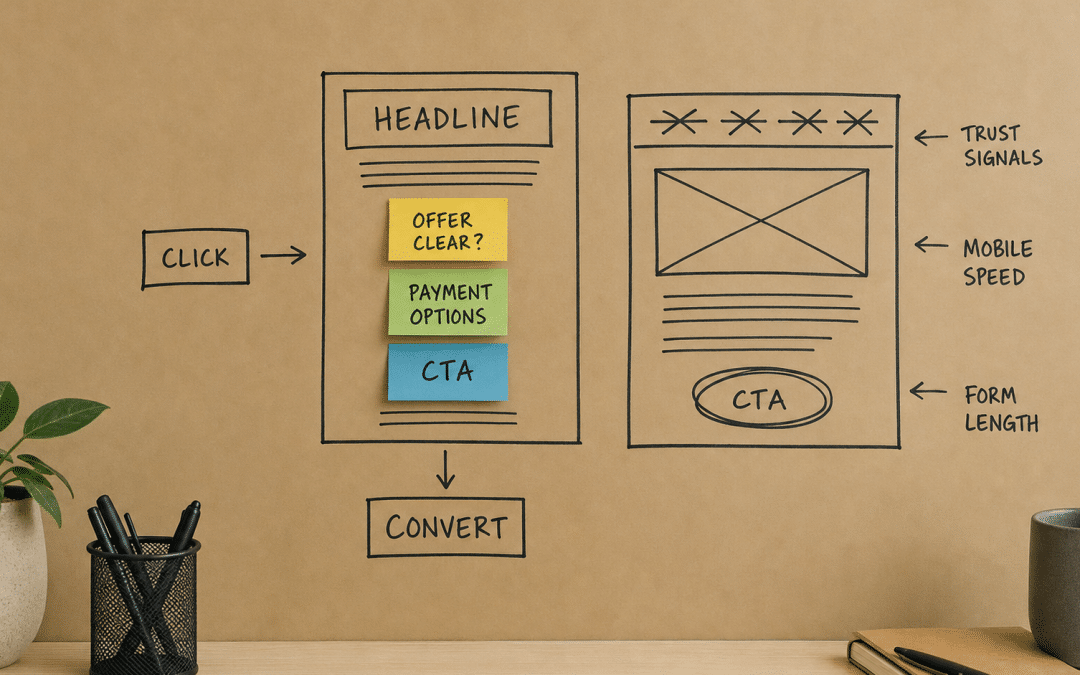
Landing page optimisation South Africa is the disciplined process of removing every friction point between a visitor's click and their conversion — and it is the highest-leverage activity available to most South African businesses running paid or organic traffic right now.
If your ads are profitable but your conversion rate is stuck below 2%, the page is the problem, not the channel. Start with our CRO guide for South Africa to understand the full framework before diving into the page-level fixes below.
The local context matters. South African visitors arrive on mobile at disproportionate rates, often on data-conscious connections, and they carry genuine scepticism about checkout security — particularly around card payments. An overseas template will miss all of that.
This post covers the specific levers that move South African conversion rates, from trust signals to payment-method sequencing to copy that resonates in this market. See also our piece on what conversion rate optimisation actually means for businesses here.
Quick Answer
Landing page optimisation South Africa means systematically testing and fixing the elements that cause South African visitors to leave without converting: slow mobile load times, mismatched trust signals, hidden costs, wrong payment options, and copy written for a foreign audience. Fix these in priority order and conversion rates climb without increasing ad spend.
Is your landing page losing South African visitors before they even reach the CTA?
Get a Free Landing Page AuditWhat Landing Page Optimisation South Africa Actually Means
Landing page optimisation South Africa refers to the ongoing, evidence-based process of improving specific page elements — headline, offer, form, CTA, trust signals, load speed — until more of the right visitors complete the desired action. It is not a redesign exercise. It is a measurement discipline.
Most businesses conflate design with optimisation. A beautiful page that loads in four seconds on a Vodacom LTE connection, hides the delivery cost until checkout, and lists no recognisable local payment method is a well-designed failure. Optimisation identifies which specific element is suppressing conversions and tests a fix — one change, measured against a control, with a sample large enough to trust.
The distinction between landing page optimisation South Africa and general web design matters because the levers differ. Design asks "does this look good?". Optimisation asks "does this change behaviour?". Every decision must trace back to data: heatmaps, session recordings, form-drop analysis, and — where traffic allows — controlled A/B testing.
Why South African Landing Pages Underperform
South African landing pages underperform primarily because they are built on assumptions drawn from overseas markets, then left unexamined once traffic starts flowing. The local conditions that drive drop-off are specific and fixable.
Mobile load time. The majority of South African traffic arrives on mobile. A page with uncompressed hero images and undeferred scripts will render slowly on mid-range Android devices common in Johannesburg, Durban, and Cape Town. Visitors on data-limited connections do not wait — they bounce before the CTA even renders.
Trust signals that don't translate. A McAfee badge or a generic "SSL Secured" footer note does not reassure a South African shopper the way a PayFast or Peach Payments logo does. Local visitors recognise local brands. PayFast, Ozow, and the major bank logos carry real credibility. Generic international security seals carry almost none.
Hidden delivery costs. According to Baymard Institute's cart abandonment research, extra costs being too high is the leading avoidable reason shoppers abandon — cited by 40% of non-browsing abandoners. In South Africa, where courier coverage outside the metros can mean a R150 surcharge to a Limpopo address, revealing that cost only at checkout is a conversion killer.
Payment-method mismatch. South African buyers — particularly in B2B and among older demographics — have a strong preference for EFT over card. A landing page that offers only card entry and no instant-EFT option via Ozow or a similar gateway leaves a material segment of visitors with no usable path to conversion.
Key Insight
The single fastest win in landing page optimisation South Africa is surfacing the delivery cost — and the payment options — before the visitor reaches the checkout. Hiding either creates a trust gap that no headline test will close.
The Landing Page Optimisation South Africa Priority Stack
Landing page optimisation South Africa produces the fastest returns when changes are sequenced by impact, not by ease. Start where drop-off is highest and work backwards toward the traffic source.
1. Page speed. Compress every image. Defer non-critical scripts. Use a host with South African edge nodes or a CDN with Johannesburg presence so time-to-first-byte is competitive. A one-second improvement in load time has been shown in multiple studies to produce a material uplift in mobile conversion rates — direction confirmed, magnitude varies by category.
2. Headline-offer alignment. The headline must match the ad or organic result the visitor clicked. If your Google Ad says "Sectional Garage Doors — Installed in Gauteng" and the landing page says "Welcome to [Brand]", the visitor's brain registers a mismatch and suspicion rises immediately. Carry the exact language from the traffic source into the first headline.
3. Single, visible CTA. Every secondary link — nav bar, footer links, "you might also like" widgets — competes with the conversion action. Landing pages should suppress navigation and reduce the page to one decision: convert or leave. This is not controversial; it is consistently validated by A/B testing data across markets.
4. Form length. Baymard's checkout research found that 17% of shoppers abandon due to a checkout process that is too long or complicated. The same principle applies to lead-gen forms. Every field you add reduces conversion rate. Request only what is operationally required — name, email, and phone is almost always enough for a first-touch B2B lead form.
5. Social proof, localised. A testimonial from a Sandton CFO or a Durban logistics manager lands harder with a South African B2B buyer than a five-star aggregate rating. Name the company type, the city, and the outcome. Generic "Great service!" quotes do no conversion work.
6. Payment and delivery transparency. Show PayFast, Peach Payments, or Ozow logos above the fold if you sell online. State your delivery partners — The Courier Guy, Aramex — and note coverage limitations honestly. Visitors outside the metros are accustomed to being surprised by slow or unavailable delivery; proactively addressing it builds trust rather than eroding it.
Not sure which element is costing you conversions — speed, trust, or copy?
Get a Free CRO Prioritisation SessionLocal Trust Signals That Actually Convert
Trust signals for landing page optimisation South Africa work when they reference brands, credentials, and guarantees that South African visitors already recognise and value. Borrowed credibility from foreign markets produces almost no lift in this audience.
For ecommerce, the most effective trust elements are: recognised payment gateway logos (PayFast, Peach Payments, Ozow), named courier partners with estimated delivery windows, a clear returns policy that references the Consumer Protection Act, and customer reviews that include the reviewer's province or city.
For B2B lead generation, trust is built differently. Company registration numbers, POPIA-compliant data statements, and named case studies from recognisable South African brands carry the most weight. A POPIA-compliant privacy notice — brief, plain-language, above the form submit button — reduces form abandonment among business buyers who are rightly cautious about data handling under local law.
POPIA requires that data subjects know what their information will be used for before they submit it. A one-line statement beneath your form ("We use your details only to respond to your enquiry — see our privacy policy") addresses this practically without legal overstatement. For anything more specific, have a qualified practitioner review the wording.
| Element | Overseas Default | SA-Optimised Version |
|---|---|---|
| Payment logos | Visa / Mastercard / PayPal | PayFast / Peach Payments / Ozow + Visa / Mastercard |
| Delivery info | "Ships worldwide" | Named courier (The Courier Guy / Aramex) + metro vs. outlying areas note |
| Trust badge | Generic SSL seal | POPIA-compliant data statement above form submit |
| Social proof | Aggregate star rating | Named testimonial with company type and SA city |
| Returns language | "30-day hassle-free returns" | "Returns per the Consumer Protection Act — 10 business days" |
| Pricing | Price shown at checkout | Total cost including delivery shown on landing page |
Before and After: What Structured Optimisation Produces
The figures below illustrate the pattern we see, not a guaranteed outcome. They are drawn from the kinds of changes described throughout this post, applied to pages with material traffic volumes and proper A/B test controls.
| Metric | Before Optimisation | After Optimisation |
|---|---|---|
| Mobile load time (3G) | 5.8 seconds | 2.4 seconds |
| Ecommerce landing page CVR | 1.4% | 3.1% (+121%) |
| B2B lead-gen form CVR | 2.8% | 5.4% (+93%) |
| Cart abandonment rate | 74% | 61% (−18%) |
| Cost per lead (Google Ads) | R980 | R510 (−48%) |
| Revenue per 1,000 sessions | R4,200 | R8,900 (+112%) |
Measuring Landing Page Optimisation South Africa Results
Measurement is what separates landing page optimisation South Africa from guesswork. Without a baseline and a control, every change is an opinion, not an improvement.
Set up goal tracking in Google Analytics 4 before you touch the page. Capture the conversion event — form submission, purchase, phone click — as a GA4 conversion, not just an event. Record the baseline conversion rate across at least two weeks before making changes so you have a reliable starting point.
For pages with enough traffic — typically 500 or more conversions per variant per test — run controlled split tests using Google Optimize alternatives or your CMS's native testing tool.
For lower-traffic pages, use qualitative tools: heatmaps (Hotjar or Microsoft Clarity, both free at entry level), session recordings, and on-page surveys. These do not give you statistical significance but they do tell you where visitors look, where they stop scrolling, and where they abandon the form.
The metric that ties landing page optimisation South Africa back to business value is cost per acquisition, not conversion rate in isolation. A page optimised to convert tyre-kickers at 6% may perform worse commercially than a page converting qualified buyers at 3%. Track both CVR and downstream lead quality — particularly important in B2B where a single converted lead from a Pretoria enterprise account is worth a hundred unqualified form fills.
Key Insight
Conversion rate without downstream quality data is a vanity metric. The goal of landing page optimisation South Africa is lower cost per qualified acquisition, not the highest possible raw form-fill count.
GPM's Approach to Landing Page Optimisation South Africa
We audit the full traffic-to-conversion path before recommending a single change. That means reviewing the ad or organic source, the landing page itself, the checkout or form flow, and the confirmation step — because a leak at any point in that sequence costs money. Our conversion rate optimisation service is structured around that diagnostic first, so every change we recommend has a clear hypothesis and a measurement plan attached to it.
The work Dirk built GPM around was running an actual South African ecommerce business — competing for the same mobile-first, data-sensitive, EFT-preferring audience you are trying to convert. That practical experience shapes how we prioritise: speed and trust signals before headline tests, payment-method sequencing before copy revisions.
We do not import overseas playbooks and hope they translate. We know what the local audience responds to because we have tested it here, on South African traffic, with Rand-denominated results.
We work with businesses across Gauteng, KZN, and the Western Cape, including B2B firms in Pretoria — see our Pretoria digital marketing guide — and product businesses in Durban targeting the broader KZN market.
Who This Is NOT For
Businesses with fewer than 300 monthly sessions. Landing page optimisation South Africa is a traffic-leverage activity. If your page receives fewer than 300 sessions per month, you do not yet have enough data to distinguish signal from noise. Fix the traffic problem first — through SEO, paid search, or both — before optimising the page.
Teams that cannot implement changes. Optimisation produces a prioritised list of hypotheses. If your page lives on a locked CMS, your developer queue is six months long, or your brand team blocks every copy change, the audit has no value. You need the ability to ship changes within days of testing them.
Businesses seeking a one-time fix. A single round of landing page optimisation South Africa will improve results, but the gains erode as your market, competitors, and traffic mix shift. This is a continuous process. Businesses that treat it as a project — do it once, move on — typically see results plateau within a quarter.
Advertisers running broad, unqualified traffic. If your Google Ads campaign targets broad match keywords or your Meta campaign is optimised for reach rather than conversions, the page is not the core problem. Sending unqualified traffic to an optimised page produces better-looking conversion rates on poor-quality leads. Fix audience targeting and ad-to-page message match first.
Ready to find out exactly which element is suppressing your conversion rate?
Get a Free Conversion Audit ReportLanding Page Optimisation South Africa: Frequently Asked Questions
What does landing page optimisation South Africa involve at a practical level?
It involves auditing every element of a specific page — headline, offer, load speed, form, CTA, trust signals, and payment options — against a measurable baseline conversion rate, then testing changes in a controlled sequence. Work typically starts with a heatmap and session recording review, followed by a hypothesis list ranked by expected impact and implementation cost. Changes are shipped, measured, and either kept or rolled back based on results.
How long does it take to see results from landing page optimisation?
Quick-win changes — compressing images, adding local payment logos, removing navigation from a landing page — can produce measurable lifts within one to two weeks if traffic volumes are sufficient. Controlled A/B tests need enough conversions per variant to reach statistical significance, which can take two to eight weeks depending on monthly traffic. Treat the first month as a diagnostic and the second as the first proper test cycle.
Which South African payment methods should appear on a landing page?
At minimum, show PayFast or Peach Payments as your gateway, with card (Visa and Mastercard) and instant-EFT options clearly visible. Ozow has grown materially as an instant-EFT provider and carries genuine trust with South African buyers who prefer not to enter card details. For B2B, add a manual EFT option with clear banking details available on request — many procurement teams will not use a card for supplier payments above a low threshold.
Is A/B testing necessary for landing page optimisation South Africa?
It is necessary for reliable attribution of improvement to a specific change, but it is not always practical at lower traffic volumes. For pages under a few hundred monthly conversions, qualitative tools — heatmaps, session recordings, user surveys — provide enough directional evidence to make confident changes. Formal A/B testing becomes essential once traffic is high enough and the changes being tested are subtle enough that the direction of effect is genuinely uncertain.
How does POPIA affect landing page forms in South Africa?
POPIA requires that visitors understand what their personal information will be used for before they submit it. In practice, this means including a brief, plain-language data-use statement near your form's submit button and linking to a compliant privacy policy. Practices commonly interpret this as requiring an opt-in for marketing communications separate from the form submission itself. For anything beyond a basic enquiry form, have a qualified practitioner review the data-collection flow.
What is a realistic conversion rate improvement from landing page optimisation?
It depends entirely on the baseline and the quality of the current page. Pages that have never been optimised — built from a template, never load-tested on mobile, using overseas trust signals — typically have the most room to move.
A structured optimisation programme on a previously unoptimised page regularly produces doubling or better of the baseline conversion rate over two to three test cycles. Pages that have already had several optimisation rounds will see smaller incremental gains. The before/after table earlier in this post illustrates the pattern we see across our work.
Want to know exactly where your landing page is losing South African visitors?
We will audit your page, map the drop-off points, and deliver a prioritised action plan of changes ranked by impact and effort. No obligation — we'll get back to you within 24 hours.
Get Your Free Landing Page Audit