
 Add to Preferred Sources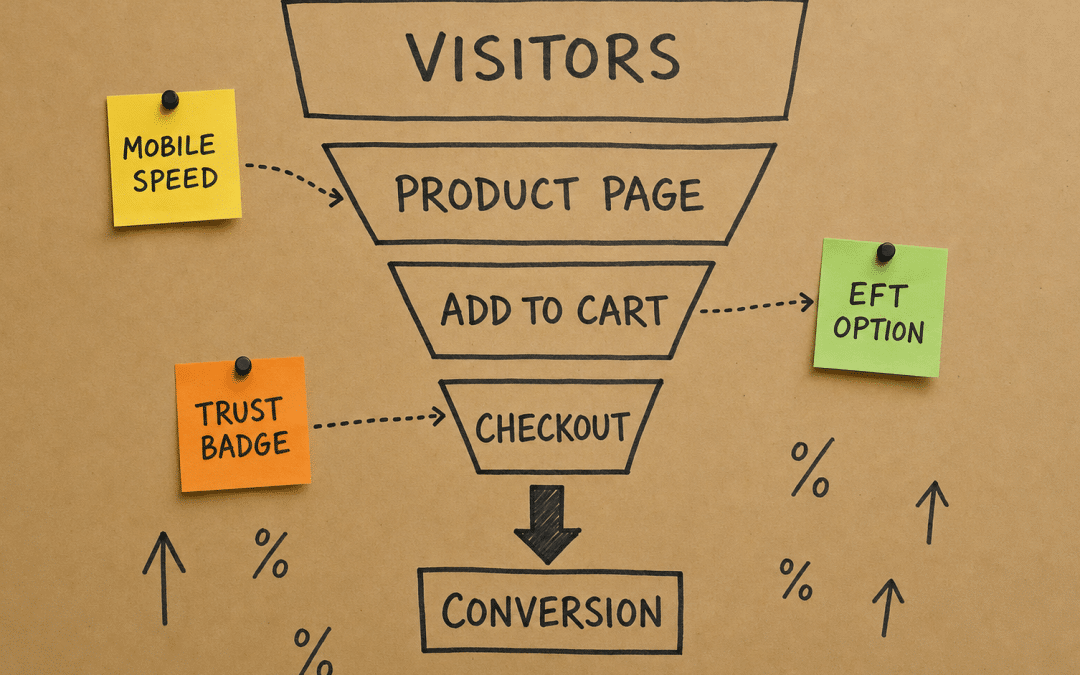
What is conversion rate optimisation? It is the practice of systematically increasing the percentage of website visitors who take a desired action — buying, enquiring, booking — without spending more on traffic. If you are running paid ads into a site that converts poorly, you are paying to fill a leaking bucket.
Our CRO guide for South Africa covers the full methodology; this post gives you the foundational definition and explains why the concept matters differently here than it does in London or New York.
South African sites carry specific friction points that generic CRO advice ignores: EFT preference over card, mobile-first traffic on constrained data plans, courier coverage anxiety beyond the metros, and POPIA-compliant consent flows that add checkout steps if built carelessly. Understanding what conversion rate optimisation means in this market is the first step to fixing those leaks methodically rather than by guessing.
Quick Answer
What is conversion rate optimisation? It is a structured process of testing and improving your website so that more of your existing visitors convert into leads or customers — cutting your effective cost per acquisition without increasing ad spend.
Not sure where your site is losing customers right now?
Get a Free Conversion AuditWhat Is Conversion Rate Optimisation and How Is It Measured?
The answer to what is conversion rate optimisation is precise: it is the discipline of raising the ratio of conversions to sessions through evidence-based changes to design, copy, and flow — measured by dividing conversions by total visitors and multiplying by 100.
The formula itself is trivial. The discipline is not. A single percentage-point improvement on a site receiving 50,000 sessions a month and selling a R2,000 product is worth hundreds of thousands of rand in additional revenue without a single extra rand in ad spend. That arithmetic is why operators who have built real ecommerce businesses prioritise CRO over traffic acquisition once their funnel is established.
Conversion events vary by business type. For an ecommerce store the primary conversion is a completed purchase. For a B2B firm it is typically a qualified lead form submission or a booked call. For a service business in Pretoria or Durban it might be a WhatsApp click or a quote request. The methodology — hypothesise, test, measure, iterate — is identical regardless of what the conversion event is.
Why What Is Conversion Rate Optimisation Matters More in South Africa
South African digital traffic has characteristics that make CRO leverage materially higher than the global average. Mobile accounts for the majority of sessions on most local sites, yet checkout flows are frequently designed for desktop. Data costs, while declining, still make large, slow pages a conversion killer on mid-range Android devices — the dominant device category outside Sandton and the Atlantic Seaboard.
Payment preference is another local variable. A meaningful share of South African shoppers prefer EFT or instant EFT via Ozow over card payments, yet many stores default to a card-first PayFast or Peach Payments layout that buries the EFT option. That single UI decision costs conversions daily. Adding Ozow as a prominent option, not a footnote, is a CRO change that costs nothing to implement and recovers real revenue.
Courier anxiety is underappreciated as a conversion barrier. Shoppers in Polokwane, George, or Upington are accustomed to being told The Courier Guy or Aramex does not deliver to their address, or that delivery takes two weeks. A site that answers coverage and timing questions before the checkout page removes a hesitation that standard checkout optimisation frameworks never mention.
Key Insight
South African CRO is not a copy-paste of US frameworks. EFT preference, mobile data constraints, courier coverage anxiety, and POPIA consent flows create local friction points that require local solutions.
Want to know which SA-specific friction points are hurting your checkout?
Get a Free Checkout ReviewThe Core Components of a CRO Programme
A CRO programme has four interlocking components: research, hypothesis formation, experimentation, and iteration. Skipping research and jumping to "let's change the button colour" is decoration, not optimisation.
Research combines quantitative data — session recordings, funnel drop-off reports, heatmaps — with qualitative signals: customer service logs, live chat transcripts, post-purchase surveys, and sales call notes. The goal is to understand why visitors are not converting, not just where they are leaving.
Hypothesis formation turns each insight into a falsifiable prediction: "Moving the payment method selector above the address fields will reduce checkout abandonment because SA shoppers decide on payment method before they commit to entering personal details." That specificity is what separates a testable hypothesis from a hunch.
Experimentation runs A/B or multivariate tests with enough traffic to reach statistical significance. On lower-traffic South African sites, this sometimes means prioritising high-confidence qualitative changes over formal split tests — an honest acknowledgement that the scientific method needs sufficient sample size to be meaningful.
Iteration closes the loop. Every test, whether it wins or loses, adds to a knowledge base about your specific audience. A test that fails to lift conversion still tells you something valuable about what your customers do not respond to.
Cart Abandonment: The Clearest Window Into CRO Opportunity
Cart abandonment is the most documented CRO problem in ecommerce. According to the Baymard Institute's aggregated analysis of 50 studies, the average documented online shopping cart abandonment rate is 70.22%. That means roughly seven in ten shoppers who add an item to a cart leave without buying.
Baymard's research identifies the leading avoidable reasons: extra costs appearing too late in checkout (40%), delivery that is too slow (20%), distrust of the site with card information (19%), and a checkout process that is too long or complicated (17%). Each of these maps directly to a testable CRO intervention.
The same research notes that an ideal checkout flow can be as short as 12 to 14 form elements, yet the average checkout contains substantially more than that by default. Reducing form field count alone — removing unnecessary fields, combining first and last name, auto-populating suburb from postal code — is a structural change that requires no traffic increase to deliver results.
On South African sites, the trust signal problem is amplified by a market where card fraud awareness is high. Prominently displaying your PayFast or Peach Payments security badges, showing a clear returns policy link before checkout, and adding real customer reviews near the add-to-cart button all address the 19% who abandon due to trust concerns.
| CRO Lever | What It Addresses | SA-Specific Consideration |
|---|---|---|
| Payment method prominence | Checkout friction | Ozow / instant EFT above the fold, not buried |
| Delivery transparency | Courier anxiety | Show metro vs. outlying ETA before checkout |
| Trust signals | Card distrust | PayFast / Peach Payments badges, reviews |
| Mobile page speed | Data-cost bounce | Compress images; reduce JS payload |
| Form field reduction | Checkout length | Auto-populate suburb from postal code |
| POPIA consent design | Consent-step friction | Single-layer consent, not stacked modals |
| Abandon-cart email / SMS | Recovery flow | Klaviyo sequence with Rand discount trigger |
| Metric | Before CRO | After CRO |
|---|---|---|
| Monthly sessions | 40,000 | 40,000 |
| Checkout conversion rate | 1.4% | 2.3% |
| Monthly orders | 560 | 920 |
| Average order value (R) | R1,850 | R1,850 |
| Monthly revenue | R1,036,000 | R1,702,000 |
| Ad spend (unchanged) | R45,000 | R45,000 |
| Effective cost per order | R80.36 | R48.91 |
The figures above illustrate the pattern we see, not a guaranteed outcome. Site size, product category, baseline conversion rate, and the quality of CRO execution all determine actual results.
Key Insight
Cart abandonment is largely a solvable design problem. Baymard's research shows that improving checkout design alone can unlock a 35.26% increase in conversion rate for large ecommerce sites — the same principles apply to any South African store willing to test systematically.
POPIA and CRO: Where Compliance and Conversion Intersect
POPIA compliance is not optional, and practices commonly interpret the Act as requiring clear, informed, and specific consent for marketing communications. The CRO implication is real: every additional consent modal, checkbox, or interruption you insert into a checkout flow adds friction. The solution is design, not avoidance.
A single, well-worded consent checkbox placed logically within the checkout flow — not as a pre-checkout popup, not as a stacked sequence of modals — satisfies the consent requirement while adding minimal friction. Sites that bolt POPIA compliance onto an existing checkout as an afterthought often double the number of steps and wonder why abandonment spikes. Build consent into the flow architecture from the start.
What Is Conversion Rate Optimisation for B2B South African Businesses?
Understanding what is conversion rate optimisation in a B2B context means applying the same evidence-based process to lead generation rather than ecommerce transactions — optimising landing pages, quote forms, and calls-to-action to increase the percentage of business visitors who raise their hand.
B2B CRO in South Africa has its own friction points. Long contact forms that ask for company registration number, VAT number, and fleet size before a prospect has even spoken to a salesperson are common. Reducing a quote form from twelve fields to five — and collecting the rest on the discovery call — consistently increases submission rates without reducing lead quality in our experience.
Businesses working with a marketing agency in Pretoria or a digital marketing agency in Durban often find that the agency's ad work is sound but the landing pages receiving that traffic were never optimised. CRO closes that gap. The same logic applies to SEO in Pretoria and SEO in Durban — organic traffic that lands on a poorly converting page is wasted regardless of how hard you worked to rank for it.
How GPM Approaches What Is Conversion Rate Optimisation
GPM treats what is conversion rate optimisation as an operator discipline, not an agency deliverable. Dirk built and scaled a South African ecommerce business before founding this agency — which means our CRO process starts with the same questions an owner asks: where is the money leaking, what is the fastest fix, and what does the data actually say versus what we assume?
Our process begins with a structured audit of your analytics, session recordings, and checkout funnel before we recommend a single change. We look specifically for the SA-market friction points — EFT placement, courier messaging, mobile load time, POPIA consent architecture — that generic audits miss. From there we build a prioritised test roadmap, not a list of 40 recommendations with no sequence.
For clients who want to go deeper, our full conversion rate optimisation service for South Africa covers ongoing testing, Klaviyo abandon-cart flows, and quarterly conversion reporting. For those who want to understand the broader strategic context first, the CRO guide for South Africa is the right starting point.
Who This Is NOT For
Sites with under 1,000 monthly sessions. CRO requires enough traffic to detect real signals. Below a certain threshold, session recordings give you anecdotes and A/B tests never reach significance. Build your traffic base first — through SEO or paid — then apply CRO methodology once you have enough data to act on.
Businesses wanting a one-time fix. CRO is a continuous process, not a single project. A site that runs one test, declares victory, and moves on will be overtaken by changes in device mix, traffic source, and customer expectations within months. If you are not prepared to test iteratively, you will not see compounding returns.
Teams unwilling to share analytics access. Every CRO engagement starts with data. If your Google Analytics 4, session recording tool, and checkout funnel reports are locked away or have never been properly configured, there is no evidence base to work from. Gut-feel redesigns are not CRO — they are decoration with extra steps.
Businesses whose core offer is broken. CRO optimises the conversion of genuine interest into action. If your pricing is uncompetitive, your product has fundamental quality problems, or your customer service generates a stream of complaints, a better button layout will not save you. Fix the offer first; then optimise the funnel around it.
Ready to find out exactly where your funnel is losing revenue?
Get a Free CRO Funnel AnalysisFrequently Asked Questions About What Is Conversion Rate Optimisation
What is conversion rate optimisation in simple terms?
It is the practice of making structured, evidence-based changes to your website so that a higher percentage of visitors take the action you want — buying, enquiring, or signing up — without increasing how much you spend on driving traffic. Think of it as fixing the funnel rather than pouring more into the top of it.
What counts as a good conversion rate for a South African ecommerce site?
Conversion rates vary significantly by product category, price point, and traffic source — direct benchmarks are often misleading. A more useful measure is your own baseline: if your rate improves consistently month on month through structured testing, you are doing CRO correctly. Broad ecommerce averages globally sit between 1% and 4%, but your category and traffic mix matter far more than any published benchmark.
How does CRO differ from SEO?
SEO brings more visitors to your site; CRO converts more of the visitors you already have. They complement each other directly — SEO work done by a team focused on AI search optimisation in South Africa or local search in KZN delivers diminishing returns if the site it points to converts poorly. The two disciplines should run in parallel, not in sequence.
How long does it take to see CRO results?
Structural changes — removing unnecessary form fields, fixing broken mobile layouts, adding prominent payment options — can produce measurable results within weeks on sites with sufficient traffic. Formal A/B tests on lower-traffic South African sites often take four to eight weeks to reach statistical significance. CRO is faster than SEO but slower than paid ads; plan for a three-to-six month programme to see compounding gains.
Does CRO require a complete website rebuild?
Rarely. Most high-impact CRO changes are iterative improvements to existing pages: reordering checkout steps, tightening copy, adding trust signals, reducing form fields, or restructuring the mobile layout. A full rebuild is sometimes warranted if the site architecture is fundamentally broken, but it is not the default starting point and should never be proposed before a proper audit.
Is what is conversion rate optimisation relevant for B2B lead generation sites?
It is every bit as relevant as it is for ecommerce. The conversion event is different — a form submission or booked call rather than a purchase — but the methodology is identical. B2B sites in South Africa commonly leave significant enquiry volume on the table through overly long contact forms, unclear value propositions on service pages, and mobile experiences that were designed as an afterthought. Each of those is a testable, fixable CRO problem.
Want to know exactly what is costing your site conversions?
We will audit your funnel, identify your highest-leverage fixes, and deliver a prioritised action plan for your South African site. No obligation — we'll get back to you within 24 hours.
Get Your Free CRO Audit