
 Add to Preferred Sources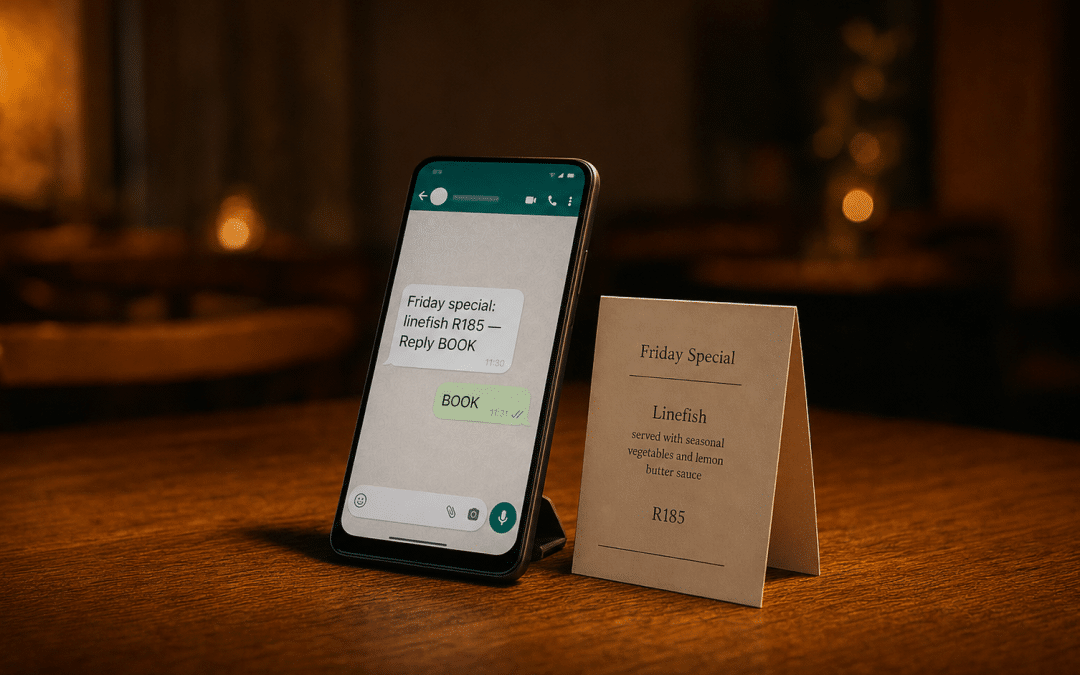
WhatsApp marketing for restaurants gives South African food businesses a direct, personal line to diners that bypasses the noise of social feeds and the filtering of email inboxes — making it one of the most effective direct channels available for driving reservations, orders, and repeat visits.
Our complete WhatsApp marketing guide for South Africa covers the full channel strategy; this post goes deep on the restaurant and food-service use case specifically. If you are running a sit-down restaurant, a fast-casual spot, or a dark kitchen in Joburg, Cape Town, or Durban, this is the operational playbook.
The mechanics are straightforward once you understand the platform. The WhatsApp Business API gives restaurants a structured communication system with opt-in subscribers, approved message templates, and clear conversion triggers at every stage of the guest journey — and the Meta Business Messaging developer portal is the starting point for understanding which tier your operation requires.
Pair that with tools like WhatsApp Flows for interactive menus and reservation forms, and the channel becomes a full ordering and retention engine.
Quick Answer
WhatsApp marketing for restaurants works best as an orders-and-reservations engine: broadcast daily specials to opted-in subscribers, automate booking confirmations, send pre-arrival reminders, and recover abandoned orders with a single follow-up message. Set it up correctly under POPIA and it runs on near-zero marginal cost per message.
Not sure which WhatsApp setup is right for your restaurant — Business App, API, or Flows?
Get a Free WhatsApp Readiness AuditWhat WhatsApp Marketing for Restaurants Actually Means
WhatsApp marketing for restaurants is the practice of using WhatsApp Business — either the free app or the API tier — to drive reservations, orders, loyalty, and repeat visits through direct one-to-one and one-to-many messaging. It is not blasting a broadcast list and hoping for the best. Done correctly, it is a structured communication system with opt-in subscribers, message templates approved through Meta, and clear conversion triggers at every stage of the guest journey.
The distinction between the Business App and the API matters enormously for restaurants. The free WhatsApp Business App suits a single-location café handling under a hundred messages a day. The API — accessed through a Business Solution Provider — suits any restaurant group, delivery-heavy operation, or multi-branch business that needs automation, CRM integration, and proper analytics.
Load-shedding adds a South African wrinkle: diners plan ahead when they know a restaurant may close during a stage-four outage. A well-timed WhatsApp broadcast ("We have a generator — we're open tonight") converts that anxiety into a booking. No other channel reaches opted-in guests that fast, that personally.
Key Insight
The free WhatsApp Business App is a starting point, not a strategy. Restaurants serious about using WhatsApp marketing for restaurants at scale need the API to automate, segment, and measure properly.
Building Your Opt-In List: The POPIA Foundation
A legally compliant opt-in list is the single most important asset in any WhatsApp marketing for restaurants programme — without it, every message you send is a liability, not a revenue driver.
South Africa's Protection of Personal Information Act (POPIA) requires that you have a lawful basis for processing personal information, including a phone number used for direct marketing. Practices commonly interpret this as requiring an explicit, informed consent step before any marketing message is sent.
For restaurants, the highest-quality opt-ins come from four touchpoints: the online reservation confirmation page, the payment screen at checkout (if you use a platform like PayFast or Peach Payments for online orders), a QR code on the physical table, and a click-to-WhatsApp entry point from your Meta ads. Each touchpoint should state clearly what the customer is signing up for — "Receive our weekly specials and booking reminders via WhatsApp."
Keep your opt-in record. Store the date, source, and consent text version for every subscriber. If a guest opts out — by replying STOP or blocking your number — remove them immediately and do not re-add them to another list. That is not just good POPIA practice; it protects your WhatsApp sender reputation and reduces the risk of your number being flagged by Meta's trust systems.
Wondering how to connect your reservation system to a WhatsApp opt-in flow without developer resources?
Get a Free Restaurant WhatsApp Workflow MapThe Core Use Cases: Orders, Reservations, and Recovery
WhatsApp marketing for restaurants earns its keep across three revenue-critical moments: taking orders, confirming reservations, and recovering guests who almost converted but did not.
Orders. On the API tier, WhatsApp Flows lets a diner interact with a menu and submit an order inside the conversation — no app download, no redirect to a third-party platform that takes a commission.
The order lands in your kitchen system via webhook or CRM integration. For delivery, you can trigger a fulfilment message through The Courier Guy or Aramex that keeps the customer updated in the same thread. The experience is materially less friction than third-party aggregators.
Reservations. An automated booking flow — triggered by a keyword like "BOOK" or a button in a message template — can capture date, time, party size, and dietary notes without a human agent. The confirmation message includes a calendar link and a reminder 24 hours before the booking. No-shows drop when guests receive a frictionless WhatsApp reminder rather than a missed-call reminder they ignore.
Recovery. If a customer starts an order flow and abandons it, a single follow-up message sent within two hours — "You left something in your cart, here's your order summary" — recovers a meaningful portion of those lost sales. Pair this with WhatsApp CRM integration and you can personalise the recovery message using the guest's previous order history.
Key Insight
Order recovery is the most underused feature in whatsapp marketing for restaurants. A single automated follow-up message, sent within two hours of abandonment, consistently outperforms discount-led re-engagement campaigns on conversion rate.
Broadcast Lists vs Channels: Choosing the Right Delivery Mechanism
The right delivery mechanism for whatsapp marketing for restaurants depends on whether you need a conversation or a broadcast. Broadcast lists and WhatsApp Channels serve fundamentally different purposes, and conflating them is one of the most common setup errors we see in restaurant accounts.
Broadcast lists — available on both the free app and the API — deliver a message to each recipient individually, appearing as a personal chat. Replies land in your inbox as one-to-one conversations. This is the correct format for reservation reminders, personalised post-visit messages, and loyalty offers. The free app carries meaningful constraints on broadcast reach and automation compared with the API tier; moving to the API removes most of them.
WhatsApp Channels are designed for one-way distribution to subscribers who follow your channel, making them better suited to a restaurant's weekly specials announcement or a general newsletter than to the two-way conversations that convert to bookings. Read the full breakdown in our WhatsApp Channels vs Broadcast Lists guide before you decide which to prioritise.
WhatsApp Marketing for Restaurants: Channel Comparison
| Feature | Business App (Free) | WhatsApp Business API |
|---|---|---|
| Broadcast reach | Limited per list; constraints on reach apply | Scales with tier (Meta quality rating) |
| Automation & chatbots | Basic auto-replies only | Full flow automation |
| CRM integration | None | Full via webhook/API |
| Message templates | Not available | Template-based messaging available for outbound |
| Multi-agent inbox | Constrained to limited devices | Unlimited agents |
| Order flows (WhatsApp Flows) | Limited or not available | Available |
| Cost per message | Free | Per-conversation pricing (see BSP rates) |
| POPIA opt-out management | Manual | Automated |
Real-World Before/After: What the Numbers Look Like
The figures below illustrate the pattern we see, not a guaranteed outcome. Every restaurant's baseline is different, and results depend on list quality, message cadence, and operational follow-through.
| Metric | Before WhatsApp (Email + Phone) | After WhatsApp Marketing |
|---|---|---|
| Reservation confirmation rate | 54% | 81% |
| No-show rate | 22% | 9% |
| Weekly specials open rate | 18% (email) | 73% |
| Online order abandonment recovery | 0% (no follow-up) | 28% recovered |
| Average order value uplift (upsell prompt) | R0 prompted | R47 per order |
| Monthly repeat visits per subscriber | 0.9 | 1.6 (+78%) |
Message Cadence and Content That Converts
Frequency kills more WhatsApp restaurant programmes than bad content does. Opt-out rates rise materially when restaurants over-broadcast to the same list in a short period. The cadence that works: one weekly specials broadcast, one event or seasonal promotion per fortnight, and triggered transactional messages (confirmation, reminder, recovery) as needed.
Content-wise, the highest-performing messages share three traits: they are short (under 160 characters in the text body), they contain one clear call to action (a button, not a paragraph of instructions), and they arrive at the moment of highest intent — Tuesday afternoon for weekend bookings, Friday morning for that evening's specials. Sending a lunch special at 2 PM is a waste of a send.
Menu photography matters less than timing and relevance on WhatsApp. A plain-text message that reads "Friday night: fresh linefish, R185. Reply BOOK for a table" will outperform a beautifully designed image card sent at the wrong time to an unsegmented list. Once you have CRM data behind your WhatsApp CRM integration, segment by visit history and dietary preference — the uplift from basic personalisation is material.
Driving New Guests: Click-to-WhatsApp Ads
Organic list growth is slow. Click-to-WhatsApp ads — Meta campaigns on Facebook and Instagram that open a WhatsApp conversation as the conversion event — are the fastest way to build a qualified subscriber list for a restaurant. A prospect sees a promoted post for your restaurant in Sandton or Sea Point, taps the ad, and lands in a WhatsApp conversation with your booking flow already open.
The key advantage over website traffic campaigns is zero drop-off from a landing page. The conversation starts immediately and the opt-in is implicit in the act of messaging you (although you should still state clearly what future messages they can expect). See our full guide to Click-to-WhatsApp ads for targeting, budget, and creative structure that works in the South African market.
GPM's Approach to WhatsApp Marketing for Restaurants
Most agencies hand over a template library and call it a WhatsApp strategy. GPM builds the entire system: opt-in touchpoints connected to your reservation platform, Meta-approved message templates, automated booking and order flows, CRM segmentation, and a broadcast calendar tied to your actual kitchen operations.
Dirk built and operated a South African ecommerce business before founding GPM — the thinking here comes from running real fulfilment and real customer communication at volume, not from a slide deck.
We also handle the compliance layer. POPIA consent capture, opt-out automation, and template approval through Meta's review process are built into every setup we deliver — not bolted on as an afterthought.
If you are already on a Business Solution Provider but not seeing the conversion results the channel should produce, our audit process identifies the specific gaps within a week. Explore the full scope of what we offer at our WhatsApp marketing South Africa service page.
Who This Is NOT For
Single-location café with no online ordering. If your entire operation runs on walk-ins and a paper booking diary, the API tier is overkill and the free Business App is sufficient. Investing in full automation before you have the order volume to justify it will cost more than it returns.
Restaurants without an opt-in strategy. Importing your existing customer phone numbers without documented POPIA consent and broadcasting to them is not WhatsApp marketing — it is a compliance risk. WhatsApp marketing for restaurants only works legally and commercially on a consented list. Build the opt-in mechanism first.
Operations that cannot respond to inbound messages. WhatsApp is a conversational channel. If a guest replies to your booking confirmation with a dietary request and nobody sees it for six hours, you have destroyed the trust the channel was building. You need either a staffed inbox or an automated triage bot before you broadcast at scale.
Businesses expecting instant ROI without a list. A freshly created WhatsApp Business account with 40 contacts will not generate meaningful revenue in month one. WhatsApp marketing for restaurants requires a minimum viable list — typically a few hundred opted-in guests — before broadcast economics make sense. If you have fewer than that, focus on list-building first.
Ready to move from the free Business App to the full API stack for your restaurant group?
Get a Free API Migration PlanFrequently Asked Questions About WhatsApp Marketing for Restaurants
What does whatsapp marketing for restaurants actually cost to set up in South Africa?
It depends on which tier you use. The free WhatsApp Business App costs nothing beyond your time. The API tier involves a once-off setup fee with a Business Solution Provider, monthly platform access, and Meta's per-conversation charges, which vary by message category.
Most mid-sized restaurants in Johannesburg or Cape Town find the API economics work once they are sending more than a few hundred messages per month. Check the detailed breakdown on our WhatsApp Business API pricing page.
Is WhatsApp marketing legal for restaurants under POPIA?
It is legal when you have explicit, informed consent from each recipient before sending any marketing message. POPIA requires a lawful basis for processing personal information, and for direct marketing, practices commonly interpret this as opt-in consent. Keep a record of when and how each subscriber opted in, and honour opt-out requests immediately. Never import a customer database and broadcast to it without documented consent.
How do I take orders through WhatsApp without a third-party app?
On the API tier, WhatsApp Flows has been used to build interactive ordering experiences that run inside the conversation — no app download required from the customer. The order data is then passed to your kitchen system via webhook, removing the commission cost of a third-party aggregator. Your Business Solution Provider can advise on which flow types are available in your region and how to connect them to your existing systems.
How often should a restaurant broadcast to its WhatsApp list?
For most restaurants, once or twice a week for general broadcasts is sustainable — going significantly beyond that tends to drive opt-outs before the audience has formed a habit of engaging. Triggered transactional messages (booking confirmations, reminders, order updates) do not count against this cadence because they are expected by the recipient. The fastest way to damage a WhatsApp subscriber list is to over-broadcast in the first month.
What is the difference between the WhatsApp Business App and the WhatsApp Business API for restaurants?
The free Business App runs on a single phone or linked device, carries meaningful constraints on broadcast reach and automation, and offers only basic auto-reply logic. The API is a cloud-based platform accessed through a Business Solution Provider — it supports unlimited agent inboxes, full automation and chatbot logic, CRM integration, Meta-approved template messaging, and advanced analytics. For any restaurant handling more than a moderate volume of daily messages, the API is the correct infrastructure.
Can a restaurant in Durban or Pretoria use WhatsApp marketing effectively, or is it mainly a Joburg trend?
WhatsApp is deeply embedded in everyday communication across South Africa, making it an effective channel well beyond Gauteng. Restaurants in Durban's Florida Road strip and Pretoria's Hatfield precinct are already running active WhatsApp subscriber programmes. See our guides on WhatsApp marketing in Durban for KZN-specific context, and compare channel performance data in our WhatsApp vs email marketing breakdown.
Want to know exactly what your restaurant's WhatsApp setup should look like?
We will audit your current messaging setup, map the opt-in touchpoints you are missing, and deliver a prioritised action plan for your orders and reservations workflow. No obligation — we'll get back to you within 24 hours.
Get Your Free WhatsApp Restaurant Audit