
 Add to Preferred Sources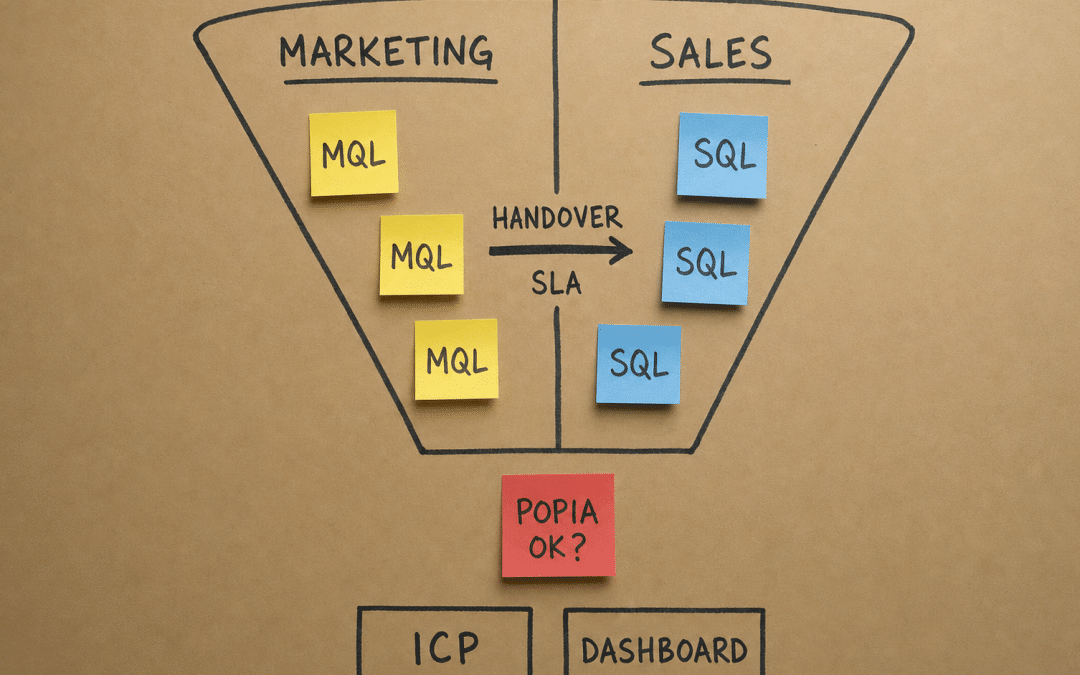
Sales marketing alignment is the single biggest lever available to South African B2B companies that want more pipeline without increasing their marketing spend — and our complete B2B lead generation guide for South Africa shows exactly why misalignment costs more than any media budget line.
When sales and marketing operate as separate silos, leads get generated and then ignored, qualified buyers fall into gaps, and both teams blame each other for a shortfall that is structural, not personal.
The South African context adds its own friction. Load-shedding disrupts follow-up cadences. POPIA governs how you store and use contact data. Procurement cycles in Johannesburg manufacturing firms run differently to those in Cape Town professional services. POPIA-compliant lead generation must be built into your shared process from day one, not retrofitted by legal after a complaint lands.
Quick Answer
Sales marketing alignment means both teams share a single definition of a qualified lead, a common set of KPIs, and a documented handover process. In the South African B2B market, companies that get this right consistently generate more pipeline per rand of marketing spend than those that don't.
Does your sales team actually work the leads your marketing team generates?
Get a Free Alignment AuditWhat Sales Marketing Alignment Actually Means
Sales marketing alignment is a formal operating model in which both functions agree on target audience, lead definitions, handover criteria, and shared revenue metrics before a campaign goes live. It is not a workshop, a Slack channel, or a quarterly debrief — it is a documented system.
Most South African B2B companies conflate alignment with communication. They hold monthly cross-functional meetings, share a CRM login, and call it done. What they are actually describing is coordination, which is a much weaker state. Coordination means the teams talk. Alignment means they are measured on the same outcome.
LinkedIn's research on B2B buyer behaviour confirms why this matters structurally: the typical B2B buyer consumes 7 to 10 pieces of content before making a purchase decision, and anywhere from 3.1 to 4.6 internal groups — IT, finance, HR, and others — can influence the final call. Marketing must nurture multiple stakeholders over a long cycle; sales must know exactly when and how to engage. Without a shared framework, those handoffs break.
Why the SA B2B Market Makes Alignment Harder
South African B2B sales cycles carry pressures that do not feature in the global playbooks most marketing teams download. Understanding them is a prerequisite for building a sales marketing alignment model that actually holds.
Load-shedding disrupts follow-up windows. A lead who books a demo during Stage 2 loadshedding may be unreachable for two hours at exactly the time your SDR plans to call. Shared SLA rules between marketing and sales must account for this explicitly — otherwise leads go cold and both sides blame the process.
POPIA changes what you can automate. Practices commonly interpret the Protection of Personal Information Act as requiring explicit, documented consent before adding a contact to an automated nurture sequence. Your marketing automation tool — whether Klaviyo, HubSpot, or a local alternative — must flag consent status so sales never calls a contact whose data was collected before opt-in was confirmed.
Market concentration affects ICP precision. In sectors like logistics, construction, and professional services, there are sometimes fewer than 200 companies that fit your ideal customer profile in a given metro. Every misaligned handoff wastes a relationship you cannot easily replace. For a closer look at sector-specific dynamics, see our guides on B2B lead generation for logistics and transport and B2B lead generation for construction and engineering.
Key Insight
In concentrated SA B2B markets — where your entire addressable universe might be 150 companies in Gauteng — a broken handover process does not just waste a lead. It burns a relationship that cannot be easily replaced.
The Four Components of a Working Alignment Model
Effective sales marketing alignment rests on four components that must exist simultaneously. Missing any one of them means the model degrades under pressure.
1. A shared Ideal Customer Profile (ICP). Marketing generates leads based on its understanding of who to target. Sales works leads based on its understanding of who closes. If those two pictures differ, the funnel leaks at the handover point. Build the ICP together, using closed-won data from the CRM, not personas drafted in isolation by a marketing manager.
2. Agreed lead definitions. A Marketing Qualified Lead (MQL) should have a written definition both teams signed off on. The same applies to a Sales Qualified Lead (SQL). In our experience, most SA B2B companies have these terms in their CRM but no one can tell you what the actual criteria are without checking a document from three years ago.
3. A documented Service Level Agreement (SLA). Marketing commits to a volume and quality of MQLs per month. Sales commits to a follow-up window — typically 24 to 48 hours for inbound leads, adjusted for load-shedding blackout periods. This SLA is reviewed monthly, not annually.
4. A single revenue dashboard. Pipeline contribution from marketing, conversion rates by lead source, average deal size, and time-to-close should all be visible to both teams in the same tool. When sales and marketing see different numbers, alignment is impossible. For the metrics that matter most, our B2B lead generation KPIs guide covers the full measurement framework.
Not sure whether your MQL definition is actually driving revenue, or just volume?
Get a Free Lead Definition ReviewSales Marketing Alignment and LinkedIn: The Channel That Rewards It
Sales marketing alignment pays its biggest dividends when it governs a channel where both teams touch the same audience. LinkedIn is that channel for most South African B2B companies.
According to LinkedIn's B2B lead generation resource, 89% of B2B marketers use LinkedIn for lead generation, and 62% say it generates leads at more than double the rate of the next-highest social channel.
With 70% of surveyed buyers describing LinkedIn as one of the most trusted sources of professional information — on par with the Wall Street Journal and Forbes — the platform creates a receptive environment for the kind of multi-touch, multi-stakeholder nurture that complex B2B sales require.
The alignment challenge on LinkedIn is specific: marketing runs Sponsored Content and Lead Gen Forms targeting procurement managers in Sandton or operations directors in Durban. Sales has first-degree connections with some of those same people. Without a shared contact-ownership policy and a clear rule about when marketing automation ends and personal outreach begins, you will double-touch prospects and erode trust. Our LinkedIn lead generation guide for South Africa covers the tactical setup in detail.
The Alignment Playbook: Step-by-Step for SA Companies
This is the sequence GPM uses when building a sales marketing alignment model for a South African B2B client. It is designed to produce a working system in 30 days, not a strategy document that sits in a shared drive.
Week 1 — Audit and ICP reset. Pull the last 24 months of closed-won deals from the CRM. Identify the common firmographic and behavioural signals. Rebuild the ICP from data, not assumption. At this stage, also audit your POPIA consent records — you need to know which contacts in your database can legally be contacted before you build any automation on top of them.
Week 2 — Define MQL and SQL criteria. Run a half-day workshop with sales leadership and the marketing lead. Exit the room with a written definition for each stage, including the specific data points your CRM will use to trigger a stage change. Behavioural signals — content downloads, webinar attendance, pricing page visits — are more reliable triggers than demographic data alone.
Week 3 — Build the SLA and the dashboard. Draft the mutual commitments: marketing's monthly MQL target, sales' follow-up SLA, and the escalation path when either side misses. Connect the CRM to a shared reporting view. If you are using HubSpot or Salesforce, this is a configuration task, not a project. If you are on a local or legacy tool, a Google Looker Studio dashboard pulling from exported data is a workable interim.
Week 4 — Launch and first review. Go live with the new definitions and SLA. Set a review meeting at day 30 to assess MQL volume, SQL conversion rate, and follow-up compliance. The first review almost always surfaces one definition that needs tightening and one process step that was skipped. That is normal — the system is designed to improve on iteration, not be perfect on launch.
Key Insight
A 30-day implementation beats a 90-day strategy project every time. South African B2B markets move fast enough that a working-but-imperfect alignment model outperforms a perfect model that launches in Q3.
| Alignment Component | Misaligned State | Aligned State |
|---|---|---|
| ICP definition | Marketing and sales use different criteria | Single ICP built from closed-won CRM data, shared and signed off |
| Lead definitions | MQL means different things to different people | Written MQL/SQL criteria in the CRM, reviewed quarterly |
| Follow-up SLA | No agreed response window; leads go cold | Documented 24–48 hour follow-up rule, load-shedding exceptions noted |
| Reporting | Each team tracks its own metrics in separate tools | Single pipeline dashboard visible to both functions |
| POPIA compliance | Automation runs on unconsented contacts | Consent flags built into CRM; automation only runs on opted-in records |
| LinkedIn strategy | Marketing and sales both contact same prospects independently | Contact-ownership policy defines who touches which account and when |
| Metric | Before Alignment | After Alignment (6 months) |
|---|---|---|
| MQLs generated per month | 85 | 91 |
| MQL-to-SQL conversion rate | 18% | 34% (+89% improvement) |
| Average follow-up time (hours) | 72 hrs | 26 hrs |
| Pipeline value attributed to marketing | R420,000/month | R810,000/month |
| Cost per SQL | R4,800 | R2,650 (-45% improvement) |
These figures illustrate the pattern we see, not a guaranteed outcome. Results vary by sector, deal size, and the starting state of your CRM data.
How GPM Builds Sales Marketing Alignment for SA B2B Companies
GPM approaches sales marketing alignment as an operational problem, not a messaging exercise. Dirk built and exited an ecommerce business before founding this agency — the frameworks here were tested with real pipeline on the line, not derived from a textbook.
When we engage a client on alignment, we begin with a revenue audit: what closed, what stalled, and where in the funnel the drop-off occurs. That diagnosis drives the ICP rebuild, the lead-definition workshop, and the SLA design. We do not hand over a document — we sit in the CRM configuration session and the first monthly review.
Our work sits inside a broader B2B lead generation service that covers content, paid media, LinkedIn, and outbound — so the alignment model we build is immediately connected to live campaigns, not tested in a vacuum. For companies in IT and managed services, manufacturing, or professional services, we also bring sector-specific ICP data that accelerates the audit phase materially.
We have run this process for clients in Johannesburg, Pretoria, and Durban. The single most common finding: the sales team was discarding between a quarter and a third of all MQLs within 48 hours without any documented reason in the CRM. That data point, on its own, is usually enough to shift the budget conversation in the alignment workshop.
Who This Is NOT For
Businesses with fewer than two dedicated salespeople. Sales marketing alignment is a coordination system. If one person is doing both functions, you do not need an SLA — you need a process checklist. Come back when the team is large enough for a genuine handover to occur.
Companies that have not cleaned their CRM in over 12 months. An alignment model built on dirty data produces confident-looking reports that point in the wrong direction. Before you define MQL criteria, you need to know which contacts in your database are still employed, still relevant, and still consented under POPIA. Fix the data first.
Organisations where the MD or CEO makes every sales decision personally. If every deal requires a founder conversation to progress, the formal handover model breaks down — there is no sales team to hand off to. Alignment becomes useful when sales is a function, not a person.
Teams expecting a once-off fix rather than an ongoing operating model. Sales marketing alignment is not a project with a finish line. Lead definitions go stale, ICPs shift as markets change, and SLAs need recalibration when headcount changes. If your organisation is not willing to hold a monthly review meeting, the model will drift back to misalignment within two quarters.
Ready to stop generating leads that your sales team never actually works?
Get a Free Pipeline AuditFrequently Asked Questions About Sales Marketing Alignment
What is sales marketing alignment and why does it matter for SA B2B companies?
It is a shared operating model in which both teams use the same lead definitions, ICP criteria, and revenue metrics. It matters in the South African B2B context because concentrated markets, longer buying cycles, and POPIA compliance requirements mean every misaligned handover carries a higher cost than in larger, more forgiving markets.
How do we define an MQL that both sales and marketing agree on?
Start with closed-won data, not theory. Pull your last two years of deals and identify the firmographic and behavioural signals that were present at the point of SQL conversion. Translate those signals into CRM-trackable criteria, then document them as the MQL threshold. Review the definition quarterly — buyer behaviour shifts, and a definition that was accurate in January can be wrong by July.
What should a sales and marketing SLA include for a South African company?
At minimum: marketing's monthly MQL volume commitment, the quality criteria each MQL must meet, sales' maximum follow-up window in hours (adjusted for load-shedding blackouts), and the process for flagging and recycling leads that do not meet SQL criteria. Add a POPIA clause confirming that only consented contacts enter the automated nurture sequence.
How does sales marketing alignment connect to LinkedIn lead generation?
LinkedIn is the primary paid channel for most South African B2B programmes, and it surfaces the same prospects to both marketing automation and individual sales reps. Without a contact-ownership policy, both functions touch the same buyer independently, which erodes trust and inflates cost. Alignment defines exactly when marketing hands a LinkedIn-sourced lead to sales and what information transfers with it.
How long does it take to see pipeline improvement from better alignment?
Most clients see a measurable improvement in MQL-to-SQL conversion within the first 60 to 90 days, primarily because the sales team stops discarding leads that were previously uncategorised. Full pipeline impact — in terms of closed revenue — typically takes one full sales cycle to show up clearly in the data, which ranges from three to nine months depending on deal size.
Does POPIA affect how sales and marketing teams share lead data internally?
Practices commonly interpret POPIA as requiring that personal information collected for one purpose — say, a content download — may only be used for compatible purposes, and that contacts can request to know what data is held about them. Internally, this means your CRM handover process should log the consent basis for each contact, so sales knows what outreach is permissible before making contact. For a full treatment, see our POPIA-compliant lead generation guide.
Want to know exactly where your sales and marketing handover is leaking pipeline?
We will audit your current lead definitions, CRM handover data, and follow-up compliance, then deliver a prioritised action plan showing where the highest-leverage fixes are. No obligation — we'll get back to you within 24 hours.
Get Your Free Alignment Audit