
 Add to Preferred Sources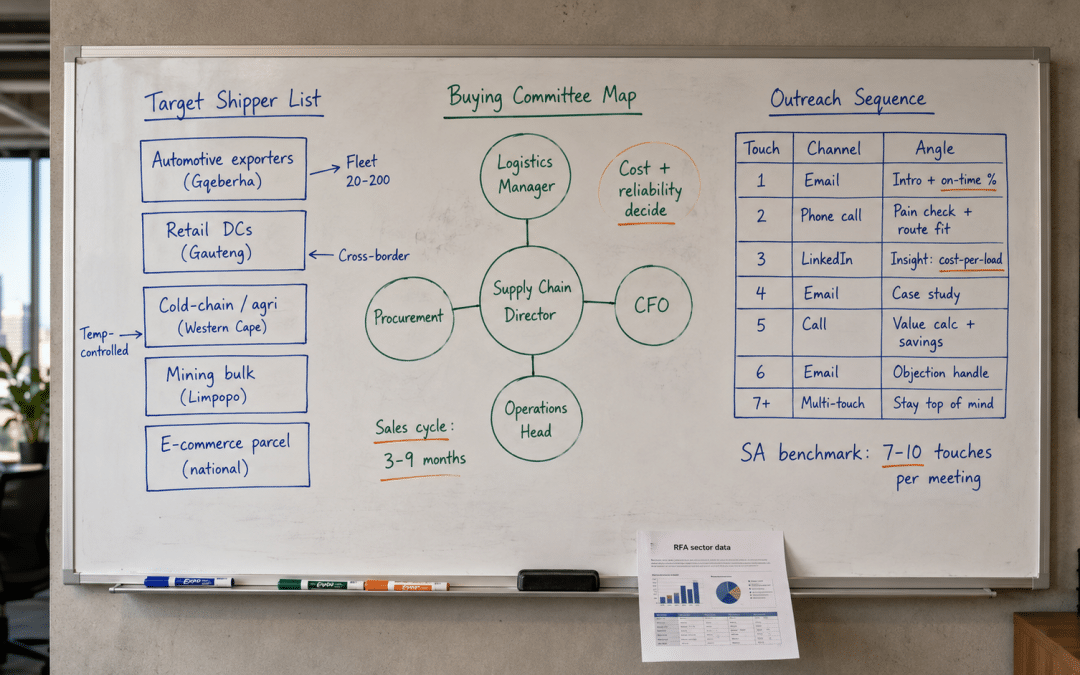
B2B lead generation for logistics in South Africa typically costs R28,000–R98,000 monthly for a properly scoped programme and delivers 7–20 qualified opportunities per quarter — but only when the programme is built around cost-and-reliability messaging, multi-stakeholder sequencing, and account targeting specific to how SA freight and supply-chain firms actually award contracts. This guide covers how to build a pipeline programme for SA transport operators, what to pay, and how to sequence outreach across the operational, financial, and executive stakeholders every freight purchase decision involves — with the same rigour we apply in our B2B lead generation South Africa guide and our professional services lead generation guide.
Quick Answer
B2B lead generation for logistics in South Africa works through account-based targeting of 70-200 named freight and supply-chain firms, cost-and-reliability messaging that leads with on-time performance and cost-per-load, and multi-stakeholder sequencing across Logistics Manager, Supply Chain Director, Procurement, CFO, and Operations Head. Expect R28,000-R98,000 monthly cost, 3-9 month sales cycles, and 7-20 qualified opportunities per quarter for programmes running 9+ months. The mistake is applying generic outreach to the sector — freight buyers switch suppliers only when reliability or cost is demonstrably better.
Want a free 60-minute strategy session focused specifically on your SA freight or supply-chain growth pipeline?
Get a Free Logistics Pipeline StrategyB2B Lead Generation for Logistics: What It Actually Costs
A freight-sector pipeline programme in South Africa is best understood as a scoped monthly engagement covering account research, cost-and-reliability content, multi-channel outreach, and pipeline management — not a per-lead purchase or a single campaign. Programmes run 9-15 months to reach steady-state output because SA transport sales cycles average 3-9 months from first touch to signed contract, longer on enterprise or cross-border accounts.
| Programme Type | Monthly Cost | Best For |
|---|---|---|
| Foundation programme | R28,000 – R44,000 | Owner-operator and small fleet firms, single lane focus |
| Growth programme | R44,000 – R70,000 | Mid-market operators, 2-3 target segments |
| Enterprise programme | R70,000 – R98,000+ | National carriers, cross-border, complex accounts |
| Specialist add-on | +R13,000 – R24,000 | Cold-chain, abnormal loads, cross-border compliance |
According to the Road Freight Association, the national trade body representing over 1,000 SA operators since 1975, the sector faces sustained pressure from rising diesel costs and infrastructure constraints — which sharpens how buyers evaluate new suppliers. The SA freight market is estimated at roughly USD 15.55 billion in 2026, a large addressable base, but every account win requires displacing an incumbent on cost or reliability. For deeper cost context, see our pipeline cost guide.
Why Generic Outreach Fails for SA Freight Operators
Generic prospecting methodology fails for SA freight and supply-chain firms because transport buyers are switching-averse, evaluate on hard operational metrics, and route decisions through multiple stakeholders most frameworks ignore. Applying standard playbooks to the sector produces high enrolment metrics and near-zero closed revenue.
The Switching-Averse Buyer Reality
Freight buyers rarely change suppliers on a whim — an incumbent carrier is embedded in systems, routes, and relationships. Switching carries operational risk, so buyers move only when a challenger demonstrates clearly better on-time performance, cost-per-load, or capacity. Outreach that leads with generic capability claims rather than hard comparative proof gets ignored. Programmes that lead with specific, credible operational metrics consistently outperform capability-led messaging.
The Hard-Metric Evaluation Reality
Transport decisions turn on measurable operational data: on-time delivery percentage, cost-per-kilometre, claims ratio, capacity availability, and route coverage. A pitch that cannot speak to these metrics in the buyer's own terms fails to earn a meeting. Prospecting for the sector must arm every touch with concrete operational evidence rather than soft positioning. See our pipeline mistakes guide for related failure patterns.
The Buying Committee Reality
SA transport contracts typically involve a Logistics Manager (owns day-to-day performance), Supply Chain Director (owns strategy), Procurement (owns commercial terms), CFO (owns cost), and Operations Head on larger accounts. Each stakeholder weighs different risk. Prospecting programmes targeting only one contact underperform badly against multi-stakeholder sequences that address operational, commercial, and strategic concerns in parallel.
The Freight-Specific Insight
SA freight and supply-chain firms evaluating a new carrier require an average of 7-10 touches across at least 3 stakeholders before granting a first meeting — and the single strongest opener is a specific, credible operational metric rather than a capability claim. Programmes that lead with "we run 97% on-time on the N3 corridor" book meetings at 5-8%, roughly a 3x improvement over programmes leading with generic service descriptions. Proof beats positioning every time. This is what effective B2B lead generation for logistics looks like in practice.
Want a cost-and-reliability outreach sequence built for your specific SA freight segment?
Get a Free Sequence RecommendationHow to Build the Logistics Programme Step by Step
Building a freight-sector pipeline programme starts with segment definition, then buying committee mapping, then metric-led sequencing — in that order. Skipping steps or reordering produces activity without pipeline. The framework below reflects what actually works for SA transport operators.
Step 1 — Segment and Target List: Build 70-200 named accounts across the segments you serve: automotive export shippers, retail distribution centres, cold-chain and agricultural exporters, mining bulk, and e-commerce parcel volume. Filter by shipping lane, load type, fleet requirement, and cross-border need. LinkedIn Sales Navigator plus Apollo.io is standard for the sector.
Step 2 — Buying Committee Mapping: For each account, identify 3-5 stakeholders across operations, commercial, and executive functions. Map who owns performance, who owns cost, and who signs. Verified contact data quality directly determines outreach conversion — invest in data hygiene before sequence execution.
Step 3 — Metric-Led Sequence: Deploy 7-10 touches per stakeholder across LinkedIn, email, and phone. Lead operational contacts with on-time and claims data; lead procurement and CFO with cost-per-load and total-cost comparisons; lead executives with strategic capacity and coverage. Message angle varies by stakeholder — a single generic message across the committee fails.
Common failure — capability-dump cold outreach: Programmes that blast identical "we offer nationwide transport solutions" messages to a broad unqualified list, ignore hard metrics, and target only one contact generate response rates under 1% and never displace incumbents. Metric-led, multi-stakeholder sequencing outperforms capability-dump spray by 6-12x on pipeline generated per programme rand.
SA Freight Segment Considerations
Different SA transport segments require different approaches driven by load type, regulatory intensity, and buyer priorities. Applying cold-chain methodology to bulk mining haulage produces poor results and vice versa.
Automotive and Retail Distribution
SA automotive export shippers (concentrated around Gqeberha and Durban) and retail distribution operators prioritise schedule reliability and yard security. Prospecting should emphasise on-time performance against tight export windows and distribution-centre slot compliance. These accounts run structured tenders, so timing outreach to tender cycles matters.
Cold-Chain and Agricultural Export
SA cold-chain and agricultural export operators prioritise temperature compliance, EU arrival-window reliability, and food-safety certification. Prospecting should demonstrate refrigerated capability, compliance credentials, and specific customer references in adjacent perishable categories. These buyers pay premium rates for proven reliability.
Mining Bulk and Cross-Border
SA mining bulk haulage and cross-border operators face long contracts, heavy compliance, and route-specific risk. Prospecting should emphasise capacity guarantees, cross-border documentation capability, and safety track record. Sales cycles run longest here (6-12 months) and contracts are largest, so patience and executive engagement matter most.
The Segment Discipline Rule
The largest single factor separating freight-sector pipeline programmes that produce results from programmes that produce activity is segment discipline. Programmes targeting one clearly-defined SA transport segment (automotive, cold-chain, mining bulk, e-commerce parcel) consistently outperform generalist programmes by 4-7x on qualified opportunities per rand invested. Operational proof only lands when it is segment-specific. Done well, B2B lead generation for logistics compounds as segment authority builds.
Want segment-specific pipeline strategy for your SA freight or supply-chain operation?
Request a Free Segment AuditMeasurement and Reporting Discipline
Strong programmes report on revenue-stage metrics, not activity metrics. Track qualified opportunities created, pipeline value by stage, meeting-to-opportunity conversion, and closed contract value by cohort — never message volume or connection counts. Activity dashboards feel productive while hiding whether the programme earns money.
Cohort tracking matters because contract cycles stretch across quarters. A shipper engaged in February may sign in September, so monthly snapshots systematically understate programme value. Group accounts by the month of first meaningful touch, then follow each cohort through to signed contract. Within three or four cohorts a clear conversion curve emerges, and that curve becomes the forecasting engine for the whole programme.
Weekly reviews should cover three questions. First, which accounts advanced a stage this week and why? Second, which accounts stalled, and what specific obstacle appeared — incumbent contract lock-in, rate objection, missing stakeholder? Third, which operational proof points earned replies and which fell flat? The answers feed straight back into targeting and message angle, turning the programme into a compounding system rather than a static campaign.
On tooling, a simple CRM discipline beats an elaborate stack used badly. Every account needs an owner, a next action, and a date. Accounts without next actions rot silently. A Friday pipeline scrub — thirty minutes, every open account, next action confirmed — is the cheapest habit that separates operators winning consistent contracts from those winning occasional luck.
The Growth Pulse Media Difference
Growth Pulse Media is run by an operator, not a delivery team. Before founding the agency, Dirk built and scaled a large South African ecommerce business — shipping daily through The Courier Guy and Aramex — so freight reliability, rates, and route realities are lived experience here, not theory.
All work is done in-house in Johannesburg with a deliberately limited client load, using the same stack we recommend to clients: Sales Navigator and Apollo.io for target research, and Google Search Console for the inbound side. No offshore outsourcing and no junior hand-offs.
If you would rather have this built for you, our pipeline-building service for SA firms runs exactly the system described above for transport operators — metric-led, multi-stakeholder outreach reported on signed contracts and revenue, never activity totals.
Who This Is NOT For
An honest disqualifier list saves both sides time. A freight-sector pipeline programme is the wrong fit if any of the following describes you:
You cannot evidence your operational performance. On-time percentages, claims ratios, and cost-per-load proof are the openers that book meetings. Without credible numbers, no sequence will displace an incumbent carrier.
You have no spare capacity to serve new contracts. Winning a major shipper and then failing the first month of service does lasting reputational damage in a tight-knit sector. Fix capacity first.
You expect signed contracts inside a quarter. SA transport cycles run 3-9 months, longer for cross-border and mining bulk. A programme judged at month three will always look like a failure.
You insist on single-contact selling. Freight decisions route through 3-5 stakeholders. If the plan is to pitch one procurement contact and wait, meeting rates stay under 2% and the budget is wasted.
Frequently Asked Questions
How much does B2B lead generation for logistics cost in South Africa?
B2B lead generation for logistics programmes in South Africa cost R28,000-R98,000 monthly depending on segment count and account complexity. Foundation programmes covering a single lane run R28,000-R44,000. Growth programmes covering 2-3 segments run R44,000-R70,000. Enterprise programmes covering national or cross-border operations run R70,000-R98,000+. Specialist add-ons for cold-chain, abnormal loads, or cross-border compliance add R13,000-R24,000 monthly.
How long before a freight pipeline programme shows results?
SA transport sales cycles average 3-9 months, meaning first qualified opportunities typically appear at months 2-3 and first signed contracts at months 5-10. Programmes evaluated below 9 months systematically understate impact because the sales cycle is backweighted. Plan for 9-12 month evaluation minimum, longer for cross-border and mining bulk contracts.
What messaging works best for reaching SA freight buyers?
Hard operational metrics beat capability claims. Lead with specific proof — on-time delivery percentage on named corridors, cost-per-load comparisons, claims ratios, capacity guarantees — rather than generic service descriptions. Freight buyers are switching-averse and only move when a challenger demonstrates clearly better reliability or cost, so credible comparative data is what earns the first meeting.
Which channels work best for reaching SA transport operators?
Multi-channel sequencing outperforms single-channel approaches. Best-performing mix for the sector: LinkedIn (senior and supply-chain stakeholder outreach), email (operational and procurement contacts), phone (qualification), and industry event presence such as the RFA Convention and transport expos. Programmes running fewer than three channels typically underperform.
How many stakeholders should we target per freight account?
Target 3-5 stakeholders per account minimum across operations, commercial, and executive functions. A typical SA transport buying committee includes Logistics Manager, Supply Chain Director, Procurement, CFO, and Operations Head on larger accounts. Targeting only one contact produces meeting rates below 2%, while multi-stakeholder sequences addressing performance, cost, and strategy in parallel book at materially higher rates.
How is freight different from other B2B verticals for pipeline building?
Freight buyers are unusually switching-averse because an incumbent carrier is embedded in operations, and they evaluate on hard operational metrics rather than soft positioning. Sales cycles (3-9 months) sit in the mid-range, buying committees are operations-weighted, and displacing an incumbent requires demonstrable cost or reliability advantage. Generic capability-led outreach produces enrolment but rarely dislodges an established supplier.
Get a Free Pipeline Audit for Your SA Logistics Business
Growth Pulse Media builds B2B lead generation programmes specifically for South African freight and supply-chain operators — with account-based targeting via LinkedIn Sales Navigator and Apollo.io, metric-led messaging that leads with on-time and cost-per-load proof, and multi-stakeholder sequencing across Operations, Commercial, and Executive audiences. We understand how SA transport buyers award contracts because we have worked these accounts.
No obligation. No lock-in contracts. We will get back to you within 24 hours.
Request Your Free Pipeline Audit →