
 Add to Preferred Sources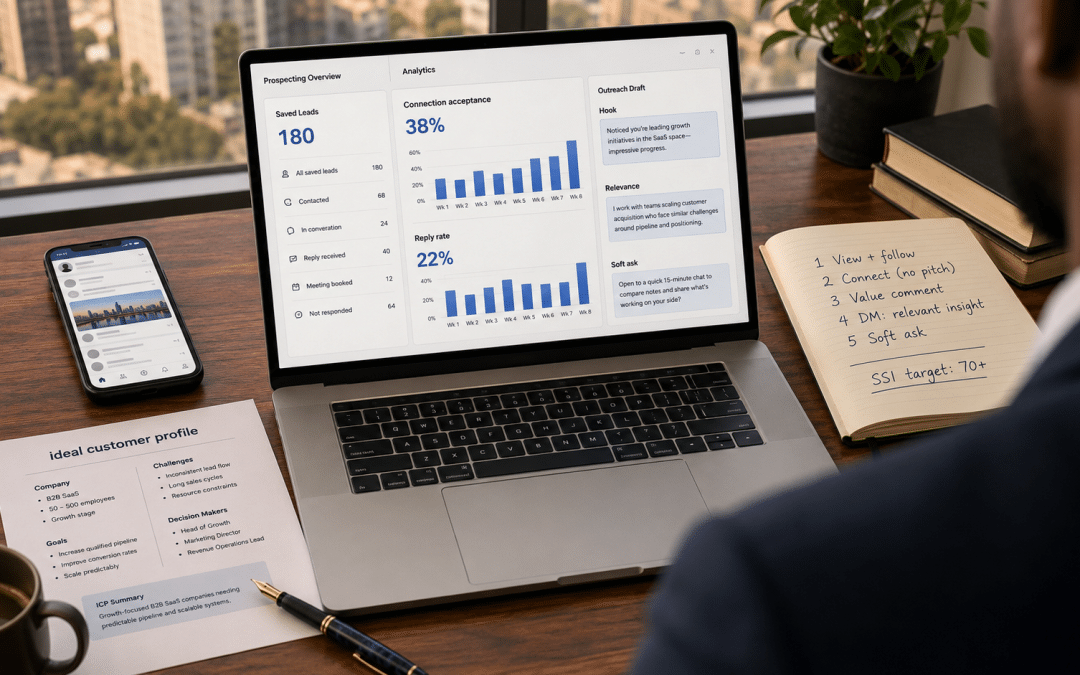
LinkedIn lead generation in South Africa is the process of turning the platform's professional network into a predictable source of qualified B2B meetings — through targeted prospecting, personalised connection-building, and content-led inbound, rather than mass connection requests and copy-paste pitches. Done properly, it is the highest-intent organic channel available to SA B2B sellers, because decision-makers actively research vendors on the platform. This guide covers how to build a repeatable system for SA businesses, what tools to use, and how to sequence outreach so connections become conversations — with the same rigour we apply in our B2B lead generation South Africa guide and our LinkedIn marketing South Africa guide.
Quick Answer
LinkedIn lead generation in South Africa works through a defined ideal customer profile, targeted prospecting via Sales Navigator, personalised connection requests with no pitch, value-led engagement, and a soft-ask message sequence — not mass outreach. Expect connection acceptance of 30-45% and reply rates of 15-25% when personalised well. LinkedIn reports top social sellers create 45% more opportunities and are 51% more likely to hit quota. The mistake is pitching on connection: it collapses acceptance and reply rates and burns the profile's reputation.
Want a free 60-minute session mapping a LinkedIn prospecting system to your SA business?
Get a Free LinkedIn Strategy SessionLinkedIn Lead Generation: Why It Works for SA B2B
The platform works for SA B2B sellers because it concentrates decision-makers in one place and signals intent that other channels cannot. According to LinkedIn's own Social Selling Index research, top social sellers create 45% more opportunities than peers and are 51% more likely to hit quota. For SA businesses selling into corporates, professional services, and mid-market firms, the platform is where buyers already research vendors — which makes organic prospecting there far warmer than cold email or cold calling.
One 2026 nuance worth knowing: LinkedIn has officially de-emphasised the Social Selling Index as a north-star metric, steering sellers toward AI-powered tools inside Sales Navigator instead. The SSI is still a useful diagnostic of profile and activity health — a score of 65-70+ is a solid B2B benchmark — but it is a means, not the goal. Pipeline conversations, not score-chasing, pay the bills.
The SA Prospecting System, Step by Step
A repeatable system beats sporadic effort every time. The framework below is what actually works for SA B2B sellers, in order — skipping steps or leading with a pitch is the most common failure.
Step 1 — Ideal Customer Profile and Profile Setup: Define exactly who you sell to (industry, company size, role, region) before touching outreach. Then rebuild your own profile as a buyer-facing asset — clear headline stating who you help and how, a summary focused on client outcomes, and social proof. Buyers check the profile before accepting; a weak one caps acceptance rates regardless of message quality.
Step 2 — Targeted Prospecting: Use Sales Navigator or boolean search to build a precise list matching the ideal customer profile. Filter by industry, seniority, geography (SA regions, or specific metros), and company headcount. A tight list of 200 right-fit prospects outperforms 2,000 loosely-matched ones on every downstream metric.
Step 3 — Connect Without Pitching: Send personalised connection requests that reference something specific — a post, a shared group, a mutual context — with no sales ask. Acceptance for well-personalised SA requests runs 30-45%. The moment a request reads as a pitch, acceptance collapses and the profile starts getting flagged.
Step 4 — Engage Before Messaging: After connecting, engage with the prospect's content — a thoughtful comment, a relevant share — before any direct message. This warms the relationship and keeps you visible. Then open a conversation with a relevant insight, not a pitch, and move to a soft ask only once genuine relevance is established.
Common failure — pitch-on-connect spray: Sending 100 identical connection requests a day with an immediate sales pitch on acceptance generates reply rates under 2%, tanks acceptance, and risks the account being restricted. High-volume automation without personalisation is the fastest way to burn a profile's reputation and waste the channel entirely.
The System Insight
The order of the five steps is not arbitrary — each one earns the right to the next. A strong profile lifts acceptance; a tight prospect list lifts relevance; connecting without a pitch protects acceptance; engaging before messaging warms the reply. Sellers who jump straight to the ask skip the compounding effect and wonder why response rates stay low. Sequence discipline, not volume, is what makes LinkedIn lead generation predictable.
Want a personalised outreach sequence built for your specific SA target market?
Get a Free Sequence RecommendationTools and Costs for SA Businesses
The channel is inexpensive relative to paid alternatives, but the right tooling matters. Costs below are indicative for SA operators building an organic prospecting motion.
| Layer | Indicative Cost | Purpose |
|---|---|---|
| Sales Navigator Core | R1,500 – R1,900 / month | Advanced search, saved leads, lead recommendations |
| Profile and content support | R6,000 – R18,000 / month | Positioning, content cadence, thought-leadership |
| Managed prospecting programme | R14,000 – R38,000 / month | Full-service list-building, outreach, and booking |
| CRM integration | R0 – R2,500 / month | Pipeline tracking, follow-up discipline |
For SA businesses comparing organic prospecting against paid, our LinkedIn Ads cost guide and LinkedIn Ads vs Google Ads comparison cover the paid side. Organic and paid work best together, but organic prospecting is where most SA B2B sellers see the strongest cost-per-meeting.
The Reputation Insight
On this platform, the sender's profile reputation is an asset that compounds or depreciates with every action. Personalised, value-led outreach compounds it — acceptance and reply rates climb as the profile builds authority. Spray-and-pitch behaviour depreciates it — the algorithm suppresses reach, acceptance falls, and eventually the account is restricted. The single most valuable long-term asset in LinkedIn lead generation is a profile that buyers trust, and it is built one genuine interaction at a time.
Measurement and Reporting Discipline
Strong programmes report on revenue-stage metrics, not vanity metrics. Track connection acceptance rate, reply rate, conversations opened, meetings booked, and qualified opportunities created — never follower count or post likes in isolation. Vanity dashboards feel productive while hiding whether the channel produces pipeline.
Cohort tracking matters because B2B cycles stretch across quarters. A prospect connected in February may book in May and sign in September, so weekly snapshots understate the channel's value. Group prospects by the month first contacted, then follow each cohort through to booked meetings and closed revenue. Within a few cohorts a clear conversion curve emerges, and that curve becomes the forecasting engine.
Weekly reviews should answer three questions. First, which message angles earned replies this week and which fell flat? Second, which prospects went quiet after connecting, and is there a re-engagement path? Third, is the acceptance rate holding — a sudden drop usually signals the requests are reading as pitches. The answers feed straight back into targeting and message craft, turning the channel into a compounding system.
On tooling, simple discipline beats an elaborate stack used badly. Every prospect needs a stage, a next action, and a date. Contacts without next actions go cold silently. A Friday review — thirty minutes, every open conversation, next action confirmed — is the cheapest habit separating sellers who book consistently from those who book occasionally.
The Growth Pulse Media Difference
Growth Pulse Media is run by an operator, not a delivery team. Before founding the agency, Dirk built and scaled a large South African ecommerce business — so the prospecting frameworks in this guide come from booking real meetings with real budgets, not from agency theory.
All work is done in-house in Johannesburg with a deliberately limited client load, using the same stack we recommend to clients: Sales Navigator and Apollo.io for prospect research, and Google Search Console for the inbound side. No offshore outsourcing and no junior hand-offs.
If you would rather have this built for you, our pipeline-building service for SA firms runs exactly the system described above — profile positioning, tight prospect lists, and personalised sequences reported on meetings booked and revenue, never follower counts.
Who This Is NOT For
An honest disqualifier list saves both sides time. This prospecting system is the wrong fit if any of the following describes you:
You want mass automation. Full auto-pilot spray gets accounts restricted and reputations burned. If the plan is 100 identical requests a day, this system will actively work against you.
You will not personalise anything. Every result in this guide — 30-45% acceptance, 15-25% replies — depends on relevance at the point of send. Template-only outreach lands well under those numbers.
You expect meetings overnight. First conversations take two to three weeks and compounding results take months. If the pipeline must move this week, phone outreach on warm signals is the honest recommendation.
Your buyers are not on the platform. Consumer trades, informal-sector buyers, and purely local walk-in businesses rarely research vendors there. Paid search and referral systems will serve you far better.
Want help turning your profile into a system that books meetings for your SA business?
Request a Free Profile and Pipeline AuditFrequently Asked Questions
How much does LinkedIn lead generation cost in South Africa?
A DIY approach costs the Sales Navigator subscription alone (R1,500-R1,900 monthly). Adding profile and content support runs R6,000-R18,000 monthly. A fully managed prospecting programme covering list-building, outreach, and meeting booking runs R14,000-R38,000 monthly depending on volume and target complexity. The channel is generally the lowest cost-per-meeting organic option for SA B2B sellers.
Is Sales Navigator worth it for SA businesses?
For most SA B2B sellers, yes. Sales Navigator's advanced filters, saved leads, and lead recommendations make targeted prospecting far more efficient than the free search, which is heavily rate-limited. At roughly R1,500-R1,900 monthly it typically pays for itself with a single booked meeting. The exception is very low-volume or highly local sellers who may not need the advanced filtering.
How many connection requests can I send safely?
LinkedIn limits weekly connection requests (broadly around 100-200 per week, and the platform adjusts this dynamically). Sending near the ceiling with generic requests risks restriction. A safer, more effective approach is fewer, highly personalised requests — quality of acceptance and reply matters far more than raw volume, and personalised requests protect the account's standing.
Should I automate LinkedIn outreach?
Heavy automation is risky — the platform actively detects and restricts it, and generic automated messages perform poorly. Light, careful assistance (saved templates you personalise per prospect, CRM logging) is fine. Full auto-pilot spray is the fastest way to get an account restricted and burn the profile's reputation. Personalisation at the point of send is what protects both results and standing.
How long before LinkedIn lead generation produces meetings?
With a defined ideal customer profile and personalised outreach, first conversations typically appear within the first two to three weeks, and first booked meetings within four to eight weeks. Consistent, compounding results build over three to six months as the profile's authority and network grow. It rewards steady, disciplined effort over sporadic bursts.
How is this different from LinkedIn Ads?
Organic prospecting builds pipeline through targeted outreach and relationship-building at low direct cost but higher time investment. LinkedIn Ads buy reach and lead volume at higher direct cost with faster scale. They complement each other — ads build awareness and capture inbound, while organic prospecting converts targeted relationships into meetings. Most SA B2B sellers start with organic and layer in ads as budget allows.
Get a Free LinkedIn Pipeline Audit for Your SA Business
Growth Pulse Media builds LinkedIn prospecting systems for South African B2B sellers — with ideal-customer-profile definition, Sales Navigator targeting, profile positioning, and personalised outreach sequences that turn connections into booked meetings. We build systems that protect your profile's reputation while producing consistent pipeline, not spray-and-pitch tactics that burn it.
No obligation. No lock-in contracts. We will get back to you within 24 hours.
Request Your Free Pipeline Audit →