
 Add to Preferred Sources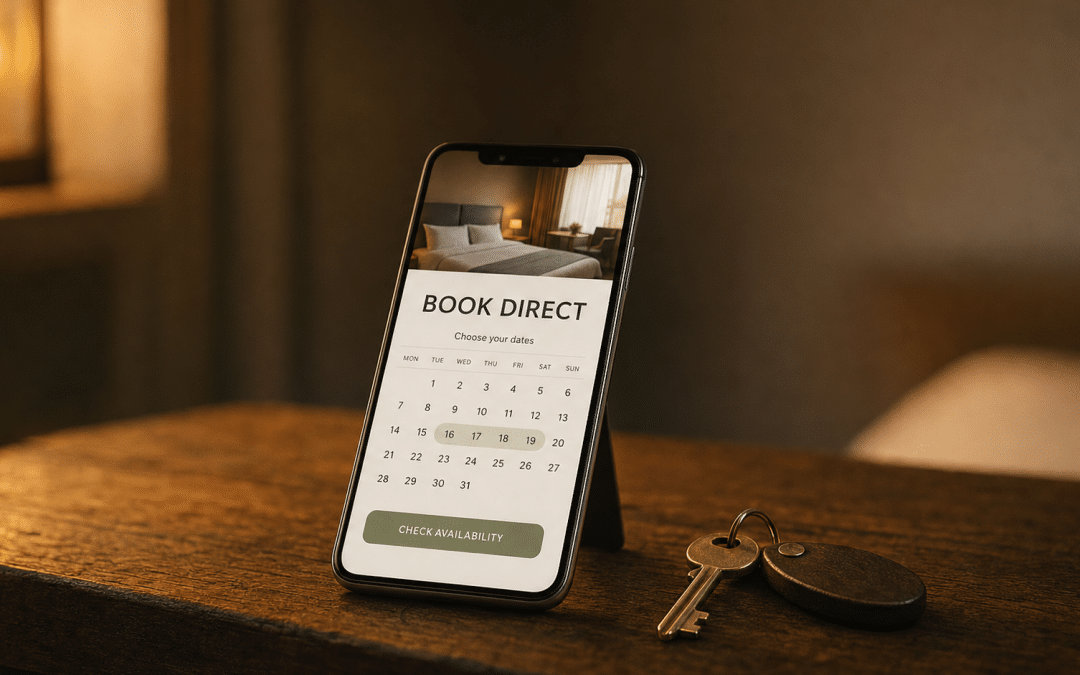
Marketing for guesthouses in South Africa comes down to one decision: how much of your revenue do you hand to Booking.com and Airbnb, and how much do you keep?
If you run a boutique property in the Cape Winelands, on the Garden Route, or in a Cape Town suburb, our Cape Town digital marketing agency team sees the same pattern repeatedly — owners paying 15–25% OTA commission on rooms they could be filling directly for a fraction of that cost.
The shift from OTA-dependent to direct-booking-first is not complicated, but it requires a deliberate system. This guide covers the channels, tools, and tactics that move the needle for South African boutique properties in 2026 — from Google Business Profile to email sequences on Klaviyo. For context on what digital marketing costs in Cape Town look like, we have a separate breakdown.
Quick Answer
Marketing for guesthouses in South Africa works best when you stack three layers: a well-optimised Google Business Profile for discovery, a fast direct-booking website with a real-time rate engine, and an email retention loop via Klaviyo or a similar platform. Together, these reduce OTA dependency materially within six to twelve months.
Do you know exactly what percentage of your bookings came through OTAs last month — and what that cost you in commission?
Get a Free Direct-Booking AuditWhy Marketing for Guesthouses Demands a Different Approach
Marketing for guesthouses is not the same as marketing a self-catering apartment block or a large chain hotel. You are selling an experience anchored in place, personality, and trust — and your ideal guest is actively looking for exactly that, not a lowest-price commodity comparison.
Large OTAs win on price aggregation and brand spend. You cannot out-bid them. What you can do is own the channels where guests who already want your specific property go to book — primarily Google Search, Google Maps, and direct referral loops.
The economics are stark: a R2,400-per-night room booked via Booking.com at 18% commission costs you R432 per booking. The same room booked direct, through a well-run Google Ads campaign costing R80 per conversion, keeps R352 more in your pocket every single time.
That arithmetic compounds across a season. A 20-room guesthouse running at 65% occupancy over peak season processes hundreds of bookings. Shifting even 40% of those from OTA to direct changes the income statement meaningfully.
Key Insight
OTA commission is a variable cost disguised as a marketing channel. Every direct booking you generate replaces a commission expense — making direct marketing the highest-ROI spend available to most South African guesthouses.
Google Business Profile: The Foundation of Marketing for Guesthouses
Your Google Business Profile (GBP) is the single most important free asset in marketing for guesthouses — it controls how your property appears in Google Maps, the local pack, and increasingly in AI-generated search summaries. Google's guidance on local ranking identifies relevance, distance, and prominence as the key factors — and all three are within your control as a property owner.
Relevance means your profile categories, services, and description accurately reflect what guests search for. If you run a pet-friendly guesthouse in Franschhoek, that attribute must appear explicitly. Distance is fixed — but prominence is built through reviews, photo updates, and consistent NAP (name, address, phone) data across the web.
For South African properties, a few specifics matter. Load-shedding has become a genuine booking signal — guests search for "guesthouse with backup power Cape Town" and similar phrases. Flag your inverter or generator status clearly in your GBP description and in the amenities list. It is not a gimmick; it is information guests genuinely need before they commit.
Franschhoek Example: A ten-room guesthouse updated its GBP with load-shedding backup status, a wine-tasting amenity tag, and 22 new guest photos over three months. It moved from position 7 to position 2 in the local pack for "guesthouse Franschhoek" without spending a rand on ads.
Your Direct-Booking Website: The Engine Room
A direct-booking website for marketing for guesthouses must do one thing above all others: convert a motivated visitor into a confirmed booking without sending them back to an OTA to check availability. That means a real-time booking widget, a best-rate guarantee, and a page-speed score that does not frustrate guests on mobile LTE.
South African guests check availability on mobile first, often on Vodacom or MTN data, then confirm on desktop. Your booking engine must load cleanly at both screen sizes. Platforms like Nightsbridge (built for the SA market) integrate directly with a WordPress or Webflow site and accept payments via PayFast or Peach Payments — removing the friction that kills conversions at checkout.
Schema markup for lodging properties helps search engines understand your room types, price range, and check-in policies — and has been used for rich results in Google Search. If your website was built before 2024, it almost certainly lacks this structured data.
Booking Engine Stack: Nightsbridge or ResRequest for availability and channel management, PayFast or Peach Payments for checkout, and a clearly visible "Book Direct & Save" banner on every page header.
SEO and Local Search for South African Boutique Properties
SEO for marketing for guesthouses in South Africa is hyperlocal. You are not competing nationally — you are competing for the top three spots when a traveller types "boutique guesthouse Camps Bay" or "family guesthouse Knysna". The tactics that move those rankings are distinct from generic SEO.
Landing pages per location and per experience type work considerably better than a single homepage trying to rank for everything. A guesthouse in Stellenbosch benefits from separate pages targeting "wedding guesthouse Stellenbosch", "Winelands cycling weekend accommodation", and "Stellenbosch guesthouse with pool" — each built around the specific search intent. Our guide to SEO for tourism businesses South Africa covers the full keyword research process for this vertical.
Review velocity matters enormously in local SEO. A property with 12 reviews from three years ago loses ground to a competitor with 9 reviews from last month. Build a post-stay review request into your checkout email — automated via Klaviyo, triggered 48 hours after departure. This is one of the highest-leverage actions in the entire marketing for guesthouses playbook. Review requests are one piece of a wider direct-booking plan, and our digital strategy for SA businesses sets that plan out first, before any execution starts.
Does your guesthouse website have individual landing pages for each experience type you offer — or is everything buried on one homepage?
Get a Free SEO Page AuditSocial Media and Paid Channels That Convert
Social media marketing for guesthouses works best when it feeds organic discovery and retargeting — not when it attempts to close cold bookings on a first touch. Instagram and Facebook remain the dominant visual channels for SA hospitality, but the goal is building an audience you can remarket to, not chasing viral reach.
Meta retargeting campaigns aimed at website visitors who viewed your rooms page but did not book are consistently among the most efficient paid channels in this vertical. Budget as little as R2,000 per month on a tightly defined retargeting audience and you are reaching people who already found you and nearly booked. Combine that with a time-limited direct-booking offer ("Book direct before Friday, complimentary breakfast included") and conversion rates improve materially.
For social content, the highest-performing formats for SA guesthouses are short-form video of the property at golden hour, guest-generated content reshared with permission, and local area guides that position your property as the knowledgeable host. Our full guide to social media marketing in Cape Town covers organic strategy and paid campaign structure for hospitality businesses.
Email Marketing: The Highest-ROI Channel Most Guesthouses Ignore
Email marketing for guesthouses generates returns that no other channel reliably matches — because you are marketing to people who have already stayed and enjoyed the experience. A past guest is dramatically more likely to book again, or to refer a friend, than a cold prospect acquired through paid search.
The tools are accessible. Klaviyo handles segmentation and automation at a price point viable for small properties. A basic retention programme for a boutique guesthouse needs only four flows: a post-stay thank-you with a review request, a re-engagement email six months later with a direct-booking incentive, a seasonal campaign (Christmas, Hermanus Whale Festival, Cape Wine), and a birthday or anniversary trigger for guests who provided that data.
POPIA compliance is non-negotiable here. Practices commonly interpret POPIA as requiring explicit opt-in consent before adding a guest to marketing communications — meaning your check-in form or booking confirmation must include a clear consent checkbox, not a pre-ticked default. Build this into your Nightsbridge or ResRequest booking flow from day one. Our email marketing Cape Town guide covers POPIA-compliant list-building in detail.
Key Insight
A POPIA-compliant email list of 400 past guests, nurtured with four automated flows in Klaviyo, consistently outperforms a R5,000 monthly Google Ads budget for repeat and referral bookings at South African boutique properties.
Comparison: OTA-Dependent vs. Direct-Booking Marketing Stack
| Channel / Factor | OTA-Dependent Model | Direct-Booking Stack |
|---|---|---|
| Commission per booking | 15–25% of room rate | R0 (cost is fixed marketing spend) |
| Guest data ownership | OTA retains guest contact details | Full CRM and email list ownership |
| Price control | Rate parity clauses restrict discounting | Flexible — direct-only offers permitted |
| Repeat booking channel | OTA re-acquires guest at full commission | Email and retargeting at near-zero cost |
| Review velocity | Reviews locked to OTA platform | Reviews directed to Google — helps SEO |
| Setup complexity | Low (list and list) | Moderate (website, booking engine, CRM) |
Before/After: What a Structured Marketing Programme Changes
The figures below illustrate the pattern we see, not a guaranteed outcome. Property size, location, and market conditions all affect results.
| Metric | Before (OTA-heavy) | After (Direct-booking stack) |
|---|---|---|
| Direct bookings share | 15% of total | 48% of total |
| Average commission cost per booking | R510 per booking | R95 per booking |
| Monthly net revenue (12 rooms, 60% occ.) | R68,400 | R81,200 |
| Google Maps ranking (target phrase) | Position 9 | Position 2 |
| Email list size (POPIA-compliant) | 0 contacts | 610 opted-in past guests |
| Repeat booking rate | 8% | 22% |
GPM's Approach to Marketing for Guesthouses in South Africa
GPM was built by someone who ran an SA ecommerce operation and watched OTA-style marketplaces extract margin at every turn. That background shapes how we approach marketing for guesthouses — we start with the commission bleed, calculate the direct-booking economics, and build backwards from there.
We do not offer templated hospitality packages. Every engagement starts with a channel audit: where are your current bookings coming from, what is each channel actually costing, and where is the highest-leverage point to intervene first? For most Cape Town and Winelands properties, that first lever is almost always Google Business Profile optimisation combined with a booking-engine upgrade — changes that compound without ongoing ad spend.
Our full service detail for Cape Town and Western Cape properties is on our Cape Town marketing agency services page. We also work with properties on the Garden Route, in KwaZulu-Natal, and in Gauteng — but our deepest local knowledge is in the Western Cape, where we understand the seasonal patterns, the Airbnb micro-market dynamics, and the load-shedding communication challenge that every Cape property navigates.
We also connect marketing for guesthouses programmes to broader tourism cluster work — see our guides on marketing for tourism businesses Cape Town and marketing for wine farms South Africa for related context if your property sits within a wine or agri-tourism destination.
Who This Is NOT For
Pure price-competition listings. If your strategy is to undercut every competitor on Airbnb and win on price alone, a direct-booking marketing programme will not help you. The economics only work when your property has a genuine experience worth paying a premium for — and guests worth retaining.
Properties unwilling to invest in their website. Marketing for guesthouses built on a slow, non-mobile-optimised site with no real-time booking engine will not generate direct bookings at scale. If the website is not on the table for upgrade, the direct-booking model cannot function.
Owners who need occupancy next week. Building a direct-booking stack takes three to six months to compound. OTAs provide immediate occupancy at a cost. If your property opens in 30 days and the rooms must be full, list on the OTAs first and build the direct channel alongside — not instead.
Guesthouses outside digital discovery intent. A remote off-grid retreat that fills entirely through word-of-mouth and repeat guests does not need a digital marketing programme. If your occupancy is already above 80% year-round without any marketing spend, this guide is not for you.
Ready to calculate exactly what OTA commissions cost your property this financial year — and what a direct-booking shift would add to net revenue?
Get Your Free Commission Savings CalculationFrequently Asked Questions About Marketing for Guesthouses
What does marketing for guesthouses in South Africa actually cost per month?
It depends heavily on which channels you activate. A foundational programme — GBP optimisation, basic SEO, and an email flow on Klaviyo — can run under R8,000 per month in agency fees and tools. Adding Google Ads or Meta retargeting adds variable spend on top. Our digital marketing costs Cape Town guide gives full benchmarks by channel and property size.
How long before a direct-booking strategy reduces OTA dependence?
Most properties see measurable direct-booking growth within three to four months of launching a complete stack — website, GBP, and email together. Full OTA reduction to a minority channel typically takes nine to twelve months. The compounding effect of a growing email list and rising Google rankings accelerates the shift over time.
Is Airbnb worth keeping once a direct-booking channel is established?
Yes, for most properties — but as a fill channel, not your primary one. Airbnb fills gaps in the calendar that direct marketing does not reach, particularly international and last-minute guests. The goal is reducing its share of peak-season bookings, not eliminating it entirely. Maintain your listing but stop treating it as the foundation.
How does POPIA affect email marketing for South African guesthouses?
Practices commonly interpret POPIA as requiring clear, affirmative opt-in consent before adding a guest to any marketing list. Your booking confirmation or check-in form should include an explicit, unticked consent checkbox for marketing emails. Do not import historical guest emails without auditing whether you have documented consent for each contact.
Which booking engine works best for small SA guesthouses?
Nightsbridge is the most widely used SA-built option and integrates with PayFast and Peach Payments natively — making it the lowest-friction setup for most properties. ResRequest suits larger lodge operations with multi-property complexity. Both allow direct connection to your website alongside OTA channel management, which is the configuration that enables a direct-booking-first strategy.
Does load-shedding status actually affect guesthouse bookings in South Africa?
It does, particularly for business travellers and guests visiting Cape Town or Johannesburg for events. Listing backup power status on your Google Business Profile, your website, and in your OTA listing description removes a genuine objection at the consideration stage. Properties that made this change in 2024 and 2025 reported it as one of the highest-engagement updates they made to their GBP.
Want to know exactly how much OTA commission your property could recover through direct marketing?
We will audit your current booking channel mix, calculate your commission exposure, and deliver a prioritised action plan for building a direct-booking stack. No obligation — we'll get back to you within 24 hours.
Get Your Free Booking Channel Audit