
 Add to Preferred Sources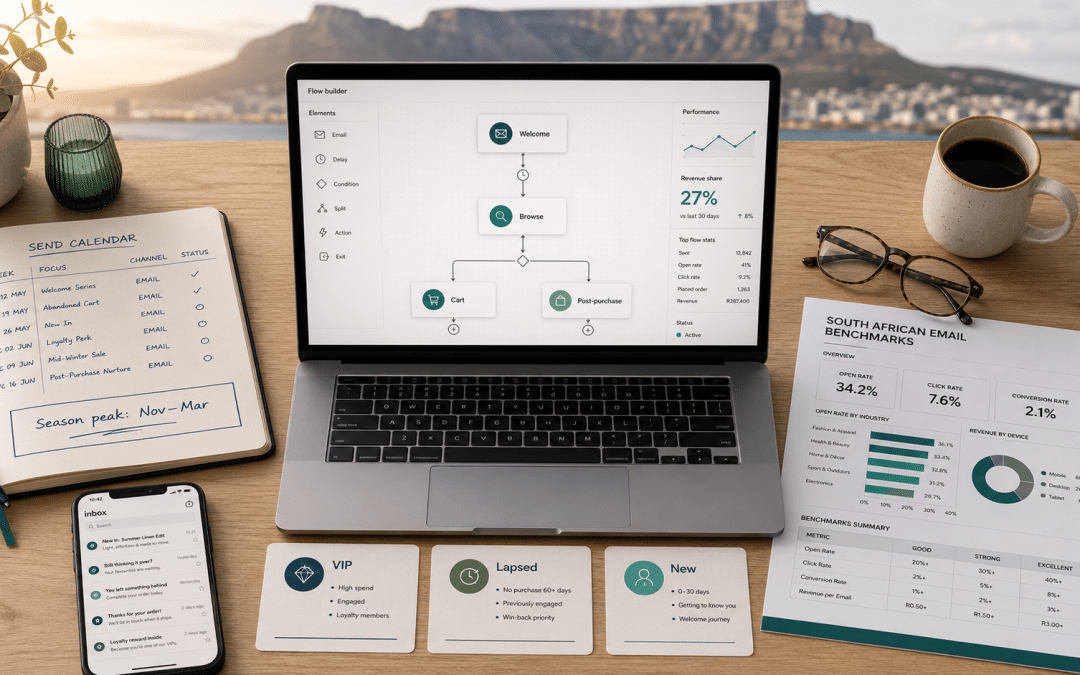
Email marketing Cape Town services cost R4,500–R25,000 monthly and typically return R25–R42 per rand spent once welcome, cart, and post-purchase flows are live — the highest-ROI owned channel available to Mother City businesses. The playbook follows our email marketing South Africa guide, adapted for the city's seasonal economy. This guide covers what CT businesses should pay, which flows to build first, and how the SA benchmark numbers translate locally.
Quick Answer
Email marketing Cape Town programmes pair a compliant, segmented list with automated flows — welcome, abandoned cart, post-purchase, win-back — then layer seasonal campaigns timed to the November-to-March peak. Expect R4,500-R25,000 monthly for managed services, opens of 25-30% on healthy SA lists, and 25-40% of online revenue from the channel once flows mature. The mistake is batch-and-blast sends to an unsegmented list: it burns deliverability exactly when the summer season should be paying out.
Curious what your list could be earning by December? Let's map it — free, no strings.
Get a Free Revenue Mapping SessionEmail Marketing Cape Town: What It Costs and What It Returns
A properly scoped programme for a CT business is a monthly engagement covering platform setup, flow building, campaign production, and revenue reporting — not a per-send purchase. Pricing scales with list size, flow complexity, and send volume, and the ranges below reflect what Mother City businesses actually pay in 2026.
| Programme Level | Indicative Cost | Best For |
|---|---|---|
| Starter (flows only) | R4,500 – R8,500 / month | Small CT stores, core automations, one campaign monthly |
| Growth | R8,500 – R15,000 / month | Segmented campaigns, seasonal calendar, A/B testing |
| Full programme | R15,000 – R25,000 / month | Multi-segment retailers, hospitality groups, B2B firms |
| Platform (Klaviyo/Omnisend) | R350 – R4,000+ / month | Paid separately; scales with subscriber count |
The return side is what justifies the spend. Global benchmark studies consistently place the channel at $36-$42 back per dollar in retail — roughly R25-R42 per rand locally — and mature SA programmes generate 25-40% of online revenue from it. Those numbers only arrive through automation, though. Campaigns alone, without flows running underneath, typically produce a third of that.
Local economics sharpen the case. According to Wesgro, the official tourism, trade and investment promotion agency for the city and the Western Cape, the regional economy is anchored by tourism, wine, agri-export, and one of Africa's strongest tech ecosystems — all sectors with pronounced seasonality. A channel you own outright, that costs cents per send, is the cheapest way to smooth demand between peak and winter months.
Why the Inbox Channel Fits Mother City Businesses
The city's business mix is unusually well suited to owned-audience selling because so much local revenue is seasonal, relationship-driven, or repeat-purchase in nature. Paid ads rent attention at peak-season prices; a subscriber list keeps it.
Hospitality, tourism, and wine
Guest houses, tour operators, restaurants, and wine farms live and die by the November-to-March window. A well-built list converts one-time summer visitors into winter-special bookings, tasting-club members, and direct reservations that bypass OTA commissions of 15-25%. For these businesses, every rand of booking revenue moved from OTA to direct is margin recovered.
Ecommerce and retail
CT's online stores face the same cart-abandonment reality as the rest of the country — roughly 70% of carts are abandoned — and recovery flows win back 10-20% of that lost revenue automatically. Our ecommerce inbox strategy guide covers the full flow stack; the short version is that cart, browse, and post-purchase automations are pure margin for any store not running them.
Professional services and B2B
The city's finance, legal, and tech firms sell on trust built over months. A fortnightly insights send keeps a firm visible through the long consideration cycles that define B2B buying — at a fraction of the cost of staying visible through paid channels. The SA strategy guide covers cadence and segmentation for this audience in depth.
Capture mechanics matter as much as the calendar. Checkout opt-ins, booking-form consent boxes, guest WiFi capture, tasting-room signups, and competitions each feed the list from a different direction — and the businesses that run four or five capture points concurrently grow their audience two to three times faster than those relying on a single website popup. Every capture point needs its own consent record for compliance purposes.
The Seasonality Insight
The single biggest lever for a Mother City business is timing the list against the season. Build and segment aggressively during peak months when traffic is cheap and abundant — every summer visitor captured is a winter customer you can reach for cents. Businesses that treat the November-March window as list-building season, not just sales season, enter winter with an owned audience while competitors start paying peak CPCs again next spring.
Want the exact flows we would build first for a CT business like yours?
Get a Free Flow BlueprintThe Flows That Do the Heavy Lifting
Automated flows are where the revenue lives — they run around the clock, triggered by behaviour, and typically out-earn campaigns three to one per send. Build these four first, in this order, before touching the campaign calendar.
1. Welcome series (3-4 sends): New subscribers are at peak attention; welcome sequences average open rates near 50%, roughly double a standard campaign. Introduce the brand, set expectations, and make the first offer. For a CT hospitality business, this is where a summer walk-in becomes a database contact with a winter-special incentive already in hand.
2. Abandoned cart (2-3 sends): The highest revenue-per-send flow in retail. First send within an hour, second at 24 hours, third with a nudge at 48-72 hours. Recovering even 10% of abandoned carts is often worth more than the entire monthly management fee.
3. Post-purchase (2-3 sends): Delivery updates, usage guidance, review requests, and a cross-sell timed to the product's natural replenishment cycle. This flow drives the repeat-purchase rate that separates profitable SA stores from break-even ones.
4. Win-back (2 sends): Automatically re-engages subscribers who have gone quiet for 90-180 days, and prunes those who stay cold. Pruning matters as much as recovering — a smaller engaged list out-delivers a large cold one, because mailbox providers score sender reputation on engagement.
Underneath everything sits deliverability. SPF, DKIM, and DMARC authentication on the sending domain, a verified sender address, and bounce rates held under 2% decide whether any of the above reaches the inbox at all. Roughly one in five unauthenticated sends now lands in spam, and reputation damage takes months to repair. Set the technical foundation before the first flow goes live, not after opens collapse.
Platform choice is a solved problem for most CT businesses: Klaviyo for Shopify-heavy retail, Omnisend for leaner budgets. Our SA platform comparison makes the pick in detail. POPIA compliance — express or legitimate-interest consent, working unsubscribe, records of consent — is non-negotiable from the first send.
Before and After: What the System Changes
The table below reflects the typical trajectory for a CT online retailer moving from ad-hoc sends to a full flow-plus-calendar system over six to nine months. Figures are indicative composites drawn from SA benchmark ranges.
| Metric | Before (batch-and-blast) | After (flows + seasonal calendar) |
|---|---|---|
| Open rate | 12-15% | 25-30% |
| Revenue share from channel | 4-6% | 25-35% |
| Abandoned-cart recovery | R0 (no flow) | R18,000-R45,000 / month |
| Monthly channel revenue (R250k store) | R10,000-R15,000 | R62,000-R87,000 |
| List growth | Static, decaying | 8-15% / month in season |
The Flow-First Rule
Flows before campaigns, always. Automations earn while you sleep, compound as the list grows, and are built once. Campaigns are recurring effort with one-off returns. A CT business that builds the four core flows first enters its seasonal calendar with a revenue floor already in place — and every campaign send lands on top of it rather than instead of it.
Once flows are live, the seasonal calendar takes over: a peak-season cadence of one to two sends weekly to engaged segments, a winter cadence of two to three monthly built around offers, and planned moments — Black Friday, festive season, Easter, school holidays — mapped a quarter ahead. The calendar is where segmentation earns its keep, because the VIP segment, the lapsed segment, and the new-subscriber segment each deserve different offers at different frequencies.
Measurement and Reporting Discipline
Strong email marketing Cape Town programmes report on revenue-stage metrics, not open rates in isolation. Track revenue per recipient, flow revenue versus campaign revenue, list growth net of churn, and deliverability health — never send volume as an achievement. A healthy SA list runs R2-R8 revenue per recipient per month depending on sector; that number, tracked monthly, is the truest single health indicator.
Seasonal cohort tracking matters in this city specifically. A subscriber captured in December behaves differently from one captured in June, so group subscribers by capture month and follow each cohort's revenue for twelve months. Within two seasons a clear pattern emerges — and that pattern tells you exactly how much a summer subscriber is worth, which in turn tells you what to spend acquiring them.
On tooling, disciplined use of the platform's own analytics beats an elaborate reporting stack used badly. Every flow needs an owner, a revenue target, and a quarterly review date; every campaign needs a defined segment and a follow-up decision. Sends without owners decay quietly, and a quarterly flow audit is the cheapest habit separating programmes that compound from programmes that stagnate.
Weekly reviews should answer three questions. First, which flows and campaigns produced revenue this week, and at what revenue per recipient? Second, is deliverability holding — a slide in opens usually signals list fatigue or reputation damage before revenue shows it? Third, which segments are growing and which are decaying? The answers feed straight back into the calendar, turning the channel into a compounding system.
The Growth Pulse Media Difference
Growth Pulse Media is run by an operator, not an account team. Before founding the agency, Dirk built and scaled a large South African ecommerce business on these exact systems — Klaviyo and Omnisend flows, PayFast and Peach Payments checkouts — so the numbers in this guide come from running the channel with real money, not from theory.
All work is done in-house with a deliberately limited client load. No offshore outsourcing, no junior hand-offs, and reporting built on revenue per recipient and rand earned — never send volume or open rates dressed up as results.
If you would rather have this built for you, our managed inbox revenue service runs exactly the system described above — flows first, seasonal calendar second, POPIA compliance throughout, reported against revenue every month.
Who This Is NOT For
An honest disqualifier list saves both sides time. This channel is the wrong fit right now if any of the following describes you:
You have no list and no traffic to build one. The channel monetises an audience; it does not create one. Fix acquisition first — paid, search, or partnerships — then come back when there is someone to send to.
You plan to send to a bought database. Purchased lists violate POPIA, trigger spam complaints, and wreck sender reputation within weeks. No competent operator will send to one, including us.
You want daily blasts to everyone. Frequency without segmentation drives unsubscribes and reputation damage that takes months to repair. If volume is the strategy, the channel will punish it.
You expect the full return in month one. Flows start earning within weeks, but the 25-40% revenue share builds over six to nine months as the list and segments mature. Judged at month two, every programme looks mediocre.
Wondering why your last few sends flopped? We will tell you — honestly.
Request a Free Campaign TeardownFrequently Asked Questions
How much does email marketing cost in Cape Town?
Email marketing Cape Town programmes run R4,500-R25,000 monthly. Starter engagements covering core automated flows and one campaign run R4,500-R8,500. Growth programmes with segmentation and a seasonal calendar run R8,500-R15,000. Full programmes for multi-segment retailers and hospitality groups run R15,000-R25,000. Platform fees (Klaviyo or Omnisend) are additional, from R350 to R4,000+ monthly depending on list size.
What return should a CT business expect?
Benchmark studies place the channel at roughly R25-R42 back per rand spent in retail, and mature SA programmes generate 25-40% of online revenue from it. Automated flows drive most of that — welcome, abandoned cart, post-purchase, and win-back sequences typically out-earn one-off campaigns three to one per send. Expect the full revenue share to build over six to nine months.
Which platform is best for Cape Town businesses?
Klaviyo is the strongest pick for Shopify-based retailers thanks to its deep store integration and flow builder. Omnisend delivers most of the same capability at a leaner price and suits smaller stores and service businesses. Both handle SA senders well. The platform matters less than the flows built on it — a well-built Omnisend account out-earns a neglected Klaviyo one every time.
Is buying an email list legal in South Africa?
No — sending to purchased lists violates POPIA's consent requirements and will generate spam complaints that damage sender reputation for months. POPIA requires demonstrable consent or a legitimate existing customer relationship, a working unsubscribe in every send, and records of how consent was obtained. Build the list through your own site, checkout, and in-person capture instead.
How does Cape Town seasonality change the approach?
The November-to-March peak is list-building season as much as sales season. Capture aggressively while traffic is cheap and abundant — competitions, checkout opt-ins, WiFi capture, booking forms — then use flows and winter campaigns to convert that summer audience during quiet months. Businesses that do this enter winter with an owned audience while competitors return to paying peak advertising prices.
How long before flows start producing revenue?
Core flows — welcome, abandoned cart, post-purchase — start earning within two to three weeks of going live, because they trigger on existing site behaviour. The compounding effects, including the 25-40% revenue share and strong revenue per recipient, build over six to nine months as segments mature and the seasonal calendar completes a full cycle.
Still weighing it against another agency's quote? Fair — bring us the quote, and we will tell you honestly whether it is good value or where the gaps are.
Get Your Free Email Revenue Audit for Your Cape Town Business
Growth Pulse Media builds inbox revenue systems for Western Cape businesses — Klaviyo and Omnisend flows, POPIA-compliant list building timed to the summer season, and reporting on revenue per recipient rather than vanity opens. Built by an operator who scaled an SA online business on these exact systems, with PayFast, Peach Payments, and local courier integration experience baked in.
No obligation — we will get back to you within 24 hours.
Request Your Free Revenue Audit →