
 Add to Preferred Sources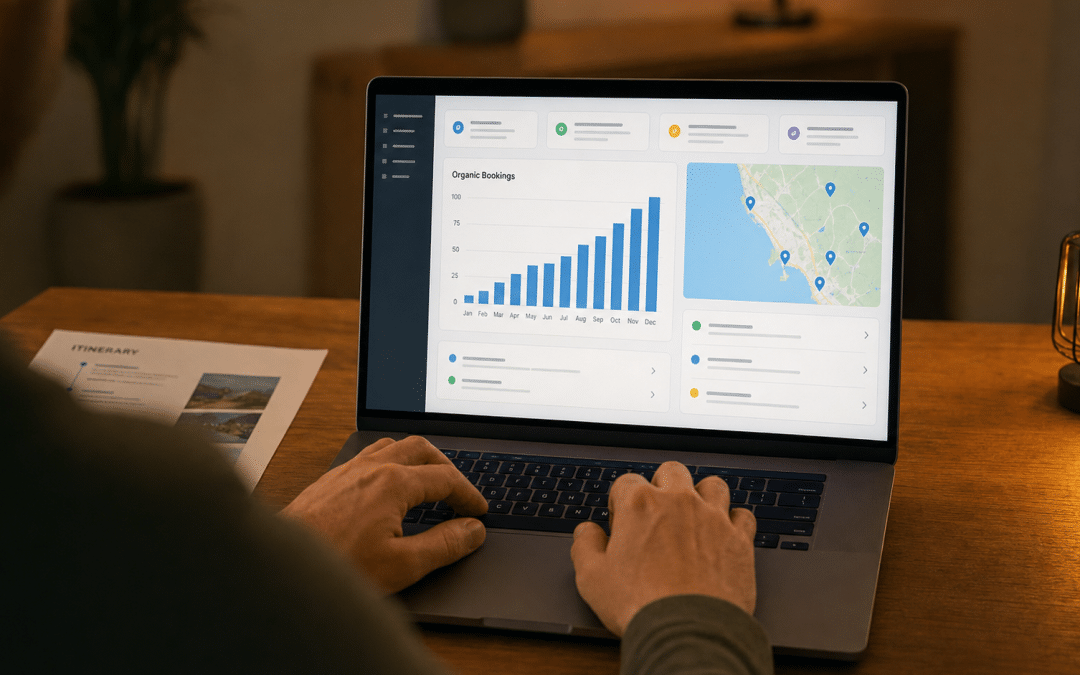
SEO for tourism businesses in South Africa is the single highest-leverage investment a lodge, tour operator, or activity provider can make — because it puts your property in front of international and domestic travellers at the exact moment they are choosing where to book.
If you want a deeper look at how this fits into a full channel mix, our Cape Town digital marketing agency overview covers the broader strategy. Done correctly, it compounds: a well-ranked listing earns clicks every day without an ongoing cost-per-click.
The challenge is that seo for tourism has a different rhythm to ordinary local SEO. Seasonality, multi-language audiences, OTA competition, and load-shedding-related site-speed issues all shape what works. This post covers the framework we apply across Cape Town, the Garden Route, the Winelands, and KwaZulu-Natal — from Google Business Profile to technical foundations and content that converts at a national level.
Quick Answer
SEO for tourism businesses in South Africa means optimising your Google Business Profile, building destination-intent content, earning local citations, and fixing site speed — so that travellers searching for experiences find you before they find an OTA that takes a commission.
Not sure where your tourism website is leaking organic traffic right now?
Get a Free SEO AuditWhat SEO for Tourism South Africa Actually Involves
SEO for tourism South Africa is a discipline that spans technical site health, local search signals, destination content, and off-site authority — all calibrated for a high-intent, geographically dispersed audience. It is not simply "adding keywords to your website." A lodge in Franschhoek and a kayaking operator in Knysna face structurally different ranking problems, even though both compete in the tourism vertical.
The core levers are the same across the vertical: a verified and fully optimised Google Business Profile, fast mobile page loads, structured destination pages, review velocity, and backlinks from travel publications and DMOs. What changes is the weighting. For a Cape Town day-tour operator, proximity signals dominate. For a safari lodge in Limpopo, topical authority and long-tail destination content drive more bookings.
There is also the OTA problem. Booking.com, SafariNow, and Airbnb outrank most independent properties on broad terms. The right seo for tourism strategy does not try to beat those platforms on "Cape Town hotels" — it targets the specific, high-intent phrases that OTAs cannot own: the name of your property, your unique experience, your exact location within a suburb or wine valley.
Google Business Profile: The Foundation of Local Tourism SEO
Your Google Business Profile (GBP) is the most immediately impactful element of seo for tourism because it controls how your business appears in Maps, the Local Pack, and AI-generated search summaries. According to Google's own guidance on local ranking, relevance, distance, and prominence all influence where a business appears — and all three are shaped by how completely and accurately you fill out your profile.
For tourism businesses, "completeness" means more than name, address, and phone number. It means the correct primary category ("Lodging," "Tour Operator," or "Tourist Attraction"), every applicable secondary category, your full service list, check-in and check-out hours, booking links, and at least 20 photos updated within the last six months. A complete, accurate profile gives Google more signals to match your listing to relevant searches.
Review volume matters significantly here. Properties with a healthy, growing review count tend to perform better in local rankings than comparable properties with far fewer reviews — even when the fewer-reviewed property has a marginally higher average rating.
The mechanism for collecting reviews should be built into your check-out process: a WhatsApp message from the host, a QR code at the reception desk, or a post-stay email sequence via Klaviyo. Responding to every review, including negative ones, signals active management.
Key Insight
A fully completed Google Business Profile — correct categories, updated photos, active review responses, and accurate hours — is the fastest single win available in SEO for tourism, and it costs nothing beyond time.
Destination Content Strategy for Tourism Websites
Destination content is the long-game engine of seo for tourism: it builds topical authority that makes your site visible for every stage of a traveller's research, not just the final booking search. The structure that works is a hub-and-spoke model — a core destination page for your area, surrounded by supporting guides on specific experiences, neighbourhoods, and seasonal itineraries.
A Hermanus whale-watching operator, for example, should hold a primary page optimised for "whale watching Hermanus" and supporting pages for "best time to see whales in Hermanus," "whale watching with children South Africa," and "Hermanus cliff path walking guide." None of those supporting pages are directly promotional — they answer questions the traveller is asking before they have decided where to book. That trust, built in research mode, converts at the booking stage.
The content must be genuinely useful, not thin. Google's quality assessments have become sophisticated enough to distinguish between a page that answers a question and a page that merely contains the keywords. Write for the person standing at Cape Point wondering what else to do in the Peninsula this afternoon — and you will rank for the terms that person typed an hour before they left their hotel.
For wineries and farm stays, our guide on marketing for wine farms and wineries covers the content structures that work specifically in that sub-vertical, which overlaps heavily with tourism intent.
Technical SEO Issues That Hit Tourism Sites Hardest
Technical SEO for tourism websites has one problem that almost no other vertical shares at the same severity: load-shedding-related hosting instability. A site hosted on an underpowered local server that goes down or slows to a crawl during Stage 4 load-shedding accumulates crawl errors and drops Core Web Vitals scores — both of which suppress rankings. Use a host with generator backup or choose a cloud platform with South African edge nodes.
Mobile speed is non-negotiable. International travellers research on mobile while in-destination, often on variable 4G connections. A page that loads in under three seconds on a mid-range Android device retains the visitor; one that loads in seven seconds loses them to the OTA that already has a cached app. Tools like Google Search Console and PageSpeed Insights will show you exactly where the bottleneck sits.
Schema markup is frequently missing from tourism sites and is worth implementing correctly. LocalBusiness, TouristAttraction, LodgingBusiness, and Event schema all help search engines understand what your page is about and have been used for generating rich results. Check our AI search optimisation guide for how structured data interacts with AI-driven search surfaces, which increasingly surface tourism results.
Is your tourism website slow enough to be costing you bookings every week?
Get a Free Technical ReviewLink Building for South African Tourism Businesses
Off-site authority — earned through backlinks from credible sources — is what separates a tourism site that ranks on page one from one that is permanently stuck on page three. For South African operators, the most valuable link sources are Cape Town Tourism, South African Tourism's official platform, provincial DMOs, travel publications like Getaway Magazine, and local news sites covering tourism stories. If earning links from tourism bodies and travel titles is hard to fit around running your property, our South African SEO services cover local and content SEO, beginning with a free audit.
Getting listed on these platforms requires effort but is achievable for any legitimate operator. Submit to South African Tourism's Tomsa-accredited database. Pitch story angles to travel journalists — "first operator to offer a specific experience" or "conservation initiative tied to the property" both generate editorial coverage. Partner with complementary businesses: a winery that links to a nearby guesthouse, and vice versa, builds a local authority cluster that lifts both.
Citation consistency matters as much as link volume. Your NAP (name, address, phone number) must be identical across your GBP, your website, SafariNow, TripAdvisor, Lekkeslaap, and every directory listing. Inconsistencies fragment your local authority signal. Run a citation audit before you build new links — fixing inconsistencies first makes every subsequent link more valuable.
Seasonality, Multilingual Audiences, and Booking Funnels
Tourism SEO in South Africa must account for sharp seasonality in a way that most other verticals do not. The Western Cape peaks in November through February. The Kruger region peaks in the dry season, May through September. Your content calendar and Google Ads budget — see our Google Ads cost guide for Cape Town benchmarks — should be planned around these curves, not on a flat monthly rhythm.
International travellers from the UK, Germany, and the Netherlands represent a significant share of inbound tourism.
Hreflang tags are theoretically applicable, but for most South African tourism SMEs, the practical priority is ensuring that English content is written for an international reader: metric distances, clear explanations of South African geography, and transparent pricing in Rand with a note that card payments are accepted via Peach Payments or PayFast. Ozow is worth adding for domestic bookings paid by EFT.
The booking funnel for tourism is longer than most operators expect. A traveller searching in March for a December trip to the Cape Winelands will click through multiple research pages before converting.
Your email capture — a downloadable itinerary guide, a "best time to visit" PDF — should sit mid-funnel so that you own the relationship when they are ready to book. Our email marketing guide for Cape Town businesses covers the platform choices and automation flows that work for this funnel shape.
| SEO Lever | Best For | Time to Impact | Cost Level |
|---|---|---|---|
| Google Business Profile optimisation | All tourism operators | 2–6 weeks | Low (time only) |
| Destination content hub | Lodges, tour operators | 3–6 months | Medium |
| Technical / speed fixes | Sites with Core Web Vitals issues | Immediate uplift | Low–Medium |
| Link building via DMOs and press | Properties with a story angle | 4–9 months | Medium |
| Review velocity programme | Operators with post-stay contact | 4–8 weeks | Low |
| Schema / structured data | All tourism websites | 6–12 weeks | Low |
| Email mid-funnel capture | High-value bookings, lodges | Ongoing | Low–Medium |
| Metric | Before SEO Programme | After SEO Programme (12 months) |
|---|---|---|
| Monthly organic sessions | 310 | 1,480 |
| Google Maps impressions (weekly) | 190 | 870 |
| Direct booking enquiries per month | 4 | 19 |
| OTA commission as % of revenue | 28% | 14% |
| Average page load (mobile) | 7.2 s | 2.6 s |
| Review count (GBP) | 17 | 64 |
The figures above illustrate the pattern we see, not a guaranteed outcome. Results vary by property type, starting domain authority, budget, and market competitiveness.
Key Insight
Reducing OTA dependence is the clearest financial return from seo for tourism: every percentage point of commission saved on a R2 million annual revenue property is R20,000 back in the operator's pocket.
Cape Town Tourism SEO: A City-Level Framework
Cape Town is the most competitive market for seo for tourism in South Africa — and also the most rewarding when you rank. The city draws both domestic and international travellers year-round, with international search volume spiking from May onward as northern-hemisphere tourists plan December and January trips.
Our dedicated guide on marketing for tourism businesses in Cape Town goes deep on the city-specific tactics; here is how the national framework intersects with the Cape Town context.
Suburb and neighbourhood specificity is the key differentiator. "Cape Town accommodation" is dominated by OTAs. "Boutique guesthouse Tamboerskloof" or "self-catering apartment Sea Point with parking" are winnable. Build your location page around your actual neighbourhood, not just "Cape Town." Connect it to the nearest V&A Waterfront, Table Mountain, or Boulders Beach search cluster through internal links and supporting content.
For operators in the Winelands, SEO for Stellenbosch businesses applies directly — the search behaviour from travellers looking for Stellenbosch wine experiences overlaps substantially with accommodation and activity searches. A joint content strategy that covers the whole Winelands corridor lifts all operators who participate.
GPM's Approach to SEO for Tourism Businesses
GPM brings operator experience to tourism SEO that most agencies cannot: Dirk van Greuning built and scaled a South African ecommerce business before founding the agency, which means the team understands booking funnels, payment gateway integrations with PayFast and Peach Payments, and the commercial reality of OTA commission pressure. We do not recommend tactics that look good in a report but do not generate bookings.
Our process for tourism clients starts with a technical audit and GBP gap analysis, followed by a 90-day content sprint targeting the three to five highest-value destination phrases for the property. Link outreach to Cape Town Tourism, provincial DMOs, and relevant travel publications runs in parallel. We track direct booking enquiries, not just rankings, because rankings without revenue are vanity. Full details of our deliverables are on our Cape Town marketing agency services page.
We also integrate review management and email capture into the programme from day one, so the SEO investment builds compounding assets — an email list and a review base — rather than purely a position in a search result that a Google algorithm update could shift.
Who This Is NOT For
Operators wanting instant bookings. SEO for tourism is a three-to-twelve-month investment. If you need bookings in the next four weeks, Google Ads or a paid OTA placement is the right tool for right now. SEO and paid search work best in combination, with SEO reducing your long-term cost per acquisition as it matures.
Businesses with no content resource. Destination content requires writing — either in-house or outsourced. If there is genuinely no capacity to produce or commission content, the strategy will stall after the technical and GBP work is done. A minimum viable content plan needs at least two to four substantive pages per quarter to build momentum.
Properties on very thin margins who cannot sustain a six-month programme. SEO for tourism requires sustained investment before it pays back. A micro-guesthouse running at near break-even may find that targeted Google Ads or Lekkeslaap promotions deliver a faster ROI cycle. We will tell you this honestly in a discovery call rather than take a retainer that does not serve you.
Operators unwilling to collect and respond to reviews. Growing your review base is a material part of building local prominence, and prominence is one of the factors Google uses in local ranking.
If the business model or team culture makes soliciting and responding to guest reviews impractical, a significant portion of the SEO work will be undermined from the start. Reviews cannot be outsourced to the agency — they require authentic guest contact from the operator.
Ready to reduce OTA commission and own your direct booking channel?
Get Your Free Tourism SEO StrategyFrequently Asked Questions: SEO for Tourism
What does seo for tourism cost for a South African operator?
It depends on the scope — a GBP optimisation and technical fix project can run from R8,000 to R20,000 once-off, while an ongoing content and link-building retainer typically sits between R12,000 and R35,000 per month for a mid-sized property. Our SEO cost Cape Town guide breaks down what drives pricing across different scope levels so you can benchmark before a conversation.
How long before a tourism website sees ranking improvements?
It varies by starting domain authority, competition level, and how aggressively content is produced. Technical fixes and GBP optimisation can produce visible improvements in Maps within four to eight weeks. Content-driven organic rankings for destination phrases typically take four to nine months to move meaningfully. Full programme results — including measurable booking uplift — are normally assessed at the twelve-month mark.
Can I outrank Booking.com and SafariNow on broad terms?
On genuinely broad terms like "Cape Town hotels," outranking OTAs is not a realistic near-term goal for an independent property. The strategy is to own the specific, high-intent terms OTAs cannot dominate: your property name, your suburb, your unique experience, and long-tail queries from travellers deep in the research phase. Those terms convert at a materially higher rate than broad OTA-dominated terms anyway.
Does POPIA affect how I collect email addresses and reviews?
South Africa's Protection of Personal Information Act applies to any collection and use of guest data, including email addresses gathered for post-stay review requests or newsletter sequences. Practices commonly interpreted under POPIA require a clear purpose statement, explicit consent, and an unsubscribe mechanism on every marketing communication. We recommend consulting a POPIA practitioner for your specific data flows rather than relying solely on marketing guidance.
How important is social media compared to SEO for tourism?
Social media and search serve different functions in the tourism funnel. Social — particularly Instagram and TikTok — generates awareness and desire; search captures travellers who have already decided they want an experience and are comparing options. Both matter, and our social media marketing guide for Cape Town covers how to allocate between channels. For direct bookings, search typically delivers a higher-intent visitor at a lower long-term cost per acquisition than paid social.
What is the single most impactful first step for a tourism business new to SEO?
Claim, verify, and fully complete your Google Business Profile — correct primary and secondary categories, all operating hours, a booking link, and at least 20 current photos. This alone produces measurable visibility improvements in Maps results within weeks, requires no budget, and sets the foundation on which every other SEO tactic compounds. Once the profile is complete, implement a systematic post-stay review request process before touching anything else.
Want to know exactly where your tourism website is losing direct bookings?
We will audit your Google Business Profile, site speed, content gaps, and top competitor rankings and deliver a prioritised action plan specific to your property and destination. No obligation — we'll get back to you within 24 hours.
Get Your Free Tourism SEO Audit