
 Add to Preferred Sources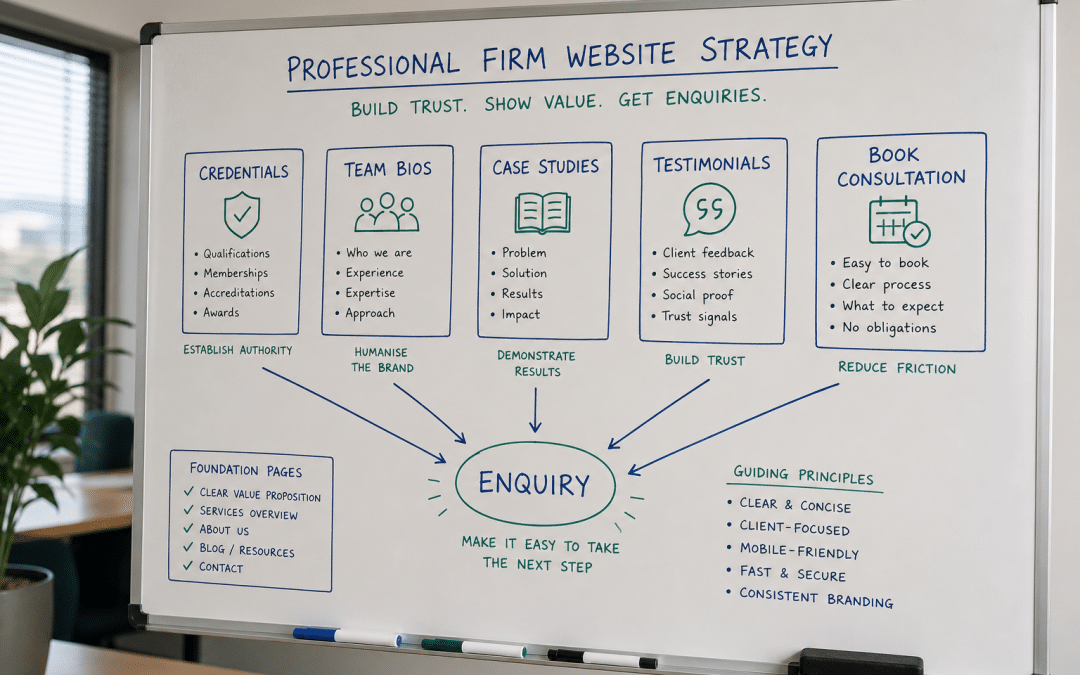
Web design for professional services is fundamentally about one thing: turning credibility into enquiries. A law firm, accountancy, or consultancy is not selling a product off a shelf — it is asking a prospect to trust it with something important, and the website is where that trust is won or lost. For the underlying build fundamentals, see our web design guide; this page is about the site a professional practice specifically needs.
The distinction matters because professional buyers behave differently. They research carefully, compare a shortlist, and read about your people and track record before they ever pick up the phone. A site that fails to establish expertise and trust loses them silently — and a polished but credibility-thin site converts far worse than its owners assume.
Quick Answer
Effective web design for professional services is built to establish trust and capture consultations, not to sell transactions. That means clear credentials and qualifications, real testimonials and case studies, named team bios, and an easy path to book a consultation or enquire. For high-trust buyers — clients of law firms, accountants, and consultants — the site's job is to prove expertise and make the next step effortless.
Want a website that turns your firm's credibility into booked consultations?
Get a Free Professional Website PlanWhat a Professional Services Website Must Do
A professional services website has two jobs: prove the firm can be trusted, and make enquiring easy. Everything else is secondary. A prospect arrives already needing the service — the question in their mind is not "what is this" but "can I trust these people with my matter", and the site has to answer that quickly and convincingly.
That makes credibility the core design problem, not decoration. Qualifications, professional body memberships, named partners, and a clear track record have to be visible and easy to verify. A practice that hides its people behind a generic "Our Team" stub, or makes no specific claims about expertise, gives a cautious buyer no reason to choose it over a competitor who does.
The second job is conversion, and for professional firms that means a consultation or enquiry rather than a checkout. The path from "this firm looks credible" to "I have booked a call" should be short and obvious on every page. A buried contact form at the end of a long journey loses the high-intent prospect who was ready to act after the first page.
Trust First, Then Capture
A professional services site succeeds by proving trust and then making the enquiry effortless. Credentials, named people, and a track record do the first job; prominent consultation and enquiry options do the second. A beautiful site that hides its expertise or its contact path fails at both — which is why so many professional websites look impressive and still generate almost nothing.
Why Professional Services Websites Are Different
Professional services sites are different because the buyer's decision is high-stakes and high-consideration. Choosing a lawyer, accountant, or consultant carries real consequences, so prospects research thoroughly, compare several firms, and weigh credibility heavily before committing. The website is doing reputational work, not just informational work.
This is why trust signals matter more here than in almost any other sector. Google's own quality framework makes the point: in its guidance on experience, expertise, authoritativeness, and trust, it states plainly that trust is the most important of those qualities. A professional site that demonstrates genuine expertise both ranks better and converts better, because the same signals persuade humans and search engines alike.
It also changes the conversion model. There is rarely an impulse purchase in professional services — the goal is a booked consultation, after which the relationship is sold in person. The site's job is to earn enough trust to win that first conversation, which is a different design brief from a shop built to close a sale on the page.
Not sure whether your firm's site is building trust or quietly losing it? Let us look.
Get a Free Credibility ReviewThe Trust Signals That Win Clients
The trust signals that win professional clients are specific, verifiable proofs of expertise — not vague claims of quality. Named team bios with real qualifications and professional registrations come first, because clients want to know exactly who will handle their matter and why that person is credible.
Case studies and testimonials do the next layer of work. A short, concrete account of a problem solved — or a named client quote — is far more persuasive than a wall of adjectives about being "leading" or "trusted". Professional body memberships, awards, and published articles all reinforce authority, positioning the firm as a genuine expert rather than a generalist.
Presentation matters as much as the proof itself. These signals need to be prominent and easy to find, not buried three clicks deep. A prospect skimming on a phone should encounter credentials, a recognisable face, and a relevant result within seconds of landing — that is what converts a cautious researcher into an enquiry.
The Credibility Stack
Five signals carry the most weight for professional firms: named team bios with qualifications, professional body memberships, concrete case studies, real client testimonials, and published expertise like articles or talks. Vague claims of being "leading" or "trusted" do nothing. Specific, verifiable proof does the persuading — and it has to be visible quickly, not hidden in an inner page.
Turning Trust Into Enquiries
Trust only pays off if the site makes acting on it effortless. The single most important conversion element is a clear, low-friction way to book a consultation or enquire, repeated sensibly throughout the site rather than tucked away on one contact page. For a hesitant professional buyer, "book a 20-minute call" often converts better than a demanding contact form.
Those enquiry forms carry a compliance duty too. Any form capturing a name, number, or matter detail is processing personal information under South Africa's POPIA, which matters doubly for firms handling confidential client data. Consent and a privacy policy should be built into the forms from the start, and the broader strategy of turning a site into a pipeline is covered in our professional services lead generation guide.
| What to ask a web partner | A professional-aware answer | A red flag |
|---|---|---|
| How will the site build trust? | Credentials, bios, case studies, testimonials | "It'll look premium" |
| What is the main conversion? | Booked consultation or enquiry | "More traffic" |
| Is it POPIA-compliant? | Consent and privacy built into forms | "Add that later" |
| Who owns the site and data? | You do, entirely | "We manage all that" |
What It Costs and How to Choose a Partner
The cost of a professional services site depends on scope — a single-practitioner site, a multi-partner firm site, and a full content-and-resources build sit at different price points. The general ranges are in our web design pricing guide, and the same principle applies: the cheapest quote usually omits the trust-building and conversion work that makes the site earn its keep.
When choosing a partner, look for one that understands the professional buyer specifically — the consideration journey, the role of credentials, the consultation-led conversion, and confidentiality obligations. The web design for professional services that actually generates enquiries comes from a team that has thought about how a firm wins trust, not one that treats your practice like a shopfront with a logo swapped in.
Scope and Specialism Drive Value
Price tracks scope — practitioners, partners, and resource depth. But the bigger variable is whether the partner understands professional buyers at all. A team that designs around credentials, the consideration journey, and consultation capture builds a site that converts; one that drops your firm into a generic template builds an expensive brochure that prospects quietly bounce from.
A Real-World Example: Before and After
The clearest illustration is a representative professional firm that replaced a dated, credibility-thin website with a trust-first, consultation-focused build. Visitor numbers barely moved; the site simply started converting the researchers who were already arriving into booked calls, because it finally proved the firm was worth trusting.
| Metric (monthly) | Before — credibility-thin site | After — trust-first site | Change |
|---|---|---|---|
| Website visitors | 1,400 | 1,500 | About the same |
| Mobile load time | 5.4s | 2.1s | −61% |
| Consultation bookings | 6 | 21 | +250% |
| Enquiry form submissions | 9 | 28 | +211% |
| Visitor-to-enquiry rate | 1.1% | 3.3% | +200% |
The consultation-bookings row is the one that matters. Going from six booked calls a month to twenty-one, on near-identical traffic, is the difference between a website that decorates the firm and one that feeds it. The lift came from credibility and a clear booking path, not from buying more visitors.
What Drove the Result
Traffic stayed flat; the site got faster, proved the firm's expertise, and made booking a consultation obvious. Consultation bookings more than tripled and enquiries roughly tripled — all from the same visitors, persuaded by credentials and a clear next step. For a professional practice, that is the whole return on investing in a proper site rather than a pretty one.
The GPM Differentiator
Most web design for professional services is sold on how prestigious the site will look, with trust-building and conversion treated as afterthoughts. We come at it from an operator's seat, having scaled South African businesses where a website had to produce real enquiries — so our web design services start with how a firm earns trust and books consultations, then build around that.
For professional clients that means credentials and case studies designed to persuade, a consultation path that is obvious on every page, POPIA handled properly on the forms, and a site fast enough to keep a researching prospect engaged. You own the site, the domain, and the enquiries it generates, with no lock-in — and an honest answer when your existing site needs a focused fix rather than a full rebuild.
Who This Is NOT For
A trust-first professional site is right for committed firms, but wrong for some. Being honest about that upfront saves everyone wasted spend — so here is who should hold off.
Firms unwilling to show their people and credentials. If you will not put named bios, qualifications, and a real track record on the site, the single biggest trust lever is gone. A professional site that stays anonymous gives cautious buyers no reason to choose it, and no build can fix that reluctance.
Anyone wanting the cheapest possible site. A site engineered for trust, speed, and consultation capture costs more than a template with a firm name dropped in. If price is the only filter, you will get the brochure site this guide warns against — and watch prospects bounce from it.
Practices with no capacity to handle enquiries. A trust-first site will produce consultation requests, but if nobody responds promptly, the investment is wasted. Fix the intake process first, or the improved site simply collects enquiries that go cold while the prospect calls a competitor.
Anyone treating client data casually. Professional firms handle confidential information, so POPIA compliance on enquiry forms is not optional. If you are not willing to handle consent and data properly, a serious partner is the wrong fit — the confidentiality and compliance stakes are simply too high.
Think a trust-first site is the right move for your firm? Start with a free review.
Get a Free Professional Website ReviewFrequently Asked Questions
What makes web design for professional services different?
Professional sites are built to establish trust and capture consultations rather than sell transactions. Clients of law firms, accountants, and consultants research carefully and weigh credibility heavily, so the site must prove expertise through credentials, bios, case studies, and testimonials. The main conversion is a booked consultation or enquiry, which is a different design goal from an ecommerce or transactional website.
What are the most important trust signals on a professional website?
Named team bios with real qualifications and professional registrations come first, followed by concrete case studies and genuine client testimonials. Professional body memberships and published expertise reinforce authority. Vague claims of being "leading" or "trusted" do little — specific, verifiable proof is what persuades a cautious professional buyer to enquire.
What should the main call to action be on a professional firm's site?
A clear, low-friction way to book a consultation or enquire, repeated sensibly across the site rather than hidden on one page. For hesitant buyers, an option like "book a short call" often converts better than a long contact form. The path from feeling reassured to taking the next step should be short and obvious on every page.
Does a professional services website need to be POPIA-compliant?
Yes. Any form capturing a name, number, or matter detail processes personal information under POPIA, which is especially important for firms handling confidential client data. Consent and a privacy policy must be built into the site rather than added later. Proper handling of enquiry data is both a legal duty and part of the trust a professional firm is selling.
How long does a professional services website take to build?
A single-practitioner site takes a few weeks through discovery, design, build, and testing, while a multi-partner firm site with resources takes longer. The timeline depends on scope and how quickly content, bios, and feedback come back from your side. Anyone promising a complete, credibility-ready professional site in a day or two is skipping the process.
Will I own the website and the enquiries it generates?
Yes, you should fully own your site, your domain, and every enquiry it captures. Never accept an arrangement where the agency keeps control of your site or your client data. Ownership is one of the most important questions to settle before any build begins, and a good partner is completely comfortable confirming it.
If you are weighing whether a proper professional site is worth it over your current one, that caution is fair — many firms have paid for prestigious-looking sites that never produced a single enquiry. The difference is a build designed around trust signals and a clear consultation path, so the credibility your firm already has finally converts into booked work.
Get a Free Professional Website Plan
We will map a trust-first website for your firm — credentials and case studies that persuade, a clear consultation path, POPIA-compliant capture, and a fast, mobile-ready build — delivered as a one-page plan you own outright, with the highest-impact priorities first. No obligation — we will get back to you within 24 hours.
Get My Free Professional Website Plan