
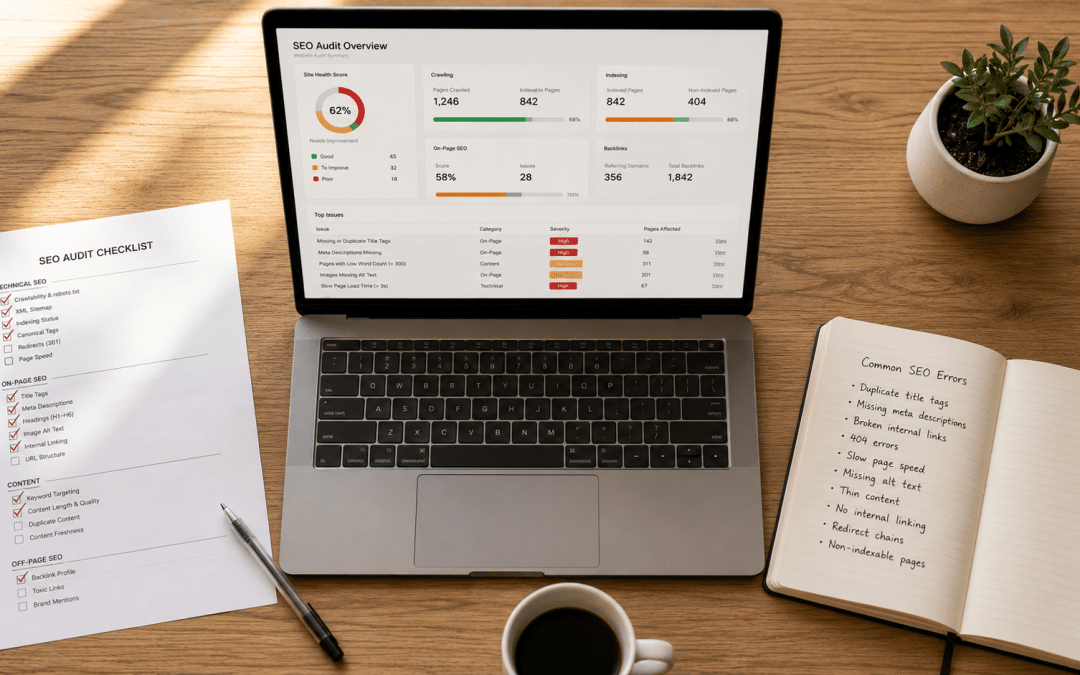
The most costly seo mistakes south africa businesses repeatedly make fall into 10 recurring patterns. The pattern map: chasing global keywords instead of locally-qualified ones, publishing thin "what is" content that AI Overviews fully summarise, and skipping local schema markup.
The remaining patterns of seo mistakes south africa operators repeat: cannibalising the same query with overlapping pages, building links from low-quality directories, ignoring Core Web Vitals on slow SA-hosted servers, anonymous content with no E-E-A-T signal, isolated pages without cluster architecture, misconfigured Google Business Profiles, and over-optimisation that triggers Google's 2026 spam policies.
This guide breaks down each mistake with the concrete SA fix pattern, shows which mistakes have the biggest revenue impact, and explains why some 2022-era "best practices" are now active liabilities post-AI Overview rollout. For broader cluster context, see the South African search pillar; for the AI Overview era strategic frame, see our AI SEO South Africa guide.
Quick Answer
The 10 most costly recurring patterns of seo mistakes south africa operators repeat: (1) Targeting global keywords with no SA modifier; (2) Publishing thin "what is" content with no original SA data — fully displaced by AI Overview citation extraction.
The next three errors: (3) Skipping LocalBusiness schema, NAP consistency, GeoCoordinates markup — costs local-pack visibility; (4) Page cannibalisation through near-identical slug patterns; (5) Building backlinks from low-quality SA directory networks — 2026 spam update penalty risk.
The remaining five: (6) Ignoring Core Web Vitals on slow SA-hosted servers (LCP > 4 seconds on mobile); (7) Anonymous content with no named author or E-E-A-T signal — citation gate fails; (8) Sprawling content portfolios without cluster architecture — topical authority dilutes; (9) Misconfigured Google Business Profile categories, hours, service area — costs local visibility; (10) Over-optimisation triggering Google's spam policies via keyword stuffing, doorway pages, or scaled content abuse.
Want a quick read on which of the 10 errors your current SA portfolio actually makes — and which fixes recover revenue fastest?
Get a Free Mistakes AuditThe 10 Most Costly Patterns of SEO Mistakes South Africa Operators Repeat
The 10 errors below recur across SA mid-market businesses with measurable consistency. Some are recent (introduced by the 2025-26 AI Overview shift); some are evergreen (recurring since 2018+). Each error has a specific SA-relevant manifestation — generic explainers without local context generally won't address the actual operating conditions of the SA market.
Mistake 1: Targeting Global Keywords Without SA Modifiers
Targeting unmodified global keywords ("best CRM software", "ecommerce platform comparison", "marketing strategy") puts SA businesses in direct competition with US/UK/EU operators with 10-100x the domain authority. The fix pattern: every primary commercial keyword should include an SA-specific modifier (south africa, johannesburg, sandton, cape town) that reduces competitive depth while matching SA buyer search behaviour. SA buyers searching commercial intent increasingly include geographic qualifiers because they need local pricing, local fulfilment, local compliance.
Mistake 2: Thin "What Is" Content Without Original SA Data
Thin definitional content that recycles industry-standard explanations gets fully summarised by AI Overview in 2026 — zero citation, traffic collapse. The fix pattern: every informational post needs at least one original first-party SA data point (real benchmark, real Rand figure, real before/after, real client outcome) that the AI cannot produce from training data alone. First-party data earns citation; recycled summary does not.
Mistake 3: Missing or Misconfigured Local Schema Markup
Skipping LocalBusiness schema, NAP (Name-Address-Phone) consistency, GeoCoordinates, Service area markup, and OpeningHours data costs local-pack visibility — the highest-converting layer of organic search for SA service businesses. The fix pattern: structured data validates the business as a real SA operator at a real SA address; AI systems triangulate against this for both ranking and citation. Missing schema is invisible to AI Overview retrieval; conversational queries about local businesses preferentially cite schema-rich operators.
Mistake 4: Page Cannibalisation Through Overlapping Slug Patterns
Cannibalisation occurs when multiple pages on the same site target the same query — two posts about "Google Ads pricing", a service page and a blog post both targeting "Shopify South Africa", or pillar + sub-page competing for the broad term. The fix pattern: every page owns one canonical query; sub-pages target adjacent long-tail variations; pillar owns the broad head term; service pages own commercial intent variants with distinct modifiers (e.g., "agency", "service", "consultant").
Mistake 5: Low-Quality SA Directory Backlinks
Building backlinks from low-quality SA business directories was effective in 2018-2020 — actively damaging in 2026 post-March-spam-update. The fix pattern: ten genuine SA media mentions (Daily Maverick, Business Day, IT-Online, MyBroadband, Bizcommunity) outweigh 200 directory profile links from the linking network of typical SA "SEO packages". Quality over quantity is operational, not aspirational — the 2026 spam update demoted sites with link manipulation patterns.
Mistake 6: Slow SA-Hosted Servers Failing Core Web Vitals
Mobile LCP (Largest Contentful Paint) above 4 seconds and INP (Interaction to Next Paint) above 500ms costs ranking — and 60-75% of SA traffic is mobile. The fix pattern: Cloudflare APO or equivalent CDN, image optimisation to WebP, lazy-loading, and deferred JavaScript.
Ideally hosting on an EU or US edge with SA Cloudflare cache rather than slow shared SA hosting. The technical baseline gate hasn't gone away in the AI era — it's just no longer enough on its own.
Mistake 7: Anonymous Content Without Named Author or E-E-A-T
Anonymous content — no author byline, no bio block, no LinkedIn linking, no credential disclosure — earns citation from AI Overview at materially lower rates than named-author content. The fix pattern: every published post has a named author with bio block, LinkedIn profile linking, and a verifiable topical track record. E-E-A-T (Experience, Expertise, Authoritativeness, Trustworthiness) moved from aspirational to operational gate in 2025; anonymous content gets summarised but not cited.
Mistake 8: Isolated Pages Without Cluster Architecture
Single-page optimisation produces diminishing returns when Google's retrieval-augmented generation pulls from clusters of related content. The fix pattern: every commercial topic anchored by 12-20 interconnected posts (pillar + sub-posts), hub-and-spoke internal linking architecture, related-post blocks that reinforce topical association. Isolated high-quality pages routinely underperform clustered mid-quality pages because cluster cohesion signals topical authority in ways isolated authority signals cannot.
Mistake 9: Misconfigured Google Business Profile
Misconfigured Google Business Profile — wrong primary category, missing service-area definition, incomplete hours, no photos, no posts, no Q&A management, no review responses — costs local-pack and Map visibility. The fix pattern: GBP receives the same operational attention as the website, with weekly posts, monthly photo updates, every review acknowledged within 48 hours, primary + secondary categories accurately selected, and Service Area for service businesses correctly defined for SA suburbs.
Mistake 10: Over-Optimisation Triggering Spam Policies
Over-optimisation — keyword stuffing, exact-match anchor link spam, doorway pages, scaled AI-generated content without value-add, hidden text, cloaking — triggers Google's 2026 spam policies.
The fix pattern for this most damaging of seo mistakes south africa operators commit: write for buyer comprehension, link with natural anchor diversity, build one comprehensive post rather than three doorway pages, and use AI as a drafting tool with original data and expert review. Per Google policy, "content created primarily to game Search rankings — regardless of method — is what our systems target".
The Mistake Pattern Most SA Operators Underestimate
Of the 10 instances of seo mistakes south africa operators repeat, errors 1, 2, 7, and 8 produce the biggest compounding revenue impact when fixed together. Global keyword targeting wastes ad budget AND content production budget AND links to non-converting traffic. Thin informational content compounds AI Overview displacement. Anonymous content forfeits the citation visibility that compounds brand authority. Isolated pages waste the cluster-cohesion lift that good architecture produces.
Fixing any one in isolation produces 10-20% lift; fixing all four together produces 60-150% organic traffic compound over 12-18 months because each fix unlocks the next. The fixes don't add — they multiply. SA operators investing fixes in the wrong order (technical first, then content, then architecture) routinely take 3-4x longer than operators starting with strategic architecture, then content, then technical hardening.
The Recovery Sequence That Compounds Fastest
The optimal fix sequence is architecture first, content second, technical hardening third. Architecture (Errors 4, 8) makes the rest of the work landable — without cluster cohesion, even great content lands in isolation.
Content (Errors 1, 2, 7) makes the architecture earn citation — original SA data + named expertise + locally-qualified targeting compound the cluster lift. Technical (Errors 3, 6, 9) ensures the work isn't penalised on infrastructure.
SA operators executing in the wrong order — chasing Core Web Vitals scores or fixing the GBP before addressing the cannibalisation and content errors — routinely take 3-4x longer to recover. The errors aren't independent fixes; they're an interconnected system where the sequence determines compounding speed.
SA-Specific Patterns Behind the 10 Errors
Several of the seo mistakes south africa operators repeat have SA-specific manifestations that don't show up in generic global SEO advice. The patterns reflect the actual operating conditions of SA-based businesses — POPIA compliance overhead, SA hosting performance realities, local query behaviour specifics, and the SA market's particular relationship to global content competition.
| Error Pattern | SA-Specific Manifestation |
|---|---|
| Geographic keyword discipline | SA buyers add "south africa" or city qualifiers at much higher rates than US/UK buyers — global-keyword targeting misses SA buyer intent specifically |
| Local schema completeness | SA businesses with multi-suburb service areas (Sandton, Rosebank, Bryanston) need ServiceArea schema for each — most SA sites have only main address |
| Hosting performance | Many SA-hosted sites still run on shared Linux servers with no CDN; mobile LCP routinely exceeds 5 seconds even with light themes |
| Directory link spam | SA-specific low-quality directory networks (often "free SA business listing" sites) carry no authority and trigger 2026 spam-update flags more reliably than generic global directories |
| POPIA compliance content gaps | SA-specific compliance topics (POPIA, B-BBEE, NCR) earn citation when global content cannot — first-party SA regulatory knowledge is genuinely scarce |
| Google Business Profile category mismatch | SA businesses routinely select wrong primary category (e.g., "Marketing Agency" instead of "Digital Marketing Service") — costs local-pack visibility for the right query |
Want a quick read on which SA-specific patterns your current portfolio is exposed to — and which fixes recover the biggest revenue?
Get a Free SA-Specific AuditReal SA Before-and-After: An Operator Fix Case Study
The seo mistakes south africa fix case study below reflects a Johannesburg-based B2B services firm, organic-traffic-dependent business model, 67-post content portfolio over 5 years, monthly organic sessions of 22,400 before the rebuild. The before-state reflects May 2025; the after-state reflects April 2026 following 10 months of methodical fix work across Mistakes 1, 2, 4, 7, and 8 (the highest-impact compound).
| Metric | Before (May 2025) | After (April 2026) |
|---|---|---|
| Monthly organic sessions | 22,400 | 31,800 |
| Commercial-intent session share | 14% | 38% |
| Average session duration | 1m 18s | 3m 04s |
| Organic-sourced qualified leads / month | 38 | 147 |
| Cost per organic-sourced lead | R 4,200 | R 1,090 |
| Pages with named author E-E-A-T | 0 | 67 |
| Cluster architecture (interconnected pillar+spokes) | 2 clusters | 6 clusters |
| Branded query volume / month | 340 | 1,820 |
What Drove the Lift
Total organic sessions grew 42%, but the more important shift was the commercial-intent session share rising from 14% to 38% — the rebuild moved the audience composition from informational-traffic-heavy to commercial-intent-heavy. Qualified leads grew 287%, cost per lead dropped 74%. The branded query lift (435%) reflects the compounding brand authority from named-author E-E-A-T + cluster cohesion + AI Overview citation visibility working together.
The operational lesson: not every error costs the same. Mistakes 1, 2, 7, and 8 produced almost all of the lift; Mistakes 3, 5, 6 were also fixed but contributed marginally to the compounding result. SA operators with limited budget should prioritise the four high-leverage fixes first, then layer the technical fixes once the strategic foundation is in place.
How Growth Pulse Media Approaches Error Diagnosis and Recovery
Most SA agencies sell error-recovery work as a one-time audit — produce a long list, hand it over, charge a fee. That framing produces lists without execution. The right approach diagnoses the four-or-five highest-impact errors specific to the operation's actual revenue model, prioritises by compounding impact, and executes the fixes in the right sequence (architecture first, content second, technical hardening third) rather than alphabetical or "easy first" order.
Dirk built and ran a real SA ecommerce business through every major Google algorithm shift from 2018 onward — direct experience watching shortcut tactics work then fail, watching low-quality directory links produce penalties.
Watching thin content collapse through Medic and Helpful Content updates, watching anonymous content lose citation share in the AI Overview rollout. That operator seat applied to your SA error-recovery work produces priority sequencing tuned to your actual buyer journey and existing portfolio rather than generic checklist execution.
SA businesses ready treating ranking work as a long-term operational asset can use our search engine optimisation service, which covers diagnostic audit, prioritised fix roadmap, implementation execution, and the ongoing operational discipline that prevents the same errors from reappearing as the portfolio scales. We pair recovery work with the strategic framework from SA content strategy and technical audit.
Who This Error-Recovery Approach Is NOT For
The seo mistakes south africa fix patterns above fit businesses with existing content portfolios of 20+ posts, monthly ranking budget above R 10,000, and willingness to commit to 9-15 month recovery cycles. Here is who should look elsewhere first.
SA operations with under 10 posts on the site: Most of the 10 errors above only manifest meaningfully once a portfolio reaches 15-20+ posts. Operations with smaller content footprints typically face foundational gaps (no clear topical anchor, no commercial intent pages, no service-area schema baseline) rather than recovery mistakes. The work for sub-10-post operations is portfolio building, not mistake recovery — different methodology, different sequencing.
Operations expecting under-3-month recovery results: The compounding fix work above takes 6-9 months to produce material ranking lift and 12-15 months to fully compound. Operations expecting first-quarter recovery from one-month audit work consistently underestimate the timeline. Google's spam update recovery is explicitly "gradual and not guaranteed" per official guidance; algorithmic re-evaluation timelines run months, not weeks.
Businesses unwilling to deprecate underperforming content: Many of the highest-impact fixes require deprecating or consolidating existing content — combining 4 thin doorway pages into 1 comprehensive cluster, redirecting sub-200-word posts to better-developed parents, removing low-quality affiliate roundups that trigger spam classifiers. SA operations attached to sunk-cost portfolios routinely refuse this work and produce inferior recovery results. The willingness to cut is operationally as important as the willingness to build.
Operations expecting recovery without addressing E-E-A-T: The named-author + bio-block + LinkedIn-linking discipline is non-negotiable in 2026 citation visibility. SA operations preferring anonymous content (often because no internal expert is willing to be the named author) cap their citation visibility regardless of how well the other 9 mistakes get fixed. The operator-as-author commitment is the gating fix for the citation-visibility era; without it, ceiling stays low.
Wondering whether your SA operation actually meets the volume and discipline prerequisites for the recovery work seo mistakes south africa operators need to execute properly?
Get a Free Recovery Readiness CheckThe discipline carrying all of this is treating seo mistakes south africa recovery as portfolio-level architecture rather than a page-level optimisation exercise. The right fix sequence, prioritised by compounding impact, executed across 9-15 months produces results that don't collapse on the next algorithm update.
SA operations building this discipline from the start avoid the recovery work entirely; SA operations that have accumulated 5+ years of errors need methodical sequencing to recover without making the situation worse.
The 2026 SA market makes proper diagnosis of seo mistakes south africa operators commit materially easier than 2024. Google's official documentation explicitly catalogues the spam triggers; AI Overview citation criteria are observable; SA-specific patterns are documented enough to triangulate against.
The binding constraint remains operator discipline — running real diagnostic audits against real revenue patterns, prioritising fixes by compounding impact rather than ease, and executing through the full 9-15 month recovery cycle rather than abandoning at month 4.
Frequently Asked Questions
What are the most expensive SEO mistakes for South African businesses?
Targeting unmodified global keywords (instead of SA-modified keywords), publishing thin "what is" content without original SA data, anonymous content without named author E-E-A-T, and isolated pages without cluster architecture produce the biggest compounding revenue impact when wrong — and the biggest lift when fixed together. These four mistakes typically waste 50-70% of organic budget in SA mid-market businesses with otherwise reasonable execution.
How long does it take to recover from SEO mistakes in South Africa?
Recovery timelines depend on the error type. Algorithmic spam-update recovery takes 6-12 months and is not guaranteed per Google's official guidance. Manual action recovery requires Reconsideration Request approval, typically 4-8 weeks after the fix work completes. Strategic recovery (cluster architecture, E-E-A-T retrofit, content rewrites) takes 9-15 months for material compounding lift. Quick technical fixes (Core Web Vitals, schema, basic GBP) show results in 30-60 days.
Does targeting Johannesburg or Cape Town keywords help South African SEO?
Yes — geographic qualifiers (johannesburg, cape town, sandton, durban, pretoria) reduce competitive depth against global content while matching SA buyer search behaviour. SA buyers searching commercial intent increasingly include geographic qualifiers because they need local pricing, local fulfilment, local compliance. Geographic modifiers also unlock local-pack visibility through GBP integration and LocalBusiness schema markup, often the highest-converting layer of organic search for SA service businesses.
Will using AI tools cause SEO mistakes in South Africa?
Per Google's official spam policy, generative AI tools used to draft, structure, or research-support content are acceptable; generative AI used to produce many pages without value-add violates the scaled content abuse policy.
The practical test: if the published content contains original data, expert insight, or first-party experience that AI couldn't produce alone, the work is acceptable. If the content is recycled summary that AI could generate without human input, the scaled abuse risk is real and the content rarely earns citation regardless.
How do I know if my South African business has been hit by a Google penalty?
Check Google Search Console for manual actions — Manual Actions report shows any explicit penalties applied by Google reviewers. Check the Performance report for traffic patterns aligned with Google's published update timeline.
Check Page Indexing for "Discovered but not indexed" anomalies — sudden de-indexing signals quality classifier reassessment. Always investigate before remediation; many "penalty" panics are actually algorithm updates affecting query competition.
What's the difference between SEO mistakes and Google algorithm updates?
these errors are persistent execution errors (keyword stuffing, anonymous content, isolated pages) that consistently underperform regardless of algorithm state. Algorithm updates re-evaluate existing content against updated quality signals — sites previously ranking on weak signals lose ground; sites with strong fundamentals gain or hold.
Errors are operational fixes; algorithm updates reward existing quality. The two are related but distinct: fixing errors prepares you for the next update; the next update doesn't fix your errors.
Ready Diagnosing and Recovering from SA SEO Mistakes With Proper Sequencing?
Growth Pulse Media runs diagnostic audits and prioritised recovery programmes for SA businesses across retail, B2B, professional services, healthcare, ecommerce, and hospitality. Full error inventory, compounding-impact prioritisation, sequenced fix roadmap, and implementation execution. Real operator experience recovering SA portfolios through multiple algorithm shifts. No obligation — we reply within 24 hours with a frank read on your situation.
Get Your Free Recovery Strategy Call