
 Add to Preferred Sources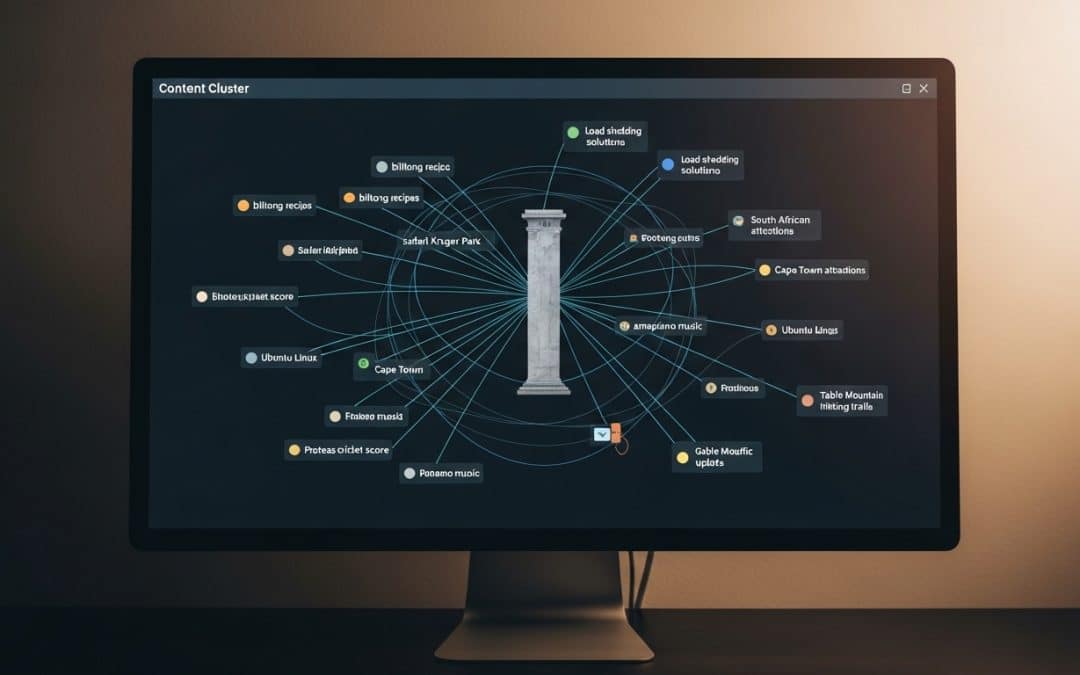
An SEO content strategy South Africa is the architecture that determines whether your SA website accumulates organic traffic that compounds month over month — or publishes posts that get indexed and ignored. Most South African businesses approach content without a strategy: they write about topics they find interesting, publish irregularly, and wonder why organic traffic does not grow.
A structured SEO strategy for South African businesses treats content as a system — with defined clusters, keyword targets, post types, and publishing cadence — not as a collection of isolated articles.
This guide covers exactly how to build an SEO content strategy for a South African business from scratch — the cluster architecture that builds topical authority, the post types that serve different SA audience intents, the keyword research approach that finds SA-specific opportunities, and the publishing cadence that generates compounding organic growth.
Quick Answer
An SEO content strategy for South African businesses works through topical cluster architecture — one comprehensive pillar post covering a broad SA topic, supported by 10–20 focused posts covering specific subtopics. Each cluster targets a distinct SA keyword theme.
Google rewards sites that cover topics comprehensively by ranking all posts in the cluster higher, not just the pillar. The mechanism is coverage, not volume — publishing 90 well-structured posts across 8 SA topic clusters consistently outperforms publishing 200 disconnected articles.
Not sure if your SA content is structured around clusters or just published ad hoc? We will audit your existing content and show you exactly what to fix first.
Get a Free SA Content Strategy AuditSEO Content Strategy South Africa: Why Cluster Architecture Outperforms Isolated Posts
An SEO content strategy for South African businesses built on cluster architecture outperforms isolated post publishing for one specific reason: Google evaluates topical authority at the domain level, not the page level. Our SEO South Africa guide is the hub for this cluster and explains how content, technical work and authority fit together for local businesses.
When your SA website publishes 15 interlinked posts covering every angle of "Shopify ecommerce in South Africa" — from setup to SEO to payment gateways to growth strategy — Google recognises your domain as an authority on that SA topic. Every post in the cluster benefits from that domain-level authority signal. A single post on "Shopify South Africa" with no supporting content does not trigger the same authority recognition, regardless of how well-written it is.
The practical result is visible in ranking data. SA websites using cluster architecture see their entire cluster rank faster and reach higher positions than equivalent single posts — because Google's assessment of topical authority lifts all cluster pages simultaneously. A SA digital marketing agency that builds complete clusters for SEO, Google Ads, Email Marketing, Social Media, and Ecommerce will consistently outrank a competitor with better-written individual posts but no cluster structure.
The Topical Authority Mechanism
Google does not rank individual pages in isolation. It ranks pages within the context of the domain they sit on and the topical coverage that domain demonstrates. A SA website with 20 posts covering every aspect of email marketing signals deeper topical authority than one with a single email marketing post — even if that single post is longer and more detailed.
Coverage depth across a topic is what Google rewards. Cluster architecture is how you demonstrate that coverage systematically.
SEO Content Strategy South Africa: The Four Post Types Every SA Cluster Needs
A complete SEO content strategy for South African businesses uses four distinct post types within each cluster — each serving a different SA audience intent and ranking for different query types. Publishing only one type produces gaps that competitors fill.
Type 1: High Impression Posts (🟡)
High Impression posts target broad, high-volume SA informational queries where the primary goal is reaching a large number of SA searchers. These posts rank for queries like "what is SEO," "how does Google Ads work," and "email marketing statistics South Africa."
They drive impressions and brand awareness at the top of the SA funnel. They are typically the first post in a cluster's money bridge sequence — introducing SA searchers to the topic before deeper content moves them toward consideration and commercial intent. Target 30–35% of your cluster's content as High Impression posts.
Type 2: Educational Posts (🔵)
Educational posts cover specific SA subtopics in depth — "how to set up abandoned cart emails for a Shopify store," "Google Ads keyword match types explained," "how to build an email list in South Africa." These are the backbone of every SA content cluster.
They rank for mid-funnel SA queries where the searcher knows what they want to learn but is not yet ready to hire. They build topical authority, drive internal link equity to the pillar post, and are the content type that earns the most organic links from other SA sites citing them as reference material. Target 35–40% of cluster content as Educational posts.
Type 3: Comparison Posts (🔴)
Comparison posts target SA searchers actively evaluating options — "Shopify vs WooCommerce South Africa," "Klaviyo vs Mailchimp for SA ecommerce," "Google Ads vs Facebook Ads South Africa." These are bottom-of-funnel posts that rank for high-intent queries.
Comparison posts convert at the highest rate of any post type because the SA searcher is in active evaluation mode. They are also among the fastest-ranking post types — comparison queries often have lower competition in the SA market than broad informational queries, and their featured snippet format (quick verdict, pros/cons table, final recommendation) is exactly what Google's algorithm extracts for SERP features. Target 14–16% of cluster content as Comparison posts.
Type 4: Commercial Posts (🟢)
Commercial posts target SA searchers with direct purchase or hire intent — "SEO agency South Africa," "Google Ads management Johannesburg," "Shopify developer South Africa." These posts sit closest to the conversion event and drive the most direct leads.
They require the strongest E-E-A-T signals — specific SA credentials, named tools, client results, and friction-removing offers — because the SA searcher is evaluating providers, not learning. They are the posts that directly compete with SA competitor service pages. Target 11–14% of cluster content as Commercial posts.
| Post Type | SA Query Example | Funnel Stage | Target % | Primary Goal |
|---|---|---|---|---|
| 🟡 High Impression | "what is email marketing" | Awareness | 30–35% | SA impressions and reach |
| 🔵 Educational | "how to build email list SA" | Consideration | 35–40% | Topical authority + links |
| 🔴 Comparison | "Klaviyo vs Mailchimp SA" | Evaluation | 14–16% | High-intent SA traffic |
| 🟢 Commercial | "email marketing agency SA" | Decision | 11–14% | Direct SA leads |
Want to know which post types your SA content strategy is missing — and which cluster gaps your competitors are exploiting right now?
Get a Free SA Cluster Gap AnalysisSEO Content Strategy South Africa: Keyword Research for SA Topics
Keyword research for a South African SEO content strategy differs from global keyword research in one important way — SA search volume is smaller than global benchmarks suggest, but SA competition is also significantly lower.
A keyword showing 1,000 monthly searches globally may have only 80–120 SA monthly searches — but the number of SA websites competing for that keyword may be 5–10 rather than 50–100. The lower competition density in the SA market means SA businesses can rank for commercially valuable keywords with less domain authority and less content than would be required in the UK or US markets.
SA Keyword Research Process
Start with your SA service or product category as the seed keyword. For a Johannesburg digital marketing agency, seeds include "digital marketing," "SEO," "Google Ads," "email marketing," and "social media marketing." Run each seed through a keyword research tool and filter for SA-specific modifiers — "south africa," "SA," "johannesburg," "cape town" — to build a list of SA-specific keyword opportunities.
Then categorise every keyword by post type and cluster. "How does SEO work in South Africa" is a High Impression post. "SEO pricing South Africa" is a Commercial post. "Shopify vs WooCommerce South Africa" is a Comparison post. "How to set up Google Search Console in SA" is an Educational post. This categorisation determines your content calendar structure before you write a single word.
Using Google Search Console Data for SA Keyword Strategy
Google Search Console is the most accurate source of SA-specific keyword data available to South African businesses — because it shows the actual queries SA users are typing to find your site, not estimated search volumes from third-party tools.
Filter GSC Performance data to South Africa, sort by impressions, and identify the queries where your SA pages are appearing in positions 8–30. These are your fastest-win content opportunities — queries where Google already considers your domain relevant but your content is not comprehensive enough to rank in the top 5. Publishing a dedicated, comprehensive post targeting each of these queries consistently produces ranking improvements within 60–90 days for SA businesses with established domains.
Effective SA keyword to cluster mapping: A Cape Town ecommerce agency uses GSC data filtered to South Africa and finds 340 queries generating impressions but averaging position 18.4. Categorising these by topic reveals 4 distinct clusters where coverage is thin — Shopify setup, payment gateways, email marketing, and abandoned cart recovery.
Building out each cluster with 8–10 posts per topic moves the domain from 340 SA queries to 2,100+ within 6 months — a 6x keyword footprint expansion from structured content production.
Ineffective SA keyword approach: The same agency writes about topics as they come to mind — a post on "Instagram marketing," then one on "SEO basics," then one on "email subject lines," then one on "Google Analytics" — with no cluster structure and no internal linking. After 40 posts, the domain has 40 isolated pages that Google cannot associate into any topical authority signal.
Average position: 24.6. Impressions per post: 180. Monthly organic leads: 1. The writing effort was not the problem. The architecture was.
SEO Content Strategy South Africa: Publishing Cadence and Compound Growth
Publishing cadence for a South African SEO content strategy determines how quickly topical authority compounds — and therefore how quickly organic traffic and leads grow.
The relationship between publishing frequency and organic growth in the SA market is not linear. Publishing twice as many posts does not produce twice as much traffic. The growth curve is exponential once a cluster reaches critical coverage mass — typically 8–12 posts covering the core subtopics of a SA keyword theme.
Below this threshold, Google has insufficient signals to assess full topical authority. Above it, every new post in the cluster ranks faster because the domain's authority in that topic is already established.
Recommended SA Publishing Cadence by Stage
| Stage | Domain Age | Indexed Pages | Recommended Cadence | Focus |
|---|---|---|---|---|
| Foundation | 0–3 months | 0–30 pages | 1–2 posts/day | Build first 2 clusters to critical mass |
| Growth | 3–6 months | 30–90 pages | 2–3 posts/day | Deepen existing clusters, add new pillars |
| Scale | 6–12 months | 90–200 pages | 3–5 posts/day | Expand to new clusters, deepen commercial posts |
| Authority | 12+ months | 200+ pages | 2–3 posts/day | Maintain coverage depth, update older posts |
One critical constraint on publishing cadence for South African businesses: content quality must never decrease as cadence increases. Google's helpful content system evaluates content quality site-wide — a SA domain where 30% of posts are thin or poorly structured will see ranking suppression across the entire site, not just on the weak posts.
Extend your content calendar before accelerating cadence. A SA business with a 90-post calendar running at 4 posts per day exhausts the calendar in 22 days — then either slows down (losing momentum) or publishes without preparation (losing quality). Build the calendar first. Then set the cadence.
The Compound Content Curve
South African websites publishing consistent, cluster-structured content see organic traffic follow a compound curve — slow in months 1–3 as Google indexes and evaluates, accelerating in months 4–6 as cluster authority establishes, and compounding in months 6–12 as topical authority attracts organic links and positions improve.
The SA businesses that abandon content strategy at month 3 because growth feels slow are stopping at exactly the point where the compound curve begins. Patience through the foundation phase is the single most important non-technical SEO decision a SA business makes.
SEO Content Strategy South Africa: Real Growth From Structured Content
A Johannesburg digital marketing agency launched with zero organic presence and built a structured 8-cluster content strategy across SEO, Google Ads, Social Media, Email Marketing, Ecommerce, Web Design, Shopify, and Local SEO. Publishing 2–3 posts per day for 6 months — all structured to V3.x blog template standard with cluster architecture and internal linking — produced the following organic growth results.
| Metric | Month 1 | Month 3 | Month 6 |
|---|---|---|---|
| Indexed pages | 18 | 64 | 142 |
| GSC queries | 84 | 380 | 1,840 |
| Daily impressions | 240 | 1,600 | 8,400 |
| Average position | 28.4 | 22.1 | 14.6 |
| Monthly organic clicks | 42 | 380 | 2,900 |
| Monthly organic leads | 0 | 3 | 18 |
| Cost per organic lead | N/A | R1,800 | R267 |
The compound nature of the growth is clear in the data. Monthly organic leads grew from 0 to 3 in the first three months, then from 3 to 18 in the next three — a 6x acceleration in the second period from the same publishing cadence.
Cost per organic lead dropped from R1,800 to R267 as domain authority accumulated and more posts ranked in positions that generated clicks. The investment cost did not change. The compounding return on that investment increased each month.
SEO Content Strategy South Africa: How Growth Pulse Media Builds SA Content Systems
Growth Pulse Media builds SEO content strategies for South African businesses using the exact cluster architecture, post type framework, and publishing cadence described in this guide. Our own domain at growthpulsemedia.co.za is the live proof point — built from zero using a structured 8-cluster SA content strategy, growing from 0 to thousands of daily organic impressions across 75+ indexed pages within months of consistent publication.
We use Google Search Console data filtered to South Africa to identify the SA-specific keyword opportunities that third-party tools undercount. We build content calendars before we start publishing — so cadence is determined by planned coverage, not by what feels relevant this week.
We report on GSC queries, average position, and organic leads — not on domain authority scores or keyword difficulty ratings that do not translate into SA business revenue. We do not outsource content creation and do not apply global content templates to the SA market.
Who This Is NOT For
A structured SEO content strategy is not the right investment for every SA business at every stage.
You need organic leads within 30 days. Content strategy compounds over months. The first meaningful organic traction typically appears at 60–90 days, with significant lead volume emerging at months 4–6. If your business has an immediate revenue gap, Google Ads fills it faster. Build content strategy in parallel with paid channels — not as a replacement for them when the timeline is urgent.
You want to publish content without committing to a defined cluster structure. Unstructured content publishing produces unstructured results. SA businesses that publish posts on whatever topics feel relevant each week build a domain with no coherent topical authority signal — and their rankings reflect that. Cluster architecture is not optional within a content strategy that works. It is the mechanism.
Your website has technical SEO problems that prevent proper indexing. Content strategy produces no organic results on a domain that Google cannot index properly. Before investing in content volume, confirm your SA site is indexed correctly in GSC, your sitemap is submitted, your robots.txt is not blocking key pages, and your Core Web Vitals are not failing on mobile. Technical problems multiply content investment — in the wrong direction.
You want content written at low cost with no strategic input. Google's helpful content system, as described in Google's people-first content guidance, evaluates whether content demonstrates genuine expertise and satisfies the searcher's intent fully.
Low-cost, templated SA content that lacks E-E-A-T signals and first-hand SA market experience triggers site-wide quality suppression — reducing rankings across the entire domain, not just the weak posts. Invest in content quality or do not invest in content at all.
An SEO content strategy that compounds is built once correctly — and then produces increasing returns for years without proportional additional investment.
Ready to build a structured SEO content strategy for your SA business that compounds organic traffic month after month? We will map your clusters, identify your SA keyword opportunities, and show you exactly where to start.
Get Your Free SA Content Strategy SessionSEO Content Strategy South Africa: Frequently Asked Questions
What is an SEO content strategy for South African businesses?
An SEO content strategy for South African businesses is a structured plan for producing and publishing content that ranks in Google SA search results and drives organic traffic, leads, and revenue. It includes topical cluster architecture (one pillar post supported by 10–20 focused posts per SA topic), keyword research targeting SA-specific search queries, post type allocation across awareness, educational, comparison, and commercial intent, and a publishing cadence that builds topical authority consistently over time.
How many blog posts does a South African website need to see SEO results?
South African websites typically need 8–12 posts covering the core subtopics of a single cluster before Google registers sufficient topical authority to rank it competitively. For a full SEO content strategy across 4–6 SA topic clusters, 40–80 well-structured posts is the threshold where compound organic growth becomes clearly visible.
SA businesses that publish fewer than 30 posts and evaluate SEO as not working are measuring results before topical authority has had time to establish.
How long does an SEO content strategy take to produce results in South Africa?
An SEO content strategy for South African businesses produces first measurable organic traffic increases within 60–90 days of consistent publishing. Meaningful SA lead volume from organic search typically emerges between months 4–6. The compound curve — where organic traffic and leads grow month over month without proportional additional investment — becomes clearly visible between months 6–9. SA businesses that measure content strategy at the 90-day mark are measuring the investment phase, not the return phase.
What is topical cluster architecture in SEO?
Topical cluster architecture in SEO is a content structure where one comprehensive pillar post covers a broad SA topic, supported by multiple focused posts each covering a specific subtopic in depth. All supporting posts link back to the pillar, and the pillar links to all supporting posts.
This internal linking structure signals to Google that your SA domain covers the topic comprehensively — lifting rankings for all posts in the cluster simultaneously, rather than each post competing independently.
What types of content work best for SA SEO?
The four content types that work best for South African SEO are High Impression posts (broad SA awareness), Educational posts covering specific SA subtopics in depth (topical authority and links), Comparison posts for SA searchers evaluating options (high-intent traffic), and Commercial posts targeting SA searchers ready to hire or buy (direct leads).
A complete SA content strategy needs all four types in the correct ratio — 30–35% high impression, 35–40% educational, 14–16% comparison, 11–14% commercial.
How do I find the right keywords for an SEO content strategy in South Africa?
Find SA keywords for a content strategy using two primary sources: Google Search Console filtered to South Africa (sort by impressions, identify queries in positions 8–30 — these are your fastest-win content opportunities), and keyword research tools filtered for SA-specific modifiers like south africa, SA, johannesburg, and cape town.
Categorise every keyword by post type and cluster before writing. Your content calendar structure should be determined by keyword research — not by what topics feel relevant on a given week.
Ready to Build an SEO Content Strategy That Compounds SA Organic Traffic?
Growth Pulse Media builds SEO content strategies for South African businesses — cluster architecture, SA keyword research via Google Search Console, content calendars mapped to SA audience intent, and consistent publishing to the V3.4 blog template standard. Our own SA domain is the proof: thousands of daily organic impressions built from zero through structured content production. No obligation — we will get back to you within 24 hours.
Get Your Free SA Content Strategy Consultation