
 Add to Preferred Sources
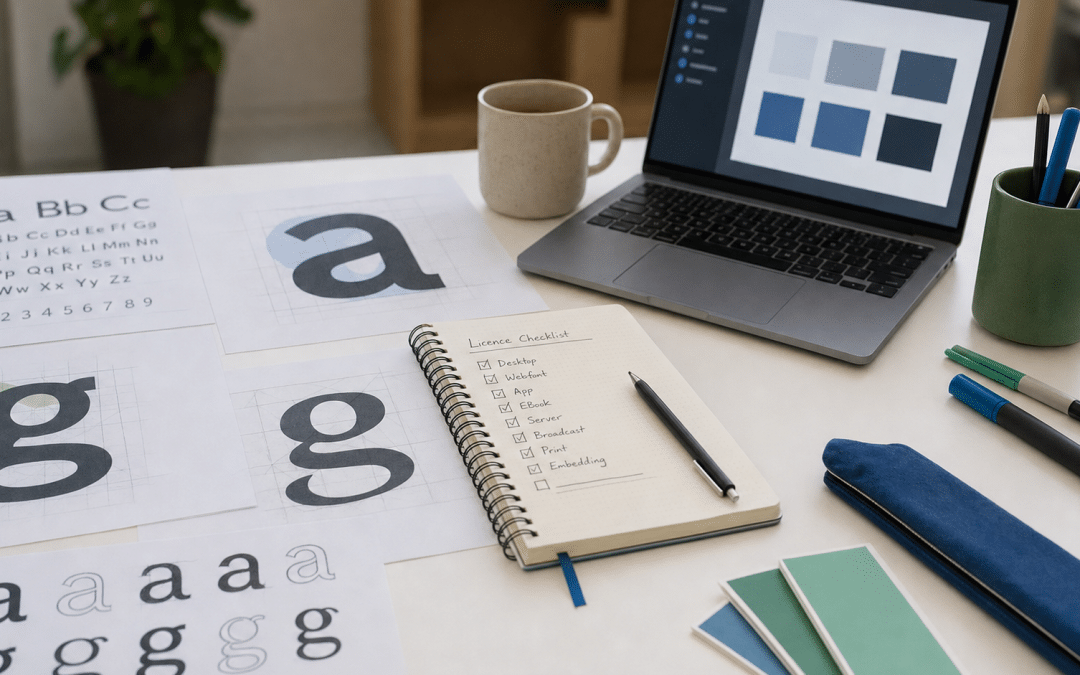
Font licensing commercial use is the question of which font files you may legally use in a logo, website, advert, packaging or app that earns you money, and the answer sits in the licence attached to each font, not in whether the font was free to download. Fonts are one part of a brand identity, and our branding in South Africa guide covers the rest of that system.
The risk is practical rather than theoretical. ENS, a South African law firm, reported in February 2025 that clients had received unexpected letters of demand for past-use licensing fees over unauthorised font use. A font chosen casually for a logo can become a bill, or a full rebrand, years later.
This post is general information, not legal advice. It sets out how the licence types work, what the South African Copyright Act means for fonts, where businesses usually go wrong, and how to build a simple licence file that protects you.
Quick Answer
Font licensing commercial use depends on the specific licence attached to each font file. Fonts under open licences such as the SIL Open Font License allow commercial use. Fonts bundled with software, or taken from a download site, may not. Match each font to every place you use it (print, website, app, advert), keep the licence document, and ask any designer for proof of licensing.
Not sure which fonts your brand is built on?
Send us your logo and website addresses and we will talk you through which fonts to check first.
What Does Font Licensing Commercial Use Actually Cover?
A font licence is a contract that sets out where, how and by how many people a font file may be used, and it is separate from your right to sell products made with that font. Monotype puts the principle plainly: "Each font file is a separate piece of software that needs to be properly licensed."
ENS's February 2025 analysis applies the same logic to South African law. It treats a font file as a "computer programme" under the Copyright Act 98 of 1978, so "any unauthorised reproduction or adaptation thereof may constitute copyright infringement." On that reading, installing a font on a computer you are not licensed for, or embedding it on a site the licence does not cover, is a copying question.
The law summary in this post rests on that one firm's analysis, and we have not found a South African court ruling that tests it.
The same analysis flags an uncertainty. It is "questionable whether or not the design of a typeface alone would pass the originality test" in South Africa, and no local judgement deals specifically with typefaces. Do not read that as a safe harbour. On ENS's analysis the font file is still protected as software, typeface names can be trademarked separately, and the licence terms you accepted still apply to you.
Key Takeaway
You do not license a "look". You license a font file for defined uses. ENS's analysis is that a font file is a "computer programme" under the Copyright Act, so copying it beyond what the licence allows may be infringement. That reading is not yet tested in the South African courts.
Which Commercial Font Licence Types Exist?
Commercial font licences are split by use, and Monotype lists seven types: desktop, web, embedded, application, ePub, server and digital advertising. That makes font licensing for commercial use a per-use decision. A font bought for print is not automatically cleared for your website.
| Licence type | What it covers | How it is limited | Best for |
|---|---|---|---|
| Desktop | Installing the font on computers for print or static images | Specific computers or devices; number of "seats" | Logo artwork, brochures, signage, documents |
| Web | Displaying the font on a website through CSS | Page views or unique visitors, and listed domains | Your website and web shop |
| Application | Using the font inside a mobile app | Number of installations or specific apps | Customer-facing apps |
| Embedding | Including the font file inside a document or file | May restrict file formats or contexts | PDFs sent to customers, interactive documents |
| Digital advertising | Listed by Monotype as a separate type | Scope set by each foundry's terms | Check before using the font in ads |
| Server | Listed by Monotype as a separate type | Scope set by each foundry's terms | Check before using the font in a tool or service |
| ePub | Listed by Monotype as a separate type | Scope set by each foundry's terms | Check before using the font in ebooks |
Limits differ by foundry. Monotype's guide notes that commercial licences vary by "number of users or devices allowed and the scope of usage". Read the licence, not the marketing page. Rows without a stated limit above are set by each foundry's own terms.
Are Free Fonts Safe for Commercial Use?
Free fonts for commercial use are safe only when the licence says so, and "free to download" and "free to use commercially" are different statements. Open licences are the clearest case: the SIL Open Font License (OFL) FAQ confirms commercial use of both original and modified versions, embedding in full or as a subset, and bundling with other software.
Google Fonts is the most common source of such fonts. A third-party summary from Fonts Plugin says the library's fonts are released under licences that allow free commercial and personal use, and names three: the SIL Open Font License 1.1, the Apache License and the Ubuntu Font Licence. Google's per-font licence page is the authority, so check it for the specific font you plan to use.
Open licences still carry conditions:
- Do not sell the font by itself. The OFL FAQ says the font is "not sold by itself". You can sell things made with it.
- Keep the licence files if you distribute the fonts to anyone else.
- Do not reuse a reserved name on a modified version without permission from the copyright holder.
The opposite assumption is the common trap. ENS lists as a misconception the idea that "if a font comes with your software package, you may commercialise it as you wish". Fonts supplied with an operating system, an office suite or a design app can carry restrictions on web use, apps and social media.
Key Takeaway
For font licensing commercial use, open-licensed fonts such as those under the SIL Open Font License are the lowest-risk route for a small business, because the licence itself permits commercial use. Fonts that merely arrived with your software, or sit on a free-download site with no clear licence file, are unverified until you read their terms.
Rebuilding a brand and unsure what you can keep?
Tell us which fonts and files your current brand uses and we will talk through which questions to put to whoever supplied them.
Where Do South African Businesses Get Caught Out?
Businesses are caught out when a font moves from the use it was licensed for into a new one nobody checked. The same typeface passes through a logo, a website, a quote template, a delivery-van wrap and a Facebook post, and each can fall under a different licence type.
The drift pattern. A designer picks a commercial font and installs it on one laptop to draw the logo. The logo is approved. Later the same font is set as the website's heading font, added to the invoice template on three office computers, and sent to a signage printer. Each step is a use the original single desktop licence may not cover.
Four situations deserve a licence check before anything is signed off:
- The logo. The sources we read do not address logo use specifically, so as general practice, check the font's own licence terms and confirm logo use in writing. If your logo is outlined into a vector file, you also need to know who holds that source. Our post on the logo files you should own covers what to ask for.
- The website. Web use needs a web licence, or an open licence, and can be capped by page views and domains. Check this before a font is uploaded to your site.
- Template tools and DIY design. Fonts offered inside a design platform are licensed for that platform's terms, which may not extend to downloading the font and using it elsewhere. Our comparison of a Canva logo versus professional design covers the wider ownership trade-offs.
- Handoff to others. Printers, agencies, freelancers and new staff often need the font. Monotype notes that most EULAs "limit the number of 'seats' or 'workstations' allowed". Sending the file to a vendor without their own licence is a seat question.
If you are challenged, Monotype's guide describes the consequences as potential liability "for damages, including financial penalties", the need to "cease using the font immediately" and re-do brand assets, and possible public attention to the infringement. Re-doing assets is the cost owners tend to underestimate, because it touches signage, stationery, packaging and the website at once.
How Do You Audit the Fonts Your Business Uses?
A font audit is the practical side of font licensing: a short inventory that links every font in use to its source, its licence and the places it appears, so you can prove coverage if anyone asks. ENS's suggested mitigation is to review the EULAs before deployment, obtain commercial licences for widespread branding use, verify designer compliance and set font usage guidelines. Those four points become the five steps below.
- List every typeface in use. Check the logo, website headings and body text, email signature, quote and invoice templates, social templates, signage and packaging. Note each weight and style you use, so the licence check covers them.
- Trace where each font came from. Foundry purchase, open library, bundled with software, or a designer supplied it. If nobody knows, mark it unverified.
- Find the licence document. Locate the EULA or the licence file for each. Note the licence type, the user or seat limit, and any cap on page views or installations.
- Match licence to use. Compare each place the font appears with the table above. A gap, such as a desktop-only licence on a live website, is the item to fix first.
- Store the proof. Keep licence documents, invoices and purchase confirmations in one shared folder, with the licence holder's name and the date. Record it in your brand guidelines so the next designer inherits it. Our brand guidelines template is a place to do this.
Rule of thumb for fixing gaps
As a working rule of thumb, fix web and logo uses first. They are public, easy for a rights holder to find and expensive to change. Replacing a body font in an internal document is cheap by comparison. Where a font is hard to license correctly, switching to an open-licensed alternative is often simpler than negotiating terms.
Once the audit is done, the sensible next step for a growing business is to write the fonts and their licences into the same document that holds your colours and logo rules. The wider brand identity checklist shows where that sits.
What Should You Ask a Designer or Agency About Fonts?
For font licensing commercial use, ask any designer or agency to name every font used, state under which licence each is held, and say who the licence holder is. ENS's advice is to "ensure your designers are using legally licensed fonts and can provide proof of licensing", which turns a vague assurance into a deliverable you can request in writing.
| Situation | Question to ask | Best for |
|---|---|---|
| New logo or rebrand | Which font is it set in, and does the licence cover logo use and a transfer to us? | Owners commissioning identity work. See our refresh versus rebrand comparison |
| New website | Is each web font on a web licence or an open licence, and under whose account? | Anyone launching or rebuilding a site |
| Print and signage | Does the printer need the font file, and is it licensed for them? | Packaging, vehicle wraps, shopfronts |
| Staff using brand fonts | How many seats does the licence cover, and who administers them? | Teams with shared templates |
| Trademarking the logo | Is the logo's lettering from a licensed font or custom-drawn? | Owners planning registration. See how to trademark a logo in South Africa |
The cost side is part of the brief too. If a font needs a paid licence, that belongs in the project price, so it is worth reading what branding costs in South Africa before comparing quotes.
Want a second pair of eyes before you sign off a brand?
Send us the designer's brief or quote and we will talk you through the licence and ownership questions worth adding to it.
Why South African Businesses Choose Growth Pulse Media
South African businesses choose Growth Pulse Media for operator-led digital work: the agency is run by founder Dirk van Greuning, who built and scaled a large South African ecommerce business before founding it. All work is executed in-house, and the client load is limited so senior attention stays on each account.
On font licensing commercial use, that operator view means treating the licence as a line item in the project, not an afterthought. If a website project is on your list, the web design page is the place to start, and a font licence list belongs in the brief from day one. For related planning, see the website cost guide.
Who This Is Not For
This guide is not the right resource for readers who need a legal opinion, who stay inside a single design platform, or who distribute fonts themselves.
You want legal certainty. This post summarises published sources and is not legal advice. If you have received a letter of demand, speak to an IP attorney before replying.
You only use fonts inside a single design platform. If you never download a font or take it outside that platform, its own terms are the ones to read, and this audit adds little.
You are a type designer or distribute fonts. Selling, modifying or redistributing font files raises licence and trademark questions beyond this guide.
Ready to put your brand on a licensed footing?
Tell us where your brand lives today and we will talk through where to start. Free audit, no obligation.
Frequently Asked Questions
Can I use a font commercially if it came with my computer or software?
Not automatically. ENS describes "if a font comes with your software package, you may commercialise it as you wish" as a misconception. Bundled fonts can carry restrictions for web use, apps and social media, so read the licence that came with the software.
Are Google Fonts free for commercial use?
A third-party summary says Google Fonts are released under open licences, including the SIL Open Font License 1.1, which allow free commercial and personal use. Under the OFL you cannot sell the font by itself, and distributing it means including the licence files. Check the licence on each font's page.
Do I need a separate licence for my website?
Often yes. Monotype lists web licences separately from desktop licences, and web licences can be limited by page views or unique visitors and by domains. An open-licensed font avoids that, but confirm its licence first.
Is a font protected by copyright in South Africa?
According to ENS's analysis, the font file is protected. It treats a font file as a computer programme under the Copyright Act 98 of 1978, so unauthorised reproduction may be infringement. ENS calls the protection of a typeface design alone questionable, and notes no local judgement deals with typefaces.
What happens if I use a font without the right licence?
Monotype's guide says you may be liable for damages including financial penalties, and may have to stop using the font and redo brand assets. ENS reports clients receiving letters of demand for past-use fees. Take legal advice if you receive one.
Get Your Brand's Fonts and Files Checked
Send us your logo, website and the designer's brief. We work across Shopify, Google Ads and Meta Ads, and we will talk through what to confirm about fonts, licences and file ownership. No obligation. We will get back to you within 24 hours.
