
 Add to Preferred Sources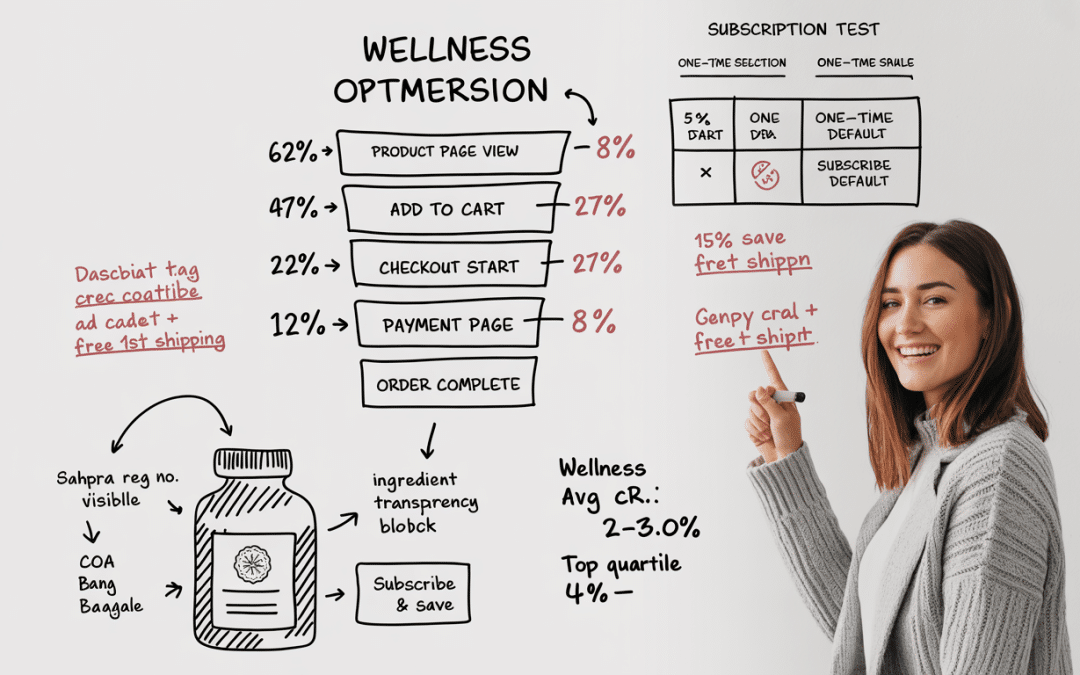
CRO for wellness brands in South Africa is a fundamentally different discipline from generic ecommerce conversion optimisation. SA supplement brands, nutraceuticals, functional foods, and wellness subscription boxes optimise for two conversion events simultaneously — initial purchase and subscription opt-in — under SAHPRA regulatory constraints that limit how products can be presented and which trust signals must be visible. Tactics calibrated for fashion or electronics produce activity without commercial outcome in wellness contexts.
This guide covers what actually works for SA wellness brands optimising conversion across product pages, subscription flows, and checkout. For broader strategic context, see our digital marketing South Africa guide. For complementary acquisition and revenue context, see our ecommerce marketing for wellness guide.
Quick Answer
CRO for wellness brands in SA works best when calibrated to dual conversion: initial purchase plus subscription opt-in. The highest-leverage levers are subscription default selection on product pages, SAHPRA trust signals at the conversion moment, ingredient transparency above the fold, reduced checkout form fields (12-14 not 23+), and BNPL integration for orders above R500. Pipeline value comes from systematic optimisation of product pages and subscription flows where actual conversion happens.
Want a free 60-minute audit of your wellness store's conversion architecture with subscription opt-in and SAHPRA trust signal recommendations?
Get a Free CRO AuditWhy CRO for Wellness Brands is Genuinely Different
Generic ecommerce CRO assumes single-conversion-event optimisation, broad creative latitude, and short attribution windows. Wellness CRO operates differently: every product page has two parallel conversion events (one-time purchase versus subscription opt-in), regulatory constraints restrict creative and claims language, and the right conversion is measured over a 12-month lifetime value window rather than first-purchase revenue. Tactics calibrated for fashion or electronics produce metric improvements without commercial outcomes in wellness contexts.
According to Baymard Institute's cart abandonment research, the average ecommerce cart abandonment rate is 70.22%, and the average checkout contains 23 form fields when the documented optimum is 12-14 fields. Wellness ecommerce typically performs at 2.0–3.0% store conversion with top brands reaching 4%+ through disciplined execution. The implication for SA wellness brands is clear: most stores have 30–60% conversion lift available through documented optimisation patterns alone, before any wellness-specific tactics.
The Critical Reframe
Generic CRO measures success in single-conversion lift and A/B test wins. CRO for wellness brands measures success in subscription adoption rate alongside store conversion rate, subscription cohort retention at 6 and 12 months, and revenue per visitor calibrated to 12-month LTV. A brand running aggressive single-conversion CRO measures sales lift but leaves recurring revenue on the table. A brand running dual-conversion CRO measures dramatically higher lifetime value. Different game.
The Five Highest-Leverage CRO Moments for SA Wellness Brands
The mistake almost every wellness brand makes is treating CRO as a homepage redesign. Homepages account for 5–15% of wellness store traffic; the highest-leverage CRO for wellness brands lives elsewhere — on supplement product pages, in subscription opt-in selection, at checkout form simplification, in payment option integration, and at exit-intent. Concentrating CRO investment on these five moments produces dramatically more revenue than redesigning the home page. Our conversion rate optimisation guide for South Africa explains the wider CRO approach that these moments sit within.
| Moment | Why It Matters | Highest-Impact Optimisation |
|---|---|---|
| Supplement product page | 40–60% of all wellness traffic lands here from search/ads | SAHPRA registration visible above fold + COA badge + ingredient transparency block + subscription toggle |
| Subscription default selection | Default choice biases adoption rate dramatically | Test subscribe-default with 15% save vs one-time-default — typical 2–4x subscription lift |
| Checkout form fields | Average has 23 fields, optimum 12–14 — every field over 14 costs 4–6% conversion | Strip form to essentials, autofill where possible, single-column layout, no forced account |
| Payment options | BNPL (PayJustNow, Payflex, Mobicred) lifts AOV 25–45% at R500+ band | Integrate 3+ SA payment options, display options above CTA, BNPL prominent |
| Exit-intent on product pages | Captures buyers who scroll but don't add to cart | "Save 10% on first subscription order" capture instead of generic discount popup |
An SA wellness brand that systematically optimises these five moments — even before any other CRO investment — typically lifts overall conversion by 60–120% and subscription adoption by 200–400% within 90 days. The same brand running a "homepage refresh" project typically lifts overall conversion by 5–10% over six months. Same effort budget, dramatically different output.
The Three Most Common SA Wellness CRO Mistakes
Three mistakes consistently destroy SA wellness brands' conversion performance. Each is invisible at the time. Identifying and correcting them produces more revenue lift than any A/B testing programme run without addressing the underlying issues.
Mistake 1 — Optimising One-Time Conversion While Ignoring Subscription
SA wellness brands often run CRO programmes focused exclusively on first-purchase conversion rate while leaving subscription opt-in unoptimised. Subscription opt-in is the higher-leverage conversion because it captures recurring revenue. A brand lifting first-purchase conversion 30% delivers a 30% revenue lift. A brand lifting subscription adoption from 8% to 30% delivers 3–4x LTV lift. The right programme runs dual-track from day one — first purchase and subscription opt-in tested in parallel.
Mistake 2 — Hiding SAHPRA Compliance Instead of Leading With It
SA wellness consumers actively look for SAHPRA registration status, complementary medicines compliance, third-party testing documentation, and conservative claims language before purchasing. Brands burying this in footer fine print or terms pages out-convert only on price. Brands that lead with visible SAHPRA registration numbers, COA badges, and ingredient transparency at the moment of conversion measurably out-convert on trust. Trust signals at the conversion moment matter more than site-wide compliance for actual purchase decisions.
Mistake 3 — Testing the Wrong Things at the Wrong Volume
SA wellness brands often run aggressive A/B testing on low-traffic pages with insufficient sample sizes. A test on a category page receiving 800 monthly visitors will never reach statistical significance regardless of test design. The fix is concentrating testing on highest-traffic, highest-revenue pages — the top 3–5 supplement product pages and the checkout flow — and accepting 70% of pages will not receive testing investment. Volume discipline beats tool sophistication.
Want to see which of these three mistakes is creating the biggest drag on your wellness store's conversion?
Request a custom wellness CRO diagnosticThe GPM Differentiator: Operator Discipline in Subscription CRO
Most SA agencies that sell CRO for wellness brands come from generic ecommerce CRO backgrounds — A/B testing tools, heuristic evaluation, generic best-practice checklists. They translate single-conversion-event frameworks into wellness contexts where dual-conversion optimisation, regulatory compliance, and subscription-cohort retention determine commercial outcome. The result is well-executed tests on the wrong metrics, optimising for clicks instead of recurring revenue.
Growth Pulse Media built and scaled an SA ecommerce business through real conversion optimisation across subscription mechanics and regulatory navigation. The operator instincts that come from running a real subscription funnel — knowing which conversion events drive LTV versus which are vanity wins, knowing how to prioritise tests by 12-month revenue lift rather than first-purchase clicks — apply directly to wellness CRO contexts.
Our CRO service works with SA wellness brands — supplement and nutraceutical brands, functional foods, fitness equipment retailers, and wellness subscription boxes — on a senior-level basis. We focus on the five high-leverage moments above before any homepage work, build dual-track conversion measurement, run tests in-house with no offshore outsourcing, prioritise LTV-aligned metrics, and limit client load to maintain senior attention.
The Operator Lesson
Two SA wellness brands with identical traffic volumes can produce completely different revenue economics. The variable is rarely tool choice or test sophistication. It is whether the brand focuses on dual conversion (one-time plus subscription opt-in), embeds SAHPRA trust signals at the conversion moment, and prioritises tests by 12-month LTV impact rather than first-purchase clicks. Operator discipline in subscription CRO separates brands that compound revenue from those running tests for activity's sake.
Real-World Impact: SA Mid-Sized Nutraceutical Brand Before and After
This is a representative SA mid-sized nutraceutical brand with 22 SKUs across vitamins, performance supplements, and functional foods, with 7 staff (3 founders, 2 marketing, 2 operations), based in Johannesburg. The "before" period reflects unoptimised conversion architecture — 23-field checkout, no subscription default optimisation, SAHPRA information in footer, single payment option. The "after" period captures 12 months after a structured wellness CRO programme.
| Metric | Before | After (12 months) | Change |
|---|---|---|---|
| Monthly store traffic | ~34,000 sessions | ~38,000 sessions | +12% |
| Store conversion rate | 1.7% | 3.6% | +112% |
| Subscription opt-in rate | 9% | 41% | +356% |
| Cart abandonment rate | 78% | 54% | −24pp |
| Average order value | R420 | R685 | +63% |
| 12-month customer LTV | R620 | R2,380 | +284% |
| Annual ecommerce revenue | R2.4m | R9.8m | +308% |
| BNPL adoption (% of orders R500+) | 0% | 32% | New revenue stream |
What Drove the Result
Traffic grew modestly — that was not the lever. The transformation came from dual-track conversion optimisation. Subscription default was switched on with 15% save, lifting opt-in from 9% to 41%. Checkout was rebuilt from 23 fields to 13 fields with autofill and guest checkout. SAHPRA registration numbers and COA badges moved from footer to product pages. PayJustNow and Mobicred were integrated. The R7.4m revenue lift came from subscription adoption and AOV growth.
Who This Is NOT For
Structured CRO for wellness brands works for the right SA brand and consumes resources for the wrong one. Four scenarios where it is the wrong call right now.
Your wellness store has fewer than 5,000 monthly sessions. CRO requires statistical traffic for reliable testing. Below this volume, A/B tests rarely reach significance and "wins" are mostly noise. Focus on traffic acquisition through SEO, paid search, and influencer partnerships until volume justifies CRO investment. Premature CRO investment on low-traffic stores wastes resources that should fund acquisition.
Your products are not yet SAHPRA-registered where registration is required. CRO programmes that improve conversion for non-compliant products amplify legal exposure rather than building sustainable business. Resolve SAHPRA registration status for all products requiring it first, then invest in conversion optimisation. Building conversion infrastructure on a non-compliant foundation increases regulatory risk substantially.
Your store has no subscription infrastructure deployed. CRO for wellness brands is fundamentally about dual conversion — first purchase plus subscription opt-in. Without subscription infrastructure (Recharge, Bold Subscriptions, Loop, or similar), the higher-leverage CRO lever is unavailable. Deploy subscription infrastructure first with at least basic discount and management options, then invest in CRO programmes that optimise the dual-conversion framework.
Your brand wants conversion lifts within 30 days. Wellness CRO operates on 60–120 day testing cycles because the buyer journey is multi-touch and subscription metrics need cohort time to materialise. Brands that judge programmes by 30-day lifts will conclude CRO "doesn't work" — when the actual revenue is generated 4–8 months downstream through compounding subscription cohorts. Plan for 12-month evaluation horizon minimum.
SA-Specific Wellness CRO Tactics That Generic Playbooks Miss
Three SA-specific tactics consistently separate wellness brands with compounding conversion improvement from those running expensive activity. Each requires direct experience of the SA wellness market because each plays against an SA-specific reality.
Tactic 1 — PayJustNow, Payflex, Mobicred Integration as a Conversion Lever
SA wellness consumers buying R500+ orders increasingly want BNPL options. Integrating PayJustNow, Payflex, or Mobicred at checkout consistently lifts AOV 25–45% and reduces abandonment 15–25%. The integration is technically straightforward through Shopify apps but is missed by most SA wellness brands. Display BNPL options prominently above the CTA, not buried below — visibility at the conversion moment determines impact. For broader payment context, see our ecommerce South Africa guide.
Tactic 2 — Discovery Vitality HealthyFood Integration as Trust Signal
SA wellness consumers using Discovery Vitality, Momentum Multiply, or Bonitas Wellness actively prefer brands integrated with medical aid wellness programmes. Visible "HealthyFood eligible" or "Vitality benefits available" badges on product pages out-convert competitors without these integrations. The badges signal medical aid wellness alignment that international brands cannot match. For complementary acquisition mechanics, see our wellness B2B lead generation guide.
Tactic 3 — Mobile-First Checkout Calibrated for SA Connectivity
SA wellness ecommerce traffic is 72%+ mobile, and SA mobile connectivity outside metros remains uneven. Mobile checkout that loads in under 2 seconds on 4G converts at 40–80% higher rates than checkout loading in 5+ seconds. Optimisations like next-gen image formats (WebP), critical CSS inlining, CDN deployment, and minimal third-party scripts in checkout consistently lift mobile conversion. The mobile experience is the primary CRO investment for SA wellness brands, not desktop polish.
Want all three tactics applied to your wellness store with a custom 12-month CRO roadmap?
Request a free wellness CRO auditFrequently Asked Questions About CRO for Wellness Brands in SA
How much does CRO for wellness brands cost in South Africa?
For SA wellness brands running structured CRO programmes, expect monthly investment of R22,000–R65,000 covering testing tools, design and development capacity, analytics setup, and ongoing optimisation. Supplement and nutraceutical brands typically run R22,000–R38,000 monthly. Larger wellness ecommerce brands with subscription complexity typically run R35,000–R55,000. Wellness subscription boxes with intensive personalisation testing typically run R45,000–R65,000. Below R18,000 monthly the programme is typically too thin to integrate dual-conversion optimisation properly.
What's the realistic timeline for CRO results for SA wellness brands?
Tactical results (conversion lifts on product pages, checkout improvements) appear within 60–120 days. Subscription adoption lifts from default selection changes appear within 30–60 days. Compound results (LTV growth, cohort retention improvement) typically appear 6–9 months in. Peak ROI from dual-conversion programmes appears 12–18 months in as subscription cohorts mature. Plan for 12-month evaluation horizon minimum.
Which testing tools work best for SA wellness ecommerce?
VWO and Optimizely are mature, full-featured platforms suited to wellness brands with adequate traffic. AB Tasty and Convert.com offer good mid-market options. For lower-budget brands, GA4 event tracking with Google Tag Manager plus manual variant rollback can substitute for purpose-built testing tools. Microsoft Clarity provides free heatmap and session recording that works well for SA traffic. Avoid testing tools without subscription analytics integration regardless of other features.
How do we measure CRO ROI for SA wellness brands?
The right metrics are subscription adoption rate alongside store conversion rate, 6-month subscription retention, AOV, and 12-month LTV per acquired customer cohort. Tactical metrics like A/B test win count or generic conversion rate systematically under-measure wellness CRO because the revenue compounds through subscription cohorts over time. Build attribution that captures lifetime value rather than first-purchase revenue alone.
How does SAHPRA compliance affect wellness CRO testing?
Significantly. Marketing claims cannot exceed product registration scope, regardless of what conversion testing might suggest converts better. Aggressive health claims may lift short-term conversion but create regulatory risk. The fix is testing within conservative claims framework — better photography, clearer ingredient transparency, stronger trust signals, social proof from reviews and testimonials — rather than testing more aggressive language. Conservative claims often convert better long-term because trust survives consumer due diligence.
What's the biggest CRO mistake SA wellness brands make?
Running CRO for wellness brands as single-conversion optimisation while ignoring subscription opt-in. Subscription opt-in is the higher-leverage conversion because it captures recurring revenue at 50–65% retention. A brand lifting first-purchase conversion 30% delivers a 30% revenue lift; a brand lifting subscription adoption from 9% to 41% delivers 3–4x LTV lift. SA wellness brands that run dual-track CRO from day one consistently outperform brands optimising single conversion events.
CRO for Wellness Brands: The Bottom Line for SA Wellness Companies
CRO for wellness brands in SA is one of the highest-leverage investments a wellness ecommerce brand can make. The gap between SA wellness store performance (typically 1.5–2.5% conversion) and the global benchmark (4%+ for top brands) combined with subscription adoption potential creates 2–4x revenue uplift opportunities at unchanged traffic. Implementations that work focus on the five high-leverage moments and embed SAHPRA trust signals at the conversion moment.
The single biggest predictor of return is not the testing tool or budget. It is whether your strategy focuses on supplement product pages, subscription opt-in default selection, checkout form simplification, SA payment option integration, and exit-intent capture — and whether SAHPRA compliance is visible at the conversion moment rather than buried in footers.
If you would rather skip the trial-and-error and have a senior operator who has built CRO programmes for SA-specific wellness ecommerce markets walk you through what would work for your brand, that is exactly what the conversation below is for.
Get a Free CRO Audit for Your SA Wellness Brand
We will review your current conversion architecture — product page design, subscription opt-in flow, checkout simplification, payment option integration, SAHPRA trust signal placement, and mobile experience — and give you a written audit covering the two or three highest-leverage opportunities, realistic 12-month LTV projections, and a phased implementation roadmap calibrated for your traffic volume.
No sales pitch, no pressure — just an honest read from senior operators who have built CRO programmes for SA wellness brands. No obligation — we will get back to you within 24 hours.
Request a Free Wellness CRO Audit →