
 Add to Preferred Sources
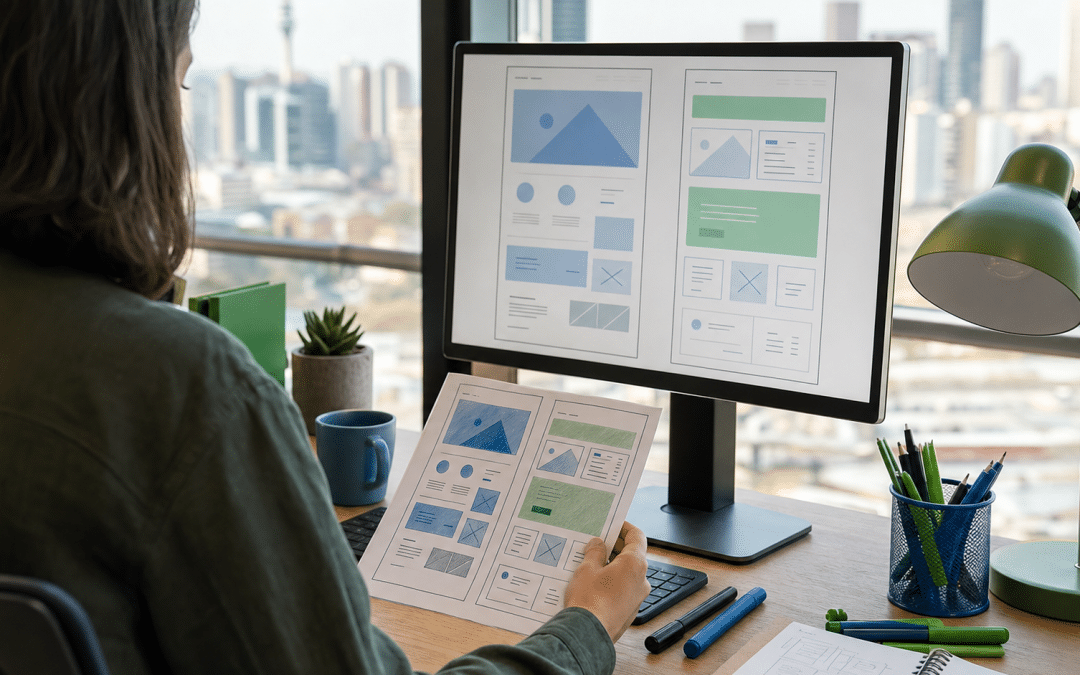
Website templates vs custom design is a choice between starting from a pre-built layout and starting from a blank page: a template fixes the structure and lets you change content, colours and images, while custom design builds the structure around how your business sells. For most South African small businesses the dividing line is not the price tag but whether your pages need to do something the template's layout cannot. This post sits inside our website builders in South Africa guide and gives you the constraints that decide it.
Three South African agencies publish their own template and custom ranges, and as the table below shows, the ranges overlap across agencies even though each agency keeps its own two tiers apart. One agency's top template price falls inside another's custom range, so "which is cheaper" does not settle anything.
Quick Answer
Choose a template when your pages fit a standard layout (home, services, about, contact), you will edit the site yourself, and speed is worth more to you than distinctiveness. Choose custom design when your enquiry or purchase path needs a layout, calculator, booking flow or integration that no template provides, or when a later rebuild would be costly, as it is on builders that do not let you change template. In the website templates vs custom design decision, scope and switching cost are better guides than the quote.
Not sure which side your site falls on?
Send us the three pages that matter most to your sales and we will tell you whether a template can carry them.
Website Templates vs Custom Design: What Each One Actually Is
A website template is a pre-designed layout, sold or bundled with a builder or CMS, where the page structure, spacing and component styles already exist and you replace the content. Custom website design is the opposite: a designer works out the page structure from your offer, your customers and your sales process, then builds that structure.
The two options are not a clean binary. In practice there are three tiers:
- Builder template. A layout inside Wix, Squarespace or similar. Fast, and edited visually, but locked to that platform.
- Purchased theme. A WordPress theme you install and adjust. ThemeForest's WordPress category listed themes priced in US dollars from $13 to $159 in October 2026. In our view the licence is rarely the real cost; the time spent adapting the theme is.
- Custom design. Layouts designed for your business, then built on WordPress, Shopify, Webflow or code.
If you are still deciding between platforms rather than approaches, start with website builder vs web designer cost, which compares subscriptions against a one-off build over three years. This post is about the layout decision that sits on top of it. If you are still choosing between builders, Carrd vs Wix and Framer vs Webflow compare the platforms whose templates you would be committing to.
What Templates and Custom Design Cost in South Africa
South African agencies price the same two options very differently, which is why a single "template costs X, custom costs Y" figure should not be trusted. The table shows what three agencies publish on their own pricing pages, as read in October 2026. These are each agency's own quotes, not a national benchmark.
| Agency (own pricing page) | Template tier | Custom tier | Read it as |
|---|---|---|---|
| Clevex | R2,000–R5,000 | R5,000–R16,000 | Cheapest custom tier of the three; template top meets custom bottom |
| Leslie Corp | R2,000–R8,000 | R10,000–R30,000 | Custom described as "custom-ish design" with a handful of pages |
| Gridweb | R5,000–R15,000 | R20,000+ | Template tier alone reaches the other agencies' custom ranges |
Gridweb's own figures give the clearest premium. Custom starts at R20,000 and its template tier runs R5,000–R15,000, so the premium for custom at the quoted minimum is R5,000 to R15,000. Gridweb's template ceiling (R15,000) is above Clevex's custom floor (R5,000) and Leslie Corp's custom floor (R10,000).
Takeaway: The Price Ranges Overlap
In South African quotes, a "template" price from one agency can cost more than a "custom" price from another, because agencies draw the line in different places. Compare what the quote includes (number of unique page layouts, integrations, who owns the files) rather than the label on it.
Build time also differs: Clevex says its packages typically go live in 14 to 21 days, while Gridweb quotes 2 to 12 weeks depending on scope. Use the premium as a break-even test: divide it by your gross profit on one new customer, and that is how many extra customers the custom layout must win to pay for itself. If you cannot name a reason a custom layout would win them, the template is the better buy. For wider cost context, see our web design pricing in South Africa breakdown.
Holding two quotes that do not compare?
Send us both and we will line up what each one includes, so you are comparing scope rather than labels.
Which Constraints Push a Site From Template to Custom?
A site moves from template to custom when one of its revenue-critical pages needs a structure, function or ownership term that the template cannot supply. The table lists the constraints we would check, in the order they usually bite.
| Your situation | Template works if… | Custom design earns its fee if… | Best for |
|---|---|---|---|
| Page structure | Your pages are home, services, about, contact and a few service pages | The key page needs a calculator, comparison tool, or a layout the template has no block for | Custom, once a core page breaks the template |
| Local payments and integrations | The theme's plugin or app already supports your payment gateway (check this for PayFast, Yoco or whichever you use) | You need a checkout, booking or quote flow wired to a CRM or accounting system | Template when an existing plugin covers it; custom when it does not |
| Who edits the site | You or your team will change text, prices and photos weekly | A developer or agency will maintain it, so editing ease matters less | Template for DIY owners |
| Brand | Your brand is simple and you are not competing on how you look | The site is the first impression for a high-value sale, and look-alike layouts hurt trust | Custom for premium services |
| Time horizon | You need to be live fast and may change direction | You expect to keep the same structure for years | Template for testing a new offer |
| Switching cost | You are on a platform where you can migrate content later | You are on a builder that will not let you change layout without rebuilding | See the next section |
Two rows do most of the work: whether a core page breaks the template, and whether integrations already exist. If both answers are no, a template is rarely a mistake. On WordPress, a well-chosen theme gets close to custom flexibility; our WordPress vs custom website comparison covers where that stops.
What Does a Website Template Lock In?
A website template locks in your layout structure, and on some builders it also locks in the platform itself, which is the cost that rarely appears on a quote. On Wix, the help centre states: "It is not currently possible to change your site's template, even if you haven't added any content or elements." The offered alternative is to create a new site and reassign your Premium plan and domain to it, which means rebuilding the content.
That makes a website builder template a decision you commit to at the start. If you outgrow it, the move is a rebuild, not a theme swap. Moving a site also carries the risks we cover in moving a website to a new host.
WordPress is more forgiving. A block theme uses blocks for all parts of a site, including the header, navigation and footer, so according to WordPress.org's documentation you can edit those parts in the Site Editor, while classic themes do not work with the Site Editor at all. That difference shapes how far you can bend a theme before you need custom work; see block theme vs classic theme for the detail. For stores, the theme question is similar, covered in Shopify themes for South African stores.
Takeaway: Check the Exit Before the Entrance
Before choosing a template, find out what leaving it costs. On Wix, switching template means a new site. On WordPress, you keep your content but may lose theme-specific layouts and shortcodes. With a custom build you decide the structure, and whether you own the files depends on what your contract says, so check it before you sign.
Does Custom Design Rank Better Than a Template?
A custom design does not rank better simply because it is custom; what helps is a fast, clear, mobile-friendly page that matches the search intent, which a template can deliver as easily as a custom build.
Google's documentation says that good results in the Core Web Vitals report or third-party tools do not guarantee that your pages will rank at the top of Google Search, and that its core ranking systems look to reward content that provides a good page experience. You can read the wording on Google Search Central's page experience guide.
Where template sites do struggle is bloat and sameness: themes that load features you never use, or a layout that cannot place your answer above the fold. Those are fixable on a good theme. For design choices that serve search, see SEO web design.
Is a Customised Template the Middle Path?
Yes, for many small businesses: a customised template is a theme that a designer adapts for your brand and your key pages. You keep the template's structure for ordinary pages and pay for custom work only where it earns money: the home page, the main service page and the enquiry form.
In the website template vs custom website argument, this is usually the answer that survives contact with a budget, and it makes website templates vs custom design a per-page decision rather than an all-or-nothing one. Ask the designer to quote it as two lines: the template build, and the custom page layouts on top. Then you can price each custom layout against the break-even test above, and drop the ones that do not clear it. The overview of cheap vs expensive websites explains what the higher end of the quote range should include.
What Should You Gather Before Asking for Quotes?
Before asking for quotes, gather five things so every supplier prices the same job: your money pages, the actions visitors must take, who edits after launch, what you already own, and the ownership terms. Without that brief, each supplier fills the gaps with their own assumptions, which helps explain the spread in the price table above.
Write down the following:
- The pages that earn money. List the three pages a buyer visits before enquiring or paying. These are the pages worth studying first, because they decide whether a standard layout is enough.
- Every action a visitor must be able to take. Request a quote, book a slot, pay a deposit, download a brochure, open a WhatsApp chat. Each one is either supported by an existing plugin or app, or it is extra work.
- Who will make changes after launch. If your receptionist will update prices, the editing screen matters as much as the front end.
- What you already own. Your domain, logo files, product photos and written copy. Missing content, not missing layouts, is what delays most launches. If you do not yet control your domain, read domain registration costs in South Africa first.
- Ownership terms. Ask who holds the files, the licences and the hosting login when the project ends.
Send the same list to every supplier, and ask each to say in writing which items are included and which are extras. A supplier who answers line by line is easier to compare, and easier to hold to the scope later.
If you want help turning that list into a brief, our business site planning guide walks through the same steps in more detail.
Why South African Businesses Choose Growth Pulse Media for Web Design
Growth Pulse Media is a Johannesburg agency founded by Dirk van Greuning, who built and scaled a large South African ecommerce business before starting the agency, and all work is executed in-house with a limited client load so senior attention stays on your project. We are a registered Shopify Partner, and our web design service can help you settle website templates vs custom design: does a template carry your key pages, or is custom design worth paying for on those pages only?
Who This Is NOT For
You need a site live this week to test an idea. A builder template or a theme is the right tool. Come back to custom design once the offer has proven itself.
You expect custom design to fix a weak offer. A new layout does not make an unclear proposition convert. Fix the offer and the page copy first.
You want the lowest quote and nothing else. As the table shows, the quoted price tells you little about scope. If the only criterion is price, a builder subscription is the honest answer.
Want a second opinion before you commit?
Request a free audit of your current site and we will tell you which pages justify custom work and which do not.
Frequently Asked Questions
Is a template or custom website better for a small business in South Africa?
A template is better when your pages fit a standard structure, you will edit the site yourself and you need to launch quickly. Custom design is better when a key page needs a layout or integration that no template offers. Many small businesses use a customised template and pay for custom layouts only on their highest-value pages.
How much more does custom design cost than a template in South Africa?
It depends on the agency, because the published ranges overlap across agencies. Gridweb quotes R5,000–R15,000 for template-based sites and R20,000+ for custom design, a premium of R5,000 to R15,000 at the quoted minimum. Clevex and Leslie Corp publish lower custom ranges, so compare scope, not labels.
Can I change my website template later?
It depends on the platform. Wix states that it is not currently possible to change your site's template, so you would create a new site and reassign your Premium plan and domain. On WordPress you can switch themes, but theme-specific layouts and shortcodes may need rework.
Does a custom website rank better on Google than a template?
Not automatically. Google says good Core Web Vitals results do not guarantee top rankings, and its ranking systems look to reward content with a good page experience. A fast, clear template site that matches the search intent can outrank a slow custom one.
Is a purchased WordPress theme a template or custom design?
It is a template. A purchased theme gives you a pre-built structure that you adapt, and ThemeForest listed WordPress themes priced in US dollars from $13 to $159 in October 2026. It becomes a customised template when a designer adapts the layouts of your key pages to your brand.
Choose the Right Build for Your Business
Tell us what your site has to do, from taking PayFast or Yoco payments to booking calls, and we will recommend a template, a customised template or custom design. All work is executed in-house. No obligation: we will get back to you within 24 hours.
