
 Add to Preferred Sources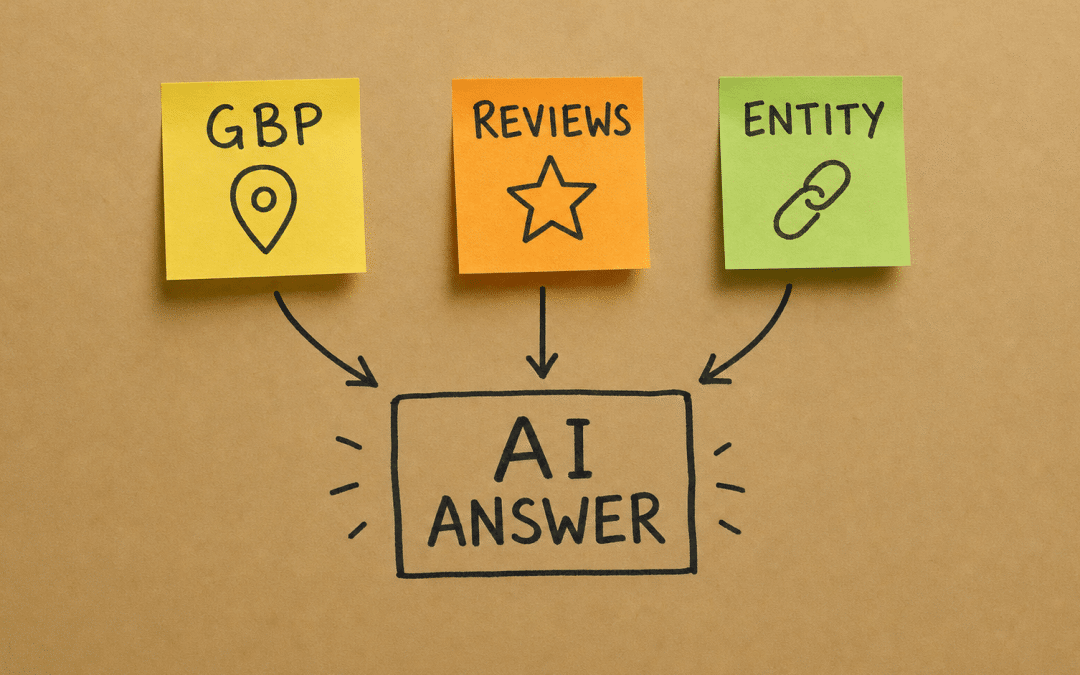
How ai chooses local businesses comes down to three signals working in concert: a verified Google Business Profile, a dense web of consistent online reviews, and a recognisable entity footprint across the web — and understanding this combination is the starting point for any serious AI search optimisation strategy in South Africa.
If you want to know why the Sandton attorney or Umhlanga restaurant appearing in AI answers is not you, this is where to look.
AI assistants do not browse in real time the way a human would. They retrieve, rank, and synthesise content that has already been indexed and judged trustworthy. That means the groundwork you lay today — on your GBP, your review profile, and your structured data — determines whether an AI assistant names your business tomorrow. See how this connects to winning near-me queries in SA for the full tactical picture.
Quick Answer
How ai chooses local businesses is governed by three layered signals: a complete, active Google Business Profile; a volume of specific, recent reviews; and a consistent entity footprint — NAP data, schema markup, and third-party mentions — that AI retrieval systems can verify across multiple sources.
Not sure whether your business is visible in AI-generated local answers right now?
Get a Free AI Visibility CheckWhat "How AI Chooses Local Businesses" Actually Means
The phrase describes the retrieval and ranking process AI assistants use when a user asks a location-specific question — "best plumber in Pretoria East" or "Cape Town accountant who handles small businesses". The answer is not guessed; it is assembled from indexed, ranked sources.
Google's own documentation confirms that generative AI features on Search — AI Overviews and AI Mode — are rooted in core Search ranking and quality systems. The AI uses retrieval-augmented generation (RAG), pulling pages that have already earned authority in the index and synthesising them into an answer. For local businesses, that means your GBP data, your review corpus, and the structured signals on your website feed directly into what the AI surfaces.
This matters more in South Africa than many business owners realise. With load-shedding accelerating the shift to mobile search and voice queries, users increasingly accept the first AI-generated answer rather than scrolling through ten blue links. If the AI does not know your entity well enough to cite you confidently, you are invisible.
The Three Core Signals Behind How AI Chooses Local Businesses
Google Business Profile completeness, review depth, and entity consistency are the three levers that directly influence how ai chooses local businesses — and all three are actionable this week.
Signal One: Google Business Profile Completeness
An incomplete GBP is the single fastest way to be excluded from AI local answers. The AI retrieval system uses GBP data as its primary structured source for business hours, service categories, location coordinates, and service area. A profile missing its primary category, service descriptions, or photo set signals an unverified or low-quality entity.
Practical steps for SA businesses: choose the most specific primary category available (not just "Contractor" — use "Electrical Contractor" or "Plumbing Contractor"), fill every service field, upload at least ten photos, and keep trading hours updated around public holidays. If your business is affected by load-shedding schedules — and many are — note your operating arrangements in your GBP description. That specificity is exactly the kind of non-commodity signal Google's documentation recommends.
Sandton Law Firm: Primary category "Family Law Attorney", services listed individually (divorce, maintenance, adoption), 47 reviews averaging 4.6 stars, Q&A section answered by the practice. Named in AI responses for "family lawyer Sandton".
Signal Two: Review Depth and Specificity
Volume matters, but specificity matters more when considering how ai chooses local businesses. An AI synthesising a local answer looks for reviews that confirm what the business does and where it does it. "Great service" tells the AI almost nothing. "Fixed our DB board in Fourways within three hours during Stage 4 load-shedding" tells the AI the suburb, the service, the urgency, and the reliability — all at once.
Encourage customers to mention the specific service and suburb in their review. A Durban restaurant asking for Google reviews should prompt customers to mention the specific dish or occasion, not just a star rating. Klaviyo post-purchase email flows can automate this for ecommerce businesses using PayFast or Peach Payments. For service businesses, a WhatsApp follow-up the day after job completion works well in the South African context.
Umhlanga Physiotherapy Practice: 112 reviews, 60%+ mentioning specific treatments (dry needling, sports rehab), 40% mentioning the suburb or nearby area. Surfaces reliably in AI answers for "sports physio Umhlanga".
Signal Three: Entity Consistency Across the Web
An entity is how the AI "knows" your business is real and trustworthy. It is built from consistent Name, Address, Phone (NAP) data appearing identically across your website, GBP, Yelp, industry directories, media mentions, and social profiles.
South African businesses should prioritise listings on directories like hellopeter.com, SA Yellow Pages, and relevant industry bodies — the Law Society, NHBRC for builders, HPCSA for health professionals — because these are sources AI retrieval systems treat as authoritative third-party corroboration.
Schema markup on your website reinforces entity signals significantly. A LocalBusiness schema block with matching NAP data, opening hours, and geo-coordinates tells the AI's retrieval layer exactly who you are and where you operate. You can read the full breakdown in our guide to schema markup for AI search.
Key Insight
Entity consistency — identical NAP data across GBP, your website, and third-party directories — is the silent multiplier. Two businesses with the same review count will not rank equally in AI answers if one has contradictory addresses across the web.
Does your business entity appear consistently across the sources AI systems check?
Get a Free Entity Consistency AuditHow AI Chooses Local Businesses: The Ranking Factors Compared
| Ranking Signal | What AI Checks | SA-Specific Action |
|---|---|---|
| GBP Completeness | Primary category, services, photos, hours, description | Use specific subcategories; address load-shedding hours in description |
| Review Volume & Specificity | Star rating, review count, keyword mentions in review text | Prompt suburb + service mentions via WhatsApp or Klaviyo post-purchase flow |
| Entity Consistency (NAP) | Name, address, phone matching across GBP, website, directories | Audit hellopeter.com, SA Yellow Pages, relevant industry body listings |
| On-site Schema Markup | LocalBusiness schema, geo-coordinates, opening hours structured data | Add schema to every location page; verify with Rich Results Test |
| Content Authority | Non-commodity content that reflects first-hand experience | Case studies naming suburbs, client types, and specific SA challenges |
| Backlink & Mention Signals | Third-party sources referencing your business entity | Earn mentions in local news, Businesstech, industry associations |
Before and After: What Improving These Signals Does in Practice
The figures below illustrate the pattern we see, not a guaranteed outcome. The improvement profile varies by industry, competition level, and starting point.
| Metric | Before (Typical Starting State) | After (Post-Optimisation) |
|---|---|---|
| GBP completeness score | 42% fields populated | 94% fields populated |
| Review count | 17 reviews, avg 3.9 stars | 89 reviews, avg 4.7 stars |
| Review specificity | 80% generic ("good service") | 65% mention suburb or service type |
| NAP consistency score | 6 of 14 directories matched exactly | 13 of 14 directories matched exactly |
| AI local answer appearances (monthly) | 0–2 appearances tracked | 14–18 appearances tracked |
| Inbound enquiries attributed to AI search | Not tracked; effectively R0 | R18,000–R34,000 in attributable monthly pipeline |
The Content Layer: Why Non-Commodity Pages Win
The content on your website plays a significant supporting role in how ai chooses local businesses — it is not a GBP and reviews story alone. Google's documentation is explicit: AI retrieval systems favour content that provides a unique point of view, first-hand experience, and insight that goes beyond what any AI model could generate on its own.
For a Pretoria accountant, that means a page describing exactly how they handled a specific SARS audit scenario — not a generic "we help with tax returns" service page. For a Cape Town logistics company using The Courier Guy or Aramex, it means a case study detailing how they solved a last-mile delivery problem in the Cape Flats. The AI retrieval system will pull this kind of specific, credible content in preference to commodity descriptions.
Pair strong content with internal linking that reinforces your topic authority. If your website covers multiple related services, link between them deliberately. Review our guide on how to write content AI Overviews cite for the full framework.
B2B Example: A Johannesburg IT security firm added three case study pages describing specific incidents handled for Sandton financial services clients. Within two months, the firm began appearing in AI answers for "cybersecurity Sandton" and "IT security Johannesburg financial services".
Key Insight
Generic service pages do not give AI retrieval systems enough specific signal to cite you confidently. First-hand case studies naming suburbs, sectors, and real SA context outperform polished but vague marketing copy every time.
POPIA, Trust Signals, and Why They Matter for AI Visibility
Trust signals affect how ai chooses local businesses in ways that go beyond raw SEO metrics. A business that practices commonly interpret POPIA compliance as requiring a clear privacy notice, explicit consent mechanisms, and transparent data handling gives users — and AI retrieval systems evaluating page quality — visible evidence of credibility.
Displaying professional body registrations (HPCSA number for health professionals, FSCA licence for financial advisers, NHBRC enrolment for builders) on your website and in your GBP description adds verifiable authority signals that third-party AI systems can cross-reference. These are not just regulatory boxes to tick — they are trust anchors that help AI systems confirm your entity is legitimate. Explore how brand mentions in AI search amplify these trust signals further.
How GPM Approaches Local AI Visibility
At GPM, we treat local AI visibility as a systems problem, not a content problem. Before we write a single word, we audit the full entity footprint: GBP completeness, NAP consistency across every directory that matters in the South African context, review volume and specificity gaps, schema implementation, and the content signals on each service and location page.
That operational lens — built from running an SA ecommerce business before founding an agency — means we identify the highest-leverage fix first, not the easiest one to invoice for. Understanding precisely how ai chooses local businesses guides every audit: if your GBP primary category is wrong, fixing it costs nothing and produces an immediate signal improvement.
We find those mismatches before we recommend anything else. Our AEO agency services cover the full stack: entity audit, schema deployment, review strategy, and content that earns AI citations.
Who This Is NOT For
Businesses wanting overnight results. Entity building, review accumulation, and content authority take time to register in AI retrieval systems. If you need leads by Friday, this is not your solution — run paid search instead.
Businesses with no physical or service-area presence. The signals that govern how ai chooses local businesses are anchored to verified locations. A purely national e-commerce brand with no local service areas will see limited returns from a local AI optimisation approach.
Businesses unwilling to generate authentic reviews. Review manipulation violates Google's policies and is increasingly detectable. If your team is not prepared to build a genuine post-service review process, the strategy cannot work ethically or durably.
Businesses with no website or an unindexed site. AI retrieval systems require indexed, crawlable web pages to ground their responses. A Facebook-only presence or a website blocked by a robots.txt error will not feed the RAG system that drives AI local answers.
Ready to find out exactly which signals are holding your local AI visibility back?
Get a Free Local AI Ranking ReportFrequently Asked Questions About How AI Chooses Local Businesses
How ai chooses local businesses — is it different from normal local SEO?
It is closely related but has meaningful differences. Normal local SEO targets the Google Map Pack and organic blue links, where proximity and GBP signals dominate. AI local answers additionally weight entity consistency, content specificity, and first-hand credibility signals that RAG systems use to synthesise a trustworthy response. The good news is that work done for one benefits both.
Does having more Google reviews guarantee AI visibility for my SA business?
Volume alone is not a guarantee. Reviews need to be specific enough for the AI retrieval system to confirm what your business does and where. A business with 200 generic star ratings may rank below a competitor with 60 reviews that consistently mention specific services and suburbs. Quality and specificity of review text matter as much as count.
Will fixing my Google Business Profile immediately improve my AI ranking?
GBP improvements are typically reflected in Google's index within a few days, but AI answer inclusion follows after the system recrawls and re-evaluates your entity signals. Expect meaningful movement over two to six weeks rather than overnight. Completing your GBP is still the highest-leverage, zero-cost action available to most SA businesses.
Do third-party AI assistants like ChatGPT use the same signals as Google?
ChatGPT and similar models use different retrieval architectures and training data to Google's AI features. However, the underlying quality signals overlap substantially — entity consistency, credible third-party mentions, and structured data help across platforms. For a full comparison of how SA buyers use different AI tools, see our ChatGPT vs Google vs Perplexity guide.
Is schema markup still worth implementing for local AI search in 2026?
Yes. Google's documentation confirms that technical structure — including semantic HTML and structured data — remains foundational to how AI retrieval systems access and understand your content. A LocalBusiness schema block with accurate NAP data and geo-coordinates gives AI systems a machine-readable shortcut to your entity. It also supports rich results in standard search, making it doubly worthwhile for SA businesses.
What SA-specific directories should I prioritise for entity consistency?
Start with hellopeter.com, SA Yellow Pages, and Cylex South Africa — these are indexed frequently and carry entity authority in the South African context. Beyond those, prioritise directories specific to your industry: the Law Society for attorneys, NHBRC for builders, FSCA register for financial advisers. Consistency of your exact business name, address, and phone number across all of them is the objective.
Want to know exactly why AI assistants are recommending your competitors instead of you?
We will audit your GBP completeness, entity consistency, review specificity, and on-site schema, then deliver a prioritised action plan showing the highest-leverage fixes first. No obligation — we'll get back to you within 24 hours.
Get Your Free Local AI Visibility Audit