
 Add to Preferred Sources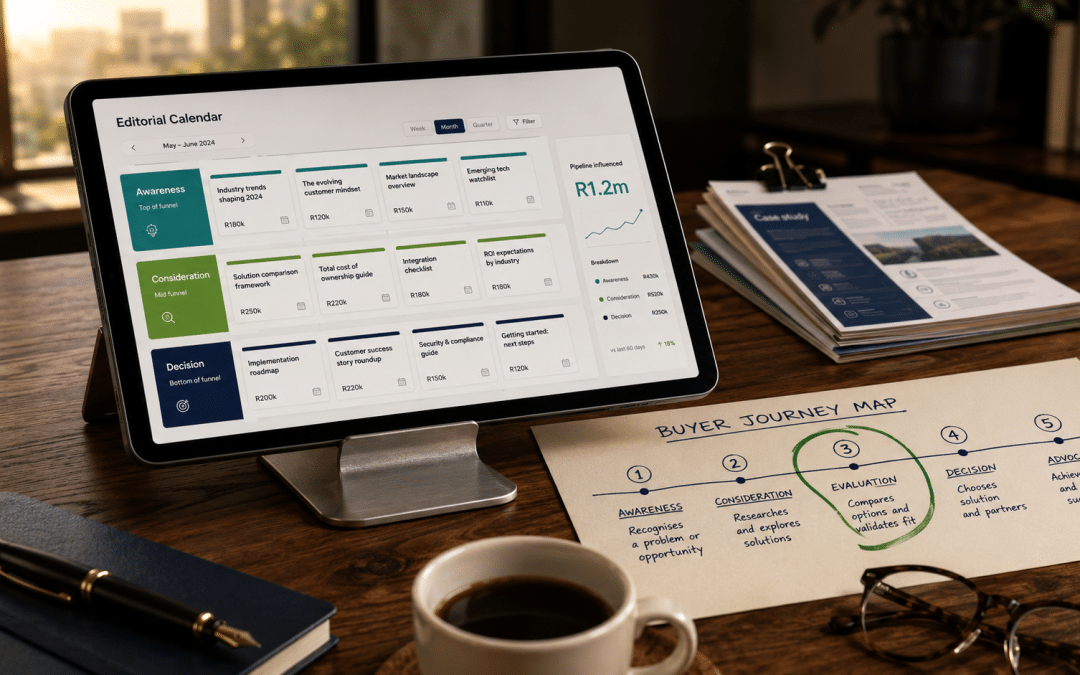
B2B content marketing in South Africa costs R18,000–R65,000 monthly for a properly scoped publishing programme and produces qualified pipeline within 6–12 months — but only when every asset is built to move a named buyer one stage closer to a conversation, rather than to fill a calendar. Most SA programmes fail because they publish for traffic instead of for pipeline. This guide covers how to build a publishing engine that generates enquiries, what to pay, and how to measure it against revenue rather than pageviews — with the same rigour we apply in our B2B lead generation South Africa guide and our SA sales funnel guide.
Quick Answer
B2B content marketing in South Africa works when publishing is anchored to buying stages rather than keyword volume: awareness assets that name a real problem, consideration assets that compare approaches honestly, and decision assets that remove risk. Expect R18,000-R65,000 monthly and 6-12 months to meaningful pipeline. Only 12% of firms globally rate their programme highly effective, and the difference is almost never writing quality — it is whether each piece has a defined buyer, stage, and next step.
Want a free 60-minute session mapping a publishing plan to your SA pipeline?
Get a Free Publishing Strategy SessionB2B Content Marketing: What It Actually Costs
A publishing programme for South African firms is best understood as a monthly engagement covering research, production, distribution, and measurement — not a per-article purchase. Programmes need 6-12 months before pipeline appears, because business buyers research quietly for months before identifying themselves.
| Programme Level | Indicative Cost | Best For |
|---|---|---|
| Foundation | R18,000 – R28,000 / month | 2-3 assets monthly, single buyer profile |
| Growth | R28,000 – R45,000 / month | 4-6 assets, multi-stage coverage, distribution |
| Authority | R45,000 – R65,000+ / month | Original research, video, thought leadership |
| Distribution add-on | +R8,000 – R20,000 / month | Paid amplification and email sequencing |
According to the Content Marketing Institute's annual research, only 12% of firms rate their programme highly effective, while 47% say they merely met most goals. What separates the effective minority is not budget — it is relevance and quality, cited by 65% of high performers, followed by team capability at 53%. Money buys volume; discipline buys pipeline. This is what effective B2B content marketing looks like in practice.
Why Most SA Programmes Never Produce Pipeline
Publishing programmes fail for South African firms because they optimise for traffic that never converts, publish without a defined buyer, and stop before the compounding phase begins. Each failure is avoidable, and each is common.
The Traffic Trap
Ranking for a high-volume term feels like progress and often produces nothing. If the searcher is a student, a competitor, or a job-seeker, the visit costs you money and returns nothing. Programmes that chase volume rather than buyer intent generate impressive dashboards and empty pipelines. The right question is never "how many people read it" but "how many of the right people took the next step".
The Undefined-Buyer Trap
An article written for "SA businesses" is written for nobody. Business buyers self-educate through roughly a dozen pieces before contacting a vendor, and they choose the pieces that speak to their exact situation. A financial director evaluating a supplier switch has different questions from an operations manager comparing systems. Writing to both at once serves neither, and generic material is the single most common reason enquiries never arrive.
The Impatience Trap
Owned assets compound; paid advertising does not. That compounding takes months to begin, so programmes killed at month four are killed exactly before returns arrive. Budget accordingly: if you cannot sustain 9-12 months, run paid acquisition instead and revisit publishing when you can commit. See our pipeline mistakes guide for adjacent failure patterns.
The Pipeline-First Insight
Every asset should be answerable to one question: which named buyer, at which buying stage, takes which next step after reading this? If a piece has no answer, it is a blog post, not a business asset. Programmes that apply this test before writing consistently outperform higher-volume programmes that skip it. Done well, B2B content marketing compounds as archive authority builds.
Want a buyer-stage publishing map built for your specific SA market?
Get a Free Buyer Journey MapThe Pipeline-First Publishing Framework
A working programme covers three buying stages deliberately, with a defined next step at each. Skipping a stage breaks the chain, and most SA firms skip the middle one entirely.
Stage 1 — Awareness assets: Name the problem your buyer already feels but has not yet priced. Cost-of-inaction pieces, industry benchmarks, and diagnostic checklists work well. The next step is small: a related resource, not a sales call. These pieces earn the right to be read again.
Stage 2 — Consideration assets: Compare approaches honestly, including options that are not yours. Buyers are comparing regardless; being the source of the fair comparison builds the trust that closes deals later. Include the case against your own approach. The next step is a deeper resource or a diagnostic.
Stage 3 — Decision assets: Remove risk. Case studies with real numbers, implementation timelines, pricing transparency, and objection-handling material. Buyers at this stage are building an internal business case; give them the ammunition. The next step is a conversation, and here the ask can be direct.
Distribution — publish is not the last step: An asset nobody sees earns nothing. Sequence each piece into email, LinkedIn, and relevant communities. In-person events and webinars consistently rank among the strongest distribution channels for business audiences, and both suit the SA market well.
Common failure — publishing on a calendar, not a journey: Producing four articles a month because the plan says four, with no defined buyer, stage, or next step, generates traffic that never converts and burns budget for a year before anyone questions it. Volume without a journey is the most expensive way to feel productive in this discipline.
Formats That Convert for SA Buyers
Format choice matters most at the point of capture. Some formats consistently outperform others for business audiences, and the pattern holds in the SA market.
Long-form guides and original research
Comprehensive guides and original research carry the highest conversion-to-pipeline rates because they demonstrate expertise rather than asserting it. Original SA data — a benchmark survey of your sector, pricing transparency nobody else publishes — is defensible, quotable, and very hard for a competitor or an AI summary to replicate without citing you.
Case studies with real numbers
A case study naming the starting position, the intervention, and the rand outcome does more decision-stage work than any other asset. Vague testimonials do nothing. Specificity is the whole value, and SA buyers are unusually sceptical of unquantified claims.
Diagnostic tools and assessments
Interactive assessments outperform static PDFs at the capture point because they return something useful immediately. A scorecard that tells a buyer where they actually stand earns an email address honestly. For adjacent capture formats, see our lead magnet ideas guide.
The Compounding Asset Rule
Paid advertising stops the moment spend stops; a published asset keeps working for years. This is why the discipline rewards patience and punishes start-stop budgeting. One genuinely excellent piece that ranks and converts for three years outperforms thirty forgettable ones. Publish less, research harder, and let the archive compound — that is the economic argument for B2B content marketing.
Want an honest assessment of whether your current publishing is producing pipeline?
Request a Free Programme AuditMeasurement and Reporting Discipline
Strong programmes report on revenue-stage outcomes, not vanity metrics. Track enquiries generated, pipeline value influenced, time-to-close for engaged prospects versus cold ones, and revenue by cohort. Pageviews and social shares are easy to measure and weakly correlated with money — which is precisely why struggling teams report them.
Cohort tracking matters because buying cycles stretch across quarters. A prospect who reads an article in February may enquire in July and sign in November, so monthly snapshots systematically understate the archive's value. Group enquiries by the month of first meaningful engagement, then follow each cohort through to closed revenue. Within three or four cohorts a conversion curve emerges, and that curve is the forecasting engine.
Weekly reviews should answer three questions. First, which pieces produced enquiries this week, and what did those readers have in common? Second, which pieces attract readers who never progress — and should they be pruned or rewritten? Third, which buyer questions keep arriving in sales calls that nothing in the archive answers? That third question is the highest-value input to the plan, and almost nobody asks it.
On tooling, disciplined analytics beats an elaborate stack used badly. Every published asset needs an owner, a buying stage, a defined next step, and a review date. Pieces without owners rot quietly. A quarterly archive review — every asset, still accurate, still converting, still worth keeping — is the cheapest habit separating programmes that compound from programmes that decay.
The Growth Pulse Media Difference
Growth Pulse Media is run by an operator, not an account team. Before founding the agency, Dirk built and scaled a large South African ecommerce business — so every framework in this guide comes from spending real money on pipeline, not from agency theory.
All work is done in-house in Johannesburg with a deliberately limited client load, using the same stack we recommend to clients: Google Search Console, Rank Math, Apollo.io, and Klaviyo. No offshore outsourcing, no junior hand-offs, and reporting built on enquiries and revenue rather than pageviews.
If you would rather have this built for you, our pipeline-building service for SA firms runs exactly the system described above — buyer-stage publishing measured against pipeline value, with every asset accountable to a named buyer and a next step.
Who This Is NOT For
An honest disqualifier list saves both sides time. This approach is the wrong fit if any of the following describes you:
You need enquiries this month. Owned assets compound over 6-12 months. If the pipeline must move within 30 days, paid acquisition is the honest recommendation — not publishing.
You cannot sustain the budget for 9-12 months. A programme killed at month four is killed exactly before returns arrive. Start-stop budgeting burns money and proves nothing either way.
You measure success in pageviews. If traffic dashboards are the goal, cheaper options exist. Everything described here is built to be judged on enquiries and revenue, and that discipline is non-negotiable.
Your sales team will not participate. The highest-value input to the plan is the questions buyers keep asking on sales calls. If that feedback loop cannot exist, the programme loses its sharpest edge.
Frequently Asked Questions
How much does B2B content marketing cost in South Africa?
Programmes cost R18,000-R65,000 monthly depending on volume and depth. Foundation programmes producing two to three assets monthly for a single buyer profile run R18,000-R28,000. Growth programmes covering multiple buying stages run R28,000-R45,000. Authority programmes including original research and video run R45,000-R65,000+. Paid distribution and email sequencing add R8,000-R20,000 monthly.
How long before it produces leads?
Expect 6-12 months to meaningful pipeline. Early signals such as rankings and engagement appear within three to four months, but business buyers research quietly for months before identifying themselves, so enquiries lag. Programmes evaluated before month six systematically understate impact because owned assets compound rather than spike. If you cannot commit nine to twelve months, paid acquisition is the better fit.
How many pieces should we publish per month?
Fewer and better beats more and thinner. Two to four well-researched pieces monthly, each tied to a named buyer and buying stage, outperforms eight generic ones. Volume only helps once relevance and quality are established, and quality is what high-performing firms cite most often as the driver of their results.
What is the difference between this and SEO?
SEO optimises for search visibility; publishing for pipeline optimises for buyer progression. They overlap heavily and work best together, but the goals differ. A page can rank beautifully and convert nobody. Start with the buyer and the next step, then apply search discipline so the right people find it — not the other way round.
Should we use AI to produce assets?
Use it for research, outlining, and first drafts, with human oversight for strategy, voice, and final editing. Teams working this way produce meaningfully more at equivalent quality. Purely machine-generated material underperforms in organic search and reads as generic to sceptical buyers, while human-only workflows struggle on volume. The hybrid model wins.
Which metrics actually matter?
Enquiries generated, pipeline value influenced, conversion rate by asset, and time-to-close for engaged prospects versus cold ones. Track revenue by cohort rather than by month. Pageviews, impressions, and social shares are directional at best — if those are your headline numbers, the programme is not being measured against the business.
Get a Free Pipeline Audit for Your SA Publishing Programme
Growth Pulse Media builds publishing programmes for South African firms that are measured against pipeline, not pageviews — with buyer-stage mapping, original SA research, decision-stage case studies with real rand outcomes, and distribution built in from day one. We would rather tell you your archive needs pruning than sell you four more articles a month.
No obligation. No lock-in contracts. We will get back to you within 24 hours.
Request Your Free Audit →