
 Add to Preferred Sources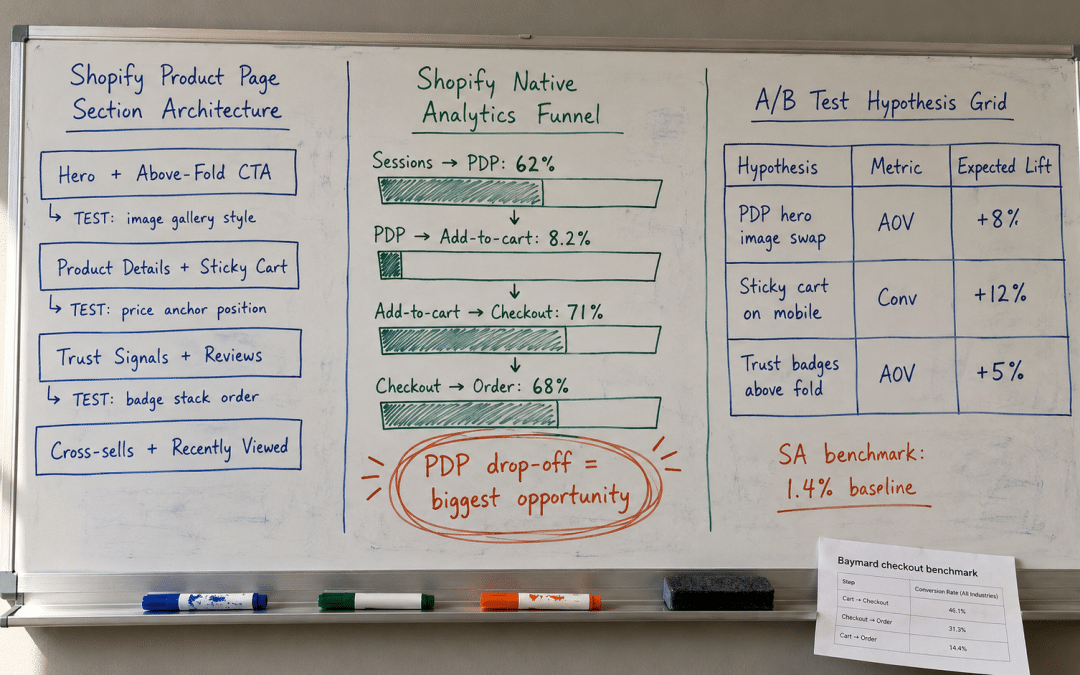
Shopify CRO South Africa is a specific methodology, not a generic checklist of "add trust badges and reduce form fields". It uses Shopify's native section architecture, native analytics funnel data, and platform-specific testing tools to identify where SA store visitors drop off — then runs disciplined experiments against those drop-off points. Most SA operators conflate CRO with checkout tweaks or abandoned cart emails.
This guide covers the Shopify-native CRO framework SA operators should apply, native analytics interpretation, third-party test tool selection, and the sequencing that produces compounding conversion gains. For broader Shopify context, see our Shopify South Africa guide. For narrower tactical guides, see our Shopify checkout optimisation guide and Shopify abandoned cart recovery guide.
Quick Answer
Shopify CRO South Africa works when SA operators start with native analytics funnel diagnosis (Sessions → PDP → Add-to-cart → Checkout → Order), identify the biggest drop-off, and run section-level tests against that step using Convert, VWO, or Intelligems. SA Shopify stores average 1.4-1.6% conversion; disciplined programmes lift this to 2.8-3.5% within 6-9 months. The mistake is scattered tactical tweaks instead of sequenced testing.
Want a free 60-minute CRO diagnostic showing your biggest funnel drop-off and the highest-impact test to run first?
Get a Free CRO DiagnosticWhy Shopify CRO is Genuinely Different From Generic Ecommerce CRO
Generic ecommerce CRO advice assumes a custom-built store where developers can change any element at will. Shopify CRO South Africa operates differently — theme sections have defined boundaries, checkout is largely fixed (except on Plus with extensibility), and the app ecosystem determines what functionality is technically testable. Applying custom-store CRO methodology to a Shopify store produces frustrated operators and stalled programmes. Shopify CRO demands platform-native methodology.
According to Shopify's enterprise data on store speed and conversion, nearly 80% of Shopify stores pass all Core Web Vitals thresholds — among the highest of any major ecommerce platform. This changes the conversation for SA operators: they start with a technical foundation most platforms lack. CRO wins come from content, layout, and trust — not from fixing performance. Operators who understand this reallocate testing capacity to higher-leverage tests.
The Critical Reframe
Generic ecommerce CRO measures friction removal — smaller checkout, faster load, fewer form fields. Shopify CRO South Africa measures section-level performance against the native analytics funnel. A Shopify store already has fast load times, one-page checkout, and Shop Pay by default. The remaining Shopify CRO wins are in product page architecture, trust signal placement, cross-sell positioning, and mobile section layout — none of which appear in generic checklists.
The Five-Step Shopify CRO Framework for SA Operators
Effective Shopify CRO South Africa on SA stores follows a repeatable five-step framework. Skipping steps or reordering them produces scattered tactical improvements that never compound. The framework below reflects what actually works for SA operators, not theoretical CRO literature.
| Step | What It Involves | Timeline |
|---|---|---|
| 1. Native funnel diagnosis | Shopify Analytics behaviour reports; identify biggest % drop-off between Sessions → PDP → ATC → Checkout → Order | Week 1 |
| 2. Hypothesis prioritisation | Rank test hypotheses by expected impact against diagnosed drop-off; use ICE or PIE scoring | Week 2 |
| 3. Test tool selection and setup | Convert, VWO, or Intelligems; theme integration; goal tracking configuration | Weeks 2-4 |
| 4. Sequenced test execution | One test at a time against diagnosed drop-off; minimum 2-week test duration; 95% confidence threshold | Weeks 3-24 |
| 5. Learning consolidation | Winning variants shipped to production; losing variants inform next hypothesis; documented learnings | Ongoing |
SA operators who follow this framework typically lift Shopify store conversion 60-140% over 6-9 months. Those who skip step 1 (diagnosis) run tests against the wrong funnel step and waste testing capacity. Those who skip step 5 (consolidation) run the same tests repeatedly because learnings never accumulate. Disciplined operators outperform tactical operators consistently.
The Three Most Common SA Shopify CRO Mistakes
Three mistakes consistently derail SA Shopify CRO South Africa programmes. Each looks like productive optimisation activity. Each destroys programme momentum and produces no compounding gains.
Mistake 1 — Running Tests Without Native Funnel Diagnosis
SA operators regularly run product page tests when the real drop-off is at add-to-cart, or checkout tests when the drop-off is at product page. Without native analytics funnel diagnosis, Shopify CRO South Africa tests get run against the wrong step — producing statistically valid results that do not move overall store conversion. The fix is Shopify Analytics behaviour reports as step 1, before any hypothesis is generated.
Mistake 2 — Testing Cosmetic Changes Instead of Structural Changes
Shopify CRO South Africa programmes routinely test button colours, headline font sizes, and image swap variations. These occasionally produce small wins but rarely move overall conversion meaningfully. Structural tests — reordering product page sections, adding sticky cart on mobile, testing single-page versus multi-step layouts, repositioning trust signals — produce the largest lifts. The rule: test structure before cosmetics. Structural tests are harder to build but move the needle 5-10x more.
Mistake 3 — Ending Tests Before Statistical Significance
SA operators watching test dashboards routinely call winners after 3-5 days because a variant "looks like" it is winning. Statistical significance typically requires 2-4 weeks at SA store traffic volumes (5,000-40,000 monthly sessions). Calling tests early produces false winners that revert when shipped. Shopify CRO South Africa discipline requires waiting for 95% confidence — even when a variant "looks" like a winner. See our CRO South Africa guide.
Want to see which of these three mistakes might be draining your Shopify CRO programme in SA?
Request a custom CRO programme auditThe GPM Differentiator: Operator Perspective on Shopify CRO
Most SA agencies offering Shopify CRO South Africa services come from either theme development backgrounds (which favour visual redesigns over disciplined testing) or generic CRO backgrounds (which apply custom-store methodology to Shopify with poor fit). The result is programmes producing activity without compounding conversion gains, or theme redesigns that occasionally lift conversion but cannot be attributed with confidence to specific changes.
Growth Pulse Media built and scaled an SA ecommerce business through real CRO decisions — running disciplined testing programmes, learning to distinguish structural tests from cosmetic ones, learning when to trust statistical significance and when to demand replication. The operator instinct that comes from running CRO under revenue pressure — knowing which experiments to prioritise, knowing when a test result is genuine versus noise — applies directly to Shopify CRO programme management. If you would rather have that judgement applied to your store, our Shopify marketing agency runs CRO alongside Google Ads, SEO and email as a Shopify Partner.
Our CRO service works with SA Shopify operators on native funnel diagnosis, test hypothesis prioritisation, test tool selection, and sequenced Shopify CRO South Africa programme execution on a senior-level basis. Limited client load ensures senior attention through the programme phases that determine outcome — hypothesis quality and test discipline, not just test volume.
The Operator Lesson
Two SA Shopify operators running identical numbers of tests can end up on completely different conversion trajectories. The variable is rarely testing tool sophistication. It is whether hypotheses were prioritised against native funnel diagnosis, whether tests targeted structural changes rather than cosmetic ones, and whether statistical significance was respected before winners were shipped. Shopify CRO South Africa discipline compounds; scattered testing activity does not.
Real-World Impact: SA Mid-Sized Shopify Store Before and After
This is a representative SA mid-sized Shopify Advanced store selling premium home and lifestyle goods with 480 SKUs and 14 staff, based in Johannesburg with fulfilment via Cape Town. The "before" period reflects scattered tactical CRO tweaks including three theme redesigns over 18 months. The "after" period captures 9 months after implementing a structured Shopify CRO South Africa programme.
| Metric | Before | After (9 months) | Change |
|---|---|---|---|
| Monthly Shopify sessions | 34,000 | 36,500 | +7% |
| Sessions → PDP rate | 58% | 67% | +9pp |
| PDP → Add-to-cart rate | 4.8% | 9.6% | +100% |
| Checkout completion rate | 63% | 74% | +11pp |
| Overall store conversion rate | 1.4% | 3.2% | +129% |
| Average order value | R780 | R925 | +19% |
| Mobile conversion rate | 0.9% | 2.6% | +189% |
| Annual store revenue | R4.5m | R13.0m | +189% |
What Drove the Result
The Shopify CRO South Africa programme cost R32k monthly across strategy, Convert testing tool, and analyst time. Native funnel diagnosis identified PDP → Add-to-cart as the biggest drop-off (not checkout, which the operator had assumed). The first four tests — product page hero, sticky mobile cart, review widget position, cross-sell placement — collectively doubled add-to-cart rate. Total investment: R288k. Additional annual revenue: R8.5m. Programme ROI: 29x.
Who This Is NOT For
Structured Shopify CRO programmes apply to most established SA operators, but four scenarios where CRO investment is misplaced deserve honest acknowledgement.
Your Shopify store gets under 5,000 monthly sessions. A/B testing requires statistical sample sizes that low-traffic stores cannot reach within reasonable test duration. Tests take 8-16 weeks to reach significance at this volume, which means only 3-6 tests per year — insufficient to compound gains. Focus first on traffic acquisition to build the sample size CRO requires. Below 5,000 monthly sessions, growth strategy delivers better returns than CRO investment.
Your store has fundamental product-market fit or pricing problems. CRO amplifies existing store performance — it does not fix broken value propositions. If products get poor reviews, prices are meaningfully higher than direct competitors, or the target market is genuinely wrong for the offer, CRO produces marginal gains at best. Fix product and pricing first; layer CRO on afterwards. CRO on a broken store produces cosmetic wins that do not translate to revenue.
Your team cannot allocate 6+ hours weekly to CRO programme work. Structured CRO programmes require hypothesis review, test build oversight, results interpretation, and learning documentation weekly. Operators who cannot allocate this capacity get patchy programme outcomes and diminishing returns. If internal capacity is genuinely constrained, delay programme investment until capacity exists — do not attempt part-time CRO with predictably poor results.
Your Shopify theme is heavily customised beyond recognition of standard structure. Deeply customised themes fight testing tools, break section-level testing, and add technical debt to every experiment. If your store runs custom code across 60%+ of theme files, structural CRO tests will be constantly blocked by technical implementation issues. Simplify theme architecture first — often by migrating to Shopify's OS 2.0 standard sections — then layer CRO. Testing on unmaintained custom code produces frustration.
SA-Specific Shopify CRO Tactics That Global Playbooks Miss
Three SA-specific Shopify CRO South Africa tactics consistently produce disproportionate results. Each requires direct SA market experience because each plays against SA consumer behaviour and infrastructure realities.
Tactic 1 — Instant EFT Prominence for SA Card-Wary Consumers
SA consumers show meaningfully lower card checkout completion rates than global averages — driven by card fraud awareness, 3DS friction, and lingering EFT preference for larger purchases. Adding Ozow instant EFT as a prominent payment option (not just an "other" tab) at checkout consistently lifts SA store conversion 8-14% based on our observed data. This is invisible to global CRO playbooks. For deeper payment gateway context, see our Shopify payment gateways guide.
Tactic 2 — Mobile Sticky Cart for SA Traffic Mix
SA mobile traffic runs 72-78% of Shopify store sessions — above global averages. A well-implemented sticky add-to-cart bar on mobile PDPs (visible during scroll, persistent through gallery browsing) lifts mobile add-to-cart 15-30% for SA stores based on observed test results. Combined with prominent instant EFT payment options, mobile conversion lifts routinely exceed 40%. Both changes are structural and require theme code work, not just section-level tests.
Tactic 3 — SA Courier Delivery Timeline Transparency
SA consumers are meaningfully more sensitive to delivery timeline uncertainty than global averages — driven by past experience with courier delays and rural delivery gaps. Adding explicit delivery window commitments ("Delivered by [date]" calculated from courier API) at PDP and checkout stages lifts SA store conversion 6-12% based on observed data. Vague "3-5 business days" language significantly underperforms specific date commitments in SA testing.
Want all three SA-specific tactics applied to your Shopify store with a custom 90-day CRO roadmap?
Request a free CRO planning sessionFrequently Asked Questions About Shopify CRO in South Africa
How much does Shopify CRO South Africa cost for SA operators?
Structured programme cost runs R22,000-R55,000 monthly for SA operators, covering strategy, hypothesis prioritisation, test tool licence (Convert typically R4,500-R9,000 monthly for SA store traffic volumes), analyst time, and results interpretation. Enterprise operators with Shopify Plus and higher traffic volumes run R55,000-R140,000 monthly. Below R22k monthly the programme lacks the discipline required to compound gains; scattered tactical work replaces structured testing.
What conversion rate is realistic for SA Shopify stores?
SA Shopify stores average 1.4-1.6% conversion — slightly below global averages driven by mobile share and card checkout friction. Stores in the top 20% run 3.2%+ and stores in the top 10% run 4.7%+. Realistic targets after 6-9 months of disciplined programme work: baseline stores lifting from 1.5% to 2.8-3.5%; already-optimised stores lifting from 2.5% to 3.8-4.5%. Gains beyond these ranges typically require Shopify Plus with checkout extensibility.
Which A/B testing tools work best for SA Shopify stores?
Convert.com is the strongest mid-market fit — clean Shopify integration, transparent pricing (R4,500-R14,000 monthly for SA store volumes), no revenue share. VWO suits larger operators needing behavioural analytics alongside testing (R8,000-R25,000 monthly). Intelligems is emerging for Shopify Plus stores wanting Profit Per Visitor as primary metric. Free tools like Google Optimize successor and native Shopify testing are limited; serious programmes need paid tools.
How long does a Shopify CRO programme take to show results?
First Shopify CRO South Africa test winners typically ship in weeks 4-8. Meaningful conversion lift (10-20%) appears at months 3-4. Compounding gains delivering 60-140% lift over baseline typically appear at months 6-9 as learning stacks. Programmes evaluated below 6 months systematically underestimate CRO impact because the compounding curve is backweighted. Plan for 9-12 month evaluation minimum.
Should we test on mobile or desktop first for SA Shopify stores?
Mobile first for SA operators, given 72-78% mobile traffic share and the meaningful conversion gap between mobile and desktop on most SA stores. Mobile CRO tests targeting sticky cart, hero image treatment, and payment method prominence typically deliver 3-5x the revenue impact of equivalent desktop tests. Desktop tests remain valuable for higher-AOV segments but sequence mobile tests first in the programme.
What's the biggest Shopify CRO mistake SA operators make?
Running scattered tactical tweaks (button colours, headline swaps, badge additions) without native funnel diagnosis identifying where actual drop-off occurs. This produces statistical noise that occasionally shows small wins but never compounds. The Shopify CRO South Africa fix is Shopify Analytics behaviour reports as step 1, structured hypothesis prioritisation against diagnosed drop-off as step 2, then disciplined test execution with statistical significance respected. Discipline beats activity every time.
Shopify CRO South Africa: The Bottom Line for SA Ecommerce Operators
Shopify CRO South Africa is a discipline that lifts SA store conversion 60-140% for operators willing to run a structured programme with native funnel diagnosis, prioritised hypotheses, and respect for statistical significance. The programmes that fail all skip diagnosis or discipline — running scattered tactical tweaks that produce noise instead of compounding gains.
The single biggest predictor of a successful programme is not testing tool selection or team size. It is whether the operator commits to funnel diagnosis before hypothesis generation, treats structural tests as higher priority than cosmetic tweaks, and respects statistical significance thresholds even when variants "look" like winners.
If you would rather skip the trial-and-error and have a senior operator who has run SA Shopify CRO programmes under revenue pressure walk you through what would work for your store, that is exactly what the conversation below is for.
Get a Free CRO Diagnostic for Your SA Shopify Store
We will run native funnel diagnosis on your Shopify store, identify the biggest drop-off point, and give you a written diagnostic covering the two or three highest-leverage tests to run first, realistic 9-month conversion projections, and a phased programme roadmap tuned to your traffic volume and product mix.
No sales pitch, no pressure — just an honest read from senior operators who have built and scaled SA ecommerce stores. No obligation — we will get back to you within 24 hours.
Request a Free CRO Diagnostic →