
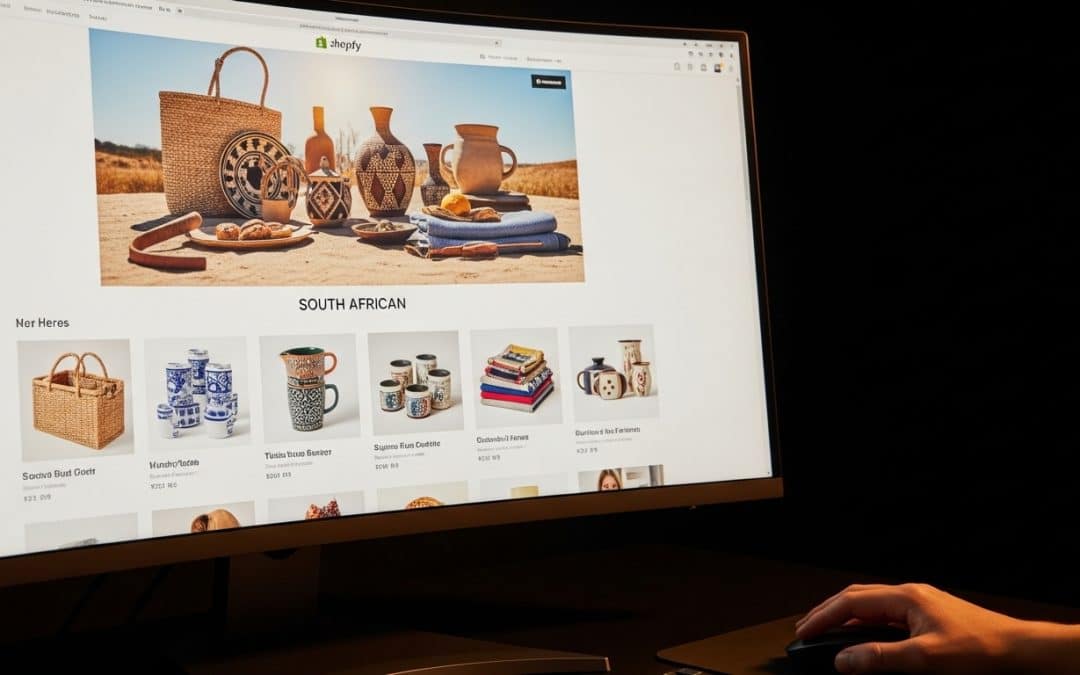
Shopify website design South Africa is not simply about choosing a theme and uploading products — a properly designed SA Shopify store is a conversion system built around local payment behaviour, mobile-first browsing, and the specific trust signals South African shoppers need before they buy. Done right, it is one of the fastest paths to a revenue-generating online store available to SA businesses in 2026. If you are exploring your Shopify options in South Africa, understanding what separates a high-converting store design from a generic template build will save you thousands of rands and months of lost sales. The design decisions you make upfront — theme structure, checkout flow, payment gateway placement, and mobile layout — directly determine whether your store converts browsers into buyers or sends them back to Google.
This guide covers everything SA businesses need to know about Shopify website design: what a properly built store includes, what drives the cost difference between quotes, which design elements move the conversion needle for South African shoppers, and how to avoid the template mistakes that kill sales before they start.
Want a Shopify store built for SA conversion rates — not just a pretty template? Let's talk about what your store actually needs.
Get a Free Shopify Design ConsultationShopify Website Design South Africa: What a Properly Built Store Actually Includes
Shopify website design in South Africa goes far beyond theme selection — a store built to convert SA shoppers requires localised checkout configuration, mobile-first layout decisions, SA-specific trust signals, and payment gateway integration that matches how South Africans actually prefer to pay.
Most SA businesses that come to us have already launched a Shopify store — often on a free or cheap theme — and are frustrated that traffic is not converting. The design is usually not the problem. The problem is that the store was not configured for a South African buyer's journey. SA shoppers are more price-sensitive than global averages, more likely to browse on mobile data, and significantly less likely to complete a purchase if they do not see a familiar local payment option at checkout. These are not design preferences — they are conversion variables that must be designed around from the start.
Theme Selection: What Actually Matters for SA Stores
Shopify's theme library has over 100 paid and free options, but not all themes are equal for South African ecommerce. The criteria that matter most for SA performance are page speed on mobile data connections, checkout customisability, and product display flexibility — not visual style. A slow theme on a 4G connection costs you the sale before the customer even sees your product.
For most SA stores, themes in the R0–R4,000 range (free to USD 180) provide everything needed. Premium themes become worth the investment when your product catalogue is large, you need advanced filtering, or your brand identity requires a level of custom layout that free themes cannot support cleanly. The theme is the starting point — what matters more is how it is configured.
Good approach: A Johannesburg fashion brand selects the free Dawn theme, configures a sticky add-to-cart bar for mobile, activates PayFast and Peach Payments at checkout, and adds trust badges above the fold on product pages. Conversion rate: 2.8%.
Poor approach: The same brand purchases a premium R3,500 theme for its visual impact, launches without configuring local payment gateways, and uses the default checkout layout. Conversion rate: 0.9% — three times lower, despite the more expensive design.
Key Insight
Theme cost has almost no correlation with conversion rate for South African Shopify stores. Configuration — payment gateways, mobile layout, trust signals, and checkout flow — drives conversion far more than the price or visual complexity of the theme. A R0 theme configured correctly will outperform a R4,000 theme launched out of the box every time.
Shopify Website Design South Africa: SA Payment Gateway Integration
South African payment gateway integration is the single most important technical decision in your Shopify website design — because it is the last thing a customer sees before they hand over money, and it is where most SA stores lose the sale.
South African shoppers have strong preferences for familiar local payment methods. PayFast and Peach Payments are the two dominant local processors, and both offer Shopify's South Africa localisation through native app integrations. Beyond card payments, SA shoppers increasingly use instant EFT options like Ozow and SnapScan — particularly for higher-value purchases where credit card hesitation is common. A Shopify store that only offers Stripe or PayPal at checkout is leaving a significant portion of SA buyers behind at the most critical point in their journey.
| Payment Gateway | Shopify Integration | Best For | Transaction Fee (approx) |
|---|---|---|---|
| PayFast | ✅ Native Shopify app | All SA stores — broadest acceptance | ~2.9% + R2 |
| Peach Payments | ✅ Native Shopify app | Higher-volume stores, recurring billing | ~2.5–3.5% |
| Ozow | ✅ Shopify app | Instant EFT, budget-conscious shoppers | ~1.5–2% |
| SnapScan | ✅ Shopify app | QR-based in-store and online | ~2.75% |
| Stripe | ✅ Shopify Payments | International sales only | ~2.9% + R5 |
| PayPal | ✅ Native | International buyers — not primary for SA | ~3.4% + fixed fee |
For most SA stores, the recommended configuration is PayFast as the primary gateway (broadest SA card acceptance), Ozow for instant EFT, and Stripe or PayPal available for international buyers. This configuration covers the full spectrum of South African payment preferences and removes the most common checkout abandonment trigger — not seeing a trusted payment option.
Not sure which payment gateways your SA store should be running? We configure Shopify checkout for SA conversion — get our recommendation for your specific product and customer profile.
Get a Free Checkout AuditShopify Website Design South Africa: Mobile-First Design for SA Shoppers
Mobile-first Shopify design for South African stores is non-negotiable — over 70% of SA ecommerce traffic arrives on mobile devices, and a significant portion of that traffic is on mobile data connections rather than wifi, which makes page speed a conversion variable, not just a technical metric.
The practical implications for SA Shopify design are significant. Every layout decision — image sizes, font sizes, button placement, form field length, checkout steps — must be evaluated on a mid-range Android device on a 4G connection, not on a MacBook on fibre. The SA mobile ecommerce reality is that your average customer is not browsing on an iPhone 15 on home wifi. Design accordingly.
Mobile Design Elements That Move the Needle for SA Stores
Sticky add-to-cart bars on product pages have consistently shown 15–25% improvement in add-to-cart rates for SA mobile shoppers — the button stays visible as the customer scrolls through product descriptions without requiring them to scroll back up. Single-column product grids on mobile outperform two-column grids for stores with detailed product images, because the images render large enough to actually drive desire. Autofill-enabled checkout fields reduce form abandonment — SA shoppers on mobile data are less patient with long checkout forms than desktop users.
Page speed is the highest-leverage mobile optimisation available. Shopify's own infrastructure handles most of the heavy lifting, but image compression, app bloat, and theme code quality all contribute. A store loading in under 2.5 seconds on a 4G connection converts measurably better than one loading in 4+ seconds — and 53% of mobile visitors abandon a page that takes longer than 3 seconds to load, regardless of how good the design looks when it finally arrives.
SA Mobile Reality
More than 70% of South African ecommerce traffic arrives on mobile. Every Shopify design decision — image weight, checkout step count, button size, font legibility — must be validated on a mid-range Android device on 4G before launch. A store that looks great on desktop and loads slowly on mobile is not a designed store — it is half a store.
Shopify Website Design South Africa: The Design Elements That Drive SA Conversions
Shopify conversion design for South African stores is shaped by specific local trust variables that differ meaningfully from global ecommerce benchmarks. SA shoppers are more likely to abandon a cart when they are uncertain about delivery reliability, return policies, or payment security — and more likely to convert when those concerns are addressed visually before they arise.
Trust Signals That Work for SA Shoppers
Payment security badges placed above the fold on product pages — specifically showing PayFast, Peach Payments, and Visa/Mastercard logos — reduce payment hesitation before the customer even reaches checkout. Local courier branding (The Courier Guy, Aramex) displayed on product pages and in the cart addresses the delivery reliability concern that is particularly strong among SA online shoppers who have had bad experiences with local logistics. A clearly visible returns policy — ideally in the product description rather than buried in the footer — removes the final hesitation point for first-time buyers.
Homepage Design: What SA Shoppers Need Above the Fold
A high-converting SA Shopify homepage addresses three questions in the first screen: what do you sell, why should I trust you, and what do you want me to do next? The hero section should lead with the product or category — not with a brand tagline that a first-time visitor cannot decode. SA shoppers arriving from Google Shopping or a social ad have high intent and low patience. Get them to the product fast.
Social proof — reviews, customer counts, media mentions — is particularly effective for SA stores because the local market is still building general ecommerce trust. A homepage that shows "4,800 SA customers served" or "As seen in Business Insider SA" converts better than one that leads with aspirational brand imagery alone.
Product Page Design: The Highest-Leverage Page on Your Store
The product page is where purchase decisions are made and where most Shopify stores leave money on the table. For SA stores, a high-converting product page includes: high-quality images from multiple angles (SA shoppers cannot touch the product, so images must substitute for the in-store experience), clear size guides or specifications, a short benefit-focused description above the add-to-cart button, prominent delivery timeframes tied to SA courier options, and customer reviews visible without scrolling on desktop.
High-converting product page structure: Product images (multiple angles) → Product name + price in Rand → Variant selector → Delivery estimate ("Ships via The Courier Guy — 2–4 business days to Gauteng") → Add to cart (sticky on mobile) → Trust badges → Short description → Full specifications → Customer reviews → Related products.
Low-converting product page structure: Single product image → Long brand story paragraph → Add to cart (not sticky) → No delivery information → No reviews → Generic footer links. This layout is common in SA stores built from themes without SA-specific configuration — and it consistently underperforms by 40–60% against the structured alternative.
Shopify Website Design South Africa: Real Conversion Impact for SA Stores
The data below reflects the typical performance improvement we observe when rebuilding or properly configuring SA Shopify stores — moving from a generic template launch to a store designed around SA buyer behaviour.
| Metric | Generic Template Launch | SA-Optimised Design (3 months) |
|---|---|---|
| Store conversion rate | 0.6–1.0% | 1.8–3.2% |
| Mobile add-to-cart rate | 3–5% | 8–14% |
| Checkout abandonment | 75–85% | 55–65% |
| Average order value | Baseline | +15–25% (upsell/cross-sell) |
| Payment gateway coverage (SA) | 1–2 options | 4–5 options |
| Mobile page load (4G) | 4–7 seconds | 1.8–2.8 seconds |
For a South African store generating R150,000/month in revenue at a 1% conversion rate with 15,000 monthly visitors, moving to a 2.5% conversion rate with the same traffic is worth an additional R225,000 in monthly revenue — without spending a single extra rand on advertising. Shopify design optimisation is the highest-ROI investment most SA stores can make before scaling their ad spend.
The Conversion Maths
A South African Shopify store at 1% conversion rate and R150,000/month revenue has R225,000 sitting on the table if conversion can be moved to 2.5%. That gap is almost entirely a design, configuration, and trust signal problem — not a traffic problem. Fix the store before you scale the ads.
How Growth Pulse Media Designs Shopify Stores for SA Businesses
We approach Shopify design for South African businesses from a conversion-first perspective, not an aesthetic one. Before founding GPM, we built and scaled a large SA ecommerce business using Shopify, PayFast, Peach Payments, The Courier Guy, and Aramex — so every recommendation we make comes from having run a real SA store under real pressure, not from reading Shopify's documentation.
That experience means we know exactly where SA shoppers drop off, which payment gateway combinations drive the highest completion rates for different product categories, and how to structure a product page for a customer browsing on mobile data in Soweto versus one shopping on desktop fibre in Sandton. We run Klaviyo and Omnisend email integrations natively with every Shopify build, so abandoned cart recovery, browse abandonment, and post-purchase flows are active from day one — not added later as an afterthought.
We work with a limited number of Shopify clients so that every store gets senior-level attention throughout the build and launch period. We do not outsource to offshore developers. We report on revenue and conversion rates — not on how many pages your site has or how it scores on a design rubric.
Who This Is NOT For
Our Shopify design services are not the right fit for every business. Be honest with yourself before reaching out.
Your budget is under R12,000 for the full build. A properly configured, conversion-optimised Shopify store requires meaningful investment in setup, configuration, and testing. If budget is the primary constraint right now, a Shopify free theme self-configured is a legitimate starting point — come back when you are ready to build the real version.
You want a design-only deliverable with no conversion strategy. We do not build pretty stores with no commercial logic behind them. Every design decision we make is tied to a conversion outcome. If you want a store that looks good in a screenshot but has not been engineered to sell, we are not the right fit.
You need to launch in under two weeks with no flexibility. A properly built Shopify store — with SA payment gateway configuration, mobile optimisation, and product page structure — takes three to four weeks minimum to do correctly. Rushed builds create expensive problems. We build stores that compound in value over years, which requires doing the foundations right the first time.
You have fewer than 10 products and no plan to grow the catalogue. For micro-catalogues with no growth ambition, the investment in a full custom Shopify build does not make commercial sense yet. A self-configured free theme gets you to market faster at this stage — invest in design when your catalogue and revenue justify it.
Ready to build a Shopify store that actually converts SA shoppers — not just one that looks good in a demo? Let's map out exactly what your store needs.
Get Your Free Shopify Store AuditShopify Website Design South Africa: Frequently Asked Questions
How much does Shopify website design cost in South Africa?
Shopify website design in South Africa typically costs between R12,000 and R60,000 depending on catalogue size, design complexity, and the level of custom configuration required. Basic stores with up to 50 products and a premium theme sit at the lower end. Stores with large catalogues, custom functionality, full SA payment gateway configuration, and email marketing integration sit higher. Ongoing Shopify costs include the platform subscription (R600–R2,000/month depending on plan) and payment gateway transaction fees.
Which Shopify theme is best for South African stores?
The best Shopify theme for a South African store is the one that loads fastest on mobile data, supports the product display format your catalogue needs, and is cleanly configurable for SA payment gateways and trust signals. Dawn (free), Sense (free), and Debut (free legacy) are strong starting points for most SA stores. Premium themes like Impulse or Prestige suit brands with large catalogues and strong visual identity requirements. Theme cost is far less important than how the theme is configured.
Do I need a developer to build a Shopify store in South Africa?
You do not need a developer to launch a basic Shopify store, but you will almost certainly benefit from one for SA-specific configuration. Payment gateway integration (PayFast, Peach Payments, Ozow), mobile performance optimisation, checkout flow customisation, and email marketing platform connections (Klaviyo, Omnisend) all require technical setup that goes beyond the Shopify admin interface. Stores built without this configuration consistently underperform on conversion rate.
How long does it take to build a Shopify store in South Africa?
A properly built SA Shopify store takes three to six weeks from briefing to launch, depending on catalogue size and design complexity. This timeline includes theme selection and configuration, product upload and optimisation, SA payment gateway setup and testing, mobile optimisation, email marketing integration, and pre-launch conversion testing. Rushed builds — under two weeks — consistently produce stores that underperform on conversion and require expensive fixes post-launch.
What SA payment gateways should my Shopify store use?
Most South African Shopify stores should run PayFast as the primary gateway for broadest SA card acceptance, Ozow for instant EFT (particularly effective for higher-value purchases), and optionally Peach Payments if you need recurring billing or advanced reporting. Stripe and PayPal should be available for international buyers but should not be the primary SA checkout options — SA shoppers convert significantly better when they see familiar local payment methods at checkout.
Can Shopify integrate with SA couriers like The Courier Guy and Aramex?
Yes — both The Courier Guy and Aramex have Shopify app integrations that allow automated rate calculation, label generation, and tracking at checkout. These integrations are important for SA store conversion because displaying a recognised local courier name and a realistic delivery timeframe at checkout directly reduces cart abandonment. International courier names without local context are a meaningful trust barrier for SA shoppers, particularly first-time buyers.
A Shopify store built for South African shoppers will always outperform a generic template — the gap in conversion rate is not marginal, it is the difference between a store that grows and one that stalls.
Ready to Build a Shopify Store That Converts SA Shoppers?
Growth Pulse Media designs and builds Shopify stores specifically for South African ecommerce — with PayFast and Peach Payments configured correctly, mobile layouts optimised for SA data speeds, and Klaviyo or Omnisend integrated from day one. We have built and scaled a large SA ecommerce business on this exact stack. No obligation — we will get back to you within 24 hours.
Get Your Free Shopify Design Consultation