Shopify abandoned cart recovery is the single highest-ROI marketing activity an SA store can run in 2026 — the shoppers have already shown intent, the data exists in the admin, and the work to reach them is mostly automation. Yet most SA stores leave the default Shopify email running unmodified and never layer WhatsApp or Klaviyo on top, missing 60-70% of the revenue an optimised flow would reclaim.
This post covers the working multi-channel flow we run for SA stores: when to use the built-in email, when to upgrade to Klaviyo, and where WhatsApp recovery fits in the SA inbox reality. For the broader context this sits inside, start with our Shopify South Africa guide.
Quick Verdict
For SA stores under R 500k monthly revenue, the working setup is the built-in checkout email (free, two-step sequence) layered with WhatsApp messages at the 4-hour mark via a chat-commerce app (e.g. Chatdaddy, Sleekflow, Yappa) costing R 400-R 1,200/month. For stores above R 500k monthly, upgrade to Klaviyo for the email layer (R 450-R 2,500/month depending on contact list size) and run a 4-step Klaviyo flow plus the WhatsApp 4-hour touch.
The combination consistently reclaims 12-18% of lost baskets for SA stores — about 3x what the default single-email setup achieves. SMS is largely redundant for this job in SA because WhatsApp out-performs it on every metric that matters (open rate, reply rate, cost per message).
Want a quick check on whether your store is ready for the Klaviyo upgrade or should stay on the built-in for now?
Get a Free Flow AuditThe SA Shopify Cart Drop-Off Reality
Shopify abandoned cart recovery starts with the SA baseline: abandonment in SA stores tracks the global benchmark almost exactly — but with a few local quirks that shift which recovery channel works best. Understanding the baseline matters before picking a stack.
| Metric | SA Average | Top Decile |
|---|---|---|
| Drop-off rate | 68-74% | 55-62% |
| Mobile drop-off rate | 75-82% | 62-68% |
| Desktop drop-off rate | 62-68% | 50-58% |
| Reclaim rate (email only) | 3-6% | 10-12% |
| Reclaim rate (multi-channel) | 12-18% | 22-28% |
According to Baymard Institute’s meta-analysis of 50 studies, the global average abandonment rate sits at 70.22% — a figure that has held remarkably steady since 2014. SA stores hit similar numbers, but the local recovery opportunity is larger because most SA merchants under-invest in the multi-channel touch.
The SA-Specific Channel Difference
South African shoppers respond to WhatsApp follow-ups at roughly 4-5x the open rate of email — 90%+ open versus 18-22% for cold follow-up emails. The trade-off: WhatsApp messages must be conversational and personal (not promotional broadcasts) or they damage the customer relationship. Email handles volume and discount-led recovery; WhatsApp handles the “are you still interested?” personal touch.
This split is why the working shopify abandoned cart recovery stack in SA is multi-channel rather than single-channel — neither one alone covers the full opportunity efficiently.
The Built-In Shopify Email: What It Does and Doesn’t Cover
It ships with a basic abandoned-checkout email built into every plan from Basic up — the entry-level shopify abandoned cart recovery feature. The flow sends a single email by default at the 10-hour mark to shoppers who reached checkout, entered an email address, but didn’t complete payment. That single email reclaims 3-5% of these abandoned checkouts in SA stores when the template is left in default — modest, but free.
| Built-In Feature | Coverage |
|---|---|
| Email at 10 hours | Default — captures only checkout-started, email-provided shoppers |
| Two-step sequence (Shopify Email) | Available on Shopify Email — second touch at 24-48 hours |
| Basket restore link | Restores full basket contents — works well, the one strong feature |
| Pre-checkout drop-off | NOT covered — only checkout-started baskets get an email |
| Discount automation | Manual — must be created and inserted by hand each campaign |
| SMS or WhatsApp | NOT covered — email channel only |
The single biggest limitation: The built-in flow only fires for shoppers who reached the checkout step. Those who added items but never reached checkout — typically 30-50% of all abandoners — get no email at all. For most SA stores running shopify abandoned cart recovery, this is the bigger missed opportunity than optimising the existing email’s copy.
When to Upgrade to Klaviyo for Multi-Step Email
Klaviyo is the standard email platform operators graduate to once monthly revenue clears around R 300-500k. The native Klaviyo integration captures every add-to-cart event (not just checkout-started), runs 4+ step recovery flows, and handles A/B testing of subject and body copy without manual work.
| Klaviyo Tier | SA Monthly Cost (ZAR) | Best For |
|---|---|---|
| Free (up to 250 contacts) | R 0 | Testing the platform; very early stage stores |
| 500 contacts | R 450 – R 700 | Stores under R 100k/month |
| 2,500 contacts | R 1,000 – R 1,400 | Stores R 100-500k/month |
| 10,000 contacts | R 2,500 – R 3,500 | Stores R 500k-R 2m/month |
| 25,000+ contacts | R 5,000+ | Plus tier stores |
The case for the Klaviyo upgrade is not about the email being prettier — it is about pre-checkout capture and multi-step automation. A 4-step Klaviyo shopify abandoned cart recovery flow at 1 hour, 12 hours, 24 hours, 72 hours typically reclaims 8-14% of lost baskets for SA stores. The same shoppers on the default single email convert back at 3-5%. The math justifies the upgrade from roughly R 300k monthly revenue upward.
Not sure whether your revenue level supports the Klaviyo upgrade yet? Tell us the numbers and we will run the breakeven for you.
Get a Free Klaviyo BreakevenThe Working SA Shopify Abandoned Cart Recovery Flow
The flow below is what we run for SA clients across fashion, beauty, home goods, and supplements. The timing and channel mix is tuned to SA buyer behaviour — specifically the mobile-first inbox culture and the WhatsApp dominance in customer communication.
| Time After Abandon | Channel | Message |
|---|---|---|
| 1 hour | Email (Klaviyo) | “Forgot something?” — gentle reminder, basket contents, no discount |
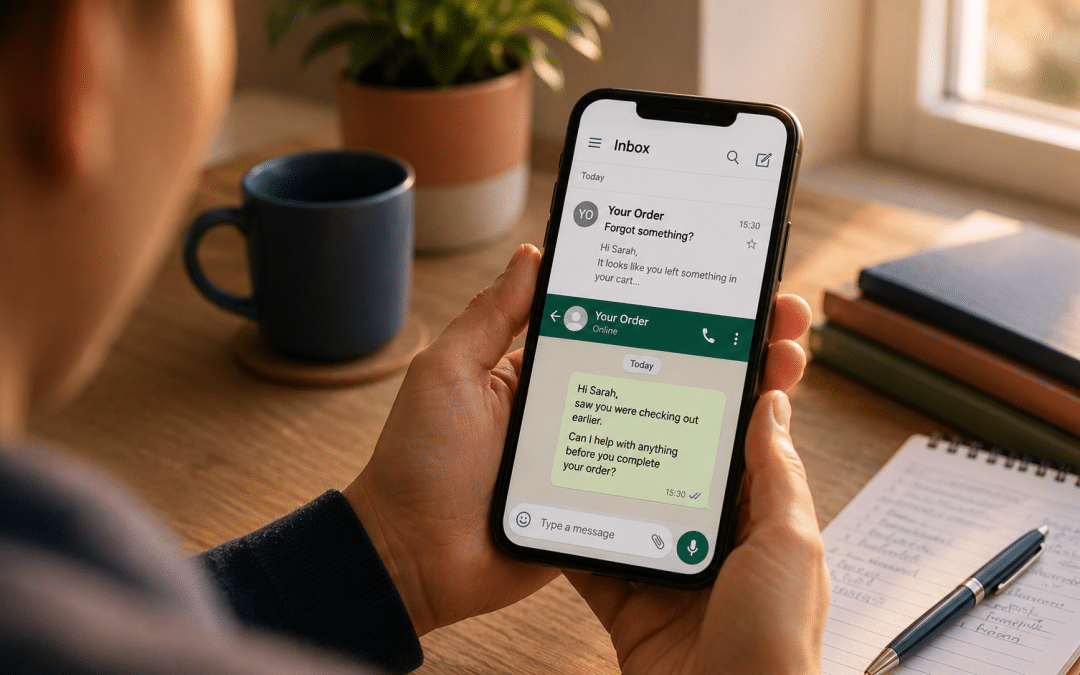
| 4 hours | “Hi [Name], saw you were checking out [item]. Any questions?” | |
| 12 hours | Email (Klaviyo) | Social proof — reviews, ratings, “people who bought this also…” |
| 24 hours | Email (Klaviyo) | 10% discount or free shipping incentive — first concession |
| 72 hours | Email (Klaviyo) | “Last chance” — discount about to expire, urgency framing |
| 7 days | Email (Klaviyo) | Move to “browse abandonment” or “back-in-stock” flow if no recovery |
The WhatsApp touch at 4 hours is the single biggest differentiator for SA stores. It catches shoppers during the early-evening browse window (most SA checkout drop-offs happen 5pm-9pm on mobile), reads as a personal message rather than a marketing blast, and routinely generates a 15-25% reply rate that the email channel cannot match.
The Discount Timing Mistake Most SA Stores Make
Offering a discount in the first email trains the shopper to wait — they learn that adding items and abandoning produces a 10% off code, and the behaviour becomes habit. The right pattern is no discount in the first 12 hours, light incentive at 24 hours, and urgency framing at 72 hours. The discount has to feel earned, not automatic.
The simplest fix for stores currently offering discount-on-first-email: shift the first email to a no-incentive reminder and watch repeat-customer behaviour normalise within 60 days.
The WhatsApp Touch: The SA-Specific Layer
For shopify abandoned cart recovery, the WhatsApp layer requires a chat-commerce platform that integrates with the store and handles the WhatsApp Business API or a WhatsApp Business app workflow. The platforms used in SA include Chatdaddy, Sleekflow, Yappa, Connectly, and Wati — most charging R 400-R 1,500 per month depending on conversation volume.
| WhatsApp Tool | Monthly Cost (ZAR) | SA Fit |
|---|---|---|
| Chatdaddy | R 400 – R 1,200 | Shopify-native integration; widely used by SA stores |
| Sleekflow | R 700 – R 2,500 | Multi-channel; pricier but stronger automation builder |
| Yappa (SA-built) | R 500 – R 1,500 | Local support, ZAR billing, SA-specific templates |
| Wati | R 600 – R 2,000 | WhatsApp Business API; strong for higher-volume stores |
| Connectly | R 1,500+ | Enterprise tier; best for Plus stores running paid acquisition |
For most SA stores under R 500k/month, Chatdaddy or Yappa is the right starting point — Shopify-integrated, ZAR-priced, and template libraries that include working SA win-back messages out of the box. The deeper context on this channel is in our WhatsApp marketing guide for South Africa.
The Real SA Outcome: Before and After
A Cape Town fashion store running on Shopify Basic with the default abandoned-checkout email — and no shopify abandoned cart recovery upgrades — saw the following baseline-to-optimised performance over 90 days after implementing the multi-channel flow above.
| Metric | Before (Default) | After (Optimised) |
|---|---|---|
| Monthly checkouts started | 1,840 | 1,920 |
| Abandonment rate | 71% | 68% |
| Reclaim rate | 4.2% | 15.8% |
| Restored orders/month | 55 | 206 |
| Avg order value | R 680 | R 720 |
| Monthly restored revenue | R 37,400 | R 148,320 |
| Stack cost (Klaviyo + Chatdaddy) | R 0 | R 1,800 |
| Net additional revenue/month | — | R 109,120 |
The net R 109,120/month additional revenue translates to roughly R 1.3 million per year on a tooling spend of R 21,600 annually — a 60x ROI on the stack investment. The math holds for any SA store doing R 200k+ monthly that currently leans on the default email alone.
How Growth Pulse Media Approaches the Shopify Flow
Most agencies install Klaviyo, switch on the default flow, and leave it. We treat shopify abandoned cart recovery as a continuously-tested system — the timing, the discount thresholds, the WhatsApp message templates, and the email subject lines are all rotated quarterly to keep reclaim rates from drifting. Dirk ran this same stack on an SA business of his own, so the recommendations come from operational experience rather than agency theory.
The deliberately limited client load means our senior team stays close to the actual sequence performance — we read the Klaviyo reports, watch the WhatsApp reply threads, and adjust the flow when SA seasonality (load-shedding, Black Friday, payday cycles) shifts buyer behaviour. For stores that want the full system run rather than just installed, our Shopify marketing agency service covers the flow layer alongside the broader programme.
Who This Setup Is NOT For
The multi-channel approach above suits SA Shopify stores doing meaningful volume (~R 100k+ monthly) and selling products with a considered-purchase rhythm. Here is who should look elsewhere first.
Stores under R 50k/month revenue: The Klaviyo and WhatsApp tooling costs (R 1,500-R 2,500/month combined) eat too much margin at this revenue level. Stay on Shopify’s built-in email and optimise the template copy and timing first — usually a 2-3 point recovery-rate lift is available there without spending a Rand on new platforms.
Pure impulse-purchase stores under R 200 AOV: Customers buying low-AOV impulse products often genuinely change their minds rather than getting interrupted. Recovery rates on impulse products run 30-50% lower than on considered purchases, and the WhatsApp touch can feel intrusive. Focus on checkout-friction reduction and Shop Pay enablement before investing in flow automation.
Stores without verified email capture at checkout: The recovery sequence only works if you have the customer’s email and (ideally) WhatsApp number. Stores running guest checkout without email capture lose 60-80% of the win-back opportunity at the data-collection step. Fix the email capture rate first; revisit the flow once you have contactable shoppers.
SA stores unwilling to manage WhatsApp replies promptly: The 4-hour WhatsApp touch generates a 15-25% reply rate — which means real customer conversations land in the inbox within minutes of sending. Stores that cannot respond to inbound WhatsApp messages within 30-60 minutes during business hours should not run the WhatsApp layer. A delayed reply damages the conversation; better to stick with email-only than damage the channel.
Want a frank read on whether your store’s stage and product fit the multi-channel recovery flow yet?
Get a Free Stack Fit CheckOne discipline underpins everything above: do not run shopify abandoned cart recovery as a set-and-forget background process. The flows that produced R 109,120/month additional revenue in the case study were rotated, A/B-tested, and adjusted every 6-8 weeks. Stores that install the sequence and walk away typically see reclaim rates degrade 30-40% over the following six months as shoppers learn the pattern and unsubscribe rates climb.
The right shopify abandoned cart recovery sequence in 2026 is a multi-channel, multi-step, continuously-tested flow that respects the SA inbox reality and the WhatsApp dominance of the local market. Stores that hold that discipline consistently produce 12-18% reclaim rates — three to four times what the default setup delivers, with most of the lift coming from automation that costs less than R 2,000/month to operate.
Frequently Asked Questions
What is a good shopify abandoned cart recovery rate for an SA store?
For email-only using the default Shopify flow, 3-6% is normal. For multi-channel flows (Klaviyo email plus WhatsApp), 12-18% is the realistic range for most SA stores. The top decile of SA store operators hits 22-28% reclaim rates with rigorously tested 5-step flows and aggressive customer-segmentation logic.
Should I use SMS or WhatsApp for cart follow-up in SA?
WhatsApp, almost always. SA customers respond to WhatsApp at 4-5x the open rate of SMS, the cost per message is roughly equivalent, and the conversation can continue naturally if the shopper has questions. SMS is largely redundant in the SA market for this use case — every metric that matters favours WhatsApp.
When should I upgrade from Shopify Email to Klaviyo for multi-step flows?
The breakeven typically sits around R 300-500k monthly revenue. Below that, Shopify’s built-in two-step flow handles enough of the opportunity that Klaviyo’s monthly cost is hard to justify. Above that, the pre-checkout capture (Klaviyo sees add-to-cart events, not just checkout-started) and 4+ step automation produces enough additional recovery to clear the upgrade cost in the first month.
How long should an abandoned cart sequence run in SA?
Seven days, with five touches. The 1-hour and 4-hour touches catch active buyers; the 12-24-hour touches handle the “let me think about it” segment; the 72-hour and 7-day touches close out the discount-led recoveries. Beyond 7 days, the shopper has either moved on or will come back through a different channel; further recovery emails just add unsubscribes.
Does WhatsApp follow-up violate POPIA in South Africa?
No, provided the customer’s WhatsApp number was collected with consent at checkout and the message offers an immediate opt-out path. POPIA section 11 covers legitimate business interest for messaging shoppers who initiated a transaction — an unfinished checkout is exactly that. The compliance gate is the consent at checkout and the response time on opt-out requests, not the WhatsApp channel itself.
What is the right discount level for abandoned cart follow-up emails in SA?
10% off at the 24-hour mark works best for most SA stores — large enough to move price-sensitive shoppers, small enough not to train discount-seeking habits. Free shipping is the alternative when AOV sits below R 800 and shipping cost was the likely friction point. Avoid more than 15% on the first sequence; that level damages margin and creates a “wait and abandon” habit with repeat customers.
Ready to Run a Cart Flow That Actually Converts?
Growth Pulse Media builds shopify abandoned cart recovery flows for SA stores — Klaviyo email layers, WhatsApp 4-hour touches, ZAR-tuned discount thresholds, and quarterly A/B testing built into the sequence. Real operator experience scaling an SA Shopify business, POPIA-compliant consent flows, in-house execution, limited client load. No obligation — we will get back to you within 24 hours with a frank assessment of where your cart flow is leaking the most revenue.
Get Your Free Cart Flow Plan