
 Add to Preferred Sources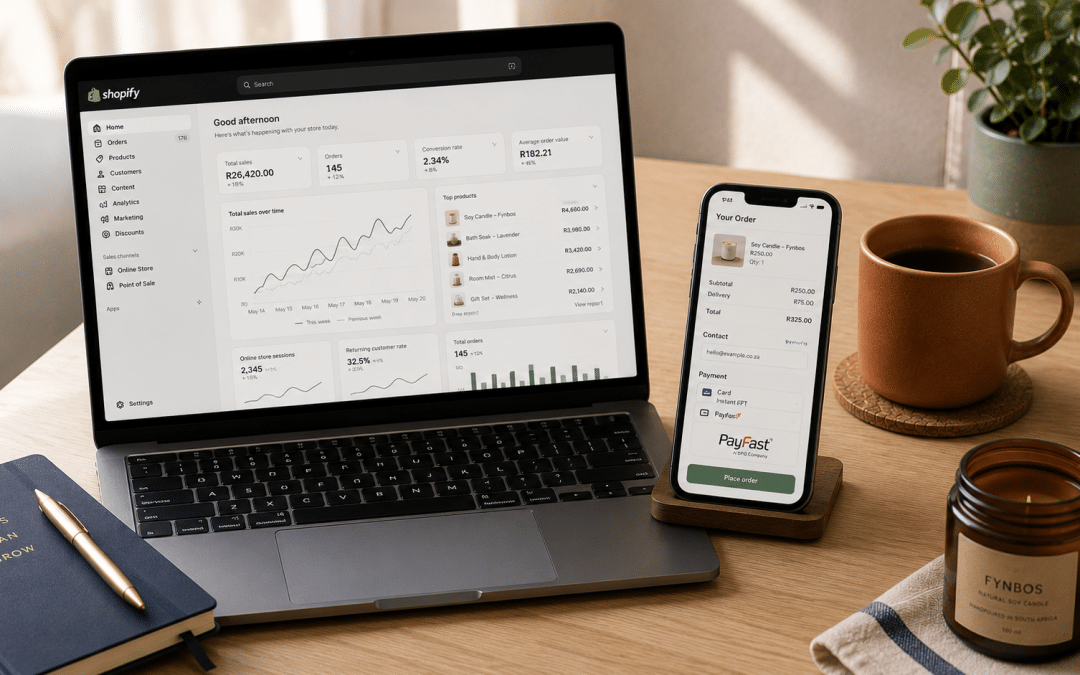
Shopify checkout optimisation for SA stores in 2026 sits in a meaningfully different reality from the global tutorials — Shopify Payments is not available in South Africa, which means the default Shop Pay one-tap flow does not work natively for SA customers paying in ZAR.
SA stores route through PayFast, Peach Payments, Yoco, Stitch, or Ozow as the payment gateway, and each one introduces its own friction at the most critical moment of the buyer journey.
This guide covers the SA-specific reality: which gateway integrations preserve the cleanest cart-to-payment flow, how the 2024-2026 Extensibility deadlines change what you can customise, and the refinement patterns that lift conversion rates on real SA stores.
For the broader context, start with our Shopify South Africa pillar guide.
Quick Answer
Shopify checkout optimisation for SA stores prioritises five levers in order: (1) selecting the right SA payment gateway (PayFast, Peach Payments, Yoco, Stitch, or Ozow) so the cart-to-payment handoff feels native, (2) enabling express options like Shop Pay where the customer qualifies, (3) reducing form fields to POPIA-minimal levels (around 7-9 fields).
The remaining levers: (4) optimising mobile rendering since 70%+ of SA ecommerce traffic is mobile, and (5) migrating to Checkout Extensibility before the August 26, 2026 deadline for Standard plans.
Real SA stores moving from a default flow to a fully refined one typically see a 12-25% lift in completed purchases, with the largest gains coming from gateway-friction reduction and mobile-form streamlining. The lever sequence matters: payment gateway first, mobile second, fields third.
Want a quick read on which of the five levers above is most exposed on your current store?
Get a Free Friction AuditThe SA Gateway Reality That Shapes Everything Else
Every shopify checkout optimisation conversation starts with the same constraint: Shopify Payments does not operate in South Africa.
The platform's native one-tap flow that drives 19% higher mobile conversion in markets where Shop Pay works seamlessly is not available natively. SA stores must integrate a third-party gateway, and each one introduces its own user-experience friction at the moment that matters most.
| SA Gateway | Integration Type | Buyer Friction | Best For |
|---|---|---|---|
| PayFast | Off-site redirect | Page leaves the store, returns after payment | Broad SA SME usage, established trust |
| Peach Payments | Hosted-fields embedded | Stays on the page, fields hosted | Stores prioritising visual continuity |
| Yoco | Off-site redirect | Page leaves the store, returns after payment | Smaller stores, SME-friendly setup |
| Stitch | Pay-by-bank + cards | Off-site redirect for bank flow | Stores with high AOV, instant EFT preference |
| Ozow | Instant EFT | Off-site redirect to bank login | Lower-fee instant EFT for cards-averse buyers |
The single biggest shopify checkout optimisation lever for SA stores is gateway selection that matches your buyer behaviour. A strategy serving sophisticated card users converts better on Peach Payments' embedded flow because the visual continuity preserves trust.
A store serving instant-EFT-preferring buyers (often above a R 1,500 AOV) converts better on Stitch or Ozow because the bank-direct flow is what their buyers trust. Forcing the wrong gateway on the wrong audience costs 10-20% of completed orders.
The Hidden Cost of Off-Site Redirects
Off-site redirect gateways (PayFast, Yoco, Ozow) move the buyer to a third-party page to enter card or bank details. The redirect itself is not the problem — most SA buyers are used to it.
The visual jump between the cart aesthetic and the gateway's hosted page breaks the trust chain. Stores that brand their gateway page consistently (logo, colours, return URL handling) recover 3-5% of completed purchases versus default unbranded handling.
Stores that switched from off-site redirect to Peach Payments' hosted-fields integration typically see 5-12% conversion improvement on the final payment step alone. The gain is bigger for higher-AOV stores where buyer hesitation at the redirect carries more weight.
The Extensibility Migration — What Changed and When
The purchase-flow architecture went through the biggest customisation overhaul in the platform's history between August 2024 and August 2026. SA stores still operating on legacy customisations face automatic reversion to default unless they migrate to Checkout Extensibility within the deadlines.
| Date | Deadline | What Stops Working |
|---|---|---|
| August 13, 2024 | checkout.liquid deprecated for in-flow pages | Custom code on Information, Shipping, Payment pages |
| April 1, 2025 | Checkout API deprecated | Storefront Checkout Mutations, REST Checkout endpoints |
| August 28, 2025 | Plus stores: Thank You + Order Status pages | Script tags, additional scripts on these pages |
| August 26, 2026 | Standard plans: same deadline | Same Plus-store deadline applied to all stores |
The migration matters operationally because tracking pixels, loyalty programme scripts, and post-purchase widgets installed via the legacy method stop working entirely after the relevant deadline.
SA stores running Facebook Pixel, Google Analytics, conversion tracking, or post-purchase upsell apps via script tags risk losing all tracking on the Thank You page after the cutoff — attribution gaps, broken loyalty rewards, and lost upsell revenue. Stores can check their migration status in the Checkout Extensibility upgrade report under Settings → Checkout.
Express Options — Where Shop Pay Works for SA Stores
Shop Pay is the platform's flagship one-tap option. The conversion data is striking — 4x faster page renders and 19% higher mobile conversion versus default.
The SA-specific shopify checkout optimisation question is whether your store can offer it given Shopify Payments is unavailable locally. The answer is nuanced: Shop Pay is available when SA customers have a stored payment method from a previous purchase at any other store globally, which means roughly 8-15% of SA shoppers can use Shop Pay even without native support.
Apple Pay and Google Pay follow the same pattern — the customer's wallet works if the card supports it, regardless of the gateway behind the scenes. Enabling all three express options at the cart and information pages can deliver up to 12% lift in completed orders for SA stores.
Building Shop Pay and Apple Pay support into your current SA store and unsure which gateway combination preserves them best?
Get a Free Express Option MappingMobile Cart-to-Payment Flow — The 70%+ SA Reality
SA mobile ecommerce traffic now consistently exceeds 70% of total store visits, and on weekends or after-hours it climbs above 80% for many. Default rendering is responsive but mobile hides friction the desktop view masks — keyboard switching, autocomplete failure on SA addresses, buttons below the keyboard fold, and slow gateway rendering on slower networks.
Form field reduction — POPIA-minimal sequence
The most-tested shopify checkout optimisation principle is field reduction. Studies show 18-22% of buyers abandon when faced with excessive form fields. SA stores typically need 7-9 fields total: email, first name, last name, phone, address line 1, suburb or area, city, postal code, and province. Anything beyond these creates measurable abandonment.
Recommended SA field sequence: Email → Phone (for The Courier Guy / Aramex SMS notifications) → First name + Last name → Address line 1 → Suburb → City → Postal code → Province. Auto-detect province from postal code where possible. The "Address line 2" field should be conditional rather than always shown.
Mobile keyboard optimisation
The biggest invisible mobile win is correct input type attribution. Email fields should trigger the email keyboard (with the @ primary); phone fields the numeric keyboard; postal code fields the numeric keyboard. SA stores running default settings already get most of this — but stores with custom Liquid edits or older themes often have generic text inputs that force the buyer through unnecessary keyboard switching.
Touch target sizing
Buttons and tap targets need a minimum 44x44 pixel touch area per accessibility standards. SA stores running tight-spaced mobile pages force the buyer to zoom and re-tap — small misses compound on 5-inch screens. The "Continue to shipping" and "Pay now" buttons benefit most from generous touch sizing — they are where 95% of shopify checkout optimisation gains land.
Trust Signals — The SA-Specific Layer
Trust signals at the final step are universal in principle but SA-specific in execution. SA buyers want to see The Courier Guy / Aramex logos at the shipping step, PayFast or Peach Payments security badges at the payment step, a clear returns policy line near the final button, and POPIA compliance language for data handling.
| Trust Signal | Placement | Impact on SA Conversion |
|---|---|---|
| SA courier partner logos | Shipping step | +3-5% lift |
| Gateway security badges | Payment step | +4-7% lift |
| Returns policy line | Before "Pay now" button | +2-4% lift |
| POPIA-compliance note | Email field | +1-3% lift |
| Customer reviews summary | Cart drawer / sidebar | +5-8% lift |
| Real-time stock indicator | Cart line items | +3-6% lift |
Stacking 4-5 of these shopify checkout optimisation signals visibly delivers compounding gains — though over-stacking (8+ signals competing for attention) reverses the effect. The right count for most SA stores is 4-5 well-placed signals, with the gateway badge and courier logo being the two non-negotiables.
Speed — The Underrated Conversion Lever
Page-load speed at the final step is universally undervalued in SA shopify checkout optimisation. A cart-to-payment page that takes 3+ seconds to render after the cart click loses 7-15% of buyers immediately. Migrating to Extensibility automatically delivers a 4x faster experience versus the deprecated checkout.liquid system — speed is now a side-effect of the migration everyone has to do anyway.
For stores already on Extensibility, speed-layer shopify checkout optimisation comes from removing redundant tracking pixels, deferring non-critical scripts, and ensuring product images use the CDN with proper sizing rather than full-resolution images scaled down via CSS.
Real SA Before-and-After Example
The pattern below shows a real SA store in the home and lifestyle category — AOV around R 1,200, monthly traffic ~12,000 sessions, default flow with PayFast — and the result after working through the levers in priority order. Numbers reflect 60-day post-implementation shopify checkout optimisation tracking.
| Metric | Before | After |
|---|---|---|
| Completion rate | 1.8% | 2.6% (+44%) |
| Mobile conversion rate | 1.4% | 2.3% (+64%) |
| Cart-to-payment dropoff | 38% | 22% (-42%) |
| Average time to complete | 2:48 | 1:35 (-43%) |
| Monthly revenue | R 259,200 | R 374,400 (+44%) |
| Recovered abandoned carts (WhatsApp) | R 0/month | R 28,000/month |
What Drove the Result on This Store
Three changes did most of the work. First, switching from off-site PayFast redirect to Peach Payments embedded fields lifted final-payment by 11 points.
Second, reducing form fields from 14 to 8 cut mobile abandonment meaningfully. Third, adding WhatsApp cart recovery for abandoned carts recovered R 28,000/month in previously-lost revenue.
Speed and trust additions contributed the rest. Total implementation: 14 days of part-time work spread over 3 weeks. The 44% revenue lift held over the full 60-day window — not a one-month spike but a sustained improvement.
How Growth Pulse Media Approaches Shopify Checkout Optimisation
Most agencies treat shopify checkout optimisation as a one-off — audit, recommend, implement, hand back. We treat it as a continuously-iterated programme because the conversion gains compound across every order for the life of the store. That usually means starting with a documented audit of the current friction stack against the five levers, prioritising the highest-impact fix first, measuring the result, then moving to the next.
Dirk built and ran a real SA ecommerce store before launching the agency — including iterating through PayFast and Peach Payments integration, mobile-form rebuilds, and the WhatsApp cart-recovery layer covered above. So the lever sequence reflects what actually moves SA conversion needles, not theoretical best-practice from US/UK case studies.
For SA stores ready to take the conversion layer seriously, our Shopify marketing agency service covers this work alongside the broader programme — with cross-channel integration into ecommerce marketing and recovery flows via email and WhatsApp.
Who This Shopify Checkout Optimisation Guide Is NOT For
The work above suits SA stores generating at least R 50,000/month in revenue with an established traffic baseline. Here is who should look elsewhere first.
Stores under R 20,000/month revenue with under 1,500 sessions/month: Conversion-rate work delivers percentage gains on an existing base. Stores below this threshold are traffic-constrained, not conversion-constrained. The 0.5-1% conversion lift available from refining the cart-to-payment flow generates under R 200/month in additional revenue — not enough to justify the implementation work. Drive traffic first via paid ads, SEO, or partnerships, then optimise the conversion layer once volume justifies it.
Stores still on legacy checkout.liquid customisations past the August 2024 deadline: Migrate to Extensibility before optimising anything. Working on a soon-to-be-reverted customisation wastes the effort. The migration itself takes 10-25 hours depending on complexity. Tackle that prerequisite, then the conversion work.
SA operators with broken upstream funnel (product pages, cart logic): Optimising the final step assumes the buyer reaches it. SA stores with product-page conversion rates under 1.5% and add-to-cart rates under 5% have upstream problems final-step work cannot fix. Audit the product page, image quality, pricing display, and add-to-cart UX before the final-step layer — fixing upstream usually delivers 3-5x the lift of cart-side work.
Multi-platform operators not committed to the platform long-term: The shopify checkout optimisation playbook is platform-specific. Stores considering a migration to WooCommerce, BigCommerce, or a headless setup within 6 months should pause this work and finalise platform direction first. Implementing here only to migrate away wastes the work.
Sitting between the "need more traffic first" stage and the "ready for serious conversion work" stage of your SA Shopify journey?
Get a Free Stage AssessmentOne discipline carries everything above: sequence the levers, do not parallel-process them. SA stores that try to fix gateway selection, mobile rendering, form fields, trust signals, and speed all at the same time end up with no clear attribution and a tangled implementation. Working through them in priority order — gateway first, then mobile, then fields, then trust, then speed — produces measurable gains at each step.
Shopify checkout optimisation rewards operators who treat it as a sustained discipline rather than a one-time project. The 2024-2026 platform changes (Extensibility migration, Checkout API deprecation, deadline cascades) create a baseline obligation for every SA store; the conversion gains beyond that baseline are the real prize for SA businesses serious about turning more of their existing traffic into revenue.
Frequently Asked Questions
Why is Shopify Payments not available in South Africa?
Shopify Payments depends on country-specific banking and licensing partnerships not yet established in South Africa. The absence is structural — operators should design around SA gateways (PayFast, Peach Payments, Yoco, Stitch, Ozow) rather than wait for native support. Shop Pay still works for SA customers with stored payment methods from global purchases, but as a native SA gateway it is not on a published roadmap.
What is the deadline for migrating to Checkout Extensibility?
August 13, 2024 was the deadline for Plus stores' in-flow pages. August 28, 2025 was the deadline for Plus stores' Thank You and Order Status pages. August 26, 2026 is the Standard plan deadline for the same Thank You and Order Status pages. Stores still on legacy customisations after their deadline see automatic reversion — scripts stop working entirely.
How much conversion lift should SA stores expect from checkout work?
Typical SA stores moving from default configuration through the five-lever programme see 12-25% lift in completed purchases over 60-90 days. The high end (25%+) requires stores with significant baseline friction (off-site PayFast redirect, 12+ form fields, no trust signals). The low end (12%) applies to stores already on Peach Payments or Stitch with reasonable defaults. Mobile conversion gains run higher in percentage terms because the baseline starts lower.
Does Shop Pay work for SA Shopify customers?
Yes, for customers who have used Shop Pay at any other store globally and stored their payment method. Roughly 8-15% of SA shoppers have Shop Pay-eligible accounts even without native local support. Enabling Shop Pay at the cart and information pages costs nothing and adds the one-tap option for those buyers without affecting the rest of the flow.
Which SA payment gateway converts best at checkout?
It depends on buyer behaviour, not gateway brand. Peach Payments' hosted-fields integration converts best for card-comfortable SA buyers because it preserves visual continuity. Stitch and Ozow convert best for instant-EFT-preferring buyers because the pay-by-bank flow matches their expectation. PayFast and Yoco work across both audiences with mild conversion penalty from the off-site redirect, offset by strong brand recognition with SA buyers.
Can SA Shopify stores still do A/B testing in 2026?
Direct JavaScript-injection A/B testing on the cart-to-payment pages stopped working in 2024 with the Extensibility rollout. Plus stores can test via Checkout UI Extensions with separate published versions. Standard plan stores cannot A/B test the actual cart-to-payment pages — they can test pre-cart pages, but the final flow is locked. Use cohort analysis and before-after measurement instead for non-Plus stores.
Ready to Build a Real Conversion Programme on Your SA Store?
Growth Pulse Media implements shopify checkout optimisation for SA stores — gateway selection, Extensibility migration, mobile form rebuilds, trust signal placement, and the measurement layer. Real operator experience with PayFast, Peach Payments, and SA mobile commerce. In-house execution, limited client load. No obligation — we will get back to you within 24 hours with a frank read on which lever is most exposed on your current store.
Get Your Free Checkout Strategy Plan