
 Add to Preferred Sources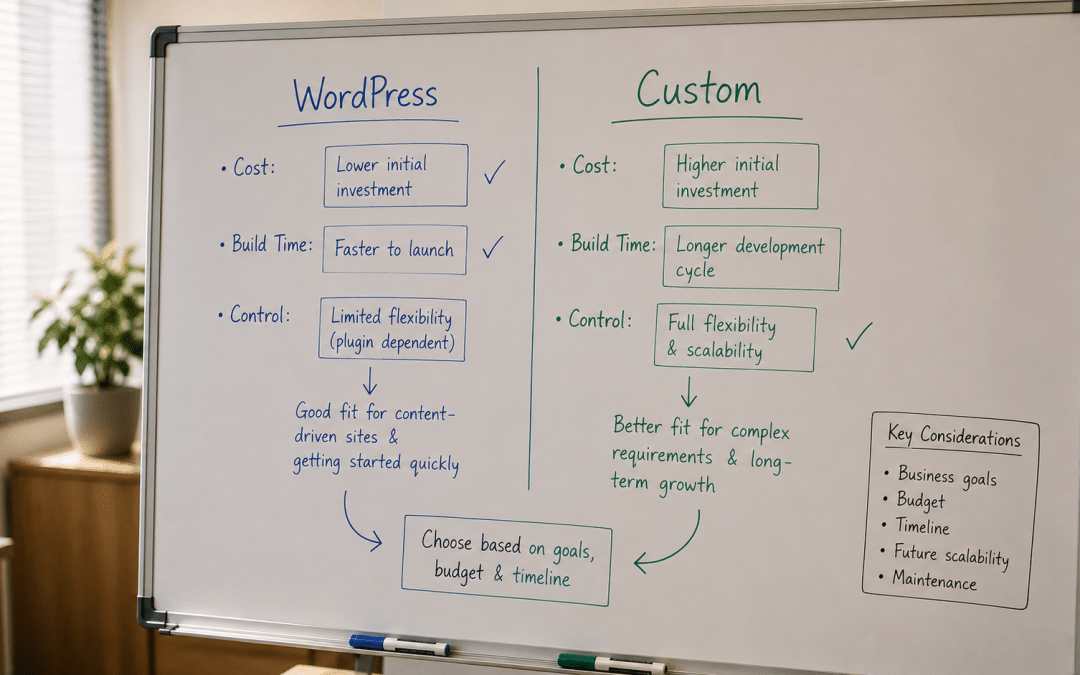
The WordPress vs custom website decision comes down to a simple truth: for most South African businesses, WordPress is the right call, and a fully custom-coded build is only worth its higher cost for genuinely unusual requirements. Both can produce an excellent site — the question is whether your needs justify building from scratch. For the wider build fundamentals, see our web design guide; this page settles the platform-versus-bespoke question.
It helps to be clear on what each option means. WordPress is an established open-source platform with a vast ecosystem of themes and plugins, while a custom website is coded specifically for one business, usually on a framework, with no off-the-shelf foundation. One trades a little flexibility for speed, cost, and ease; the other trades cost and time for total control.
Quick Verdict
For most South African SMEs, WordPress wins — it is faster to build, far cheaper, easy to edit in-house, and more than capable for brochure sites, blogs, and most online stores. A custom build is the right choice only when you need unusual functionality, very high scale, or specific integrations that the platform cannot handle cleanly. If you cannot name that specific reason, WordPress is almost certainly your answer.
Not sure which way your project should go? Let us help you decide before you spend.
Get a Free Platform RecommendationWordPress vs Custom Website: The Comparison at a Glance
The clearest way to weigh the WordPress vs custom website choice is side by side across the factors that actually drive the decision: cost, build time, control, maintenance, and who can run the site afterwards. The table below sets out where each option genuinely wins, rather than pretending either is best at everything.
| Factor | WordPress | Custom build | Best for |
|---|---|---|---|
| Upfront cost | Lower | Much higher | WordPress |
| Build time | Weeks | Months | WordPress |
| In-house editing | Easy, no developer | Usually needs a developer | WordPress |
| Total design control | High, within the platform | Absolute | Custom build |
| Unusual functionality | Plugin-dependent | Built to spec | Custom build |
| Ongoing maintenance | Updates and plugins | Developer-reliant | Depends |
The pattern is consistent: the open-source platform wins on cost, speed, and independence, while a bespoke build wins on absolute control and one-off functionality. Most businesses value the first set far more than the second, which is exactly why the platform dominates the web.
What WordPress Is and Who It Suits
WordPress is an open-source content management system that powers a huge share of the world's websites, which is the strongest evidence of how well it serves ordinary business needs. According to W3Techs usage statistics, it runs around 43% of all websites and roughly 60% of those built on a CMS, while only about 28% of sites use no CMS at all — the hand-coded and custom corner of the web.
That dominance brings practical advantages. A massive ecosystem of themes and plugins means most features already exist, builds are quick and affordable, and the skills are easy to hire — every second SA agency and freelancer knows the platform. Crucially, a non-technical owner can update content, prices, and pages without paying a developer for every change.
It suits the vast majority of businesses: service companies, professional practices, content sites, and most online stores via WooCommerce. If your requirements are common ones — a credible site, a blog, lead capture, or a standard shop — the platform does the job at a fraction of the cost and time a bespoke build would demand.
Why WordPress Suits Most Businesses
WordPress wins for most SA businesses because it is cheaper, faster to build, and editable in-house, with a plugin for almost everything and developers easy to find. It powers around 43% of the web for a reason. Unless you have a specific need it cannot meet, the platform delivers a professional site without the cost and lock-in of building from scratch.
Want a fast, editable WordPress site that you actually own and control?
Get a Free Website QuoteWhat a Custom Website Is and Who It Suits
A custom website is built from the ground up for one business, with code written to its exact specification rather than assembled from existing themes and plugins. That delivers absolute control over every detail and no reliance on third-party plugins — but at a much higher cost, a far longer timeline, and an ongoing dependence on the developer who built it.
That trade-off is worth it in specific cases. Businesses with genuinely unusual functionality, very high traffic and scale, complex integrations with internal systems, or strict performance and security requirements may find that no off-the-shelf approach fits. For them, a bespoke build is an investment in capability the platform simply cannot provide cleanly.
The risk is choosing custom without that clear reason. A bespoke site costs far more, takes longer, and often leaves the owner unable to make a simple change without going back to the developer. Paying for absolute control you do not need is one of the more expensive ways to build a website in South Africa.
When Custom Is Genuinely Worth It
A custom build is the right choice only when you can name a specific reason the platform cannot meet — unusual functionality, very high scale, complex integrations, or strict security needs. Absent that, custom means paying far more, waiting far longer, and depending on one developer for every change. The control is real, but most businesses are buying control they will never use.
The Real Cost and Time Difference
The cost gap between the two approaches is the factor that decides most projects. A professional WordPress build typically lands in the lower-to-mid five figures in Rand, while a genuinely custom-coded site usually starts well into six figures and takes months rather than weeks. That difference is rarely marginal — it often runs to several times the price for the same practical result. The detailed ranges are in our web design pricing guide.
For a business weighing the spend, the question is what that extra money buys. If a custom build delivers functionality that directly drives revenue, it can be money well spent. If it merely delivers a site that looks much like a well-built WordPress one would have, the premium is wasted — a common and costly website design mistake covered in our mistakes guide.
A Real-World Example: Choosing Right vs Wrong
The clearest illustration is a representative SA business that commissioned an expensive custom build for a standard brochure-and-enquiry site, then rebuilt on WordPress after struggling to update it. The custom version cost far more and could not be edited in-house; the WordPress rebuild did the same job, cost a fraction, and the team could finally manage it themselves.
| Metric | Before — over-spec custom build | After — fit-for-purpose WordPress | Change |
|---|---|---|---|
| Build cost | R180,000 | R45,000 | −75% |
| Build time | 5 months | 4 weeks | −80% |
| Cost per content edit | Developer call-out | Free, in-house | Eliminated |
| Time to publish a page | Days, via developer | Minutes, in-house | −95% |
The point is not that custom is bad — it is that custom was the wrong fit for a standard need. The business paid a large premium for control it never used, then spent again to get a site it could actually run. Matching the approach to the requirement, not the other way round, is the whole decision.
Match the Build to the Need
The expensive mistake is choosing custom for a standard requirement — paying a heavy premium for control the business never uses, then rebuilding on WordPress anyway. The right approach is decided by the need: common requirements suit the platform, genuinely unusual ones may justify a bespoke build. Get that match right and the budget goes to results, not to capability nobody will use.
Which Should a South African Business Choose?
The decision becomes simple once you frame it as one question: is there a specific thing your website must do that an established platform cannot handle cleanly? If you can name that thing — and it is real, not just a preference — a custom build deserves consideration. If you cannot, the platform is your answer, and the budget is better spent on design, content, and getting found.
For the overwhelming majority of local businesses, the honest answer is that there is no such requirement. A service business, a practice, a content site, or a standard online store is exactly what the open-source platform was built for. Choosing bespoke in those cases adds cost and delay without adding anything a visitor or the bottom line will ever notice.
A useful test is to imagine explaining the choice to whoever pays the bill. "We built custom because we needed something no plugin could do" is a sound reason. "We built custom because it sounded better" is not. If your justification is the second kind, the money is better invested in a well-built site you own, can edit, and can grow over time.
The GPM Differentiator
Most agencies have a built-in bias in the WordPress vs custom website debate — custom shops push custom because it bills more; template shops push templates because they are quick. We come at it from an operator's seat, having scaled SA businesses where the budget had to produce returns — so our web design services start with your actual requirement and recommend the approach that fits, even when it is cheaper.
For most clients that means a well-built WordPress site they own and can edit themselves, with local payment and courier integrations and proper SEO foundations. When a project genuinely needs custom work, we say so — and when it does not, we will not sell you control you will never use. You own the site, the domain, and the platform, with no lock-in.
Who This Guide Is NOT For
This honest, fit-for-purpose view suits most businesses, but not everyone. Being clear about that upfront saves wasted spend — so here is who should read it differently.
Businesses with genuinely unusual, complex functionality. If your site must do something no plugin handles — heavy custom logic, deep system integrations, or extreme scale — the default WordPress answer may not apply, and a custom build could be the right investment. The verdict here is for standard needs, not edge cases.
Anyone choosing a platform on prestige rather than need. If "custom" appeals because it sounds more impressive, that is the wrong reason to spend the premium. A well-built WordPress site is not a downgrade for a standard business — and visitors cannot tell the difference. Buying status, not capability, wastes the budget.
Owners unwilling to maintain any site. WordPress needs occasional updates and plugin housekeeping, and a custom site needs developer attention. If nobody will maintain the site at all, neither approach stays healthy. Decide who owns upkeep before choosing a platform, not after problems appear.
Anyone chasing the cheapest possible quote regardless of fit. The lowest WordPress quote often means a bloated template with no SEO or speed work, while the lowest custom quote can mean an unfinished, unsupported build. Cheapest and right are rarely the same answer, on either platform.
Want an honest answer on which approach actually fits your project? Start free.
Get a Free Platform ReviewFrequently Asked Questions
Is WordPress or a custom website better for a small business in South Africa?
For most South African small businesses, WordPress is the better choice. It is cheaper, faster to build, and editable in-house, and it handles brochure sites, blogs, and most online stores comfortably. A custom build only makes sense when you have a specific requirement the platform cannot meet, such as unusual functionality or very high scale. If you cannot name that reason, WordPress is almost always the right answer.
Is a custom website more secure than WordPress?
Not inherently. WordPress security depends on keeping the core, themes, and plugins updated and using reputable ones, which is straightforward with good maintenance. A custom site has a smaller public attack surface but relies entirely on the developer's coding standards and ongoing support. Both can be secure or insecure — the deciding factor is competent build and maintenance, not the platform itself.
Can WordPress handle a professional, high-quality website?
Yes. WordPress powers around 43% of all websites, including many large, professional brands, so the idea that it is only for hobby sites is outdated. With a quality theme or custom design, proper speed optimisation, and good SEO foundations, a WordPress site is indistinguishable from a custom one to visitors. The platform is a limitation only for genuinely unusual technical requirements.
Why is a custom website so much more expensive?
A custom website is coded from scratch to one specification, so you pay for design, development, and testing of features that already exist as plugins on WordPress. That means far more developer hours, a longer timeline, and ongoing reliance on that developer for changes. The premium is justified when you need capability the platform cannot provide, and wasted when you do not.
Will I be able to update the website myself?
On WordPress, yes — a non-technical owner can edit content, prices, and pages without a developer, which is one of its biggest advantages. On a custom site, most changes usually require the developer who built it, which adds cost and delay. If in-house control matters to you, that difference alone often settles the decision in WordPress's favour.
Do I own the website either way?
You should own your site, domain, and platform regardless of approach. With WordPress that ownership is clear because the platform is open-source and widely supported. With a custom build, confirm in writing that you own the code and can move to another developer — otherwise you risk being locked to one supplier. Ownership is a question to settle before any build begins.
If you are unsure whether your project is a standard case or an edge case, that uncertainty is normal — and it is exactly the question worth answering before you spend. The right approach is decided by your actual requirement, so a short, honest review of what you need usually makes the WordPress vs custom website choice obvious.
Get a Free Platform Recommendation
Tell us what your website needs to do, and we will recommend the right approach — WordPress or custom — with honest reasoning and a clear cost picture, delivered as a one-page recommendation you own outright, with no pressure either way. No obligation — we will get back to you within 24 hours.
Get My Free Platform Recommendation