
 Add to Preferred Sources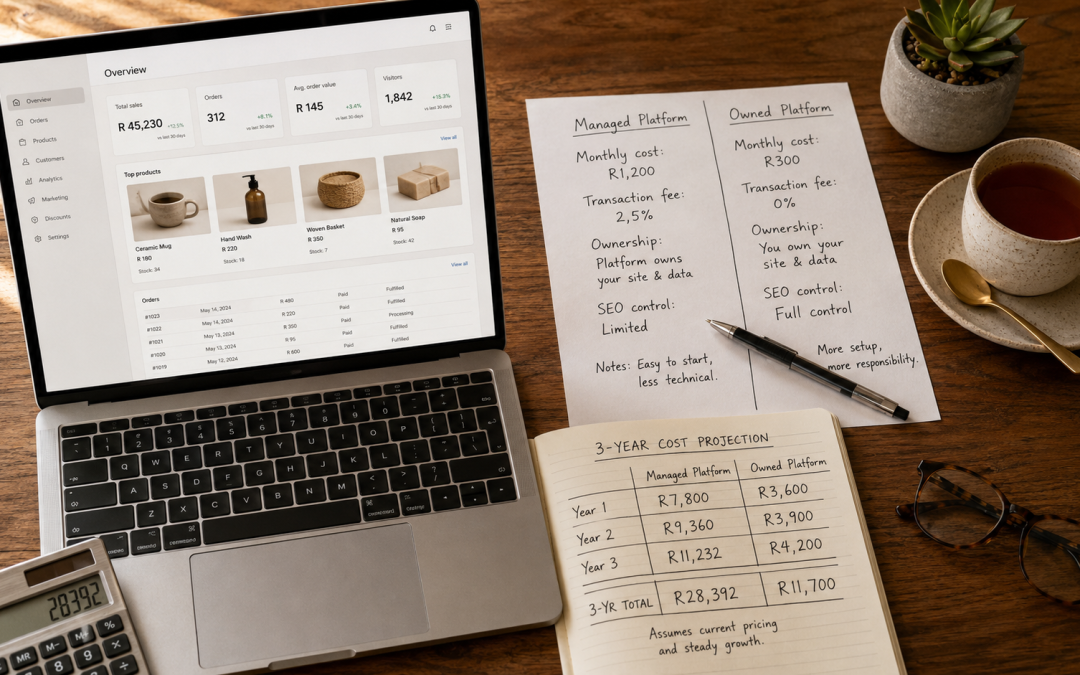
WordPress vs Shopify South Africa is the platform-ownership decision every SA business owner faces before building an online store — and it is not really a feature comparison, it is a choice between renting a managed platform and owning your own. Shopify rents you simplicity, reliability, and support at a recurring monthly cost; WordPress lets you own the platform outright with lower long-term cost and total control, at the price of managing it yourself.
This guide breaks down the real decision across cost, ownership, ease of use, SEO control, and scalability so you can choose correctly the first time rather than rebuilding later. For the broader context, see our complete ecommerce marketing guide for South African businesses, and for the narrower store-engine comparison see our dedicated WooCommerce vs Shopify South Africa comparison.
Quick Answer
The wordpress vs shopify south africa decision comes down to one honest question: do you want to own your platform or rent managed simplicity? Choose Shopify if you are non-technical, want to launch fast, and value predictable monthly cost and 24/7 support over long-term savings — most SA stores can be live in 48 hours. Choose WordPress with WooCommerce if you want to own the platform completely, control long-term cost, and have maximum SEO and customisation flexibility — accepting that setup needs technical skill or a developer. Financially, WordPress almost always wins over three years (often saving R30,000–R60,000 in platform and transaction fees), while Shopify wins on speed-to-launch and zero infrastructure management. Neither is universally better — the right answer depends entirely on your technical capacity, budget structure, and how much you value ownership versus convenience.
Not sure whether WordPress or Shopify is right for your SA business? We will give you a straight recommendation.
Get a Free Platform RecommendationWordPress vs Shopify South Africa: The Core Decision
The wordpress vs shopify south africa decision is fundamentally about ownership versus managed convenience, not about which platform has more features. Both can run a professional, profitable SA online store — the real question is who controls the infrastructure, who carries the management burden, and where the money goes over time.
| Factor | Shopify (Managed) | WordPress + WooCommerce (Owned) | Best For |
|---|---|---|---|
| Ease of setup | Very easy — all-in-one | Moderate — requires configuration | Shopify for speed |
| Monthly platform cost | R730–R7,500+ | R100–R500 (hosting) | WordPress on cost |
| Transaction fees | 0.6–2% on top of gateway | Gateway fees only | WordPress on margin |
| Customisation | Good within theme limits | Effectively unlimited | WordPress on flexibility |
| SEO control | Good, fixed URL structure | Full control via Rank Math | WordPress on SEO |
| SA payment gateways | PayFast, Peach, Yoco | PayFast, Peach, Yoco, PayGate | Tie |
| Support | 24/7 official support | Community plus hired help | Shopify on support |
| Platform ownership | Rented — you never own it | Owned — fully yours | WordPress on ownership |
Why ownership is the real dividing line
Most SA platform comparisons focus on features and miss the structural point. With Shopify you are a long-term tenant — the store works well, but you never own the underlying asset and you pay rent indefinitely. With WordPress you own the codebase, the data, and the hosting relationship outright. For a business intending to build long-term equity, that ownership distinction often matters more than any single feature difference.
WordPress vs Shopify South Africa: True Cost Comparison
The wordpress vs shopify south africa cost comparison consistently favours WordPress for long-term savings, but the headline subscription price is the least important number — the transaction-fee and app-cost structure is where the real divergence happens over time.
Shopify costs
Shopify's official pricing page lists Basic at roughly R730 per month (around R550 on annual billing), the mid Grow tier higher, and Advanced at approximately R5,600 per month at current exchange rates. Because Shopify bills in USD, the rand cost moves with the exchange rate, so the real monthly figure is never fully fixed for an SA merchant.
The bigger cost is structural. Because Shopify Payments is not available in South Africa, every SA store using PayFast or Peach Payments pays an additional Shopify transaction fee — 2% on Basic, 1% on the mid tier, 0.6% on Advanced — on top of the gateway's own fee. Apps compound this further: features that are free WordPress plugins (reviews, advanced reporting, certain automations) are often paid Shopify apps at R200–R900+ per month each.
WordPress with WooCommerce costs
WordPress and WooCommerce are free software. The real costs are hosting (R100–R500 per month for quality shared or VPS hosting), a domain (around R150 per year), and optionally a premium theme as a once-off R1,000–R3,000 purchase. Payment gateways charge their own transaction fee only — there is no platform cut layered on top, which is the single largest long-term cost difference at volume.
The Transaction Fee Blind Spot
The most underappreciated factor in the wordpress vs shopify south africa cost decision is the platform transaction fee, not the subscription. A growing SA store on Shopify Basic paying the 2% platform fee on R200,000 monthly revenue is spending R4,000 per month — R48,000 per year — in fees a WordPress store simply never pays, entirely separate from the payment gateway charge both platforms incur. Upgrading Shopify plans reduces the percentage but raises the fixed monthly fee, so the saving only partially offsets. Over three years at growing volume, the owned-platform route typically retains R30,000–R60,000 more than the equivalent managed setup — money that compounds into the business rather than into platform rent.
Want help modelling the true three-year cost for your specific SA store volume?
Get a Free Platform Cost AnalysisWordPress vs Shopify South Africa: Ease of Use
On ease of use the wordpress vs shopify south africa comparison clearly favours Shopify for non-technical owners — and for many SA businesses this single factor legitimately outweighs every cost argument, because a store that never launches saves nothing.
Shopify is built for people who are not technical. You sign up, choose a theme, add products, connect a gateway, and you are selling. Hosting, security, and updates are handled for you, and official support is available around the clock when something breaks. This is a genuine, defensible advantage, not a marketing claim.
WordPress requires real setup — installing WordPress and WooCommerce, configuring settings, securing the site, choosing and customising a theme, and managing updates. Most SA owners hire a developer for the initial build, then run day-to-day operations themselves. For context on professional setup, see our web design Johannesburg guide. The complexity lives in the build, not the daily use — once configured well, adding products and content is straightforward.
WordPress vs Shopify South Africa: SEO and Long-Term Control
For SEO the wordpress vs shopify south africa comparison favours WordPress for businesses where organic search is a primary growth channel — not because Shopify cannot rank, but because WordPress exposes more of the technical levers that determine SA Google rankings. Whichever platform you pick, our web design service builds fast, mobile-first WordPress and Shopify websites designed to turn visitors into customers.
WordPress with Rank Math gives full control over schema markup, sitemaps, canonical tags, breadcrumbs, redirect management, and completely customisable URL structures. For a business whose growth depends on content and organic search, that control compounds over years. For the broader organic strategy context, see our SEO South Africa guide.
Shopify handles core SEO adequately but forces fixed "/collections/" and "/products/" URL patterns and limits some technical configuration. For a store relying mainly on paid traffic or marketplace-style discovery the limitation rarely bites, but for a content-led SA business it is a real long-term constraint worth weighing honestly.
The Rebuild Cost Nobody Budgets For
The most expensive outcome in the wordpress vs shopify south africa decision is not choosing the pricier platform — it is choosing the wrong one and migrating a live store later. A full Shopify-to-WordPress migration of a trading SA store typically costs R5,000–R15,000 in developer time and carries real risk of damaging established SEO rankings if redirects are mishandled. This is why the decision deserves genuine three-year cost and capacity analysis upfront. The platform that is cheapest to launch on is sometimes the most expensive to leave, and the platform that is slowest to build is sometimes the one you never have to rebuild.
The Before-After Reality for an SA Store
The wordpress vs shopify south africa decision plays out over years, not at launch — the gap between the two paths widens as the store grows. Below is a realistic comparison for an SA store growing from R80,000 to R250,000 monthly revenue over a three-year period.
| Metric | Shopify Managed Path (Before) | WordPress Owned Path (After) |
|---|---|---|
| Time to launch | 2–7 days, no developer needed | 2–4 weeks with developer setup |
| Monthly platform cost (mature) | R3,000–R5,000 with apps | R300–R900 hosting and plugins |
| Platform transaction fee | 0.6–2% on every sale | 0% — gateway fee only |
| Annual fee at R250k/month | R36,000–R60,000 all-in | R6,000–R12,000 all-in |
| SEO technical control | Limited, fixed URL structure | Full control via Rank Math |
| Ongoing management burden | Minimal — Shopify handles it | Self or retained developer |
| Platform asset owned | None — rented indefinitely | Fully owned codebase and data |
| 3-year platform cost | R108,000–R180,000 | R18,000–R36,000 |
The table makes the trade-off honest rather than one-sided. WordPress retains dramatically more cash over three years and hands the business a fully owned asset — but Shopify launches faster and removes the entire management burden. The right choice depends on whether the business values the cash and ownership enough to carry the technical responsibility, or values speed and simplicity enough to pay the long-term premium.
Why GPM Approaches the Platform Decision Differently
Most SA agencies have a default platform they push on every client, usually because it is the one they are fastest at building. That serves the agency, not the client — the right platform genuinely differs by business, and recommending the same one to everyone is a sign the recommendation is about the builder, not the buyer.
Growth Pulse Media builds ecommerce marketing programmes for South African businesses on both Shopify and WordPress, and we make the platform recommendation based on the specific business — its technical capacity, three-year cost model, SEO dependence, and growth plan — not on which platform is convenient for us. We have run stores on both and seen where each genuinely wins and loses in the SA market.
Our typical engagement starts with a short platform audit — modelling the realistic three-year total cost on each platform for the specific revenue trajectory, assessing technical capacity honestly, weighing SEO dependence, and giving a clear recommendation before any build work begins rather than after a costly wrong choice is already live.
Who Each Platform Is NOT For
Being honest about who each platform does not suit prevents the most expensive mistake in this decision — choosing wrong and rebuilding a live store later.
Shopify is NOT for margin-sensitive SA stores at scale. A high-volume store on thin margins paying a 0.6–2% platform transaction fee on top of gateway fees is surrendering meaningful profit every month for convenience it may no longer need. Once a store is established and the team can manage infrastructure, the managed-platform premium becomes pure margin erosion that an owned platform avoids entirely.
WordPress is NOT for non-technical owners with no developer. An SA owner with no technical comfort and no budget for developer setup will misconfigure WordPress security, performance, or payments — turning the cost saving into expensive downtime and lost sales. For this owner the Shopify premium is not waste; it is buying reliability they genuinely cannot self-provide.
Shopify is NOT for content-led SEO businesses. An SA business whose primary growth channel is organic search and content will eventually hit Shopify's fixed URL structure and technical SEO limits. Choosing it for a content-dependent model means accepting a permanent ceiling on the exact channel the business relies on most.
WordPress is NOT for owners who need to launch this week. An SA business needing to be selling within days — a seasonal launch, a campaign deadline, a fast pivot — cannot absorb a 2–4 week WordPress build. Forcing it produces a rushed, badly configured store; Shopify's speed-to-launch is the correct call when the timeline is genuinely the binding constraint.
Want an expert to model which platform fits your specific SA business and budget?
Book a 20-Minute Platform Fit CallFrequently Asked Questions
Questions on the wordpress vs shopify south africa decision that come up most often when SA business owners are choosing a platform and trying to avoid an expensive rebuild later.
Is WordPress or Shopify better for South African businesses?
Neither is universally better — it depends on your priorities. Shopify is better for SA businesses that want simplicity, fast launch, and managed infrastructure with 24/7 support. WordPress with WooCommerce is better for businesses that prioritise platform ownership, long-term cost control, and SEO flexibility.
Both platforms fully support South African payment gateways including PayFast and Peach Payments, so the decision is about ownership, cost structure, and technical capacity rather than local compatibility.
Which is cheaper — WordPress or Shopify in South Africa?
WordPress is significantly cheaper over the long term. Shopify Basic costs approximately R730 per month plus a 0.6–2% platform transaction fee on every sale, so a store doing R200,000 monthly can pay R4,000+ per month in platform fees alone. WordPress hosting costs R100–R500 per month with no platform transaction fee on top of your gateway.
Over three years, WordPress typically saves an SA business R30,000–R60,000 in combined platform and transaction fees, though that saving assumes the business can manage or pay for the technical setup WordPress requires.
Does Shopify work with South African payment gateways?
Yes — Shopify integrates with PayFast, Peach Payments, and Yoco. However, Shopify Payments (Shopify's own gateway) is not available in South Africa, so SA merchants pay both their gateway's transaction fee and Shopify's additional platform fee of 0.6% to 2% depending on the plan.
WooCommerce integrates with all the same SA gateways without any additional platform fee layered on top, which is the core long-term cost difference between the two platforms at volume.
Can I switch from Shopify to WordPress later?
Yes, but migrating a live store involves moving products, customer data, order history, and URL structures, and a full migration typically costs R5,000–R15,000 in developer time. It also risks disrupting established SEO rankings if redirects are not handled correctly.
It is far less disruptive and cheaper to choose the right platform from the start than to migrate a trading store with established rankings later, which is why the upfront decision deserves real analysis rather than a default choice.
Which platform is better for SEO in South Africa?
WordPress with Rank Math gives more SEO control — fully customisable URL structures, complete schema markup control, redirect management, and easier technical SEO configuration. Shopify handles core SEO adequately but forces fixed "/collections/" and "/products/" URL patterns and limits some technical configuration.
For an SA business where content marketing and organic search are primary growth channels, WordPress's SEO flexibility is a meaningful long-term advantage. For a store driven mainly by paid traffic, the difference rarely matters in practice.
Which platform should a brand-new SA store choose?
A brand-new SA store with no technical resources and a need to validate demand quickly is usually better starting on Shopify, because speed-to-launch and zero infrastructure management matter more than long-term cost before product-market fit is proven.
Once demand is validated and the business is committed and able to manage infrastructure, the long-term economics of owning a WordPress platform become compelling — which is why some SA businesses deliberately start on Shopify and move to WordPress once the model is proven and the cost saving justifies the migration.
Get Your Custom Platform Recommendation for Your SA Store
Receive a custom wordpress vs shopify south africa recommendation covering your realistic three-year total cost on each platform, an honest technical-capacity assessment, your SEO dependence, and a clear build recommendation — configured with PayFast or Peach Payments, SA courier integration, and email automation from day one. Built by operators who run SA stores on both platforms, not by an agency pushing its default. No obligation — we will get back to you within 24 hours.
Request Your Custom Platform Plan