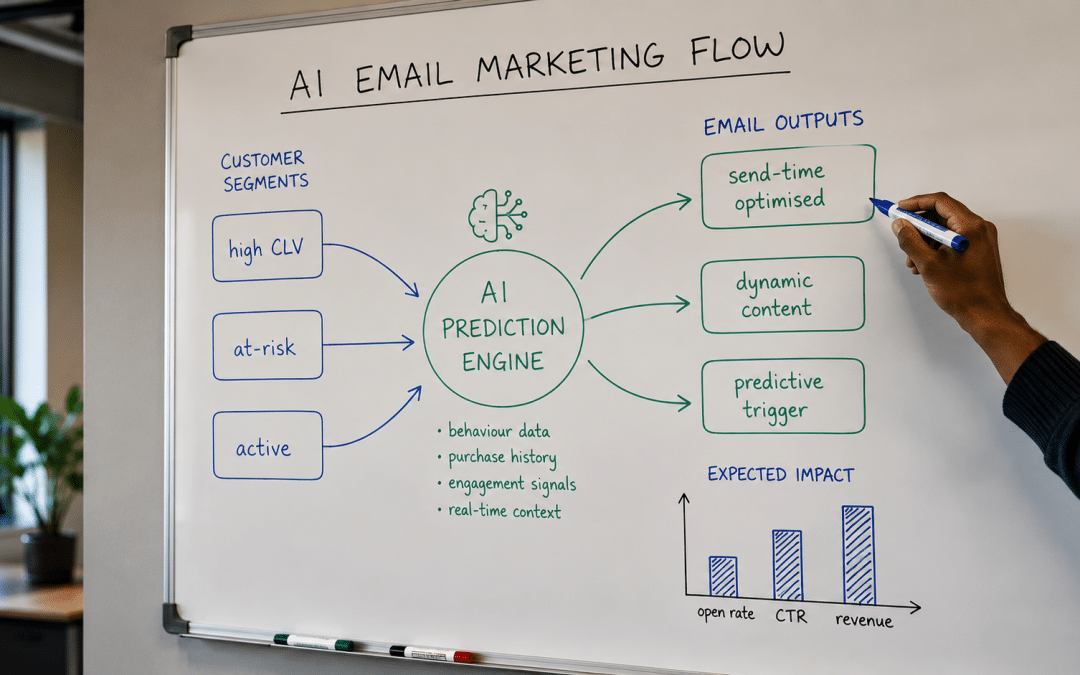
AI email marketing in South Africa is the use of machine learning models to predict customer behaviour, generate personalised content, and optimise send timing for each individual subscriber — moving SA brands from batch-and-blast campaigns to one-to-one messaging at scale. Where rules-based automation triggers on fixed events, AI-driven email adapts dynamically based on predicted customer signals like churn risk, expected next order date, and lifetime value.
This guide breaks down how AI-powered email works for South African businesses, which AI features actually move revenue (versus marketing-checkbox features), and how to deploy AI personalisation without violating POPIA. For the broader cluster, start with our complete email marketing guide for South Africa.
Quick Answer
AI email marketing for SA businesses delivers measurable revenue in three areas: predictive analytics (estimating next order date, churn risk, lifetime value per customer), send-time optimisation (calculating each subscriber's individual best-send window instead of a global blast time), and dynamic content personalisation (rendering different product blocks, offers, or images based on AI-predicted preferences).
Real SA outcomes from properly deployed AI features: 15-30% revenue lift from flows, 20-40% improvement in open rates from send-time optimisation, and 3-5× higher click-through on AI-personalised product blocks versus static content.
Want a free audit of which AI email marketing features would deliver fastest in your specific SA business?
Get a Free AI Email AuditWhat AI Email Marketing Actually Means in 2026
AI email marketing means using machine learning models — not just rules-based automation — to make per-subscriber decisions about content, timing, segmentation, and offers. The distinction matters because most SA marketing teams already run "automated" emails (welcome flows, cart recovery, post-purchase sequences), but those are rules-based not AI-based. Rules-based automation fires on triggers you defined. AI email marketing fires on predictions the model generated.
Practical example: rules-based automation sends a replenishment reminder 30 days after purchase to every customer. AI email marketing sends a replenishment reminder 2 days before each individual customer's predicted next-order date — which might be 18 days for a frequent buyer and 47 days for an occasional one. Same flow, dramatically different revenue outcome because the timing is calibrated to the person rather than the calendar.
The four AI capabilities driving real revenue for SA email programmes in 2026: predictive analytics, send-time optimisation, dynamic content personalisation, and AI-assisted content generation. The first three are revenue-additive. The fourth is mostly a time-saver, sometimes a quality risk.
Predictive Analytics: The Highest-Leverage AI Email Marketing Feature
Predictive analytics is where AI-driven email produces the most measurable revenue lift for SA businesses. The model uses each customer's order history, browse behaviour, and engagement signals to generate per-customer forward-looking metrics: predicted next order date, expected lifetime value, churn risk score, and historic average time between orders.
These metrics replace shared campaign-calendar logic with per-customer cadence logic. According to Klaviyo's predictive analytics documentation, brands that adjust replenishment flows to fire on predicted next-order-date instead of fixed intervals consistently see 20-30% revenue lift from those flows. For SA ecommerce stores with 1,000+ active customers, that translates to R 15,000-R 60,000/month in incremental revenue from a single flow change.
| Predictive Metric | What It Predicts | How AI Email Marketing Uses It |
|---|---|---|
| Predicted next order date | The week each customer is likely to reorder | Time replenishment emails to land 2-3 days before the predicted date |
| Predicted CLV | Forecast revenue per customer over 365 days | Segment VIP campaigns to top-predicted-CLV customers only |
| Churn risk score | Probability a customer will lapse | Trigger win-back campaigns before customers actually churn |
| Average time between orders | Personal purchase rhythm | Validate predicted-order-date and pace replenishment cadence |
Why Predictive Analytics Outperforms Rules-Based Automation
Rules-based automation treats all customers identically — a 30-day post-purchase email goes to everyone, regardless of whether they typically reorder in 15 days or 60. Predictive analytics breaks that pattern by making timing a function of individual behaviour.
For SA ecommerce stores, the lift compounds because timing relevance also lifts inbox-placement signals — emails arriving when customers are mentally ready to buy get higher engagement, which improves deliverability for all future sends.
Send-Time Optimisation: AI Email Marketing's Easiest Revenue Win
Send-time optimisation is the AI email feature most SA businesses underuse despite being one of the easiest to activate. Instead of sending campaigns at a global best-send time (the platform default, usually Tuesday 10am), the AI calculates each subscriber's individual best-open-window based on their historical email-open behaviour and sends each subscriber's copy at their personal optimal time.
The lift is real but bounded: typical results in SA show 15-25% improvement in open rates and 10-20% improvement in click-through compared to global send-time campaigns. The catch: send-time optimisation only works when you have at least 6 months of engagement history per subscriber. New lists or recent migrations need that data accumulation window before the AI has enough signal to predict accurately.
Want us to identify which AI email marketing features your platform already includes that you are not using?
Get a Free Platform AuditDynamic Content Personalisation: The AI Email Marketing Feature With the Highest Ceiling
Dynamic content personalisation is where the AI personalisation revenue ceiling is highest, but execution complexity is also highest. Instead of sending the same email to your full segment, the AI renders different product blocks, hero images, subject lines, or offers per recipient based on predicted preferences derived from browse history, past purchases, and behavioural signals.
SA examples that work: a homewares store renders different room aesthetics (modern minimalist vs traditional vs Scandi) per recipient based on past click patterns; a fashion ecommerce store renders product blocks by predicted style preference; a B2B SaaS company renders case-study testimonials matched to the recipient's industry. The shared mechanic: one email template, dynamically populated per recipient.
| Personalisation Level | What It Does | Typical Revenue Lift |
|---|---|---|
| Name + last purchase (basic) | "Hi [name], thanks for buying [product]" | 5-10% |
| Segment-based content | Different content per ICP segment | 15-25% |
| AI predicted preferences | Dynamic product blocks per recipient | 25-50% |
| Full per-recipient generation | Subject, hero, body, CTA all personalised | 40-80% (when executed well) |
AI-Assisted Content Generation: Useful but Lower Priority
AI-assisted content generation — subject line drafts, email body copy suggestions, image alt-text generation — is the AI feature most prominently marketed by platforms but produces the lowest revenue lift. SA marketers using these features report 60-70% time savings on routine content production, which is genuinely useful, but the output usually requires meaningful human editing before it sounds on-brand.
The honest assessment: use AI content generation for ideation and first drafts to compress production time, but do not deploy AI-generated content without human review. SA buyer audiences detect generic AI tone quickly, and the resulting deliverability and engagement penalties exceed the time saved. For South African email programmes, content authenticity matters more than content speed.
Real-World SA Example: AI Email Marketing Deployment Outcomes
Here is how the four AI email marketing capabilities played out in a real SA deployment. A South African homewares and lifestyle ecommerce store with R 720,000/month in revenue and a 32,000-subscriber email list activated all four AI features in sequence over 4 months in late 2025.
| Metric | Before AI Email Marketing | After 4 Months | Difference |
|---|---|---|---|
| Avg open rate (campaigns) | 22.4% | 34.8% | +12.4 pp |
| Avg click-through rate | 2.1% | 4.6% | +2.5 pp |
| Revenue from flows / month | R 84,000 | R 142,000 | +R 58,000/mo (+69%) |
| Replenishment flow revenue | R 14,000 | R 38,500 | +175% |
| Win-back campaign revenue | R 6,200 | R 22,400 | +261% |
| VIP segment AOV | R 880 | R 1,240 | +41% |
| Total email revenue contribution | R 184,000 (26%) | R 268,000 (37%) | +R 84,000/mo |
The R 84,000/month total revenue lift came primarily from three of the four features. Predictive analytics drove the replenishment flow lift. Send-time optimisation drove the open-rate improvement. Dynamic content personalisation drove the VIP-segment AOV lift. AI content generation contributed roughly 4 hours/week of production time savings but no direct revenue impact.
What the SA Deployment Outcomes Teach
The features that drove most of the lift were the ones operating on data the store already had — order history, browse signals, engagement patterns. AI email marketing does not invent value; it extracts value from data that batch-and-blast email leaves on the table.
Stores with rich behavioural data (1,000+ active customers, 6+ months history) see lift fastest. Stores with thin data (under 500 active customers, under 3 months history) see minimal lift because the AI lacks signal to predict against.
How Growth Pulse Media Deploys AI Email Marketing for SA Businesses
Most SA email marketing agencies activate AI features piecemeal — turn on subject-line AI here, switch on send-time optimisation there, declare the platform "AI-powered." We approach it differently because Dirk scaled his own SA ecommerce business before starting Growth Pulse Media, so we know which AI features actually move SA revenue versus which ones are platform marketing.
Every AI deployment we run starts with a data audit: how much engagement history exists, how clean is the customer event data, what segments have enough volume for predictive models to function. Then we sequence activation: predictive analytics first (highest revenue lift), send-time optimisation second (easiest to demonstrate value), dynamic personalisation third (highest ceiling but needs more setup), AI content generation last (productivity gain, not revenue lift).
We work with a deliberately limited number of clients per quarter so every AI email programme gets senior-level attention during the critical setup period. For SA businesses wanting an AI email marketing programme designed and built end-to-end, our email marketing service covers platform setup, data integration, AI feature deployment, and ongoing optimisation.
POPIA and AI Email Marketing: What SA Businesses Must Know
AI-driven email marketing in South Africa operates under POPIA, which has specific requirements that differ from US/EU AI marketing playbooks. The Information Regulator's POPIA Code of Conduct requires that automated decision-making with significant impact be disclosed to data subjects, and that customers have the right to opt out of profiling.
For email marketing, this matters in three practical ways: AI-based segmentation requires the underlying data collection to be POPIA-compliant (consent-based, purpose-limited, securely stored); predictive scoring outcomes that materially affect what customers see should be transparent in privacy policies; and customers must have a clear opt-out for AI-driven personalisation if they prefer non-personalised content. For the broader compliance picture, see our email marketing compliance for South Africa guide.
Common AI Email Marketing Mistakes SA Businesses Make
Activating AI features before the data layer is clean: AI predictions are only as good as the data feeding them. Stores with duplicate customer records, inconsistent product catalogues, or missing browse-event tracking get poor AI predictions and blame the AI. Audit the data layer first — clean records, single customer view, complete event tracking. Then activate AI features.
Treating AI subject line generation as a deliverability strategy: AI-written subject lines are useful for ideation but should not be deployed at scale without human review. Generic AI tone reduces engagement, which damages sender reputation, which damages deliverability for all future sends. Use AI for first drafts, then edit before sending.
Skipping send-time optimisation because "it sounds too small to matter": Send-time optimisation produces 15-25% open-rate lift with under 30 minutes of setup. The reason it sounds small is the toggle is so simple — but the compounding effect across hundreds of campaigns over 12 months produces R 50,000-R 200,000+ in additional revenue for typical SA stores. Activate it on day one.
Buying expensive AI add-on platforms when the core platform already has AI: Klaviyo, ActiveCampaign, Brevo, and HubSpot all include AI-driven email features in standard pricing tiers. SA businesses sometimes buy third-party AI personalisation tools costing R 4,000-R 12,000/month when the same capability already exists in the platform they pay for. Audit existing platform capabilities first. See our email marketing platforms comparison for AI feature parity.
Who This Guide Is NOT For
AI-driven email is not the right next focus for every SA business. Here is who should look elsewhere first.
Businesses with fewer than 500 active customers or subscribers: AI models need behavioural data volume to predict accurately. Under 500 active records, the predictions are noisy and the lift is minimal. Focus on list growth and basic automation first; revisit AI features once the list crosses 1,000+ engaged subscribers with 6+ months history.
Businesses without basic email marketing fundamentals in place: AI features cannot rescue an email programme with poor deliverability, weak segmentation, or no welcome flow. Build the fundamentals first — proper authentication, segmentation by lifecycle stage, working core flows. AI-driven email features amplify what already works; they do not fix broken foundations.
Businesses prioritising privacy positioning: Some SA brands target customers who actively avoid AI-driven personalisation (privacy-conscious B2B segments, certain professional services). For these audiences, transparent rules-based segmentation may outperform AI personalisation because it matches the buyer's preference. Test before assuming AI wins.
Businesses without bandwidth to monitor AI outputs: AI-driven email features need periodic auditing — segment definitions drift, predicted-CLV calibration changes, send-time models retrain weekly. Without a person responsible for monthly AI-feature review, errors compound silently. Assign ownership before activating.
Not sure if your SA business has the foundations for AI email marketing to work? We will tell you honestly.
Get a Free Foundation CheckFrequently Asked Questions
How much does AI email marketing cost for an SA business?
Most AI email marketing features come standard in mid-tier platform plans. Klaviyo, ActiveCampaign, and Brevo include predictive analytics, send-time optimisation, and AI content generation in plans starting around R 1,200-R 3,500/month for typical SA SMEs. Standalone AI personalisation platforms (Movable Ink, Liveclicker) cost R 8,000-R 25,000+/month and only make sense at enterprise scale.
How long does AI email marketing take to show measurable results?
Send-time optimisation shows results within 14-30 days of activation (once enough sends have generated open-time data). Predictive analytics produces results within 30-60 days as the models train on order history. Dynamic content personalisation needs 60-90 days for behavioural patterns to crystallise. Plan for a 90-day setup window before declaring AI lift; report monthly during that window.
Does AI email marketing replace the need for a copywriter or strategist?
No. AI email marketing automates targeting, timing, and dynamic content rendering, but strategy, brand voice, and campaign concepts still need human input. The most effective SA email programmes use AI for execution (who, when, what to render) and humans for strategy (what to say, how to position offers, brand voice). AI is a multiplier on good strategy; it does not generate strategy.
What platforms have the best AI email marketing features for SA businesses?
For SA ecommerce: Klaviyo has the deepest predictive analytics and is the default for Shopify stores. For B2B: HubSpot has the most mature AI segmentation tied to CRM data. For mid-market generalists: ActiveCampaign offers strong AI features at lower price points than Klaviyo or HubSpot. Brevo (formerly Sendinblue) is the budget option with adequate AI features for under-1,000-contact lists.
Can AI email marketing work for B2B businesses, not just ecommerce?
Yes. B2B email programmes benefit from AI segmentation (clustering accounts by behavioural signals), predictive lead scoring (identifying which leads are most likely to convert), and dynamic content personalisation (rendering case studies and offers per buyer-stage). The mechanics differ slightly — B2B has longer cycles and richer firmographic data — but the principles are identical.
Is AI email marketing safe under POPIA?
Yes when configured properly. POPIA requires consent-based data collection, purpose limitation, and transparent handling of automated decisions affecting customers. AI email marketing platforms can be POPIA-compliant if the underlying data collection is consented, profiling is disclosed in privacy policies, and customers have clear opt-out paths. Working with an SA-aware platform partner accelerates compliance setup.
Ready to Deploy AI Email Marketing That Actually Lifts Revenue?
Growth Pulse Media builds AI email marketing programmes for South African businesses — platform selection, data audit, AI feature activation in sequence, and ongoing optimisation. Real operator experience, in-house execution, limited client load. No obligation — we will get back to you within 24 hours with a frank assessment of which AI features would deliver fastest in your specific business.
Get Your Free AI Email Marketing Plan