
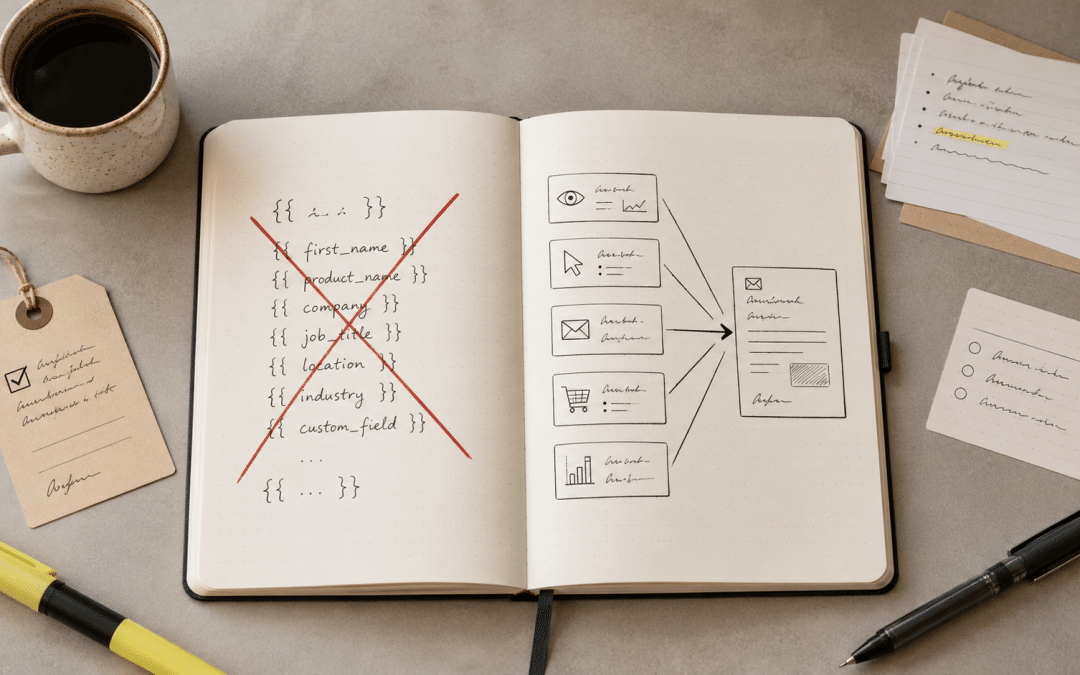
Email personalisation south africa is the practice of tailoring an email's content to the individual recipient based on what you actually know about them. The single most important thing to understand is that real personalisation is behavioural relevance, not putting someone's first name in the subject line.
Most of what SA businesses call personalisation is token theatre: a merge tag that changes nothing about whether the email is relevant. This guide explains what personalisation genuinely is, why the SA context makes the distinction matter more, and how to do it properly, building on our complete email marketing guide for South African businesses.
Quick Answer
Email personalisation means changing what an email says, offers, or triggers on, based on a specific recipient's behaviour, history, or stated preferences — so the message is genuinely more relevant to them, not just stamped with their name. The critical distinction is between token personalisation (inserting "{FirstName}", which is cosmetic and adds almost no relevance) and behavioural personalisation (content driven by what someone actually browsed, bought, or engaged with, which adds real relevance). It depends entirely on data and consent: you can only personalise on what you legitimately know, and in South Africa POPIA governs how that data is collected and used. The expensive mistake SA businesses make is treating a first-name merge tag as "personalisation done" — running cosmetic theatre while the email's content stays identical for everyone, then concluding personalisation does not work when what was tested was never personalisation at all.
Putting first names in subject lines and wondering why "personalisation" did nothing? That is the exact trap.
Get a Free Personalisation ReviewEmail Personalisation South Africa: What It Actually Is
Email personalisation south africa is best understood as relevance driven by data, not decoration applied to a template — changing the substance of the email for the recipient, not just the salutation. The test is simple: if you removed the personalisation, would the email be meaningfully less relevant, or just less decorated?
This distinction is the whole subject of email personalisation south africa. A first-name token passes a cosmetic check but fails the relevance test — remove it and the email is identical in usefulness. A product recommendation based on what someone actually browsed fails gracefully if removed, because it was carrying real relevance.
Personalisation is the second thing; the first is merge-field theatre that has been mislabelled as personalisation for so long that the mislabel is now the default understanding.
According to Klaviyo's framework for behaviour-based email personalisation, genuine personalisation is built on unified behavioural profiles — what a customer viewed, added to cart, or engaged with — that trigger relevant content, rather than on surface attributes inserted into a template. The data is the personalisation; the merge tag is not.
Email Personalisation South Africa: Token Theatre vs Real Relevance
Email personalisation south africa fails most often not because personalisation does not work, but because what was implemented and tested was never personalisation — it was a name stamped on an unchanged broadcast. Naming the two things precisely is more useful than another definition.
Token personalisation changes the label, not the content
Inserting a first name, company, or city is a cosmetic merge: the email's actual content, offer, and relevance are identical for every recipient. It feels personal for a moment and then is not, because nothing about the message was shaped by who the person is or what they did. Tested honestly, it produces small or no gains — and is then wrongly used as evidence that personalisation is overrated.
Behavioural personalisation changes the email itself
Real personalisation changes what the email recommends, triggers on, or says, based on actual behaviour — a follow-up because someone viewed a product, a different offer because of past purchases, a re-engagement because activity dropped. The content genuinely differs by recipient. This is the version that produces the results people attribute to "personalisation" — and it is the version most SA businesses are not actually doing.
If Removing It Changes Nothing, It Was Never Personalisation
The single test that resolves most email personalisation south africa confusion is the removal test: take the personalisation out and ask whether the email became less relevant or merely less decorated. A first-name token removed leaves an identically useful email — proof it was never personalisation, just garnish. A behaviour-triggered recommendation removed leaves a generic email that no longer speaks to what the recipient actually did — proof it was carrying real relevance. This is why so many SA businesses conclude "personalisation does not move the numbers": they tested garnish and drew a conclusion about substance. The discipline is not "add the recipient's name" — it is "change what the email does based on what you genuinely know about this person", and if you cannot point to the thing that would break when removed, you have not personalised anything.
Email Personalisation South Africa: Why Segmentation Is Not the Same Thing
Email personalisation south africa is constantly confused with segmentation, but they are different layers — segmentation is how you group people; personalisation is what you do differently for them once grouped. One is the input, the other is the action.
Segmentation is the prerequisite, not the outcome
Dividing a list into engaged, lapsed, or high-value groups is segmentation — necessary, but on its own it changes nothing the recipient experiences unless the content sent to each group is genuinely different. Segmentation without differentiated content is just sorted inactivity. Our guide to email segmentation for South Africa covers building those groups properly; this post is about what you must then do with them.
Personalisation is what makes the segmentation worth doing
For email personalisation south africa, the point of segmenting is to be able to personalise — to send the lapsed group something different from the engaged group because their relevance needs differ. A business that segments meticulously and then sends every segment the same email has done the hard part and skipped the part that creates the value. Segmentation is the cost; personalisation is the return on it.
Segmenting your list carefully but sending every segment the same email? That is the most common half-finished setup.
Get a Free Segmentation-to-Personalisation AuditEmail Personalisation South Africa: Why the SA Context Sharpens It
Email personalisation south africa carries constraints generic advice ignores — POPIA governs the data it depends on, and the small SA list economics mean there is little room for the volume that masks weak personalisation elsewhere. The local context changes what is both legal and viable.
POPIA governs the data personalisation runs on
Personalisation is only as good as the data behind it, and in South Africa POPIA regulates how that data is collected, stored, and used. Behavioural personalisation built on data gathered without proper consent is not just weaker — it is a compliance risk. Consent-based, transparently collected data is the only sustainable foundation for personalisation here.
Small SA lists punish fake personalisation faster
In a large market, weak token personalisation can hide behind volume. On a smaller SA list there is no volume to hide behind — irrelevant "personalised" mail that is really a broadcast burns engagement on an audience you cannot easily replace. The SA context removes the cushion that lets cosmetic personalisation look acceptable elsewhere.
Personalisation Is a Data Discipline, Not a Template Feature
The reframing that makes email personalisation south africa work is treating it as a consented-data discipline rather than a template feature you switch on. The merge-tag button in any email tool is the feature; it is not personalisation. Real personalisation requires legitimately collected behavioural data, a way to act on it, and the restraint to only personalise on what you genuinely and lawfully know — which in the SA POPIA context is a narrower, more deliberate set than the "collect everything and stamp names on it" model imported from elsewhere. This is why the businesses that win SA email personalisation are not the ones with the fanciest template tags — they are the ones with clean, consented behavioural data and the discipline to let it, not a merge field, decide what each person receives.
Email Personalisation South Africa: Token Theatre vs Behavioural Relevance
Email personalisation south africa produces opposite outcomes depending on whether it is cosmetic token insertion or genuine behavioural relevance — same email tool, two entirely different results. The before-state is the token theatre most SA businesses run; the after-state is real personalisation.
| Dimension | Token Theatre (before) | Behavioural Relevance (after) |
|---|---|---|
| What changes per recipient | Only the name in the greeting | The content, offer, and trigger itself |
| Data required | A name field | Consented behavioural and purchase data |
| Removal test | Remove it, email is identical | Remove it, email loses real relevance |
| Result when tested honestly | Small or no measurable gain | The lift people attribute to personalisation |
| SA viability | Burns small lists with fake relevance | Earns engagement a small list rewards |
For where this fits in the wider system, our guide to how email marketing works in South Africa sets the context, and automated drip sequences are where personalisation most often runs — personalisation is the relevance layer those mechanics exist to deliver.
Email Personalisation South Africa: The Data It Genuinely Needs
Email personalisation south africa is only ever as good as the data underneath it, and most failed personalisation is really a data problem wearing a template problem's clothes. You cannot personalise on what you do not legitimately know — so the real question is what data you have a lawful, reliable basis to act on.
There are three honest data sources. Zero-party data is what someone tells you directly — preferences chosen, a quiz answered, a stated interest — and it is the cleanest because it is explicit and consented by design. First-party behavioural data is what someone does on your owned channels — what they browsed, bought, opened, clicked — and it is powerful precisely because behaviour reveals intent that stated preferences often do not.
The third category is the one to be wary of: inferred or acquired data that was never genuinely consented. It feels like more personalisation fuel, but in the SA POPIA context it is a liability, and personalisation built on it tends to feel intrusive rather than relevant — the recipient senses you know things you were not given.
This is why email personalisation south africa is a narrower, more deliberate discipline locally than the "collect everything" model imported from larger markets. The constraint is not a weakness; it forces personalisation onto the data that actually produces relevance — what people told you and what they genuinely did — rather than the data that merely produces volume.
The hard precondition here is that real personalisation is downstream of legitimately collected data — there is no template feature that manufactures relevance you do not have the data to support. Zero-party and first-party behavioural data are the foundation; inferred or acquired data is a POPIA risk that produces intrusive pseudo-relevance, not the genuine kind.
This is why the businesses that win at email personalisation south africa are not the ones with the most data — they are the ones with the cleanest consented data and the discipline to personalise only on it.
If a personalisation idea requires data you cannot point to a lawful, consented source for, the idea is not blocked by your email tool. It is blocked by the fact that you do not actually know the thing you were about to pretend to know.
How Growth Pulse Media Approaches Personalisation
Most agencies sell personalisation as a feature toggle — turn on merge tags, call it personalised — which is exactly the theatre that produces no result and then gets blamed on the concept. Growth Pulse Media's email marketing work for South African businesses treats personalisation as a consented-data discipline, because the operator reality is that relevance comes from behavioural data acted on properly, not from a name in a subject line.
The operator background behind GPM means personalisation is judged by whether the email's substance genuinely changed for the recipient and whether engagement and revenue followed — not by whether merge tags are switched on. Work is executed in-house, so the people setting up the behavioural triggers are accountable for whether the personalisation actually lifts results, which removes the incentive to ship token theatre and call it done.
Who This Guide Is NOT For
Understanding personalisation properly matters for any SA business doing email, but this guide is not the right focus in several situations, and being honest about that prevents wasted effort.
Businesses with no behavioural data at all. Real personalisation needs something to personalise on. A business that collects only email addresses and no consented behavioural signal cannot do this yet — the prior work is ethical data collection, not template tags.
Operators who only want the first-name tag. Anyone whose definition of personalisation is the merge field will misuse this guide. The whole point is that the token is not the thing — wanting only the cosmetic version is choosing the part that demonstrably does not work.
Businesses unwilling to handle data lawfully. Personalisation in South Africa runs on POPIA-compliant data. A business unwilling to collect and use data with proper consent cannot do behavioural personalisation sustainably — the compliance foundation is not optional here.
Those whose real problem is the offer or list. If emails reach the inbox and the offer simply is not compelling, personalisation will not rescue it. Personalising an unwanted message makes it a precisely targeted unwanted message — the prior fix is the offer, not the relevance layer.
Ready to find out whether your "personalisation" is real or theatre — and what data you would need to make it real?
Get Your Free Personalisation DiagnosisEmail Personalisation South Africa: Frequently Asked Questions
What is email personalisation in simple terms?
Email personalisation is changing what an email says, offers, or triggers on, based on what you genuinely know about the individual recipient — so the message is more relevant to them specifically, not just stamped with their name.
The key distinction is relevance versus decoration. Real personalisation changes the substance of the email; a first-name merge tag only changes the label and adds almost no relevance.
Is putting someone's first name in the subject line personalisation?
Technically yes, but it is the weakest, most cosmetic form — token personalisation. The email's content, offer, and relevance stay identical for everyone; only the greeting changes.
This is why first-name personalisation often shows little measurable gain when tested honestly. It is not that personalisation does not work — it is that a name token was never meaningful personalisation in the first place.
What is the difference between personalisation and segmentation?
Segmentation is how you group your list (engaged, lapsed, high-value); personalisation is what you do differently for each group once segmented. Segmentation is the input; personalisation is the action taken on it.
Segmenting carefully and then sending every segment the same email is the most common half-finished setup — it does the hard preparation and skips the step that actually creates the value.
Does POPIA affect email personalisation in South Africa?
Yes. Personalisation depends on data, and South Africa's POPIA framework governs how that data is collected, stored, and used. Behavioural personalisation built on data gathered without proper consent is a compliance risk, not just weaker marketing.
Consent-based, transparently collected data is the only sustainable foundation for personalisation in the SA context. The data discipline is part of doing this properly, not an optional add-on.
Why does personalisation matter more for small SA lists?
On a large list, weak token personalisation can hide behind volume. A smaller SA list has no volume cushion, so irrelevant "personalised" mail that is really a broadcast burns engagement on an audience that is hard to replace.
The small-list context removes the margin that lets cosmetic personalisation look acceptable elsewhere. Real, relevant personalisation is what a finite SA list actually rewards with engagement.
How do I start doing real personalisation?
Begin with consented behavioural data — what recipients browse, buy, and engage with — and a way to trigger content from it, rather than reaching for the first-name tag. Then change what the email actually does for different behaviours, not just its greeting.
The email personalisation south africa starting point is data and consent, not template features. If you cannot point to the thing that would break when removed, you have not personalised anything yet.
Get an Honest Personalisation Assessment
Growth Pulse Media will tell you straight whether your email personalisation is real behavioural relevance or cosmetic token theatre — and exactly what consented data and triggers you would need to make it genuinely work for a South African list, with the reasoning, not a "switch on merge tags" pitch. Built by operators who judge personalisation by whether the email's substance changed and revenue followed. No obligation — we will get back to you within 24 hours.
Get Your Free Personalisation Assessment