
 Add to Preferred Sources
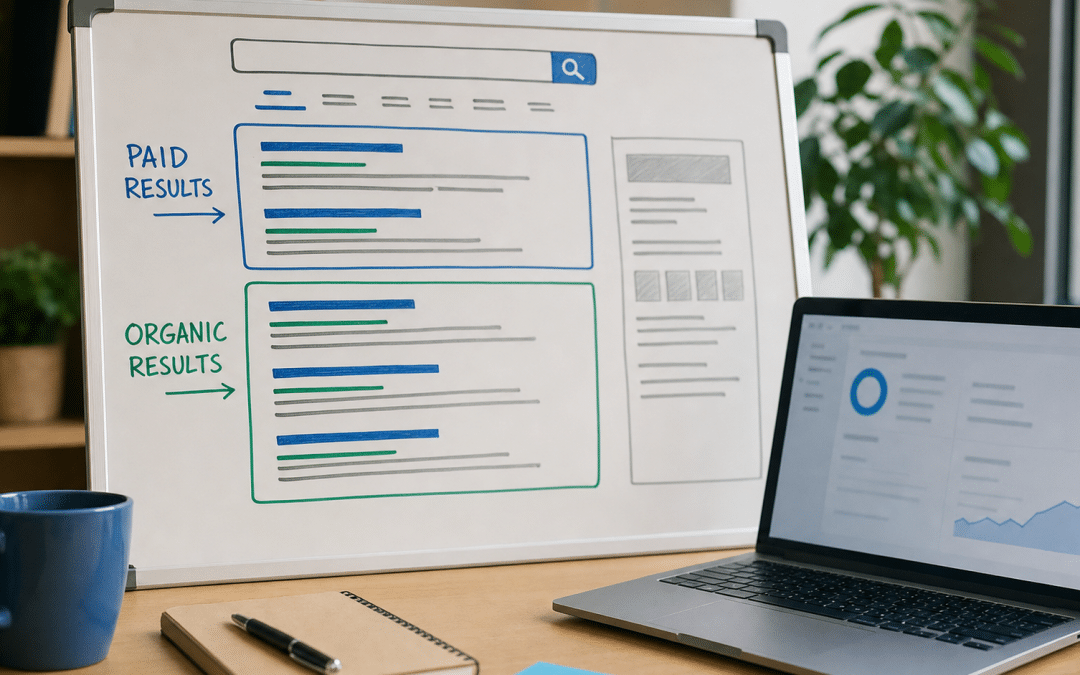
Search engine marketing (SEM) is the practice of increasing a website's visibility in search results, and today the term almost always means paying for that visibility through ads on Google and Bing. Its unpaid sibling is search engine optimisation, covered in our SEO guide for South Africa. This post settles which meaning a supplier probably intends, how the two channels differ, and what a paid click can cost a South African business.
The confusion is real because the term has changed meaning. A proposal that says "SEM" might mean Google Ads only, or Google Ads plus SEO. The table below shows how to tell them apart before you sign anything.
Quick Answer
In current usage, search engine marketing almost always means paid advertising on search results pages: you bid on searches, your ad appears above or below the organic listings, and you pay per click. Some older sources still use SEM as an umbrella that includes SEO, so ask which one is meant. Paid search starts producing clicks as soon as a campaign runs; SEO does not bill per click but takes longer to respond.
Jump to
Not sure whether your site needs paid or organic first?
Send us your website address and your main service, and we will tell you which route fits your goal.
Ask for a Fit CheckWhat Is Search Engine Marketing? Two Definitions in Use
SEM is the work of raising a website's visibility on search results pages, and in current usage that work is mostly paid.
Optimizely's glossary defines it as "a digital marketing strategy used to increase the visibility of a website in search engine results pages" and adds that the term "now refers almost exclusively to paid search advertising" (Optimizely). The same entry notes that SEM is also called paid search or pay per click (PPC).
BruceClay's history of the term explains the split: when Danny Sullivan discussed it in 2001, SEM was an umbrella and both SEO and PPC people worked in it, but the label has since narrowed to paid, and "search marketing" is now the phrase used for paid and organic together (BruceClay).
| Term | What it covers | Where you will see it | What to do |
|---|---|---|---|
| SEM, narrow sense | Paid search ads only: Google Ads, Microsoft Advertising. | Current glossaries and industry writing, such as Optimizely's entry. | Treat it as a media budget plus management, billed per click. |
| SEM, broad sense | Paid ads and organic SEO together. | Older articles, some textbooks and courses. | Ask the supplier to itemise paid work and SEO work separately. |
| Search marketing | Paid and organic together, by the newer label. | Industry writing that wants to be unambiguous. | Use this phrase in your own briefs to avoid the problem. |
| Paid search engine marketing / PPC | The narrow meaning, spelled out. | Reporting, job adverts, quotes. | Best wording for a brief: it is much harder to misread. |
Takeaway
When a quote says "SEM", the working assumption in current usage is paid search, though not in every source. Because older sources use the broad meaning, write "paid search" or "Google Ads" in your own briefs and ask any supplier to list what is included and what is billed per click.
How Is SEM Different From SEO?
In the search engine marketing vs SEO question, SEM pays for placement in the labelled ad slots while SEO earns placement in the ordinary results. The two run on separate systems. Google Ads Help says ads can appear above or below the search results, and Google Search Central says plainly that "Google doesn't accept payment to crawl a site more frequently, or rank it higher" (How Google Search works). Our owner-level explainer on how Google Search works covers the organic side.
| Question | SEM (paid search) | SEO (organic) | Best for |
|---|---|---|---|
| How is placement decided? | An auction on bid and quality, recalculated on every search. | Google's ranking systems; Google says it does not accept payment to rank a site higher. | Paid for control, organic for durability. |
| What do you pay Google? | A charge per click, within your budget. | Nothing per click; the cost is the work to build and maintain pages. | Paid where each click must be justified, organic where volume matters. |
| What happens when you stop? | Ads stop appearing once the campaign is paused or the budget is spent. | There is no campaign to switch off and no per-click bill; results still depend on the page staying live and relevant. | Organic for lasting assets, paid for time-limited offers. |
| How quickly can you test? | Ads can start running once the campaign is live and the platform has approved them. | Google's SEO Starter Guide says "Some changes might take effect in a few hours, others could take several months." | Paid for fast tests of demand. |
The channels also feed each other. A paid campaign shows which search phrases bring enquiries, and that evidence can steer which pages to build for organic results. The full trade-off, with budgets, sits in our SEO vs Google Ads comparison, and the SEO side is defined in SEO meaning explained.
Already paying for clicks and unsure what you get?
Send us your current Google Ads account details and we will show you where spend is going.
Request a Spend ReviewHow Does the Google Ads Auction Decide Who Appears?
The Google Ads auction ranks competing ads by Ad Rank and shows the highest first, and it re-runs for every search. According to Google Ads Help on ad position, the advertiser with the highest Ad Rank takes the top position and the second-highest takes the second, with Ad Rank built from your bid, ad and landing page quality, the search context and other factors.
Four things follow from that for a business owner:
- You choose a maximum bid, not a fixed price. Google Ads Help says the bid is the most you are willing to pay for a click and that what you end up paying "is often less".
- Relevance affects what you pay. The page a click lands on is part of how Google judges your ad, so a vague landing page is a cost problem as well as a conversion problem.
- Your budget is a daily average. Google Ads calculates budgets daily and says that for a monthly figure you multiply the daily budget by 30.4. A single day's spend can reach twice the daily average, but Google says that in a billing period you are "never charged more than 30.4 multiplied by your average daily budget amount".
- Quality Score is a diagnostic, not a lever. Google states that "Quality Score is not an input in the ad auction", so do not chase the 1-10 number for its own sake. Our Quality Score guide explains how to read it.
Takeaway
Paid search is an auction, not a price list. You set a maximum bid and a daily budget, Google ranks ads by Ad Rank on every search, and you pay per click. To see how the mechanics play out in a live account, read how Google Ads works in South Africa.
What Does a Paid Click Cost in South Africa?
Search engine marketing South Africa budgets run on cost per click, which in the sources cited runs from R5 to R195.52, and the two published agency benchmarks below disagree sharply, so budget with a range rather than one average. Neither is official data, and neither should be read as a national figure.
| Source | Cost per click quoted | Basis | Read it as |
|---|---|---|---|
| Launch Digital, published 29 May 2026 | R5 to R50 for most keywords; R10 to R15 as a planning average | Agency guidance on typical campaigns | A planning range for ordinary keywords |
| Juicy Designs, July 2025 to June 2026 | R88.97 average; Insurance R195.52, Attorneys & Legal Services R162.01 on average | 1,224 search campaigns on the agency's own and client accounts, Google Ads and Microsoft Ads | One agency's own accounts; its industry mix is not disclosed here |
What R10,000 a month buys: a worked example
Take a hypothetical budget of R10,000 a month. Clicks equal budget divided by cost per click, so the answer depends on which benchmark describes your keywords.
At R10 a click, that is 1,000 clicks. At R15 a click, about 667 clicks. At the Juicy Designs average of R88.97, about 112 clicks. In Google Ads terms, R10,000 a month is about R329 a day (R10,000 divided by 30.4).
Clicks are not enquiries. Cost per conversion equals cost per click divided by conversion rate. The Juicy Designs dataset reports an 8.18% average conversion rate, so R88.97 divided by 0.0818 is about R1,088 per conversion in that dataset. Your own rate may be far higher or lower, and "conversion" depends on what you track.
As a mixed-source illustration only: if clicks at Launch Digital's R10 to R15 converted at the Juicy Designs rate of 8.18%, that would be about R122 to R183 per conversion. Set against R1,088, the six-to-nine-fold gap between the two click prices carries straight through to the cost of an enquiry.
This is an illustration of the method, not a prediction for your account.
The practical lesson is to price your own keywords before committing a budget. Google's Keyword Planner and the first weeks of a small test campaign give a cost per click for your actual search terms. Our pages on Google Ads costs in South Africa and the minimum Google Ads budget go deeper on budgets, and is Google Ads worth it covers the return question.
Takeaway
Two published South African cost-per-click sources differ by roughly six to nine times, so the same R10,000 monthly budget can mean about 112 clicks or 1,000. Divide your budget by a cost per click taken from your own keywords, then divide that click cost by your conversion rate to find what an enquiry costs.
Which Should You Start With: Paid Clicks or Organic Rankings?
Start with paid search when you need tested demand quickly or have a time-limited offer, and start with SEO when your budget is thin and your sales cycle is long enough to wait. In South Africa one engine dominates, which simplifies the choice: Statcounter put Google at 92.89% of South African search engine market share in October 2026, with Bing at 6.28% (Statcounter). That is a market-share measure, not a headcount of searchers.
| Your situation | Lean towards | Why | Best for |
|---|---|---|---|
| Offer ends this month, or a launch date is fixed | Paid search | Ads can run as soon as the campaign is live, while Google's starter guide says some organic changes could take several months. | Time-limited promotions |
| Competitive, high-value vertical such as insurance or legal | Test paid cheaply, build organic in parallel | Juicy Designs' sample shows clicks costing R195.52 (Insurance) and R162.01 (Attorneys) on average, so unmanaged spend gets expensive quickly. | Businesses with high lifetime value per client |
| Small budget, long sales cycle | SEO first | No per-click charge; the cost is building pages and keeping them current. | Services that people research before buying |
| Site has no pages for your services yet | Fix the website first | Paid clicks to a thin page waste money, and SEO needs pages to optimise. | New websites |
| Want a Bing audience too | Add Microsoft Advertising after Google | Bing's share is small, so treat it as a second step; see Bing Ads vs Google Ads. | Campaigns already working on Google |
Whichever you lead with, measure it in the same place. Conversion tracking in GA4 and Google Ads is what turns a click bill into a cost per enquiry, and without it the R1,088 style calculation above stays theoretical.
Why South African Businesses Choose Growth Pulse Media
A business chooses Growth Pulse Media for operator-led advice from a Johannesburg-based agency: its founder, Dirk van Greuning, built and scaled a large South African ecommerce business before founding the agency. We work with Google Ads, GA4 and Search Console, all work is executed in-house, and the client load is limited so senior attention stays on each account.
If you want the organic side scoped for your site, our SEO service page sets out how engagements are structured. The first step is a free audit or consultation, with no obligation.
Who This Is Not For
This guide is not suited to readers who want a promised lead count, an organic-ranking boost from ads, or a campaign without a working website.
You want a fixed number of leads promised from a stated budget. The worked example shows clicks, not enquiries, and two sources disagree on the click price. Nobody can honestly promise your result before your keywords are priced.
You expect ads to improve your organic ranking. Google says it does not accept payment to rank a site higher, so a paid campaign is judged on its own merits.
You have no website, or a site that cannot take an enquiry. Paid clicks need a page worth landing on. Sort the site first, then return to the choice table above.
Ready to see what paid search would look like for you?
Share your service, your area and a rough monthly figure, and we will send back a straight answer on fit.
Get a Straight AnswerFrequently Asked Questions
What is search engine marketing?
SEM is advertising on search results pages, where you bid on searches and pay per click when someone selects your ad. In current usage it almost always means paid search; some older sources use it as an umbrella that also covers SEO.
Is SEM the same as SEO?
No. SEM buys labelled placement through an auction and charges per click, while SEO earns unpaid placement and has no per-click charge. Google says it does not accept payment to rank a site higher, so paid ads do not improve organic position.
Does SEM include SEO?
Not in current usage, where it almost always refers to paid search. The original 2001 sense covered both, and "search marketing" is now the term for paid and organic together, so ask a supplier which they mean.
How much does search engine marketing cost in South Africa?
Costs are charged per click, and published sources differ widely: Launch Digital quotes R5 to R50 for most keywords, while a Juicy Designs analysis of 1,224 campaigns reports an R88.97 average. Price your own keywords before setting a budget, then divide by your conversion rate to find the cost of an enquiry.
Is SEM worth it for a small business?
It can be, when the cost per enquiry stays below what an enquiry is worth to you. Small tests with conversion tracking in place answer that with your own data instead of a benchmark.
Ready to put a number on your search budget?
We work with Google Ads, GA4 and Search Console, so your review uses the data from the accounts you already have. No obligation. We will get back to you within 24 hours.
Get Your Free Audit