
 Add to Preferred Sources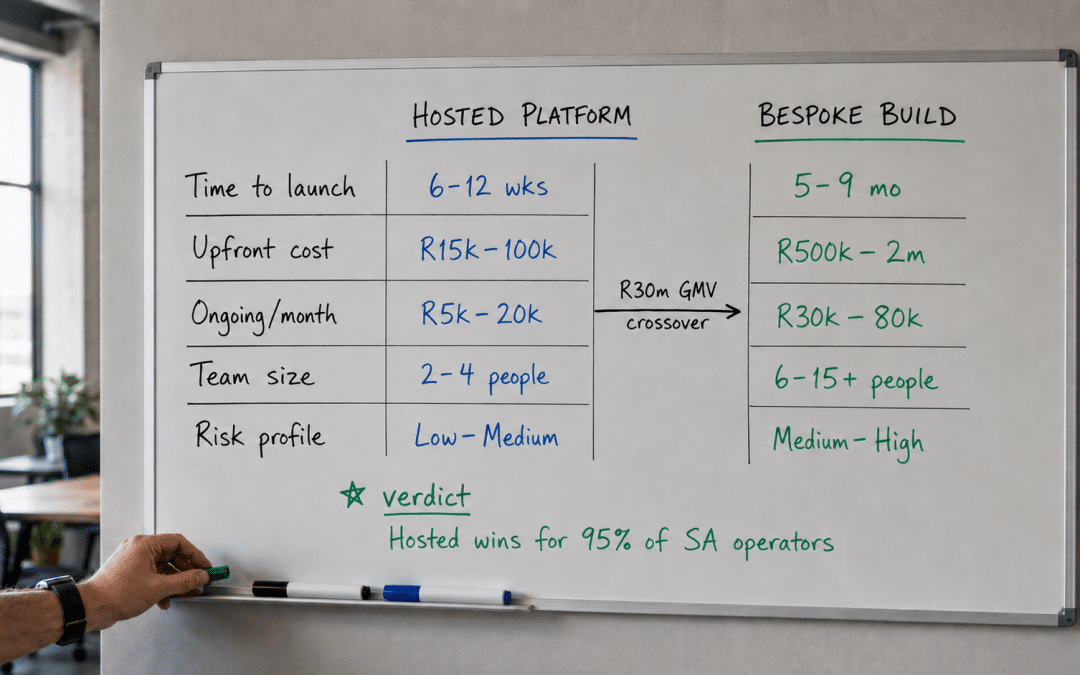
Shopify vs custom build is the single biggest platform decision most SA ecommerce operators face, and the wrong answer produces a two-year sunk cost that no amount of marketing spend can recover. SA supplement brands, retailers, and B2B operators repeatedly get sold custom builds by developers who benefit from hourly billing, when a hosted platform would have delivered better outcomes at a fraction of the cost.
This guide covers what actually determines the right choice for SA ecommerce operators across store scale, product complexity, integration requirements, and long-term cost trajectory. For broader Shopify context in the SA market, see our Shopify South Africa guide. For general ecommerce platform mechanics, see our best ecommerce platforms for SA businesses guide.
Quick Answer
For 90%+ of SA operators under R25m annual GMV, the shopify vs custom build decision lands decisively on Shopify — lower total cost of ownership, faster time to market, no maintenance burden. Custom builds only make commercial sense above R25m+ GMV with genuinely unique business logic hosted platforms cannot support. The mistake most SA operators make is buying custom development for functionality Shopify apps deliver at 5-10% of the cost.
Want a free 60-minute audit of whether Shopify or a custom build is right for your SA ecommerce operation?
Get a Free Platform AuditWhy Shopify vs Custom Build is Genuinely Different in SA
Generic platform comparisons assume global cost structures, mature developer markets, and universal payment integrations. The shopify vs custom build decision in SA operates on different economics: local development runs R450-R1,200 per hour for Shopify specialists and R650-R1,800 per hour for full-stack developers, and local payment gateways each carry their own integration complexity. Platform decisions ignoring these realities produce results that do not match global benchmarks.
According to Shopify's independent TCO research across major ecommerce platforms, hosted platforms deliver up to 36% better total cost of ownership than self-hosted or custom alternatives when measured over a full three-year lifecycle including implementation, operating, and change costs. Custom builds carry hidden costs — hosting, security patching, PCI compliance audits, DevOps staffing — that only surface after launch. SA operators repeatedly underestimate these ongoing costs by 3-5x.
The Critical Reframe
The shopify vs custom build comparison must measure three-year total cost including hosting, PCI DSS overhead, POPIA infrastructure, developer retainer, security patches, integration maintenance, and lock-in risk. An operator running a custom build at R25k monthly developer retainer over 36 months burns R900k in maintenance alone — before any feature development. The equivalent Shopify Advanced plan runs R28k monthly all-in including apps, hosting, and PCI compliance.
The Five-Question Framework SA Ecommerce Operators Should Actually Use
The mistake almost every SA operator makes is starting with a feature comparison. Feature comparisons favour custom builds because custom can technically do anything. The right shopify vs custom build framework starts with commercial fit — five questions determine 90%+ of the decision.
| Question | Shopify Wins If | Custom Build Wins If |
|---|---|---|
| What is your annual GMV? | Under R25m per year | Above R25m with unique business logic |
| How unique is your commercial model? | Standard product catalogue, checkout, subscriptions | Complex B2B pricing, quote-to-cash, made-to-order manufacturing |
| Do you have in-house engineering? | No — or under 2 full-time developers | Yes — dedicated 3+ engineer team on payroll |
| How fast do you need to launch? | Under 3 months | Timeline flexibility of 6-12+ months |
| What is your risk appetite? | Predictable costs, uptime SLA required | Willing to own uptime, security, compliance directly |
An operator answering "Shopify wins" to 3+ of these five questions almost always benefits commercially from the hosted route. An operator answering "custom build wins" to 4+ has genuine cause to consider bespoke development. Anything in between — the most common outcome — points to Shopify with strategic app selection and possible Shopify Plus at scale. The platform question is rarely as ambiguous as developers make it sound.
The Three Most Common SA Ecommerce Platform Mistakes
Three mistakes consistently destroy SA ecommerce operators' platform economics. Each is invisible at the time. Identifying and correcting them saves more Rand than any subsequent optimisation work.
Mistake 1 — Buying Custom Development for Standard Functionality
SA operators regularly commission custom development for functionality Shopify apps deliver at 5-10% of the cost — abandoned cart recovery, product recommendations, subscription billing, wholesale pricing, multi-currency, loyalty programmes. The Shopify app ecosystem covers 90%+ of common ecommerce functionality with mature apps at R100-R2,000 monthly per feature. Custom developers benefit from building these from scratch at R150k-R500k per feature. The shopify vs custom build gap on standard functionality is enormous.
Mistake 2 — Underestimating SA-Specific Compliance Overhead
SA custom builds carry PCI DSS compliance overhead (R25k-R80k annually for scans and audits), POPIA data-handling requirements, and increasingly SARB regulatory attention for payment flows. Hosted platforms absorb most of this into the subscription. Custom builds pay for compliance monthly as invisible P&L line items. The shopify vs custom build compliance cost delta typically runs 60-80% either direction — a difference that dwarfs headline platform pricing.
Mistake 3 — Ignoring the Total Cost of Ownership Trajectory
SA operators compare shopify vs custom build on year-one implementation cost — Shopify at R25k-R60k versus custom at R150k-R400k. Custom looks worse initially. But year-two and year-three costs invert dramatically: Shopify remains at R20k-R45k monthly all-in, while custom builds climb to R35k-R85k monthly as maintenance debt accumulates, developers churn, and platform patches consume increasing dev time. The three-year TCO comparison almost always favours Shopify for stores under R50m GMV.
Want to see which of these three mistakes might be affecting your SA ecommerce platform economics?
Request a custom platform diagnosticThe GPM Differentiator: Operator Perspective on Platform Selection
Most SA agencies advising on shopify vs custom build come from either pure Shopify partner backgrounds (biased toward Shopify) or custom development backgrounds (biased toward custom). Both benefit from the platform they recommend. The advice reflects the recommender's revenue model, not the operator's commercial interest. Independent shopify vs custom build perspective is genuinely rare in the SA market.
Growth Pulse Media built and scaled an SA ecommerce business through real platform selection decisions — starting with Shopify, considering custom migration at R30m+ GMV, choosing to stay hosted and reinvest development capital into growth channels. The operator instincts that come from making these decisions under real revenue pressure — knowing when custom is actually needed, knowing when it is a developer's upsell — apply directly to platform selection.
Our Shopify marketing agency service works with SA ecommerce operators on platform selection, migration planning, and Shopify optimisation on a senior-level basis. We do not build custom code and do not benefit financially from recommending custom development. Our advice reflects operator interest, not development pipeline. We limit client load to maintain senior attention through platform decisions that determine three-year cost trajectories.
The Operator Lesson
Two SA operators with identical GMV can end up on completely different cost trajectories based purely on the shopify vs custom build call. The variable is rarely operator sophistication — it is whether independent advice was available at the decision point. Custom developers benefit from custom recommendations. Shopify partners benefit from Shopify recommendations. Operator-perspective advice — from someone who has run stores, not just built them — remains rare and valuable in SA.
Real-World Impact: SA Mid-Sized Ecommerce Retailer Before and After
This is a representative SA mid-sized ecommerce retailer selling home and lifestyle goods with 340 SKUs and 8 staff (2 founders, 2 marketing, 2 operations, 2 customer service), based in Cape Town with warehousing in Johannesburg. The "before" period reflects a custom Laravel build launched in 2023 at R285k with R28k monthly developer retainer. The "after" period captures 12 months after migrating to Shopify Advanced with strategic apps.
| Metric | Before (Custom) | After (Shopify) | Change |
|---|---|---|---|
| Monthly platform + maintenance cost | R31,500 | R18,400 | −42% |
| PCI compliance annual audit cost | R45,000 | R0 (included) | −R45k saved |
| Feature deployment cycle time | 3-6 weeks | Same-day for apps | Real-time deployment |
| Downtime hours (annual) | ~34 hours | ~2 hours | −94% |
| Cart abandonment recovery revenue | R0 (not built) | R84,000 monthly | R1m annual lift |
| Subscription revenue infrastructure | R145k custom quote | R820 monthly app | Structural cost delta |
| Store conversion rate | 1.6% | 2.9% | +81% |
| Annual ecommerce revenue | R14.2m | R23.8m | +68% |
What Drove the Result
The migration from Laravel to Shopify Advanced was budgeted at R180k and delivered in 11 weeks. Monthly platform costs dropped 42%, and R45k annual PCI audit spend vanished into the subscription. The bigger commercial impact came from apps — abandoned cart recovery, subscription billing, and improved checkout collectively lifted conversion 81% and added R9.6m annual revenue. Custom platforms never had these features because each represented a R150k+ dev quote no operator would authorise.
Who This Is NOT For
The shopify vs custom build framework above applies to most SA ecommerce operators, but four scenarios where Shopify is genuinely the wrong choice deserve honest acknowledgement.
Your business requires fully custom checkout that Shopify Plus checkout extensibility cannot support. Some SA operators — particularly complex B2B with quote-to-cash workflows, multi-party approval routing, or credit facility integration — need checkout logic that Shopify architecture genuinely cannot deliver. Shopify Plus checkout extensibility covers most cases; if it does not cover yours, custom becomes commercially defensible. Validate this against a Shopify Plus solution engineer before assuming custom is required.
Your commercial model requires full code ownership for legal or regulatory reasons. Some SA financial services, insurance-adjacent, or fintech ecommerce operators have compliance obligations requiring full code ownership and audit trail control. Hosted platforms cannot satisfy this constraint regardless of TCO advantages. In these cases, custom build is not a choice — it is a compliance requirement. Confirm this with legal counsel before deciding.
Your GMV is above R50m annually and your business model is genuinely unique. At scale with unique commercial logic, custom builds sometimes deliver commercial advantage that platform economics cannot match. This applies to a small minority of SA ecommerce operators. Validate the "genuinely unique" claim rigorously — most operators believe their model is unique when it is actually a variation of a solved problem. When unique-and-large-scale is validated, custom becomes defensible.
You have a 3+ engineer team already on payroll with ecommerce expertise. If the custom build cost is largely absorbed by existing engineering capacity, the marginal cost equation shifts. Operators with dedicated engineering teams may find custom builds commercially neutral or advantageous. This is rare in SA mid-market ecommerce — most operators do not have this capacity — but where it exists, custom becomes a legitimate consideration rather than a cost trap.
SA-Specific Platform Tactics That Generic Comparisons Miss
Three SA-specific tactics consistently determine platform economics beyond the global TCO frameworks. Each requires direct experience of the SA ecommerce market because each plays against an SA-specific reality.
Tactic 1 — SA Payment Gateway Integration Depth
PayFast, Peach Payments, Ozow, Yoco, and iKhokha each carry different integration complexity and fee structures. Shopify Payments is not yet available locally, so SA Shopify operators use third-party gateways with 0.5-2% Shopify transaction fees. This affects the shopify vs custom build math directly — custom eliminates transaction fees, but only if the operator processes R2m+ monthly card volume where fee savings justify build cost. See our Shopify payment gateways guide.
Tactic 2 — SA Courier API Maintenance Burden
The Courier Guy, Aramex, PUDO Locker, Bob Go, and other SA courier APIs update endpoints, add features, and occasionally break integrations 6-8 times per year on average. Hosted platform apps absorb this maintenance into subscriptions. In the shopify vs custom build calculation, custom courier maintenance typically consumes 80-140 dev hours over three years (R60k-R200k) that hosted platforms include in monthly fees.
Tactic 3 — POPIA Compliance Infrastructure Cost
POPIA compliance requires consent management, subject access request workflows, breach notification infrastructure, and data-handling audit trails. Shopify and other hosted platforms absorb this into the subscription with built-in tooling. Custom builds require operator-funded infrastructure — typically R80k-R250k initial setup and R15k-R40k monthly ongoing. The shopify vs custom build POPIA infrastructure gap alone often exceeds the headline platform cost difference. See our wellness ecommerce guide covering SAHPRA and POPIA.
Want all three tactics applied to your SA ecommerce operation with a custom 12-month platform roadmap?
Request a free platform auditFrequently Asked Questions About Shopify vs Custom Build in SA
How much does Shopify cost for SA ecommerce operators compared to a custom build?
Shopify pricing for SA operators typically runs R550-R28,000 monthly all-in depending on plan (Basic through Advanced), plus 0.5-2% transaction fees on non-Shopify Payments gateways. Custom builds typically cost R150k-R400k initial development plus R18k-R45k monthly ongoing maintenance for stores under R25m GMV. Total three-year TCO for hosted runs R750k-R1.1m versus R1.4m-R2.3m for custom builds — a 40-55% cost delta. The gap widens for smaller stores and narrows above R50m GMV where custom advantages scale.
Can we migrate from a custom build to Shopify in South Africa?
Yes, and migration typically runs 8-16 weeks depending on data complexity, product catalogue size, and integration count. Standard migration cost for SA operators runs R120k-R280k and includes product data migration, customer database transfer, order history import, redirect mapping, and payment gateway reconnection. Migration ROI typically appears within 6-9 months through reduced maintenance cost and improved conversion rates. Migration risk is manageable with proper planning.
Which Shopify plan works best for SA ecommerce operators?
Basic (R550/month) works for stores under R2m annual GMV with simple product catalogues. Grow (R1,700/month) suits R2m-R8m operators needing standard analytics and shipping features. Advanced (R6,700/month) fits R8m-R30m operators requiring advanced reporting, checkout customisation, and lower transaction fees. Shopify Plus (starts at R42,000/month or roughly R450k+ annually with SA operators typically negotiating year-long or three-year contracts) suits R30m+ operators needing custom checkout, multi-store, or B2B features.
What SA payment gateways integrate with Shopify?
PayFast, Peach Payments, Ozow, Yoco, iKhokha, and MyGate all offer Shopify integrations. Shopify Payments is not yet available in SA. Choose based on transaction volume (PayFast and Peach dominate mid-market; Yoco and Ozow suit smaller operators), payment methods (Peach offers the widest coverage including instant EFT and mobile wallets), and settlement timelines (Ozow and PayFast settle T+1, others range T+2 to T+3). Multi-gateway setups are common at scale.
How do we handle POPIA compliance on Shopify vs a custom build?
Shopify absorbs most POPIA infrastructure into the platform — consent management via built-in customer privacy features, data export tooling for subject access requests, breach notification workflows via Shopify security team, and PCI DSS Level 1 compliance included in subscription. SA custom builds require operator-funded infrastructure for each of these compliance functions, typically R80k-R250k initial setup plus R15k-R40k monthly ongoing. Hosted platforms deliver a substantial compliance cost advantage that year-one comparisons often miss.
What's the biggest platform mistake SA ecommerce operators make?
Making the shopify vs custom build call on year-one implementation cost rather than three-year TCO. Custom builds often look competitively priced at implementation but climb dramatically over years two and three as maintenance debt accumulates, features accumulate, and developer turnover requires knowledge transfer. Hosted platforms flatten this trajectory. SA operators who evaluate the shopify vs custom build decision on three-year TCO with realistic maintenance assumptions consistently outperform those evaluating on launch cost alone.
Shopify vs Custom Build: The Bottom Line for SA Ecommerce Operators
Shopify vs custom build is a decision that determines three-year cost trajectories and commercial optionality for SA ecommerce operators. For 90%+ of SA operators under R25m annual GMV, the shopify vs custom build call lands decisively on Shopify — better TCO, faster time-to-market, lower compliance overhead. Custom builds only make sense for a small minority with genuinely unique commercial models, high GMV scale, or specific regulatory constraints hosted platforms cannot address.
The single biggest predictor of a good platform decision is not technical evaluation depth. It is whether the operator applies the five-question framework honestly, calculates three-year TCO rather than launch cost, and factors SA-specific compliance and integration realities into the equation.
If you would rather skip the trial-and-error and have a senior operator who has made this decision under real revenue pressure walk you through what would work for your ecommerce operation, that is exactly what the conversation below is for.
Get a Free Platform Audit for Your SA Ecommerce Operation
We will review your current or proposed platform architecture — five-question framework analysis, three-year TCO calculation, SA payment gateway fit, POPIA and PCI DSS compliance overhead, and migration risk assessment — and give you a written audit covering the platform decision most aligned with your commercial trajectory, realistic 36-month cost projections, and a phased implementation roadmap.
No sales pitch, no pressure — just an honest read from senior operators who have built and scaled SA ecommerce businesses. No obligation — we will get back to you within 24 hours.
Request a Free Platform Audit →